
 Worksheets
Module 1 -5
Total questions: 140
Worksheet time: 1hrs 10mins
A car travels 24 miles in 45 minutes. What is its average speed?
32 mph.
36 mph.
18 mph.
What is a scalene triangle?
2 sides unequal.
All 3 sides unequal.
2 sides equal.
Work out the following sum: 4 {2 (5-1) -3} + 8.
28
37
54
A rectangle is 11cm x 120cm. What is its area in m2 ?
0.132.
1320.
13.2.
3/4 multiplied by 0.82 is equal to
1.23.
0.615.
2.46.
The formula for calculating the area of a right angled triangle is
½ height + base.
½ (base * height).
½ base / height.
To convert imperial gallons to liters, multiply by.
4.5.
5.4.
4.7.
How many centimeters is in an inch?
25.4.
2.54.
0.254.
What torque loading would you apply to a nut if the force is 50 lbs., exerted 2 feet from its axis?
600 lbs.ft.
100 lbs.ft.
251 lbs.ft.
Convert 162 knots to MPH.
186 mph.
176 mph.
196 mph.
To convert inches to millimeters, it is necessary to.
Divide by 25.4.
Multiply by 25.4.
Multiply by 2.54.
Solve the following equation: 5x = 3x + 2.
3.
5.
1.
Simplify the following (w + z)(x - y)(y - w) / (y - x)(w - y)(w + z).
-1.
0.
1.
Given 43 - x = 21, find the value of x.
43 - 21.
43/21.
43 + 21.
Given that A = X + BY, what is Y equal to?
A - X add B.
A - X divided by B.
A - X minus B.
(x - 3)(x + 5) =.
x2 + 2x.
x2 + 2x - 15.
x2 - 15.
Evaluate. 2X2 Z2 (3X - Z2) =.
6X2 Z2 + 3X - Z2.
6X2 Z2 - 2X2 Z2.
6X3 Z2 - 2X2 Z4.
Factorize the following: 4x2 - 6x - 28 = 0.
(4x - 14) (x + 2).
(2x + 7) (x - 2).
(2x2 + 7) (x + 2).
Make m the subject of the formula in y = mx + c. Find m.
m = y - x/c.
m = (y - c)/x.
m = (y + c)/x.
If x2 - 3 = 6, then x = ?.
±3.
18.
± 2.
In the following equation what is the y-intercept? 4y = 2x + 8
2.
4.
8.
How many times does the x-axis get crossed when y = x2 -3.
3.
1.
2.
Two lines with equations y = 3x-6 and y = 3x + 4?
meet when y = 3.
are at right angles.
are parallel.
A straight line graph has the equation 3y = 12x-3. What is the gradient?
1/4.
4/1.
3/4.
What type of equation is y = x2 + 9x + 14?
Quadratic.
Circular.
Exponential.
What is commonly referred to as the law of a straight line?
y = x2 + 180.
The line must pass through the 180-degree datum.
y = mx + c.
What is the equation of a straight line with gradient m and intercept on the y axis c?
y = mx + c.
x = y + mc.
y = cx + m.
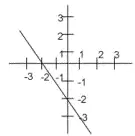
What is the equation of the line shown?
y = 2x + 2.
y = -2-x.
y = x-2.
What is the equation of a straight line that passes through the two points (0,0) and (3,2)?
y = 3x + 2.
y = 2x + 3.
y =2x/3
The line with equation x = 3 is.
at 45° to both axes.
parallel to the x axis.
parallel to the y axis.
What is the mass number of an element?
Number of electrons and protons.
Number of neutrons and protons.
Number of electrons and neutrons.
What is the atomic number of an element?
The number of neutrons in the atom.
The number of electrons in the atom.
The number of protons in the atom.
What determines an element's identity?
The number of neutrons.
The number of electrons.
The number of protons.
If an atom has 2 protons, how many electrons will it have?
1
8
2
The number of protons in an atom is equal to the number of.
electrons.
neutrons.
mass number
An atom with 3 free electrons in its outer shell is said to be.
pentavalent.
covalent.
trivalent.
The splitting of a chemical compound is called.
bombardment.
synthesis.
analysis.
An atom consists of.
protons, neutron and electrons.
protons and electrons.
protons and neutrons.
The maximum number of electrons in the inner shell of an atom is.
8.
2.
4.
The mass of a proton equals the mass of a.
neutron.
beta particle.
electron.
Catalysts.
speed up reactions.
speed up and slow down reactions.
slow down reactions.
If the outer shell of an atom is full the the element is.
unstable / reactive.
a good conductor.
practically inert.
Oxygen has a valency of.
2.
6.
8.
An isotope of an element will have more/less _________ than usual.
electrons.
neutrons.
protons.
The smallest part of an element is.
a compound.
an atom.
a molecule.
For a car weighing 1000 N, what force would be required to accelerate the car to 3 ms-2.
3270 N.
305.8 N.
3000 N.
The SI unit of acceleration is the.
metre per second squared (m/s2).
metre per second (m/s).
square metre (m2).
If a body starts at rest and reaches 84 m/s in 3 seconds, its acceleration is.
28 m/s2.
14 m/s2.
252 m/s2.
The SI unit of velocity is the.
metre per second squared (m/s2).
metre per second (m/s).
metre (m).
A spring extends 7 cm to the ground and back again 20 times a minute. What is the period?
7 cm.
3 seconds.
1/3 cycle.
What is the angular velocity of a shaft rotating at 300rpm in radians/second?
10π radians/second.
2π radians/second.
5π radians/second.
A mass on a spring nearly hits the ground 20 times a minute, its frequency is.
3 cycles per second.
1/3 cycle per second.
20 cycles per second.
An object travels 18 km in 1 minute 30 seconds. What is its average speed?
200 m/s
270 m/s
100 ms.
A spaceship travels a distance of 480,000 miles in 2 days. What is its speed?
48,000 mph
36,000 mph
10,000 mph
Newton's laws of motion apply to.
solid substances only.
all substances irrespective of state.
gases and liquids only.
Convert 25 degrees centigrade to fahrenheit.
57
77
-7
When gases change temperature/pressure, the scale used is.
Kelvin.
degrees Fahrenheit.
degrees Centigrade.
One degree increment on the Centigrade scale is equal to what increment on the Fahrenheit scale?
1.8 °F
33 °F
12 °F
What is 1 BTU/lb in joules per kilogram?
4128 joules per kilogram.
9.18 joules per kilogram.
2326 joules per kilogram.
What is -28 °C on the Kelvin scale?
245 K.
18 K.
291 K.
Which type of circuit is used when the temperature of the source has insufficient heat for thermocouple application?
thermistor.
temperature bulb.
balanced bridge
The absolute temperature scale that has the same increments as the Fahrenheit scale is the.
Rankin scale.
Kelvin scale.
Celsius scale.
The absolute temperature scale that has the same increments as the Celsius scale is the.
Rankin scale.
Kelvin scale.
Fahrenheit scale.
You are at the north pole where the temperature is minus 50 °C below freezing. What sort of thermometer would you use to measure it?
Water.
Alcohol.
Mercury.
Convert 15 °C to °F.
37 °F.
59 °F.
62 °F.
1 calorie is equal to.
4 J.
40 J.
400 J.
1 BTU equals.
1055 Joules.
1055 Calorie.
1055 kJ
Temperature is a measure of.
the amount of friction produced by two mating surfaces.
the amount of vibration of molecules.
the heat energy of particles.
Heat is described as.
a high temperature.
energy in transit.
the stored energy in a hot body.
What temperature scale is used with the combined gas law?
Absolute.
Fahrenheit.
Celsius.
A neutron has,
The opposite charge to an Electron but half the weight of a proton.
The same charge as an Electron but half the mass.
No electrical charge but will add weight to the nucleus.
The unit which consists of two or more different types of atoms is known as a.
Particle of an element.
Molecule of a compound.
Molecule of an element.
What charge does the nucleus of an atom possess?
Positive.
Neutral.
Negative.
If electrons are added to an atom it becomes.
A neutral ion.
A positive ion.
A negative ion.
If a free electron is given to another atom, that atom is a.
Valency atom.
Negative ion.
Positive ion.
The atomic number of an atom is determined by the number of
Protons.
Electrons.
Neutrons.
On current is found in.
Conductors and semi-conductors.
Liquids and gasses.
Semi-conductors.
Electricity conducts through.
Vacuum.
Solids and liquids and gasses.
Solids only.
Electricity built up as an electrical charge on the surface of an object. It is considered
DC
AC
Static
If an insulated conductor is placed near to a negatively charged rod, the nearest end of the conductor becomes.
No change will occur.
Negatively charged.
Positively charged.
The electromagnetic force between two charged bodies is.
Inversely proportional to the distance between them
Inversely proportional to the square of the distance between them.
Proportional to the distance between them.
What effect do the electrons of one atom have upon the electrons of another atom?
They have no effect on each other.
They repel each other.
They attract each other.
If a negatively charged conductor is placed next to an insulated rod.
The rod becomes negatively charged.
The rod has no charge.
The rod becomes positively charged.
Which of the following is 1 Amp?
1000 mA.
1000 kA.
1000 μA.
A volt can be considered to be a.
Unit of electrical power.
Quantity of electrical energy.
Unit of electrical pressure.
What is 3.25 volts in millivolts?
3,250 millivolts.
325,000 millivolts.
3.25 millivolts.
Electromotive force is.
Watts.
Ohms.
Volts.
1µF capacitor is equivalent to.
1,000,000 Farads.
0.000,001 Farads.
0.001 Farads.
What is the SI unit of conductance?
Ohm.
Siemen.
Ohm-metre.
Potential difference is another term for
Voltage
Charge
Energy
A piezoelectric device generates electricity through.
Friction.
Light.
Pressure.
A photozoidal cell produces electricity when subjected to.
Light.
Pressure.
H
A photozoidal cell produces electricity when subjected to.
Light.
Pressure.
Heat.
A component that produces an output voltage due to incident light is called a.
Liquid crystal.
Solar cell.
Light emitting diode.
Thermocouple harnesses are made from the same materials as the thermocouple so that.
Mini junctions are not formed.
The resistance is not increased beyond limits.
They will not corrode.
A simple generator converts mechanical energy and magnetism into?
Lines of flux per revolution
Reverse polarity
Electrical energy
A solar cell or a photovoltaic cell is a device that:
Converts sun energy into electricity.
Converts electricity energy into light energy
Converts light energy into electricity.
Thermocouples generate:
A voltage between the two wires that is proportional to the temperature at the junction.
A current between the two wires that is proportional to the temperature at the junction
A variable resistance between the two wires that is proportional to the temperature at the junction
A battery rated at 40 Ah will supply 200 mA for.
200 hours.
20 hours.
5 hours.
A 20 cell battery with each cell having an internal resistance of 0.1 ohms is charged with 2 leads having a total resistance of 0.1 ohms. The battery is charged with a current of 5 amps. What is the charging voltage?
0.5 volts.
10.5 volts.
0.005 volts.
Two 10V, 20 Ah batteries are connected in parallel and connected across a 10 ohm load. How long could they supply normal current before the voltage begins to decay?
40 hours.
20 hours.
4 hours.
A zinc-carbon battery life depends upon.
The amount of zinc.
The purity of the carbon rod.
The amount of the electrolyte paste.
Two batteries 12V and 40 Ah each, are in series. What is the total capacity?.
12V 80 Ah.
24V 40 Ah.
24V 80Ah.
If a battery has got low internal resistance, then the.
No load voltage will be the same as on load voltage.
On load voltage will be greater than no load voltage.
No load voltage will be greater than on load voltage.
Conventional current flow inside a battery is from.
Either anode to cathode or cathode to anode, depending on the active elements.
Cathode to anode.
Anode to cathode.
Convention requires that in a symmetrical 3 phase system, the.
Red voltage is taken as the reference phase.
Yellow voltage phase leads the red phase by 120 degrees.
Red voltage phase leads the blue phase by 120 degrees.
One advantage of using AC electrical power in aircraft is.
Space and weight can be saved, since AC devices, especially motors, are smaller and simpler than DC devices.
AC electrical motors can be reversed while DC motors cannot.
The effective voltage is 1.41 times the maximum instantaneous voltage; therefore, less power input is required.
Frequency (Hz) is the number of cycles per.
Minute
Second
Revolution
An integrated step input at unequal time base produces.
a sine wave.
a square wave.
saw tooth wave.
A wave form having equal amplitude and time base is a.
Rectangular.
Saw tooth.
Square waveform
Typical displays on an EHSI are.
Engine indications.
VOR, Map, Plan and weather radar.
VOR, Plan, Map and Attitude.
What is the fixed feature of an ADI?
The glideslope pointer.
The aircraft symbol.
The lateral deviation bar.
Engine parameters are displayed on.
ECAM.
EHSI.
FMSCDU
What is the fixed feature of an ADI?
The glideslope pointer.
The aircraft symbol.
The lateral deviation bar.
What are the basic elements for 'Classic T' format?
Direction, altitude and height.
Airspeed, pitch and roll.
Airspeed, attitude, altitude and direction
On an EFIS system the weather radar is displayed on.
The FMC CDU.
The EADI.
The EHSI
EADI displays show.
Pitch, roll and waypoints.
Pitch and roll attitudes.
Heading and weather radar.
Radio altitude is displayed on an EFIS system.
On the Electronic Horizontal Situation Indicator.
On the Electronic Attitude Direction Indicator.
On the RMI.
On a modern 'glass cockpit' aircraft, engine information is displayed on.
FMS.
EFIS.
ECAM.
What does EFIS mean?
Electronic Fire Indication Signal.
Electronic Flight Instrument System.
Electronic Flight Information System.
What does EICAS mean?
Electronic indicator and control alerting system.
Engine indicating and Crew alerting system.
Electronic indicator and crew alerting system.
What does ECAM mean?
Engine Centralised Aircraft Management System.
Engine Centralised Aircraft Monitoring System.
Electronic Centralised Aircraft Monitoring System.
On an EADI, the Flight Director command bars show.
The path with respect to the horizon.
The required path with respect to the actual path.
The actual path with respect to the required path.
What would you expect to see displayed on an EADI display?
Compass heading, selected heading and VOR.
Course information, weather radar, way point alert and bearing pointers.
Flight director command bars, slip indicator, rate to altitude& autoland.
An EADI display of flight director commands are coloured.
cyan.
magenta.
red.
The EFIS system consists of.
EHSI, Mode control panel, EADI.
EADI, EHSI, Symbol generators.
Mode control Panel, RDMI, EHSI.
A BYTE is usually.
An 8 bit word.
A six bit word.
A 12 bit word.
A computer using RAM would utilize.
Magnetic tape.
A compact disc.
An integrated circuit (chip).
What is EPROM?
Enhanced programmable read only memory.
Erasable programmable read only memory.
Erasable programming read only module.
How many bytes can be carried in a 32bit word?
8 bytes.
4 bytes.
2 bytes.
Data is usually stored in.
RAM.
ROM.
EEPROM.
A computer requires to operate, a.
Address bus, a data bus only.
Data bus, a control bus, a address bus.
Data bus, a control bus only.
What precautions are required when removing ESDS equipment?
Wear a wrist strap connected to an approved ground point.
No special precautions are required.
Keep one hand on the airframe.
Electrostatic discharge occurs when.
The ground lead on a wrist strap touches the skin.
Materials are rubbed together or pulled apart.
Materials of different potential are brought in close proximity to each other.
The resistance of the wrist strap used as part of anti static precautions should be.
Clipped into a receptacle with a 200 megaohm resistor connected to a common ground point.
1 megohm - 200 megaohm.
Clipped into a receptacle with a 1 megaohm resistor connected to a common ground point.
Which insulating materials should be kept out of the work area.
Vinyl, rubber, mica, copper
Vinyl, rubber, mica, nylon
Vinyl, rubber, mica, nylon, conductive footwear.
After attaching a wrist strap to your wrist (which is connected to aircraft ground), prior to removal of ESDS equipment, the resistance measured.
Between your skin and the pin ground must be >1 megohms.
Between the strap and the pin ground must be <1 megohms.
Between the strap and the pin ground must be >1 Megohms.
A wrist band must be worn when working with ESDS devices.
To dissipate and prevent static build-up on the operator
To prevent the operator from getting an electric shock.
To dissipate static charge on the device.
A humid atmosphere.
Reduces static charge.
Eliminates static charge.
Has no effect on the level of charge.
Static Safe Workstation must have
Floor and table-top mats both connected through a 1 mega-ohm resistor connected to a common ground point.
Floor and table-top mats both connected through a 20 mega-ohm resistor connected to a common ground point.
Floor and table-top mats do not require static protection, only personal require protection.

