
 Worksheets
06. Changing populations
Total questions: 96
Worksheet time: 48mins
What was the estimated global population around 10,000 years ago when people began to domesticate animals and cultivate crops?
125,000 people
5 million people
30 million people
250 million people
By what year did the global population reach 1 billion?
1650
1800
1900
2000
Which region is projected to have the fastest rate of population growth in the future?
Europe
Asia
Africa
North America
What percentage of the world's population did Asia account for in 2023?
22.0%
59.1%
77.2%
9.2%
What significant advances have contributed to the rapid growth in human population in recent centuries?
Technological gadgets
Public health and medicine
Space exploration
Industrial machinery
What was the highest global population growth rate recorded in LICs and MICs during the mid-1960s?
1.8 per cent per year
2.4 per cent per year
0.9 per cent per year
3.0 per cent per year
By 2023, what was the global population growth rate?
1.8 per cent per year
2.4 per cent per year
0.9 per cent per year
1.5 per cent per year
Which two countries had populations over 1.4 billion by mid-2023?
China and the USA
India and China
India and the USA
China and Brazil
What is the term used to describe the difference between the birth rate and the death rate?
Population momentum
Demographic transition
Natural increase
Fertility rate
What is the birth rate if a country has 17 births per 1000 people in a year?
1.7 per 1000
17 per 1000
170 per 1000
0.17 per 1000
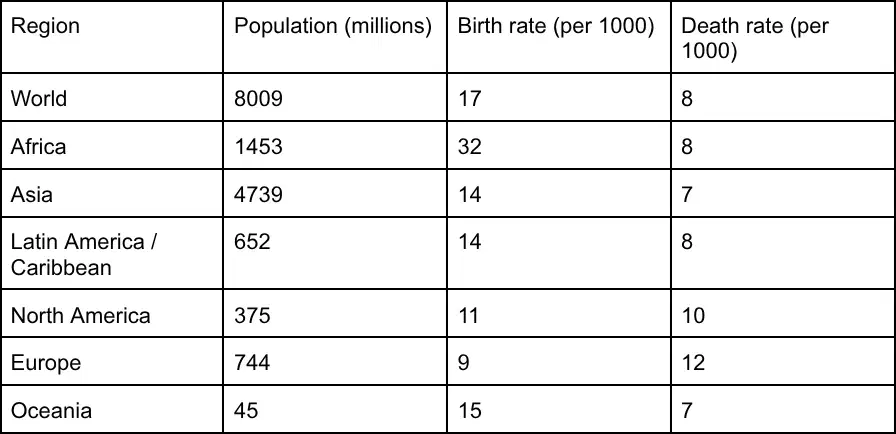
What is the birth rate per 1000 in Africa according to the table?
32
14
11
9

Which region has the highest death rate per 1000 according to the table?
Europe
Africa
Asia
Oceania
What does the equation P -(B-D) +/- M represent in the context of population change?
Population change considering births, deaths, and migration
Birth rate calculation
Death rate calculation
Migration rate only
Since the 1990s, what has been the primary source of population growth in HICs?
Natural change
Positive net migration
Decrease in death rate
Increase in birth rate
By 2050, what is expected to happen to the population of HICs if net migration is not sufficient?
Population will begin to decline
Population will remain stable
Population will increase rapidly
Birth rate will surpass death rate
What is the total fertility rate (TFR) generally considered to be replacement level fertility?
2.12
1.5
3.0
2.5
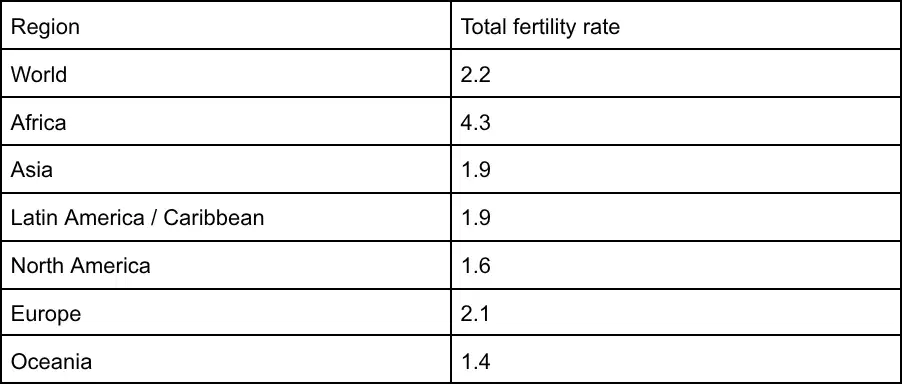
Which region has the highest total fertility rate according to the table?
Asia
Africa
Europe
Oceania
What is the most important factor affecting fertility according to the document?
Economic growth
Education level
Number/proportion of women in reproductive age
Government policies
How does education influence fertility?
It decreases the need for family planning.
It increases the fertility rate.
It provides knowledge of contraception and family planning.
It has no effect on fertility.
Which factor is mentioned as a key element in lowering fertility rates in some societies?
High rates of reproduction
Female literacy
Extended family networks
Child-dependency costs
What is a major reason for low fertility rates in high-income countries?
High rates of reproduction
Influence of religion
Cost of living issues
Extended family networks
How have population policies in most countries aimed to reduce fertility?
Encouraging larger families
Investing in birth control programs
Promoting high rates of reproduction
Increasing child-dependency costs
What impact do internal and international conflicts have on fertility according to the text?
They encourage larger families
They have no impact
They can significantly reduce fertility
They increase fertility rates
What was the trend in global population growth after the second half of the 1960s?
It continued to increase rapidly
It began to slow down
It remained constant
It decreased sharply
What was the average number of births per woman globally in 1950?
2.2 births
3.5 births
5 births
4 births
Which country introduced the one-child policy in 1979?
India
China
Japan
France
What is a pro-natalist policy?
Encouraging lower fertility
Encouraging higher fertility
Reducing government investment
Promoting single-child families
Which of the following countries is known for pro-natalist policies?
India
China
Japan
Brazil
What was the projected global fertility rate by 2050?
2.5 births per woman
2.1 births per woman
1.8 births per woman
3.0 births per woman
What is the main characteristic of the high stationary stage (stage 1) in the demographic transition model?
Low birth rate and high death rate
High birth rate and stable death rate
Low birth rate and low death rate
High birth rate and low death rate
During which stage of the demographic transition model does the death rate decline significantly while the birth rate remains high?
High stationary stage (stage 1)
Early expanding stage (stage 2)
Late expanding stage (stage 3)
Low stationary stage (stage 4)
What factor contributes to the decline in birth rates during the late expanding stage (stage 3)?
Increased infant mortality
Improved education and access to contraception
Higher death rates
Decreased life expectancy
In which stage of the demographic transition model are both birth and death rates low?
High stationary stage (stage 1)
Early expanding stage (stage 2)
Late expanding stage (stage 3)
Low stationary stage (stage 4)
What is a significant factor in the natural decrease stage (stage 5) of the demographic transition model?
Increasing birth rates
Decreasing death rates
Birth rates falling below death rates
High infant mortality
Which stage of the demographic transition model is characterized by a natural decrease in population due to the birth rate falling below the death rate?
Stage 1
Stage 2
Stage 4
Stage 5
What is a common criticism of the demographic transition model?
It is too focused on economic growth.
It is too Eurocentric.
It ignores technological advancements.
It overemphasizes migration.
Which factor is NOT typically studied in population structures?
Age
Language
Religion
Climate
How are age and sex structures usually illustrated in demographic studies?
Line graphs
Bar charts
Population pyramids
Pie charts
Which stage of the demographic transition model is Japan in, according to the text?
Stage 2
Stage 3
Stage 4
Stage 5
What does a dependency ratio of 80 indicate?
80 people are economically active for every 100 dependents.
80 people are dependent for every 100 economically active people.
80% of the population is economically active.
80% of the population is dependent.
How is the dependency ratio calculated?
% population aged 0 to 14 + % population aged 65 and over / % population aged 15-64 (x100)
% population aged 15-64 / % population aged 0 to 14 + % population aged 65 and over (x100)
% population aged 0 to 14 / % population aged 15-64 + % population aged 65 and over (x100)
% population aged 65 and over / % population aged 0 to 14 + % population aged 15-64 (x100)
What is a significant economic advantage of a low dependency ratio?
Higher birth rates
More government funding
Larger economically active age range
Increased youth dependency
What is the demographic dividend?
A decrease in the economically active population
An increase in youth dependency
A process where changing age structure aids economic growth
A reduction in living standards
How does net migration affect the dependency ratio?
It has no effect
It can increase the number of people in the economically active population
It only affects the elderly population
It decreases the number of young adults
What is the natural sex ratio at birth?
100 boys per 100 girls
105 boys per 100 girls
110 boys per 100 girls
95 boys per 100 girls
Which region is expected to have the highest demographic dividend?
Europe
North America
Africa
South America
What is a common characteristic of population pyramids in areas with strong rural-to-urban migration?
They show a balanced age structure
They indicate fewer young adults than expected
They show age-selective in-migration
They are unaffected by migration
What is the global average proportion of the population under the age of 15?
16%
25%
42%
10%
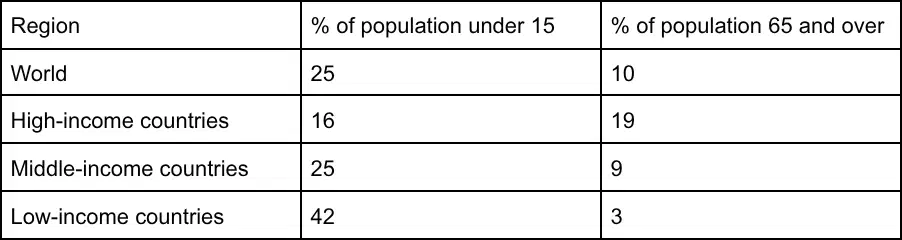
Which region has the highest percentage of population under 15 according to Table 6.8?
High-income countries
Middle-income countries
Low-income countries
World
What is a significant challenge for countries with large youthful populations?
High life expectancy
Increased resources for health, education, and housing
Low birth rates
High percentage of elderly population
What is the GNI per capita of The Gambia as given in the 2023 World Population Data Sheet?
US$ 2470
US$ 1970
US$ 3000
US$ 1500
What is demographic ageing?
A decrease in the median age of a population
An increase in the median age of a population
A decrease in life expectancy
An increase in birth rates
Which country topped the global league table for the median age in 2023?
Japan
USA
Monaco
Germany
What is the fastest-growing segment of the population according to the text?
Children under 5 years old
Teenagers
The 'oldest-old' (85 years and older)
Middle-aged adults
What initiative did the United Nations establish to address demographic ageing?
UN Decade of Healthy Ageing
UN Decade of Youth Empowerment
UN Decade of Economic Growth
UN Decade of Environmental Protection
What is a major theme of the UN Decade of Healthy Ageing?
Increasing birth rates
Demographic preparedness
Reducing taxes
Increasing retirement age
What is the definition of international migration according to the text?
Movement of people within a country for employment.
Movement of people across a specified boundary to establish a new permanent place of residence.
Temporary travel for tourism purposes.
Seasonal movement of people for agricultural work.
What percentage of the world’s population was living outside their country of birth in 2020?
2.5%
3.6%
5.0%
4.2%
Which of the following is NOT a type of migrant mentioned in the text?
Economic migrants
Refugees
Asylum seekers
Tourists
What was the global refugee population at the end of 2020?
20.4 million
26.4 million
30.4 million
36.4 million
Which country accounted for 6.7 million of the global total of refugees by the end of 2020?
Afghanistan
Iraq
Syrian Arab Republic
Sudan
Which country hosts the largest number of refugees, mainly from Syria?
Lebanon
Turkey
Afghanistan
South Sudan
What percentage of the global refugee population is under 18 years of age?
25%
38%
50%
60%
What is a primary characteristic of refugee movements compared to economic migrants?
Planned and slow
Sudden and rapid
Based on skill demand
Limited to one country
What is the main difference between voluntary and forced migration?
Voluntary migration is always international
Forced migration involves a free choice
Voluntary migration involves a free choice
Forced migration is always legal
According to the International Labour Organization, how many people are estimated to be involved in human trafficking?
10 million
15 million
25 million
30 million
What are the main barriers to international migration in the modern world?
Physical geography
Legal restrictions
Economic factors
Social factors
Who produced a series of principles of migration in 1966?
E. S. Lee
John Smith
Anna Brown
Michael Johnson
What are push factors in migration?
Positive aspects of the destination
Negative aspects of the current location
Legal restrictions on migration
Economic incentives
Which of the following is an example of an economic push factor?
Better employment prospects
Unemployment and underemployment
Higher overall standard of living
Greater job security

What is a pull factor related to social conditions?
Poor housing conditions
Limited social systems
Better housing conditions with utility connections
Overcrowding and lack of sanitation
What is a major reason for international economic migration?
Desire for political stability
Seeking employment opportunities
Escaping natural disasters
Joining family members abroad
Which country is mentioned as having a reluctance to accept large-scale immigration?
Saudi Arabia
Bangladesh
Japan
Syria
What is a significant factor influencing migration decisions according to demographers?
Climate change
Social networks
Political conflicts
Natural disasters
What environmental factor is mentioned as increasing health problems?
High levels of pollution
Lack of food
Political instability
Economic downturn
What is a reason for people retiring to warmer climates?
Higher crime rates
Stricter environmental legislation
Higher environmental quality
Political conflicts
What is one reason medical professionals migrate internationally?
To find better weather
To escape political unrest
To meet the demand for healthcare professionals
To pursue higher education
How has air pollution influenced migration according to the text?
It has decreased migration due to health improvements
It has increased migration as people seek healthier environments
It has no impact on migration patterns
It has increased migration to urban areas
What is a significant impact of remittances on countries of origin?
They increase unemployment
They reduce pressure on local resources
They cause inflation
They decrease the cost of living
According to the text, what is a positive impact of migration on countries of destination?
Decrease in available labor
Increase in unemployment
Reduction in labor costs
Increase in inflation

What is one benefit for migrants themselves as mentioned in the text?
Higher wages than in their country of origin
Limited job opportunities
Increased cost of living
Reduced access to education
What is one positive impact of return migration on a community?
Loss of young adult workers
Increase in housing pressure
Bringing new skills, ideas, and money
Causing divisions in the community
How can increasing cultural diversity benefit receiving communities?
By reducing the rate of population aging
By increasing unemployment
By causing ethnic tension
By increasing housing costs
What is a potential negative impact of migration on the environment?
Increased cultural diversity
A larger population
Improved health services
Enhanced educational opportunities
Which of the following is a major source of remittances?
Australia
USA
Brazil
South Africa
What is a concern related to heavy reliance on remittances?
Increase in local employment
Creation of a culture of dependency
Reduction in poverty
Increase in foreign investment
What does the term 'diaspora' refer to?
The concentration of people in one country
The dispersal of people originally from one country around the world
The migration of people within a country
The economic impact of migration
What is a potential disadvantage of migration for countries of origin?
Increase in cultural diversity
Brain-drain effect
Reduction in housing demand
Decrease in economic stability
How can an influx of young migrants positively impact a country of destination?
Increase in dependency ratio
Reduction in population ageing
Decrease in cultural diversity
Increase in housing prices
What is a common concern of trade unions regarding migration?
Increase in cultural diversity
Loss of employment prospects for members
Decrease in housing demand
Increase in economic stability
What is one benefit for migrants in their country of destination?
Decrease in job opportunities
Higher financial costs
Development of language skills
Increase in dependency ratio
What is one of the greatest costs for many migrants according to the text?
Housing
Separation from family
Education
Healthcare
Which organization is identified as the leading international organization for migration?
United Nations
World Health Organization
International Organization for Migration
International Labour Organization
What is a major concern for migrants in receiving countries?
Language barriers
Risk of exploitation
Climate change
Political instability
According to the text, what do developed countries tend to do regarding immigration?
Encourage more immigration
Tighten controls on immigration
Provide free housing
Offer free education
What does international law provide for those who meet the criteria for refugee status?
Free travel
International protection
Employment opportunities
Educational scholarships

