
 Worksheets
Chapter 5 and 6 - SWT301
Total questions: 52
Worksheet time: 52mins
Name
Class
Date
1.
Student name
4 lines
2.
Student code
4 lines
3.
How do testers add value to iteration and release planning?
a)
Testers determine the priority of the user stories to be developed
b)
Testers focus only on the functional aspects of the system to be tested
c)
Testers participate in the detailed risk identification and risk assessment of user stories
d)
Testers guarantee the release of high-quality software through early test design during the release planning
4.
Which TWO of the following options are the exit criteria for testing a system?
a)
Test environment readiness
b)
The ability to log in to the test object by the tester
c)
Estimated defect density is reached
d)
Requirements are translated into given/when/then format
e)
Regression tests are automated
5.
Your team uses the three-point estimation technique to estimate the test effort for a new high-risk feature. The following estimates were made:
• Most optimistic estimation: 2 person-hours
• Most likely estimation: 11 person-hours
• Most pessimistic estimation: 14 person-hours
What is the final estimate?
a)
9 person-hours
b)
14 person-hours
c)
11 person-hours
d)
10 person-hours
6.
Consider the following test categories (1-4) and agile testing quadrants (A-D):
1. Usability testing
2. Component testing
3. Functional testing
4. Reliability testing
A. Agile testing quadrant Q1: technology facing, supporting the development team
B. Agile testing quadrant Q2: business facing, supporting the development team
C. Agile testing quadrant Q3: business facing, critique the product
D. Agile testing quadrant Q4: technology facing, critique the product
How do the following test categories map onto the agile testing quadrants?
a)
1C, 2A, 3B, 4D
b)
1D, 2A, 3C, 4B
c)
1C, 2B, 3D, 4A
d)
1D, 2B, 3C, 4A
7.
During a risk analysis the following risk was identified and assessed:
• Risk: Response time is too long to generate a report
• Risk likelihood: medium; risk impact: high
• Response to risk:
+ An independent test team performs performance efficiency testing during system testing
+ A selected sample of end users performs alpha testing and beta testing before the release
What measure is proposed to be taken in response to this analyzed risk?
a)
Risk acceptance
b)
Contingency plan
c)
Risk mitigation
d)
Risk transfer
8.
Which work product can be used by an agile team to show the amount of work that has been completed and the amount of total work remaining for a given iteration?
a)
Acceptance criteria
b)
Defect report
c)
Test completion report
d)
Burndown chart
9.
You need to update one of the automated test scripts to be in line with a new requirement. Which process indicates that you create a new version of the test script in the test repository?
a)
Traceability management
b)
Maintenance testing
c)
Configuration management
d)
Requirements engineering
10.
You received the following defect report from the developers stating that the anomaly described in this test report is not reproducible.
Application hangs up
2022-May-03 – John Doe – Rejected
The application hangs up after entering “Test input: $ä” in the Name field on the new user creation screen. Tried to log off, log in with test_admin01 account, same issue. Tried with other test admin accounts, same issue. No error message received; log (see attached) contains fatal error notification. Based on the test case TC-1305, the application should accept the provided input and create the user. Please fix with high priority, this feature is related to REQ-0012, which is a critical new business requirement.
What critical information is MISSING from this test report that would have been useful for the developers?
a)
Expected result and actual result
b)
References and defect status
c)
Test environment and test item
d)
Priority and severity
11.
Which test activity does a data preparation tool support?
a)
Test monitoring and test control
b)
Test analysis
c)
Test design and test implementation
d)
Test completion
12.
Which item correctly identifies a potential risk of performing test automation?
a)
It may introduce unknown regressions in production
b)
Sufficient efforts to maintain testware may not be properly allocated
c)
Testing tools and associated testware may not be sufficiently relied upon
d)
It may reduce the time allocated for manual testing
13.
Consider the following part of a test plan.
Testing will be performed using component testing and component integration testing. The regulations require to demonstrate that 100% branch coverage is achieved for each component classified as critical.
Which part of the test plan does this part belong to?
a)
Communication
b)
Risk register
c)
Context of testing
d)
Test approach
14.
Which of the following is TRUE regarding the test pyramid?
a)
It emphasizes having far more tests at the lower test levels
b)
It suggests that each low-level test checks a large part of the functionality
c)
It describes distribution of test types across the SDLC
d)
It has no impact on the construction of automated tests
15.
During risk analysis the team considered the following risk: “The system allows too high a discount for a customer”. The team estimated the risk impact to be very high.
What can one say about the risk likelihood?
a)
It is also very high. High risk impact always implies high risk likelihood
b)
It is very low. High risk impact always implies low risk likelihood
c)
One cannot say anything about risk likelihood. Risk impact and risk likelihood are independent.
d)
Risk likelihood is not important with such a high-risk impact. One does not need to define it. Select ONE option.
16.
The following list contains risks that have been identified for a new software product to be developed:
i. Management moves two experienced testers to another project
ii. The system does not comply with security standards
iii. System response time exceeds user requirements
iv. Stakeholders have inaccurate expectations
v. Disabled people have problems when using the system
Which of them are project risks?
a)
i, iv are project risks
b)
iv, v are project risks
c)
i, iii are project risks
d)
ii, v are project risks
17.
Which of the following is an example of how product risk analysis influences thoroughness and scope of testing?
a)
The test manager monitors and reports the level of all known risks on a daily basis so the stakeholders can make an informed decision on the release date
b)
One of the identified risks was "Lack of support of open-source databases", so the team decided to integrate the system with an open-source database
c)
During the quantitative risk analysis, the team estimated the total level of all identified risks and reported it as the total residual risk before testing
d)
Risk assessment revealed a very high level of performance risks, so it was decided to perform detailed performance efficiency testing early in the SDLC
18.
Which TWO of the following options are common metrics used for reporting on the quality level of the test object?
a)
Number of defects found during system testing
b)
Total effort on test design divided by the number of designed test cases
c)
Number of executed test procedures
d)
Number of defects found divided by the size of a work product
e)
Time needed to repair a defect
19.
Which of the following pieces of information contained in a test progress report is the LEAST useful for business representatives?
a)
Impediments to testing
b)
Branch coverage achieved
c)
Test progress
d)
New risks within the test cycle
20.
Your team follows the process that uses the DevOps delivery pipeline. The first three steps of this process are:
(1) Code development
(2) Submit code into a version control system and merge it into the “test” branch
(3) Perform component testing for the submitted code
Which of the following is BEST suited to be the entry criterion for step (2) of this pipeline?
a)
Static analysis returns no high severity warnings for the submitted code
b)
System version control reports no conflicts when merging code into the “test” branch
c)
Component tests are compiled and ready to be executed
d)
Statement coverage is at least 80%
21.
According to the testing quadrants model, which of the following falls into quadrant Q1 (“technology facing” and “support the team”)?
a)
Usability testing
b)
Functional testing
c)
User acceptance testing
d)
Component integration testing
22.
Given the following risks:
1. Ineffective loop implementation causes long system responses
2. Consumers change their preferences
3. Flooding of the server room
4. Patients above a certain age receive inaccurate reports
And the following mitigation activities:
A. Risk acceptance
B. Testing for performance efficiency
C. Using boundary value analysis as the test technique
D. Risk transfer
Which of the following BEST matches the risks with the mitigation activities?
a)
1C, 2D, 3A, 4B
b)
1B, 2D, 3A, 4C
c)
1B, 2A, 3D, 4C
d)
1C, 2A, 3D, 4B
23.
Which of the following is a product quality metric?
a)
Mean time to failure
b)
Number of defects found
c)
Requirements coverage
d)
Defect detection percentage
24.
You are a member of a test team located in North America, developing a product for a client located in Europe. The team is agile and follows the DevOps approach and uses a continuous integration/continuous delivery pipeline.
Which of the following is the LEAST effective way to communicate test progress to the customer?
a)
Face-to-face
b)
Dashboards
c)
Email
d)
Video conferencing
25.
Which of the following BEST describes an example of how configuration management (CM) supports testing?
a)
Having the version number of the environment, the CM tool can retrieve the version numbers of libraries, stubs and drivers used in that environment
b)
Having a record of the values of the inputs, the CM tool can execute the test cases for these configurations and calculate the coverage
c)
Having data about the date of purchase of a software license, the CM tool automatically generates information about the fact that the product license is coming to an end
d)
Having the version number of the test case, the CM tool can automatically generate test data for this test case
26.
Given the following descriptions:
1. Support workflow tracking
2. Facilitate communication
3. Virtual machines
4. Support reviews
And the following test tool categories:
A. Static testing tools
B. Tools supporting scalability and deployment standardization
C. DevOps tools
D. Collaboration tools
Which of the following BEST matches the descriptions and categories?
a)
1A, 2B, 3C, 4D
b)
1B, 2D, 3C, 4A
c)
1C, 2D, 3B, 4A
d)
1D, 2C, 3A, 4B
27.
Which of the following is MOST likely to be a benefit of test automation?
a)
It provides coverage measures that are too complicated for humans to derive
b)
It shares responsibility for the testing with the tool vendor
c)
It removes the need for critical thinking when analyzing test results
d)
It generates test cases from an analysis of the program code
28.
Which of the following is NOT a purpose of a test plan?
a)
To define test data and expected results for component tests and component integration tests
b)
To define as exit criteria from the component test level that “100% statement coverage and 100% branch coverage must be achieved”
c)
To describe what fields the test progress report shall contain and what should be the form of this report
d)
To explain why system integration testing will be excluded from testing, although the test strategy requires this test level
29.
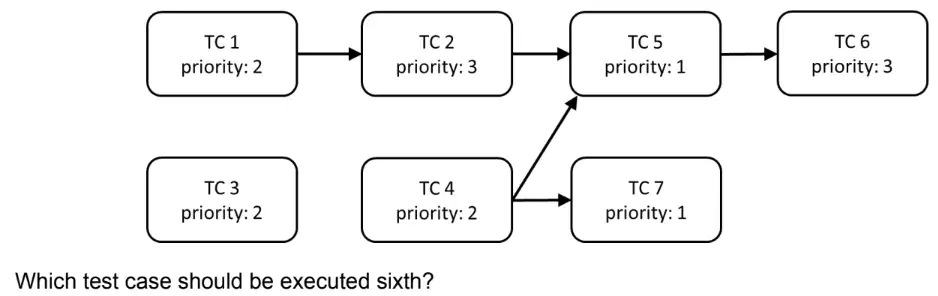
You are preparing a test execution schedule for executing seven test cases TC 1 to TC 7.
The following figure includes the priorities of these test cases (1=highest priority, 3 = lowest
priority).
The figure also shows the dependencies between test cases using arrows. For instance, the arrow
from TC 4 to TC 5 means that TC 5 can only be executed if TC 4 was previously executed.
a)
TC 3
b)
TC 5
c)
TC 6
d)
TC 2
30.
What is the relationship between the testing quadrants, test levels and test types?
a)
Testing quadrants represent particular combinations of test levels and test types, defining their location in the software development lifecycle
b)
Testing quadrants describe the degree of granularity of individual test types performed at each test level
c)
Testing quadrants assign the test types that can be performed to the test levels
d)
Testing quadrants group test levels and test types by several criteria such as targeting specific stakeholders
31.
Which of the following is an example of how product risk analysis may influence the thoroughness and scope of testing?
a)
Continuous risk monitoring allows us to identify an emerging risk as soon as possible
b)
Risk identification allows us to implement risk mitigation activities and reduce the risk level
c)
The assessed risk level helps us to select the rigor of testing
d)
Risk analysis allows us to derive coverage items
32.
Which of the following is NOT an example of how configuration management supports testing?
a)
All commits to the repository are uniquely identified and version controlled
b)
All changes in the test environment elements are tracked
c)
All requirement specifications are referenced unambiguously in test plans
d)
All identified defects have an assigned status
33.
Tools from which of the following categories help with the organization of test cases, detected defects and configuration management?
a)
Test execution and coverage tools
b)
Test design and implementation tools
c)
Defect management tools
d)
Test management tools
34.
Which of the following BEST define EXIT criteria in a testing project?
Select TWO options.
a)
Budget is approved
b)
Budget runs out
c)
Test basis is available
d)
Test cases achieved at least 80% statement coverage
e)
All test analysts are ISTQB certified at the Foundation Level
35.
The team wants to estimate the time needed for one tester to execute four test cases for a software component. The team has gathered the following measures of the effort used to execute a single test case:
• Best-case scenario: 1 hour
• Worst-case scenario: 8 hours
• Most likely scenario: 3 hours
Given that the three-point estimation technique is being used, what is the final estimate of the time needed to execute all four test cases?
a)
14 hours
b)
3.5 hours
c)
16 hours
d)
12 hours
36.
How can the testing quadrants be beneficial for testing?
a)
They help in test planning by dividing the test process into four phases, corresponding to the four basic test levels: component, integration, system, and acceptance testing
b)
They help in assessing the high-level coverage (e.g., requirements coverage) based on low-level coverage (e.g., code coverage)
c)
They help non-technical stakeholders to understand the different test types and that some test types are more relevant to certain test levels than others
d)
They help agile teams to develop a communication strategy based on classifying people according to four basic psychological types, and on modelling the relations between them
37.
For a given risk, its risk level is $1,000 and its risk likelihood is estimated as 50%.
What is the risk impact?
a)
$500
b)
$2,000
c)
$50,000
d)
$200
38.
Which of the following are product risks?
Select TWO options
a)
Scope creep
b)
Poor architecture
c)
Cost-cutting
d)
Poor tool support
e)
Too long response time
39.
Which of the following is NOT a valid purpose for a test report?
a)
Tracking test progress and identifying areas that require further attention
b)
Providing information on the tests executed, their results, and defects found
c)
Providing information about each defect, such as the steps to reproduce it
d)
Providing information on testing planned for the next period
40.
The user reported a software failure. An engineer from the support team asked the user for the software version number where the failure was observed. Based on the version number, the team reassembled all the files that made up the release. This later allowed a developer to perform analysis, find the defect, and fix it.
Which of the following enabled the above activity to be performed by the team?
a)
Risk management
b)
Test monitoring and control
c)
Whole team approach
d)
Configuration management
41.
Given the following test tool categories:
i. Collaboration tools
ii. DevOps tools
iii. Management tools
iv. Non-functional testing tools
v. Test design and implementation tools
Tools from which of the categories are MOST likely to facilitate test execution?
a)
i, v
b)
ii, iv
c)
i, iii, v
d)
ii, iii, iv
42.
Which of the following is a project risk?
a)
A module that performs incorrect calculations due to a defect in a formula
b)
A failed performance test
c)
An issue with the interface between the system under test and a peripheral device
d)
A problem with the development manager which is resulting in his rejecting all defect reports
43.
Which of the following variances should be explained in the Test Summary Report?
a)
The variances between the weekly status reports and the test exit criteria
b)
The variances between the defects found and the defects fixed
c)
The variances between what was planned for testing and what was actually tested
d)
The variances between the test cases executed and the total number of test cases
44.
If the developers are releasing code for testing that is not version controlled, what process is missing?
a)
Configuration management
b)
Debugging
c)
Test and defect management
d)
Risk analysis
45.
You have been testing software that will be used to track credit card purchases. You have found a defect that causes the system to crash, but only if a person has made and voided 10 purchases in a row. What is the proper priority and severity rating for this defect?
a)
Priority high, severity high
b)
Priority high, severity low
c)
Priority low, severity low
d)
Priority low, severity high
46.
Which of the following is an example of a tool that supports static testing?
a)
A tool that assists with tracking the results of reviews
b)
A defect tracking tool
c)
A test automation tool
d)
A tool that helps design test cases for security testing
47.
Level of risk is determined by which of the following?
a)
Likelihood and impact
b)
Priority and risk rating
c)
Probability and practicality
d)
Risk identification and mitigation
48.
Which of the following is an example of a good exit criterion from system testing?
a)
All tests should be completed
b)
The project budget should be spent
c)
All defects should be fixed
d)
All severity 1 defects must be resolved
49.
Which of the following is a project risk?
a)
A defect that is causing a performance issue
b)
A duplicate requirement
c)
An issue with a data conversion procedure
d)
A schedule that requires work during Christmas shutdown
50.
You have just completed testing on a major ERP implementation. The project has taken two years and is now ready for final approval before go-live. What test documentation should be produced at this time?
a)
Formal test summary report
b)
Testing team task board
c)
Email to the team congratulating them on their success
d)
Burn down chart
51.
What is the primary purpose of a test execution tool?
a)
It runs automated test scripts to test the test object
b)
It automatically records defects in the defect tracking system
c)
It analyzes code to determine if there are any coding standard violations
d)
It tracks test cases, defects and requirements traceability
52.
Which of the following is a risk with test automation?
a)
Using an automation tool that will not be supported in the future
b)
. Developing test automation for particularly tedious manual testing areas
c)
Using technical testers to implement the automation
d)
Developing automated reporting
100 %

