
 Worksheets
Respiratory and Circulatory System Quiz
Total questions: 27
Worksheet time: 9mins
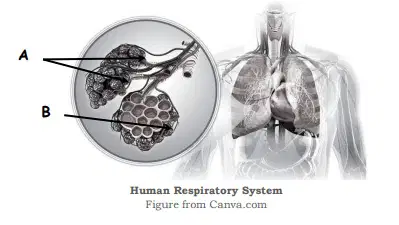
What important process happens in the netlike structure labeled A?
Nitrogen and oxygen are exchanged.
Carbon dioxide and oxygen are exchanged.
Nitrogen and carbon dioxide remain constant.
Carbon dioxide and oxygen diffuse into the blood.
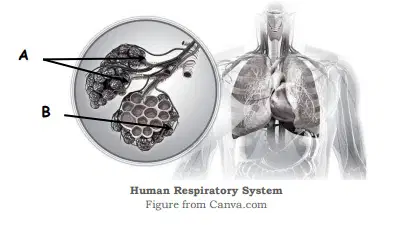
What structure of the Respiratory System is labeled B in the diagram?
Alveolus
Bronchi
Bronchiole
Pharynx
Why is the lung considered as the primary organ of the respiratory system?
Because it is the largest organ of the system.
Because it has two parts: the right and left lungs.
Because it is located near the middle of the chest cavity.
Because it contains the alveoli that is responsible for gas exchange.
Which of the following statements about the human respiratory system is false?
The bronchioles branch into bronchi.
Alveolar ducts connect to alveolar sacs.
When we breathe in, air travels from the pharynx to the trachea.
Gas exchange between the lungs and blood takes place in the alveolus.
Which structure is responsible for the movement of the chest cavity during the breathing process?
Bronchi and trachea
Larynx and pharynx
Nasal cavity and pharynx
Diaphragm and rib muscle
Which is the order of airflow during inhalation?
Nasal cavity, trachea, larynx, bronchi, bronchioles, alveoli.
Nasal cavity, larynx, trachea, bronchi, bronchioles, alveoli.
Nasal cavity, larynx, trachea, bronchioles, bronchi, alveoli.
Nasal cavity, trachea, larynx, bronchi, bronchioles, alveoli.
Which of the following statements about the circulatory system is false?
Blood in the aorta is oxygenated.
Blood in the pulmonary vein is oxygenated.
Blood in the pulmonary artery is oxygenated.
Blood in the inferior vena cava is deoxygenated.
Which is the main organ of circulation?
Blood
Heart
Capillary
Blood vessels
How do arteries differ from veins?
Arteries carry blood.
Arteries are thin-walled and are used for gas exchange.
Arteries have thicker wall layers to accommodate the changes in pressure from the heart.
Arteries have thinner wall layers and valves and move blood by the action of skeletal muscle.
Which blood vessel carries blood from all parts of the body to the heart?
Aorta
Vena cava
Pulmonary vein
Pulmonary artery
What type of circulation is responsible for removing oxygen-depleted blood cells from the heart going to the lungs to receive proper amount of oxygen?
Open circulation
Coronary circulation
Systemic circulation
Pulmonary circulation
What is the correct order of blood circulation starting from the different parts of the body, lungs and, back to the body?
Superior and inferior vena cava, right atrium, right ventricle, lungs, left atrium, left ventricle, aorta, body
Superior and inferior vena cava, left atrium, left ventricle, lungs, right atrium, right ventricle, aorta, body
Superior and inferior vena cava, left ventricle, right ventricle, lungs, left atrium, right atrium, aorta, body
Superior and inferior vena cava, right atrium, left ventricle, lungs, left atrium, right ventricle, aorta, body
In which organ do gas exchange and gas transport occur?
Tubes
Blood vessels
Lungs and tubes
Lungs and blood vessels
Which best defines this pair of words:
Respiratory system: Circulatory system?
Gets the oxygen needed by the cells : Delivers the oxygen to the cells
Ingests food and breaks it down into usable nutrients : Excretes solid waste products
Cleans dissolved waste products from the blood and excretes them : Excretes solid waste products.
Moves materials between body systems, including oxygen, nutrients, hormones, and waste products : Allows gas exchange between cells and environment
How does the respiratory system work with circulatory system?
Always work independently from one another.
Work together to keep blood pumping to all parts of the body.
Work together only when we are active, and never when we are resting or sleeping.
Work together to deliver oxygen to cells and remove carbon dioxide from the body.
What are the main functions of the human respiratory and circulatory systems?
How do the respiratory and the circulatory system work independently and together?
What are the smallest blood vessels that move blood to and from the cells of the body?
Arteries
Veins
Capillaries
Aorta
What is the main function of the heart?
To pump blood
To filter blood
To produce blood
To store blood
What are the two smaller chambers of the heart called?
Atria
Ventricles
Septum
Valves
What is the function of pulmonary circulation?
To carry oxygenated blood
To carry deoxygenated blood to the lungs
To supply blood to the heart
To transport nutrients
What does systemic circulation do?
Carries blood to the lungs
Carries oxygenated blood to the body
Carries deoxygenated blood to the heart
Carries blood to the heart only
What is the role of the heart valves?
To allow blood to flow backwards
To prevent blood from flowing backwards
To pump blood
To filter blood
What is the pathway of blood flow from the body to the heart?
Aorta
Vena Cava
Pulmonary Artery
Pulmonary Vein
What is the function of the respiratory system in relation to the circulatory system?
To transport blood
To exchange gases
To pump blood
To filter blood
What happens to blood when it reaches the lungs?
It picks up oxygen
It loses oxygen
It becomes deoxygenated
It is filtered
What is the main function of the aorta?
To carry deoxygenated blood
To carry oxygenated blood to the body
To pump blood
To filter blood

