
NEW
Font size
 Worksheets
Congenital Heart Disease IN ADULT Quiz
Total questions: 76
Worksheet time: 38mins
What is the estimated number of adults with congenital heart disease (CHD) living in the United States?
At least 1 million
At least 2 million
At least 4 million
At least 14 million
Which organization published guidelines in 2008 and revised them in 2018 to standardize the care of adults with congenital heart disease (ACHD)?
American Heart Association only
American College of Cardiology only
American College of Cardiology and American Heart Association
World Health Organization
What is a key reason for the need for collaboration among primary care practitioners, cardiologists, and ACHD subspecialty cardiologists?
To reduce healthcare costs
To improve patient satisfaction scores
To address the complexity of care required for adults with CHD
To increase the number of surgeries performed
According to the text, what is a special consideration for adults with CHD regarding their exercise capacity?
They always recognize changes in their exercise capacity
They may not recognize subtle changes in their exercise capacity
They should avoid all forms of exercise
They have no restrictions on exercise
Why is regular evaluation of anatomic, hemodynamic, and electrophysiologic sequelae recommended for ACHD patients?
To increase medication dosage
To monitor for irreversible physiologic changes
To reduce the need for surgery
To avoid all physical activity
What is the main focus of non-cardiac surgery assessment in adults with CHD?
Reducing hospital stay
Assessing myocardial perfusion and loading conditions
Increasing exercise tolerance
Avoiding all medications
What should women with CHD receive before conceiving a pregnancy?
Only genetic counseling
Counseling regarding both maternal and fetal risks
No counseling is necessary
Only dietary advice
Which of the following is NOT a risk factor for adverse cardiac outcome in pregnancy for women with CHD?
Prior history of cardiac events or arrhythmias
Functional status (New York Heart Association class ≥III)
Absence of mechanical heart valve
Presence of mechanical heart valve
What is the recommended approach for reviewing pregnancy medications in women with CHD?
Continue all medications as before
Review to ensure their safety in pregnancy
Discontinue all medications
Only review after delivery
What is the significance of the World Health Organization (WHO) classification of risk during pregnancy for women with heart disease?
It determines the need for surgery
It helps counsel women at risk about the significant risks of morbidity and mortality during pregnancy and postpartum
It is used only for pediatric patients
It is not relevant for women with CHD
What is the significance of the diagram?
Diagram of the respiratory system
Diagram of the digestive system
Diagram showing the passage of blood flow between blood vessels and cardiac chambers in various disorders
Diagram of the nervous system
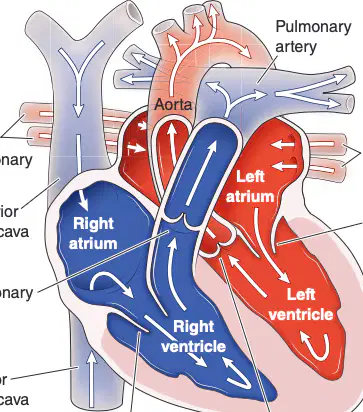
Which chamber of the heart receives oxygenated blood from the pulmonary veins?
Right atrium
Left atrium
Right ventricle
Left ventricle
What is the main function of the pulmonary artery in the heart?
To carry oxygenated blood from the heart to the body
To carry deoxygenated blood from the heart to the lungs
To carry oxygenated blood from the lungs to the heart
To carry deoxygenated blood from the body to the heart
According to the provided table, which of the following is a multiorgan consideration in adult congenital heart disease patients related to the hepatic system?
Anemia
Liver fibrosis
Scoliosis
Decreased renal function
During cardiac development, what is the significance of the heart tube looping to the right (D-loop)?
It forms the left atrium and ventricle
It positions the future ventricles inferior or caudal to the inflow
It results in the formation of the aortic arch
It causes the heart to stop growing
Which genetic syndrome is most notably associated with conotruncal heart defects?
Down syndrome (Trisomy 21)
Turner syndrome
DiGeorge syndrome (22q11 deletion)
Marfan syndrome
It is important to differentiate between alignment and connection of heart segments in congenital heart disease because:
Because they are the same and do not affect diagnosis
Because alignment and connection are different concepts and both are important, especially in complex defects
Because only alignment matters in heart function
Because connection only affects the pulmonary veins
According to the modified World Health Organization (mWHO) classification, which heart condition in pregnancy is classified as mWHO I?
Small or mild pulmonary stenosis
Moderate mitral stenosis
Pulmonary arterial hypertension
Severe aortic dilation (>45 mm in Marfan)
What is the risk associated with mWHO IV heart disease classification in pregnancy?
Extremely high risk of maternal mortality or severe morbidity
No increased risk of maternal mortality and no/mild increase in morbidity
Intermediate increased risk of maternal mortality or moderate increase in morbidity
Significantly increased risk of maternal mortality or severe morbidity
Which of the following is a common type of atrial septal defect (ASD)?
Secundum ASD
Tetralogy of Fallot
Patent ductus arteriosus
Mitral valve prolapse
A patient with a left-to-right shunt due to an ASD is likely to have which of the following findings on physical examination?
Wide, fixed splitting of the second heart sound
Continuous machinery murmur
Systolic ejection click
Diastolic rumble at the apex
Which of the following statements best describes the difference between a secundum ASD and a patent foramen ovale (PFO)?
A secundum ASD is a defect in the atrial septum, while a PFO is a persistent patency of the flap of the fossa ovalis not associated with right-sided cardiac dilation.
A secundum ASD is always associated with abnormal development of the AV valves, while a PFO is not.
A secundum ASD is a defect in the ventricular septum, while a PFO is a defect in the atrial septum.
A secundum ASD is only found in infants, while a PFO is only found in adults.
Which of the following is NOT a risk factor for right heart dilation?
Diabetes mellitus
Systemic hypertension
Atherosclerosis
Mitral valve prolapse
Why is it important to distinguish between different types of atrial septal defects (ASDs) in adults?
Because management and closure options may differ based on the type of ASD
Because all ASDs require immediate surgical intervention
Because only secundum ASDs cause symptoms
Because only primum ASDs are associated with pulmonary hypertension

Which type of ASD is associated with a deficiency of the atrioventricular (AV) canal portion of the atrial septum?
Primum ASD
Secundum ASD
Sinus venosus defect
Patent ductus arteriosus
Which of the following is NOT a congenital etiology of right heart dilation listed in Table 269-3?
Tricuspid valve dysplasia with regurgitation
Pulmonary arterial hypertension
Mitral valve prolapse
Ebstein anomaly
What is the primary anatomical abnormality in Ebstein anomaly?
Malformation of the mitral valve
Displacement of the tricuspid valve leaflets toward the apex of the right ventricle
Thickening of the aortic valve
Stenosis of the pulmonary valve
Which clinical sign may be present in patients with Ebstein anomaly due to redundancy of the anterior tricuspid valve leaflet?
S3 gallop
Systolic ejection murmur
Sail sign
Opening snap
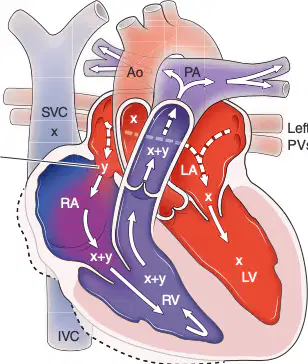
Which type of atrial septal defect is most commonly associated with an abnormal connection between the left upper pulmonary vein and the superior vena cava?
Primum ASD
Secundum ASD
Sinus venosus defect
Coronary sinus septal defect
Partial anomalous pulmonary venous return (PAPVR) most commonly involves which pulmonary vein?
Right lower pulmonary vein
Left upper pulmonary vein
Right upper pulmonary vein
Left lower pulmonary vein
Which of the following statements about ventricular septal defects (VSDs) is TRUE?
VSDs are the least common congenital heart defect in adults.
Most VSDs in adults are large and require surgical closure.
The most common location for VSDs is in the membranous septum.
Muscular VSDs always result in significant hemodynamic consequences.
A patient with a significant atrial septal defect (ASD) may present with which of the following symptoms?
Cyanosis at rest
Arrhythmias or shortness of breath
Severe chest pain
Hypertension
Which of the following is a potential complication of Ebstein anomaly that may require surgical treatment?
Mitral valve replacement
Tricuspid valve repair or replacement
Aortic valve stenosis
Pulmonary artery banding
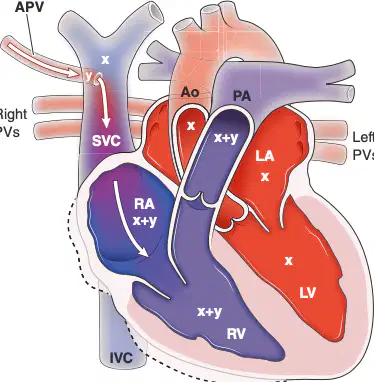
Which of the following best describes Partial Anomalous Pulmonary Venous Return (PAPVR)?
A. All pulmonary veins drain into the left atrium.
B. Some pulmonary veins drain into the right atrium or systemic veins instead of the left atrium.
C. The aorta arises from the right ventricle.
D. The tricuspid valve is absent.
What is the main hemodynamic consequence of a significant left-to-right shunt in Partial Anomalous Pulmonary Venous Return?
A. Decreased pulmonary blood flow
B. Increased right heart volume load
C. Decreased systemic venous return
D. Left ventricular hypertrophy
Which congenital heart defect is characterized by anterior deviation of the conal septum, resulting in a ventricular septal defect (VSD), right ventricular outflow tract obstruction, right ventricular hypertrophy, and an overriding aorta?
A. Ebstein malformation
B. Tetralogy of Fallot
C. Patent ductus arteriosus
D. Partial anomalous pulmonary venous return
What is the primary goal of surgical repair in Tetralogy of Fallot?
A. To close the atrial septal defect
B. To alleviate pulmonary stenosis and close the ventricular septal defect
C. To replace the tricuspid valve
D. To reduce left atrial pressure
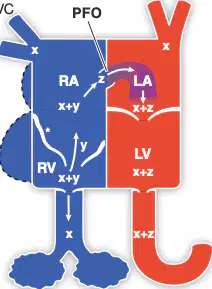
Which of the following statements about Ebstein malformation is correct?
A. The tricuspid valve leaflets are normally attached to the annulus.
B. The right atrium is typically small in size.
C. The tricuspid valve leaflets are displaced toward the apex of the right ventricle.
D. The left ventricle is always dilated.
A patient with Ebstein malformation is most likely to have which of the following clinical findings?
A. Left ventricular hypertrophy
B. Right atrial dilation and tricuspid regurgitation
C. Aortic stenosis
D. Pulmonary vein stenosis
Which of the following is a common late complication in adults who have undergone repair for Tetralogy of Fallot?
A. Left atrial myxoma
B. Pulmonary regurgitation with right ventricular dilation
C. Mitral valve prolapse
D. Aortic dissection
Why is magnetic resonance imaging (MRI) particularly important in the follow-up of patients with repaired Tetralogy of Fallot?
A. To detect coronary artery disease
B. To assess right ventricular size, function, and mass
C. To measure left atrial pressure
D. To evaluate mitral valve function
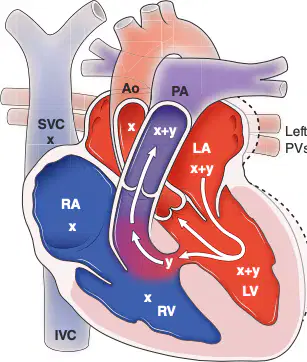
What is the primary difference in pressure that allows for a "shunt" of blood in a ventricular septal defect (VSD)?
Difference in pressure and outflow resistance between the right and left ventricles
Difference in pressure between the atria
Difference in oxygen saturation between the lungs and heart
Difference in pressure between the pulmonary veins and arteries
Which of the following is a common intervention for patients with repaired Tetralogy of Fallot (TOF) who develop pulmonary valve regurgitation (PVR)?
Percutaneous implantation of pulmonary valves
Administration of antibiotics
Use of beta-blockers only
Removal of the right ventricle
Transposition of the Great Arteries (TGA) is characterized by which of the following?
The great arteries arising from the opposite side of the ventricular septum than normal
The aorta and pulmonary artery both arising from the left ventricle
The pulmonary veins draining into the right atrium
The aorta and pulmonary artery both arising from the right atrium
Why is the physiology of D-loop TGA not compatible with long-term survival without surgical intervention?
The systemic and pulmonary circulations are in parallel rather than in series
The heart cannot pump enough blood to the lungs
The left ventricle is underdeveloped
The atria are not connected to the ventricles
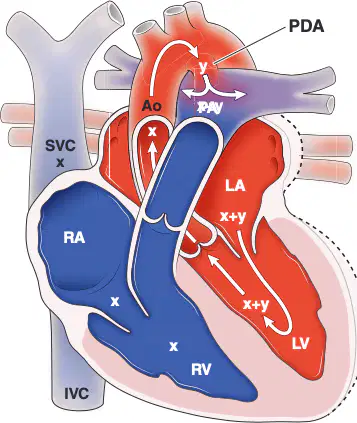
In the presence of a patent ductus arteriosus (PDA), what is the result of the shunt of blood from the aorta to the pulmonary arteries?
Increased volume of blood in the lungs, left atrium, and left ventricle
Decreased oxygenation of systemic blood
Decreased pressure in the right ventricle
Increased resistance in the aorta
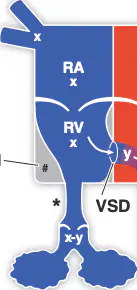
Which of the following is NOT a component of the Tetralogy of Fallot?
Ventricular septal defect (VSD)
Right ventricular hypertrophy (RVH)
Left atrial hypertrophy (LAH)
Pulmonary outflow tract obstruction
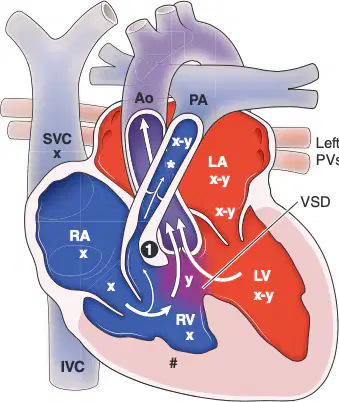
What is the primary effect of the ventricular septal defect (VSD) in Tetralogy of Fallot?
It allows oxygenated blood to flow from the left ventricle to the right atrium.
It allows deoxygenated blood to mix with oxygenated blood in the left ventricle.
It prevents blood from entering the pulmonary artery.
It causes the left ventricle to become hypertrophied.
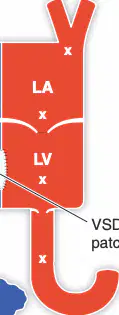
After surgical repair of Tetralogy of Fallot, which of the following complications is most commonly associated with the procedure?
Systemic cyanosis
Pulmonary regurgitation
Left ventricular hypertrophy
Aortic stenosis
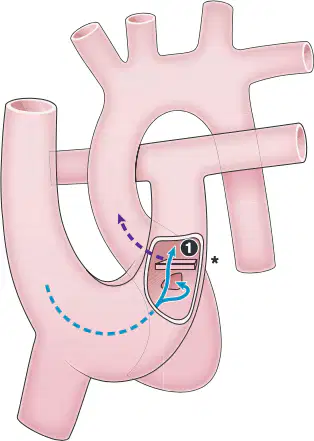
Which anatomical structure is primarily responsible for the outflow tract obstruction in Tetralogy of Fallot?
Mitral valve
Conal septum
Left atrium
Inferior vena cava
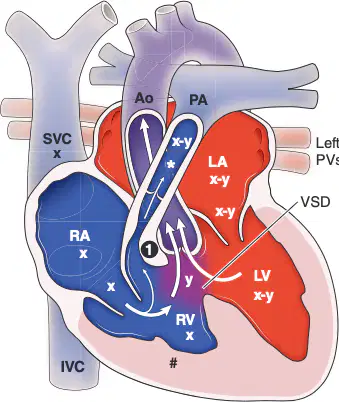
Patients with unrepaired Tetralogy of Fallot experience systemic arterial cyanosis because:
Because deoxygenated blood from the right ventricle enters the left ventricle and is pumped into the systemic circulation.
Because oxygenated blood bypasses the lungs and enters the systemic circulation.
Because the pulmonary artery is completely blocked.
Because the left atrium receives only deoxygenated blood.
Which of the following is a potential sequelae of repaired Tetralogy of Fallot?
Right atrial dilation
Left atrial hypertrophy
Mitral valve prolapse
Aortic stenosis
What is the main physiological abnormality in D-loop Transposition of the Great Arteries (TGA)?
The aorta arises from the right ventricle and the pulmonary artery arises from the left ventricle
The aorta arises from the left ventricle and the pulmonary artery arises from the right ventricle
Both great arteries arise from the left ventricle
Both great arteries arise from the right ventricle
Which surgical procedure allows both anatomic and physiologic correction for D-loop transposition of the great arteries?
Atrial switch
Arterial switch
Fontan procedure
Norwood procedure
What is a common physical finding in patients with coarctation of the aorta?
Lower extremity blood pressure and pulses are lower than those in the upper extremities
Lower extremity blood pressure and pulses are higher than those in the upper extremities
Blood pressure is equal in all extremities
No difference in pulse or blood pressure is observed
Which of the following is NOT typically associated with patients with unrepaired TGA?
Atrial septal defect (ASD)
Ventricular septal defect (VSD)
Patent ductus arteriosus (PDA)
Mitral valve prolapse
What is the main function of the atrial switch procedure in the context of TGA?
Redirect deoxygenated blood to the left ventricle and oxygenated blood to the right ventricle
Redirect deoxygenated blood to the right ventricle and oxygenated blood to the left ventricle
Switch the positions of the aorta and pulmonary artery
Close the ventricular septal defect
Which of the following is a less common form of TGA that may not require surgical intervention?
L-loop TGA
D-loop TGA
Tetralogy of Fallot
Coarctation of the aorta

What does the diagram of D-loop Transposition primarily illustrate?
The abnormal connection of the great arteries to the ventricles
The normal flow of blood through the heart
The structure of the mitral and tricuspid valves
The conduction system of the heart
Which of the following best describes the term "single ventricle heart disease"?
A condition where both ventricles are normal
A condition where one ventricle or its valves preclude surgical creation of a biventricular circulation
A condition where only the atria are affected
A condition with no impact on heart function
Which surgical procedure is associated with the risk of coronary artery stenosis as a long-term sequela?
Atrial switch
Arterial switch
Rastelli procedure
Fontan procedure
What is the main purpose of the Fontan procedure in patients with single ventricle physiology?
To separate the pulmonary and systemic circulations completely
To allow passive flow of systemic venous return of deoxygenated blood to the lungs
To increase the number of ventricles in the heart
To repair coronary artery stenosis
Which of the following is a common long-term complication for patients who have undergone a Fontan procedure?
Increased risk of arrhythmias and heart failure
Complete recovery with no complications
Decreased risk of thrombosis
Improved hepatic function
What is the primary pathophysiological mechanism behind Eisenmenger Syndrome?
Decreased pulmonary vascular resistance
Excessive blood flow to the pulmonary vasculature leading to increased resistance and reversal of the shunt
Increased systemic vascular resistance
Decreased blood flow to the lungs
Which of the following is NOT a long-term sequela of the arterial switch procedure for D-Loop TGA surgery?
Subaortic stenosis
Pulmonary regurgitation
Neo-aortic root dilation
Tricuspid regurgitation
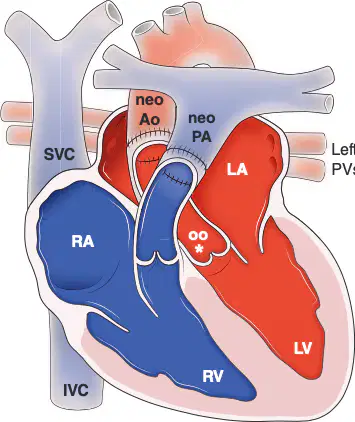
Which anatomical structure is labeled as "neo Ao" in the arterial switch diagram?
Neo-pulmonary artery
Neo-aorta
Neo-left atrium
Neo-right ventricle
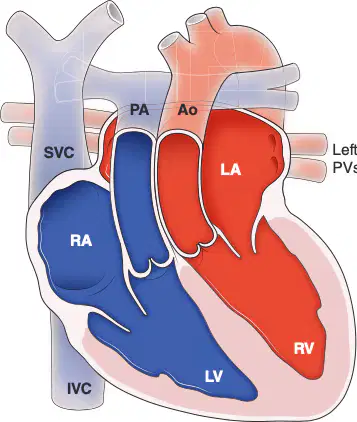
Which of the following best describes congenitally corrected transposition of the great arteries (L-loop transposition)?
A condition where the atria and ventricles are in normal alignment but the great arteries are switched
A condition characterized by atrioventricular discordance and ventriculoarterial discordance
A condition where both atria are connected to the same ventricle
A condition where the pulmonary artery arises from the left ventricle and the aorta from the right ventricle without any discordance
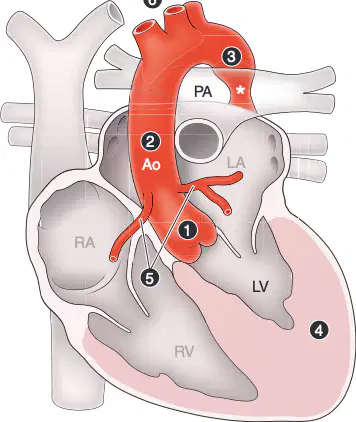
Which of the following is NOT a common sequelae of aortic coarctation?
Systemic arterial hypertension
Left ventricular hypertrophy
Pulmonary artery stenosis
Cerebral aneurysm formation
Which management strategy is recommended for symptomatic patients with Eisenmenger syndrome (ES) to address cyanosis?
Routine phlebotomy in all adults with ES
Hydration alone or phlebotomy with iron supplementation when appropriate
Use of estrogen-containing contraceptives
Immediate lung transplantation for all patients
Why is routine phlebotomy contraindicated in asymptomatic adults with Eisenmenger syndrome (ES)?
It increases the risk of pulmonary hypertension
It can lead to iron deficiency and reduced quality of life
It causes left ventricular hypertrophy
It prevents optimization of hydration status
Which of the following statements best reflects the role of palliative care in adults with congenital heart disease (ACHD)?
Palliative care is only for patients with cancer, not ACHD
Palliative care in ACHD focuses on quality-of-life-limiting comorbidities and end-of-life care
Palliative care is not recommended for patients with heart failure
Palliative care is only provided during surgical procedures
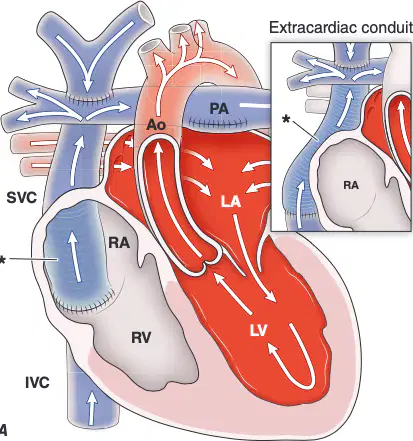
What is the primary purpose of a Fontan surgery?
To connect the pulmonary veins directly to the aorta
To create a circulation where deoxygenated blood is directed to the pulmonary arteries without a pumping chamber
To increase the pressure in the right atrium
To bypass the left ventricle entirely
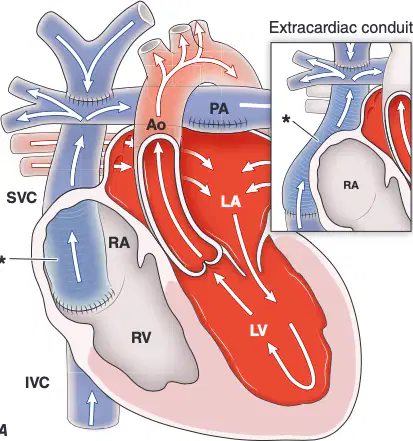
Which vessels are connected in a Fontan procedure to direct blood flow to the pulmonary arteries?
SVC and pulmonary veins
IVC and aorta
SVC and IVC
Left atrium and right ventricle
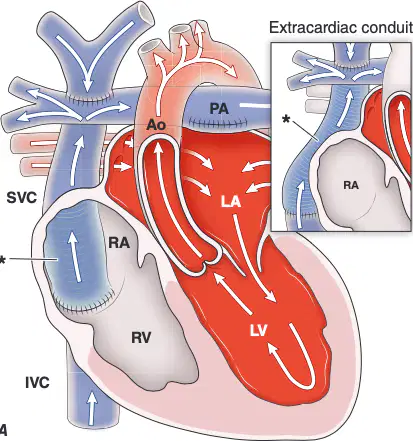
In Fontan circulation, what is the relationship between pulmonary artery (PA) pressure and left atrial (LA) pressure?
PA pressure is less than LA pressure
PA pressure is equal to LA pressure
PA pressure is greater than LA pressure
PA pressure is unrelated to LA pressure
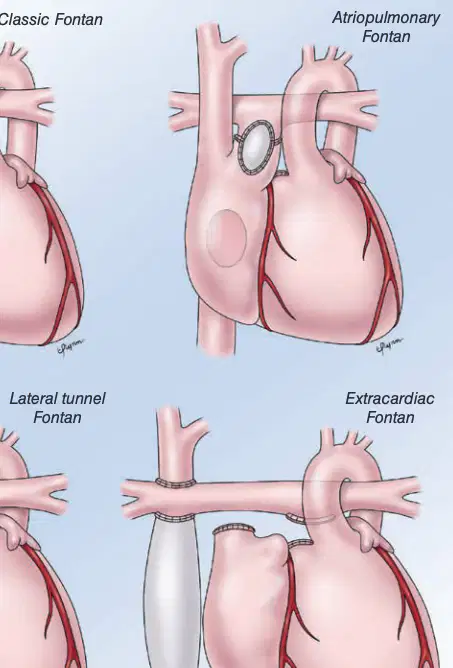
Which of the following is NOT a type of Fontan operation shown in the diagram?
Classic Fontan
Atriopulmonary Fontan
Lateral tunnel Fontan
Biventricular Fontan
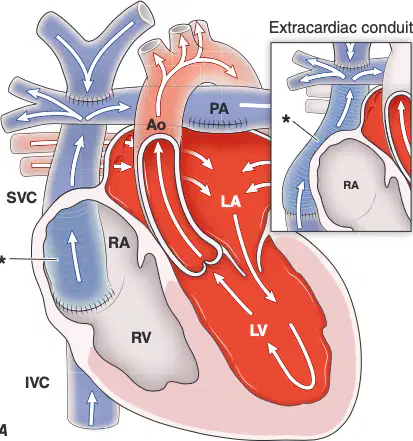
Why does Fontan circulation require the absence of a pumping chamber to the pulmonary arteries?
To allow the right ventricle to generate higher pressure
To permit flow through the lungs due to higher PA pressure than LA pressure
To increase oxygenation in the left atrium
To bypass the aorta entirely

