
NEW
Font size
 Worksheets
aortic stenosis
Total questions: 74
Worksheet time: 37mins
Which of the following is the most common cause of valvular heart disease worldwide?
Coronary artery disease
Hypertension
Rheumatic fever
Diabetes mellitus
According to the text, what is the estimated prevalence of severe aortic stenosis (AS) in adults aged ≥75 years?
1.5%
2.0%
3.5%
5.0%
Which region is NOT listed as highly prevalent for rheumatic heart disease in the provided world map?
Sub-Saharan Africa
India
Southeast Asia
Western Europe
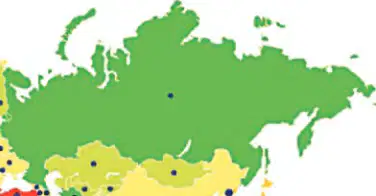
What does the world map in Figure 261-1 illustrate?
The distribution of coronary artery disease worldwide
The global burden and change in prevalence of rheumatic heart disease
The prevalence of diabetes mellitus in different countries
The incidence of infective endocarditis globally
Which of the following statements best describes the trend in mortality rate from rheumatic heart disease between 1990 and 2015?
It decreased by nearly 90%
It remained unchanged
It increased by nearly 90%
It increased by 20%
What is a major factor contributing to the high prevalence and mortality of rheumatic heart disease in economically deprived areas?
High rates of diabetes mellitus
Overcrowding and limited access to medical resources
Increased use of antibiotics
High rates of coronary artery disease
Which of the following is NOT a major driver of increased incidence of infective endocarditis?
Aging population
Increased use of antibiotics
More virulent multidrug-resistant microorganisms
Growing epidemic of diabetes mellitus
What is the main reason for the accelerated natural history of valvular heart disease in developing countries?
Repeated infections with more virulent strains of group A streptococcus
High rates of obesity
Increased use of valve surgery
Improved access to health care
Which of the following is the most common valve lesion among adult patients with chronic valvular heart disease?
Mitral stenosis
Aortic stenosis
Pulmonary stenosis
Tricuspid regurgitation
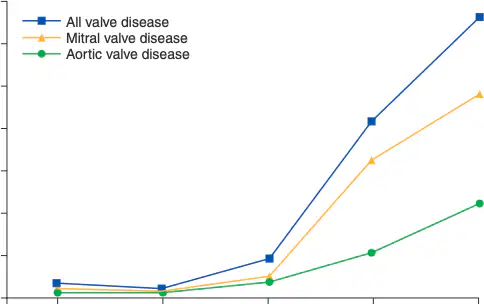
According to the provided graph, which type of valvular disease shows the highest prevalence of moderate or severe disease in individuals aged 75 and above?
All valve disease
Mitral valve disease
Aortic valve disease
Tricuspid valve disease
Which of the following is NOT a major cause of aortic stenosis as listed in Table 261-1?
Congenital (bicuspid, unicuspid)
Degenerative calcific disease
Rheumatic fever
Infective endocarditis
What is the approximate prevalence of bicuspid aortic valve (BAV) disease in the general population?
0.1–0.2%
0.5–1.4%
2–4%
5–10%
Which of the following statements best describes the inheritance pattern of bicuspid aortic valve (BAV) disease?
Autosomal recessive with a 1:1 male-to-female ratio
X-linked dominant with a 2:1 male-to-female ratio
Autosomal dominant with incomplete penetrance and a 2:1 male-to-female ratio
Mitochondrial inheritance with equal male and female prevalence
A patient with bicuspid aortic valve (BAV) is at increased risk for which of the following complications compared to patients with trileaflet aortic valves?
Infective endocarditis only
Aortic aneurysm formation or dissection
Pulmonary hypertension
Mitral valve prolapse
Which of the following is a common feature of aortic stenosis due to degenerative calcific disease?
Rapid progression in all patients
Involvement of the mitral valve in all cases
Calcification and thickening of the leaflets without severe enough obstruction to cause symptoms in all cases
Always associated with rheumatic fever
Which of the following traditional atherosclerotic risk factors is associated with the development and progression of calcific aortic stenosis?
High HDL cholesterol
Low blood pressure
Low-density lipoprotein (LDL) cholesterol
Young age
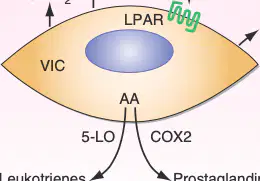
Which of the following is a key event in the pathogenesis of calcific aortic stenosis?
Lipid and inflammatory cell infiltration of the endothelium
Direct bacterial infection of the aortic valve
Autoimmune destruction of the myocardium
Genetic mutation of hemoglobin
According to the Laplace relation, what happens to the left ventricular (LV) wall stress when the radius of the ventricle increases?
Wall stress increases
Wall stress decreases
Wall stress remains unchanged
Wall stress becomes negative
Which cell type is primarily responsible for the deposition of calcium hydroxyapatite in calcific aortic stenosis?
Osteoprogenitor cell
Red blood cell
Neutrophil
Platelet
What is a common compensatory response of the left ventricle to chronic outflow obstruction in aortic stenosis?
Hypertrophy of the left ventricle
Atrophy of the left ventricle
Dilation of the right atrium
Fibrosis of the mitral valve
Which of the following is a late complication of severe aortic stenosis?
Left ventricular failure
Increased pulmonary compliance
Enhanced mitral valve function
Decreased coronary artery resistance
What is the significance of a mean systolic pressure gradient >40 mmHg across the aortic valve?
It indicates severe obstruction to LV outflow
It indicates normal aortic valve function
It suggests mild pulmonary hypertension
It is diagnostic of mitral regurgitation
Which of the following best describes the symptoms of severe aortic stenosis?
Symptoms may not appear until the valve orifice is less than 1.0 cm²
Symptoms always appear early in the disease
Symptoms are unrelated to the size of the valve orifice
Symptoms are primarily gastrointestinal
Which of the following is a common symptom in patients with severe aortic stenosis (AS)?
Persistent cough
Syncope on exertion
Frequent urination
Night sweats
What is the most reliable physical finding in patients with severe aortic stenosis (AS)?
Loud S3 heart sound
Systolic murmur at the base of the heart
Diastolic murmur at the apex
Continuous murmur at the left sternal border
Which laboratory examination is most useful for evaluating the severity of aortic stenosis (AS)?
Chest X-ray
Echocardiogram
Blood pressure measurement
Urinalysis
Which of the following statements about the ECG in aortic stenosis (AS) is correct?
The ECG always shows left ventricular hypertrophy (LVH) in AS.
The ECG can exclude the development of hypertrophy in AS.
The ECG may show LV hypertrophy, but this is not always present.
The ECG is not useful in the evaluation of AS.
A patient with aortic stenosis (AS) is found to have a mean aortic valve gradient of 45 mmHg and a valve area of 0.8 cm². What is the severity of their AS?
Mild
Moderate
Severe
Trivial
Why is echocardiography considered the key investigation for aortic stenosis (AS)?
It measures blood sugar levels.
It provides accurate assessment of aortic valve area and gradient.
It detects lung infections.
It measures kidney function.
Which of the following is NOT a typical symptom of aortic stenosis (AS)?
Angina pectoris
Exertional syncope
Dyspnea
Persistent diarrhea
What is the significance of a double apical impulse in a patient with aortic stenosis (AS)?
It indicates the presence of aortic regurgitation.
It is a sign of left ventricular hypertrophy.
It suggests right ventricular failure.
It is a normal finding in elderly patients.
Which imaging modality is increasingly used to assess aortic valve morphology and function in aortic stenosis (AS)?
Abdominal ultrasound
Chest X-ray
Computed tomography (CT) angiography
Bone scan
In the context of aortic stenosis (AS), what does a 'parvus et tardus' pulse indicate?
Rapid and bounding pulse
Slow-rising and delayed pulse
Irregularly irregular pulse
Pulsus paradoxus
Which of the following is NOT a typical finding in the natural history of aortic stenosis (AS)?
Most deaths in patients with severe AS occur between the seventh and eighth decades.
Sudden death is common in asymptomatic patients with severe AS.
The annual reduction in valve area averages 0.1 cm².
The mean annual increase in peak jet velocity averages 0.3 m/s.
Which medication is generally safe for asymptomatic patients with preserved left ventricular systolic function and aortic stenosis?
Beta blockers
Digoxin
Nitrates
Calcium channel blockers
Which of the following is a primary indication for coronary angiography in patients with aortic stenosis?
To assess the need for surgical or transcatheter valve intervention
To measure left ventricular pressure
To evaluate pulmonary congestion
To diagnose endocarditis
Which of the following statements best describes the role of surgical treatment in asymptomatic patients with calcific aortic stenosis?
Surgery is always recommended regardless of symptoms.
Surgery should be considered only if there is evidence of deteriorating LV function.
Surgery is contraindicated in elderly patients.
Surgery is only performed in patients with endocarditis.
A patient with severe aortic stenosis (valve area <1 cm²) and symptoms is being evaluated for surgery. Which of the following factors is most important in determining the timing of surgery?
Patient’s age alone
Presence of symptoms and left ventricular function
Family history of aortic disease
History of hypertension
Which of the following is a potential risk associated with attempts to cross the aortic valve for measurement of LV pressures in catheterization?
Cerebral embolization
Pulmonary edema
Myocardial infarction
Renal failure
Which of the following is a reason for performing right- and left-sided heart catheterization in patients with aortic stenosis?
When there is a discrepancy between the clinical and noninvasive findings
To treat hypertension
To diagnose diabetes
To assess liver function
Which of the following is a key consideration in the management of elderly patients with severe aortic stenosis and comorbidities?
The adequacy of hepatic, renal, and pulmonary function before AVR
The patient’s cholesterol level
The patient’s exercise tolerance only
The patient’s age alone
A patient with severe aortic stenosis and low-flow, low-gradient findings is being considered for intervention. What is the most important next step?
Assess for contractile reserve using dobutamine stress echocardiography
Proceed directly to surgery
Start diuretics
Begin anticoagulation therapy
Which of the following statements about the 10-year survival rate of older adult patients with surgical aortic valve replacement (SAVR) is correct?
It is approximately 60%
It is less than 10%
It is 100%
It is 90%
Which of the following is a defining criterion for Severe Aortic Stenosis (AS) stage D1?
Vmax 3–3.9 m/s
Vmax ≥4 m/s and AVA ≤1.0 cm²
EF <50%
BNP >3x normal
What is the recommended intervention for patients with symptomatic severe AS (stage D1) and left ventricular ejection fraction (EF) <50%?
Medical management only
AVR (SAVR or TAVI)
Observation and follow-up
Cardiac rehabilitation
According to the management strategy, which AS stage is characterized by Vmax 3–3.9 m/s?
AS stage D1
AS stage C
AS stage B
AS stage D3
A patient with severe AS (Vmax ≥4 m/s) but no symptoms and an EF <50% falls under which AS stage?
AS stage D1
AS stage C
AS stage B
AS stage D2
Which of the following findings would most likely prompt consideration of AVR (SAVR or TAVI) in an asymptomatic patient with severe AS?
Vmax 3.5 m/s
BNP within normal range
Vmax ≥5 m/s or rapid disease progression
EF >60% on all studies
Based on the provided mortality rates after aortic valve surgery, which operation has a higher unadjusted operative mortality?
AVR (isolated)
AVR + CABG
Both have the same mortality
Neither has any mortality
Why should preoperative coronary angiography be performed in patients with aortic stenosis?
To confirm the diagnosis of AS
To assess for coronary artery disease
To measure BNP levels
To determine ejection fraction
Which of the following is NOT a potential late postoperative complication after aortic valve replacement?
Aortic root dilation
Pulmonary homograft stenosis
Myocardial infarction
Prosthetic valve endocarditis
Which procedure is preferable to operation in many children and young adults with congenital, noncalcific AS?
Percutaneous aortic balloon valvuloplasty
Transcatheter aortic valve implantation (TAVI)
Surgical aortic valve replacement (SAVR)
Coronary artery bypass grafting (CABG)
What is the main advantage of transcatheter aortic valve replacement (TAVR) over surgical aortic valve replacement (SAVR) in low surgical risk patients, according to recent RCTs?
Fewer procedural deaths and strokes
Longer hospital stays
Higher risk of major bleeding
Increased need for reoperation
Which of the following is NOT a commonly used system for TAVI?
Balloon-expandable valve
Self-expanding valve
Mechanical valve
Bioprosthetic valve
According to the Kaplan-Meier estimates shown in Figure 261-6, what is the approximate percentage of death, stroke, or rehospitalization at 12 months for TAVR?
4.2%
9.3%
15%
25%
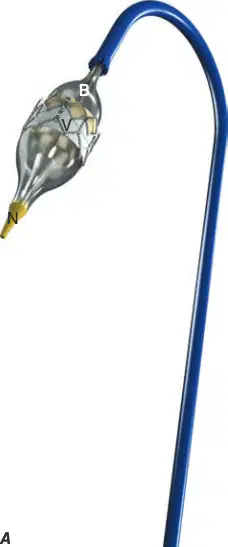
Which part of the TAVR device is responsible for expanding the valve during the procedure?
Balloon
Nose cone
Guide wire
Sheath
Which patient group has seen an increased use of valve-in-valve TAVI as an alternative to reoperative valve replacement in the past 5 years?
Patients with structural deterioration of bioprosthetic aortic valves
Patients with mechanical valve failure
Patients with congenital heart disease
Patients with coronary artery disease
What is a key reason for preferring TAVI over SAVR in certain patients with trileaflet AS?
Preference for a biological prosthesis
Lower cost
Shorter procedure time
Less need for anesthesia
Which of the following is a contraindication for VKA anticoagulation in patients being considered for aortic valve replacement (AVR)?
Cannot be managed
Not desired
Contraindicated
All of the above
At what age is surgical aortic valve replacement (SAVR) generally recommended over transcatheter aortic valve implantation (TAVI) for patients with aortic stenosis and no prohibitive surgical risk?
Under 50 years
50–65 years
Over 65 years
Over 80 years
Which risk assessment factor would indicate a high or prohibitive surgical risk for AVR?
STS ≥8%
>2 frailty measures
>2 organ systems affected
All of the above
A patient with symptomatic severe aortic stenosis (AS) and an ejection fraction (EF) less than 50% is being evaluated for valve replacement. What is the next step if the patient has suitable valve and vascular anatomy for transfemoral TAVI?
Proceed with TAVI
Proceed with SAVR
Palliative care
No intervention
For patients over 80 years old with symptomatic severe AS and suitable anatomy, which intervention is generally preferred?
SAVR
TAVI
Palliative care
Mechanical AVR
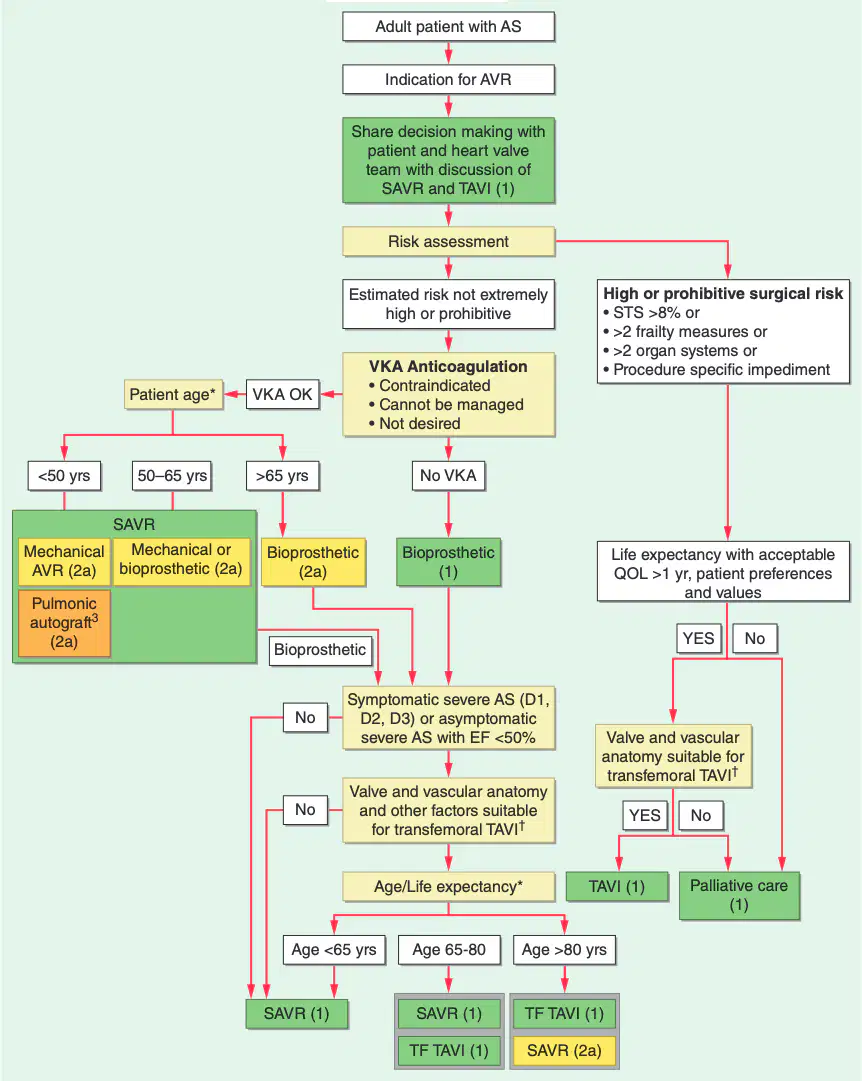
Which factor is NOT considered in the decision-making process for AVR versus TAVI according to the flowchart?
Patient age
Valve and vascular anatomy
Patient's favorite color
Life expectancy with acceptable quality of life
Which of the following factors favors SAVR (Surgical Aortic Valve Replacement) over TAVI (Transcatheter Aortic Valve Implantation) in patients with aortic stenosis?
Younger age/longer life expectancy
Older age/fewer expected remaining years of life
Limited life expectancy
Severe frailty unlikely to improve after TAVI
What is a key anatomical feature that favors TAVI over SAVR in aortic stenosis patients?
Calcific trileaflet aortic stenosis
Bicuspid aortic valve
Subaortic (LVOT) calcification
Small or large aortic annulus
Which prosthetic valve preference is associated with TAVI?
Bioprosthetic valve preferred
Mechanical or surgical bioprosthetic valve preferred
Concern for patient-prosthesis mismatch
Annular enlargement might be considered
A patient with severe aortic stenosis and severe aortic regurgitation due to annular calcification is most likely to be managed with which approach?
TAVI
SAVR
Medical management only
Balloon valvuloplasty
Which of the following is a noncardiac condition that favors TAVI over SAVR?
Severe lung, liver, or renal disease
Severe aortic regurgitation
Atrial fibrillation
Severe coronary artery disease requiring bypass grafting
What is a goal of care and patient preference that favors TAVI?
Accepts uncertainty about valve durability
Less uncertainty about valve durability
Avoid repeat intervention
Improved long-term exercise capacity and QOL
Which of the following is a characteristic of primary valve disease leading to aortic regurgitation?
Thickening, deformity, and shortening of the individual aortic valve cusps
Aortic root disease only
Congenital bicuspid aortic valve is never involved
Always associated with rheumatic fever
Patients with congenital bicuspid aortic valve (BAV) and aortic regurgitation most commonly require surgery before what age?
40 years
60 years
20 years
80 years
Which of the following is NOT a procedure-specific impediment to TAVI?
Vascular access does not allow transfemoral TAVI
Previous chest irradiation
Valve anatomy, annular size, or low coronary ostial height precludes TAVI
Severe aortic regurgitation
What is a common reason for favoring palliative care in patients with aortic stenosis?
Life prolongation not an important goal
Younger age/longer life expectancy
Valve anatomy suitable for TAVI
Low risk of permanent pacer

