
 Worksheets
Federation: Australia Unites
Total questions: 80
Worksheet time: 40mins
When did Australia become a nation by uniting its six colonies?
26 January 1788
1 January 1901
31 July 1900
25 April 1915
Before 1901, Australia was a collection of ______ colonies. (Fill in the blank)
British
French
Spanish
Dutch
Each Australian colony had its own government, laws, defence force, stamps, and tariffs before federation.
True
False
Before the colonies could join together, what did they need to set out the rules for how Australia would be run?
A new flag
A constitution
A national anthem
A cricket team
The Constitution was approved by a vote of the people in referendums held in each colony between June 1899 and July 1900.
True
False
Who became Australia’s first Prime Minister after the Constitution was agreed to by the British Parliament?
Lord Hopetoun
Sir Edmund Barton
Queen Victoria
John Macarthur
What document provides the rules for the governance of Australia and is described as the birth certificate of the nation?
The Australian Constitution
The Magna Carta
The Bill of Rights
The Treaty of Versailles
The Constitution created a federal Parliament and united the six self-governing British colonies as separate states within the Commonwealth of Australia.
True
False
According to the Australian Constitution, which sections outline most of the law-making powers of the federal Parliament?
Sections 1 and 2
Sections 10 and 20
Sections 51 and 52
Sections 100 and 101
Match the following groups with their main components:
The Prime Minister and ministers
The Parliament
The Queen (represented by the Governor-General), the Senate, the House of Representatives
The Executive
All federal courts, including the High Court
The Judiciary
What are the three levels of law-making in Australia?
Federal, State/Territory, Local
National, Regional, City
Executive, Legislative, Judicial
Parliament, Council, Assembly
Representatives are elected to federal and state/territory parliaments and local councils in separate elections.
True
False
Generally, each level of government provides different services to the people of Australia. The federal government has power over issues that affect the whole nation. Name two areas the federal government can make laws about.
Defence, immigration (other acceptable answers: trade, foreign affairs, industrial relations, transport, social security, family support, postal and telephone services, taxation)
Local roads, rubbish collection
Public libraries, local parks
School zoning, local sporting clubs
Local government responsibilities include town planning, pet control, rubbish collection and recycling, and recreation facilities such as parks and swimming pools.
True
False
Australia has one federal government, six state and two territory governments, and over 560 local councils. This means most Australians are governed by how many sets of laws?
One
Two
Three
Four

Which level of government raises money to run the country by collecting taxes on incomes (wages), goods and services, and company profits, and spends it on national matters such as trade, defence, immigration, and the environment?
Federal Government
State/Territory Governments
Local Councils
State/Territory Governments spend money on which of the following matters?
Trade and immigration
Schools, housing and hospitals, roads and railways, police and ambulance services
Town planning and rubbish collection
Local Councils collect taxes (rates) from all local property owners and spend this on local matters. Which of the following is NOT a responsibility of Local Councils?
A) Town planning
B) Defence
C) Pet control
Fill in the blank: If a state Parliament and the federal Parliament pass conflicting laws on the same subject, then the ______ law overrides the state law.
federal
state
municipal
international
The federal Parliament can override a territory law at any time under section 122 of the Constitution.
True
False
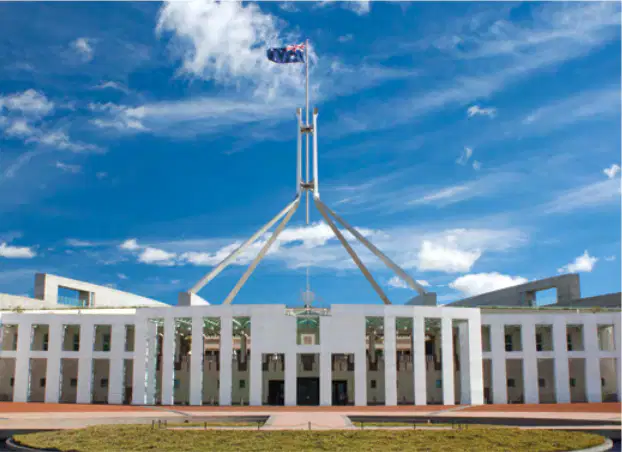
What is the name of the building where the federal Parliament meets in Canberra?
Parliament House
The Capitol
Canberra Tower
Government Hall
What is the minimum age at which Australians must enrol to vote in federal elections?
18 years
16 years
21 years
25 years
How many houses does the federal Parliament of Australia consist of?
Two houses
Three houses
One house
Four houses
How many members are there in the House of Representatives?
150
100
200
435
How many senators does each Australian state have in the Senate?
12
6
8
10

In the example of preferential voting using 100 votes, who is elected after the 3rd count and with how many votes?
Ari is elected with 54 votes.
Ben is elected with 60 votes.
Cara is elected with 48 votes.
Dana is elected with 52 votes.
In the House of Representatives, a candidate must get more than 50% of the votes to be elected.
True
False
If no candidate gets an absolute majority of first preference votes in the House of Representatives election, what happens?
Preferences are distributed until a candidate achieves a majority.
The election is declared invalid and held again.
The candidate with the most first preference votes wins automatically.
The seat remains vacant until the next election.
In Senate elections, Australians are voting to fill more than one vacancy. What voting system is used for Senate elections?
First-past-the-post
Proportional representation
Preferential voting
Random selection
How is the number of votes required (quota) for a Senate candidate to be elected calculated?
By dividing the total number of votes by the number of candidates
By dividing the total number of votes by one more than the number of candidates and adding one to the result
By multiplying the number of candidates by the total votes
By subtracting the number of candidates from the total votes
What does 'above-the-line' voting mean in Senate elections?
It means voters only have to put a number '1' in the box above the party or group they choose, and preferences are distributed according to the party or group's instructions.
It means voters must number every candidate individually below the line.
It means voters can only vote for independent candidates.
It means voters must write the name of their preferred candidate.
What does 'below-the-line' voting require voters to do on the Senate ballot paper?
Voters must write a number in the box beside every name on the ballot-paper, '1' for their first preference, '2' for their second preference, and so on, until all the boxes are numbered.
Voters must tick only one box above the line to indicate their preferred party.
Voters must write the name of their preferred candidate at the top of the ballot-paper.
Voters must leave all boxes blank except for their top three preferences.
Independents and smaller parties have a greater chance of being elected to the Senate under the proportional representation system.
True
False
According to the example in the image, what is the quota for electing six state senators if there are 700,000 total votes?
100,000
100,001
700,000
6,000
In what year were women given the right to vote in federal elections in Australia?
1902
1918
1894
1921
When are federal elections for the House of Representatives held according to the Constitution?
Members of the House of Representatives are elected for a maximum term of three years, although elections may be called earlier.
Members of the House of Representatives are elected for a maximum term of four years, although elections may be called earlier.
Members of the House of Representatives are elected for a maximum term of five years, although elections may be called earlier.
Members of the House of Representatives are elected every six years, regardless of circumstances.
Who is responsible for the orderly running of the House of Representatives chamber?
The President
The Speaker
The Chairman of Committees
The Prime Minister
Fill in the blank: The ______ is a senator and, among other things, is responsible for the orderly running of the chamber.
President
Speaker
Clerk
Sergeant-at-Arms
Who is in charge of a government department that puts law into action?
The Speaker
The President
A Minister
The Clerk
Match the parliamentary role to its description:
Runs the chamber during committee of the whole
B
Responsible for the orderly running of the House of Representatives
C
Responsible for the orderly running of the Senate
A
In charge of a government department that puts law into action
D
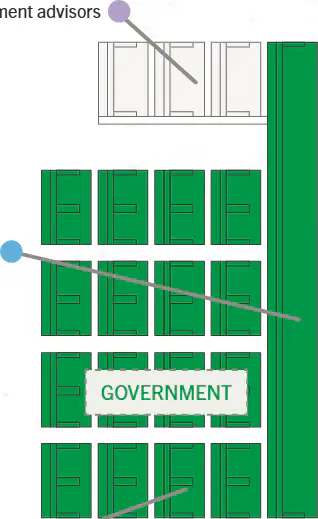
Which group sits on the left side of the House of Representatives chamber diagram?
Opposition
Government
Independents and Minor Parties
Shadow Ministers
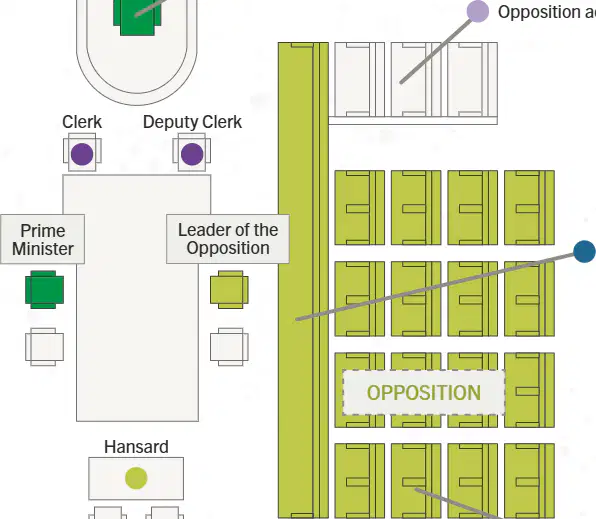
The Leader of the Opposition sits next to the Prime Minister in the House of Representatives chamber.
True
False
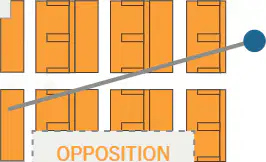
Who are shadow ministers?
Members of parliament who are not ministers or shadow ministers
Non-elected officers who assist the Speaker
Members who closely watch the actions of government ministers
Officers who record chamber decisions
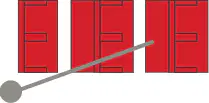
Backbenchers are members of parliament who are not ministers or shadow ministers.
True
False
What is the role of the Clerk in the Senate?
The Clerk is the top level non-elected officer in each chamber. The Clerk and Deputy Clerk record chamber decisions and advise members of parliament about chamber rules.
The Clerk is responsible for voting on all bills in the Senate.
The Clerk is the head of the Senate's security team.
The Clerk is the official spokesperson for the Senate.
The Serjeant-at-Arms assists the Speaker to maintain order and helps to run the chamber.
True
False
Who is the non-elected officer that assists the President to maintain order and helps to run the chamber?
The Clerk
The Usher of the Black Rod
The Serjeant-at-Arms
Government advisors
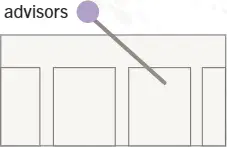
Government advisors give advice to ministers.
True
False
Match the following roles with their correct descriptions:
Give advice to shadow ministers
Closely watch the actions of government ministers
Members who are not ministers or shadow ministers
Members who are not ministers or shadow ministers
Non-elected officer who assists the Speaker
Record chamber decisions and advise on rules
Non-elected officer who assists the President
Non-elected officer who assists the Speaker
Record chamber decisions and advise on rules
Non-elected officer who assists the President
What does the Federal Parliament represent?
Only the Prime Minister
All Australians
Only political parties
Only ministers
Members of parliament can 'cross the floor', which means:
Changing their seat in Parliament
Voting against the decisions of their party
Leaving Parliament
Speaking on behalf of Australians
Fill in the blank: Members of parliament are protected by __________, which means legal action can't be taken against them for anything they say or do in Parliament.
parliamentary privilege
judicial immunity
executive order
ministerial discretion
Most members of parliament belong to a political party.
True
False
Who served in Parliament from 1950 until 1978 and crossed the floor a record 150 times?
Senator Reg Wright
Senator John Button
Senator Neville Bonner
Senator Margaret Guilfoyle
What is the main aim of political parties in Parliament?
To have enough of their members elected to Parliament to form government.
To organize social events for members.
To create new sports teams.
To manage the country's businesses.
'Freedom of speech' in the context of Parliament refers to:
The right of members to speak freely in Parliament without fear of legal consequences.
The right of the public to speak in Parliament whenever they wish.
The right of the media to report on all parliamentary discussions without restrictions.
The right of the government to censor speeches in Parliament.
After a federal election, how is the government formed in Australia?
By the Prime Minister alone
By the party or coalition with the support of the majority of members in the House of Representatives
By the Senate
By the Governor-General
How many members must support the government in the House of Representatives for it to stay in power?
At least 76 members
At least 51 members
At least 100 members
At least 150 members
Who chooses the Prime Minister in Australia?
The Australian people directly
The Governor-General
Members of the government
The Senate
What is the group made up of the Prime Minister and ministers called?
The ministry or the executive government
The judiciary
The parliament
The opposition
The executive government administers laws made by the Parliament.
True
False
What is the main role of the opposition in the Australian government?
To set out ideas and plans for how it would govern the country and explain why it would do a better job than the current government.
To enforce all government policies without question.
To appoint the Prime Minister and Cabinet members.
To manage the country's finances and set the national budget.
Who makes up the crossbench in the House of Representatives?
Only the opposition
Minor parties and Independents
The executive government
The Prime Minister
According to the sample daily schedule, what is the first activity of a member of parliament on Tuesday 14 March?
Breakfast meeting with schools about junk food in school canteens
Parliamentary debate on new laws
Lunch with local business leaders
Press conference on education policy
How many days a year does Parliament sit, according to the text?
About 70 days a year
About 30 days a year
About 150 days a year
About 365 days a year
What is one example of a task members of parliament do when Parliament is not sitting?
They meet with community organisations, visit schools, make presentations, attend local party meetings, handle enquiries from their constituents and speak to the media.
They travel abroad for personal vacations only.
They are not allowed to communicate with anyone outside Parliament.
They are required to remain at home and not perform any work-related duties.
What is one of the main roles of the Parliament?
To make and change laws
To collect taxes
To run schools
To build roads
What is a proposal for a new law called?
Act
Bill
Motion
Amendment
Bills introduced by non-government members of parliament are known as _________
private members' or private senators' bills
government bills
public bills
executive bills
About what percentage of bills introduced in Parliament become law?
10%
50%
90%
100%
A bill becomes a law if it is passed by both the House of Representatives and Senate in identical form and has been assented to (signed) by the _________?
Governor-General
Prime Minister
Chief Justice
Speaker of the House
Any member of parliament can suggest amendments to a bill.
True
False
What does the Clerk do when a bill is introduced and passes the second and third reading stages?
Signs the bill
Reads the title aloud
Debates the bill
Votes on the bill

What is the first stage when a bill is introduced to the House of Representatives?
2nd reading
House committee
1st reading
3rd reading
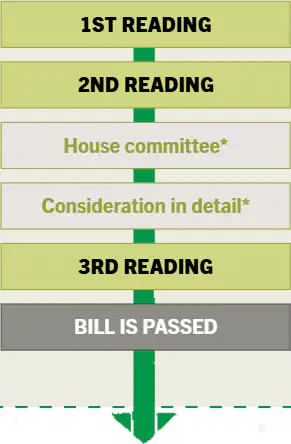
In the House of Representatives, what happens during the 2nd reading?
Members vote on the bill in its final form
Members debate and vote on the main idea of the bill
Public inquiry into the bill
Members discuss the bill in detail
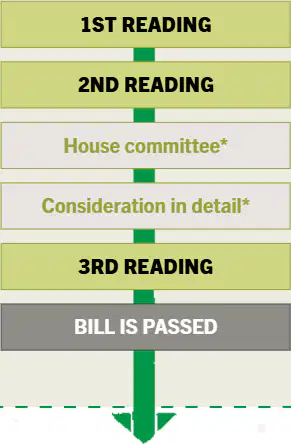
Fill in the blank: The ________ is a public inquiry into the bill and reporting back to the House of Representatives.
House committee
Senate President
Prime Minister
Governor-General
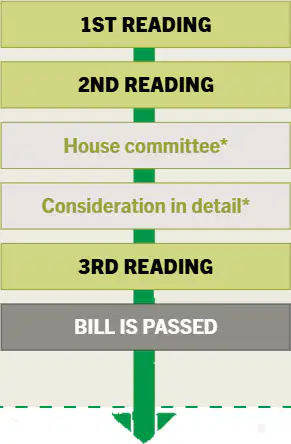
What is the final stage in the House of Representatives before the bill is sent to the Senate?
2nd reading
3rd reading
House committee
Consideration in detail
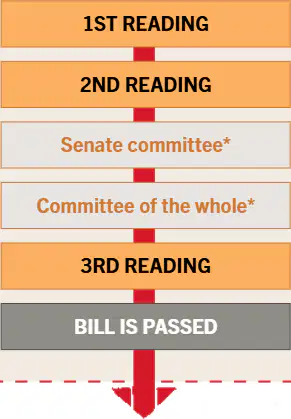
In the Senate, what is the purpose of the 'Committee of the whole' stage?
A) Senators debate and vote on the main idea of the bill
B) Senators discuss the bill in detail, including any changes to the bill
C) Public inquiry into the bill
D) Senators vote on the bill in its final form
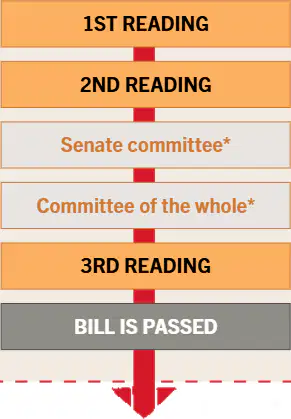
True or False: The 'Senate committee' stage is a mandatory part of the bill process in the Senate.
True
False
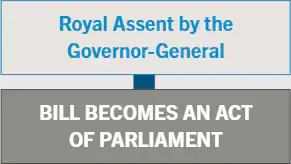
What happens after a bill is passed in both the House of Representatives and the Senate?
It becomes a law immediately
It is sent to the Governor-General for Royal Assent
It is debated again
It is sent back to the House of Representatives

