
 Worksheets
Economic and Material Causes of Revolt
Total questions: 20
Worksheet time: 10mins
According to the passage, what was a major cause of social upheaval at the end of the eighteenth century?
The rise of a capitalist global economy
The decline of agriculture
The end of colonialism
The spread of democracy
Capitalism is an economic system in which property is ______ held and profits are reinvested to increase production.
privately
publicly
communally
governmentally
According to the passage, what was a constant threat from Western Europe to Japan during the period from 1500 to 1800?
War
Famine
Disease
Industrialization
The idea of popular sovereignty goes deeper than simply who decides who sits in power. A key part of sovereignty is a person's control over the valuable products of their ______ and the lucrative resources of their land.
labor
education
technology
language
The financial aftermath of the Seven Years' War—________ for both sides—ignited the American and French Revolutions.
incredibly expensive
barely noticeable
mildly profitable
completely irrelevant
easily manageable
According to the passage, what was the main reason the two most significant revolutions in world history were set in motion?
Lofty political ideals
Two global empires fighting to control resources, labor, and markets
Religious differences
Scientific discoveries
According to the passage, what was the main reason for the American Revolution?
Religious freedom
Taxes
Land disputes
Slavery
The Seven Years’ War put the British empire in serious debt, and the plan for financial recovery was to ________ the American colonies.
tax
free
isolate
unite
The British defeat in the American Revolution helped set the stage for later waves of anti-colonial revolutions.
True
False
According to the passage, which social group started to question France's social order during the French Revolution?
The aristocracy
The clergy
The middle and bottom of the social pyramid
The king
The rising price of ______ drove people to revolt in France in 1789.
bread
wine
cheese
meat
The French bourgeoisie directed the course of the early revolution and wrote its documents.
True
False
The phrase 'storming the Bastille' means, according to the footnote in the passage:
attacking and capturing a prison fortress
celebrating a national holiday
signing a peace treaty
building a new government
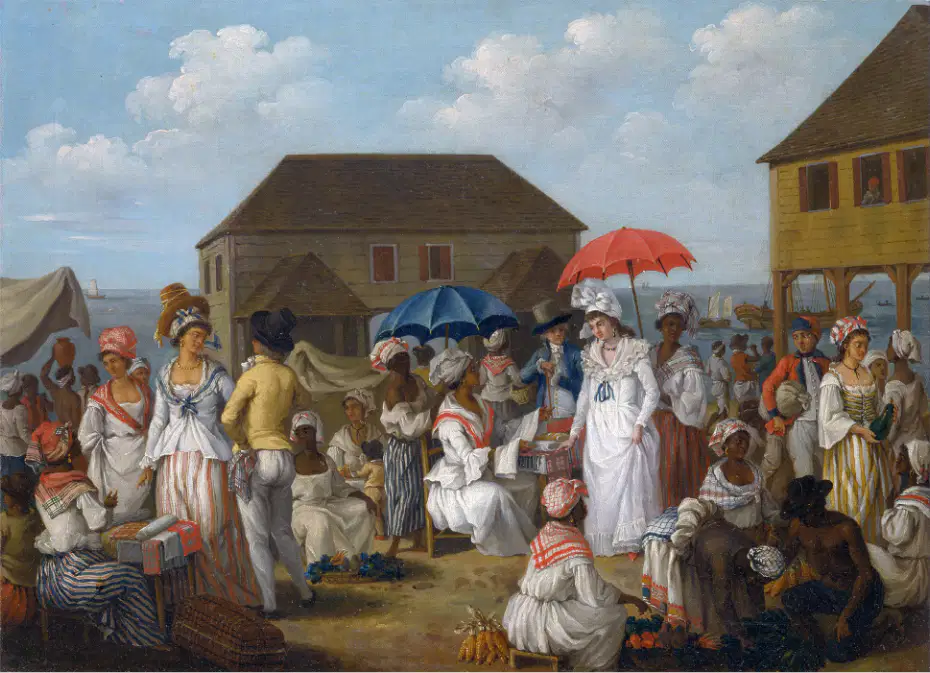
This image depicts which aspect of society in the French Caribbean colonies?
The division between enslaved people and free colonists
The industrialization of the colonies
The equality among all social classes
The absence of slavery in the colonies
The Haitian Revolution was the world’s first successful revolt of enslaved people.
True
False
One reason grands blancs were unhappy in Saint Domingue was:
They wanted more political power.
They opposed the abolition of slavery.
They were against trade with France.
They supported equal rights for all.
According to the passage, how did the Haitian Constitution of 1806 differ from the American and French constitutions regarding the right to property?
It allowed slavery and restricted citizenship to white foreigners.
It included the right to enjoy and dispose of one's work and industry, making slavery incompatible with property rights.
It did not mention property rights at all.
It only protected the property of the wealthy elite.
The Haitian Constitutions outlawed _______ and extended citizenship to all non-white foreigners who came to Haiti.
slavery
voting rights
land ownership
taxation
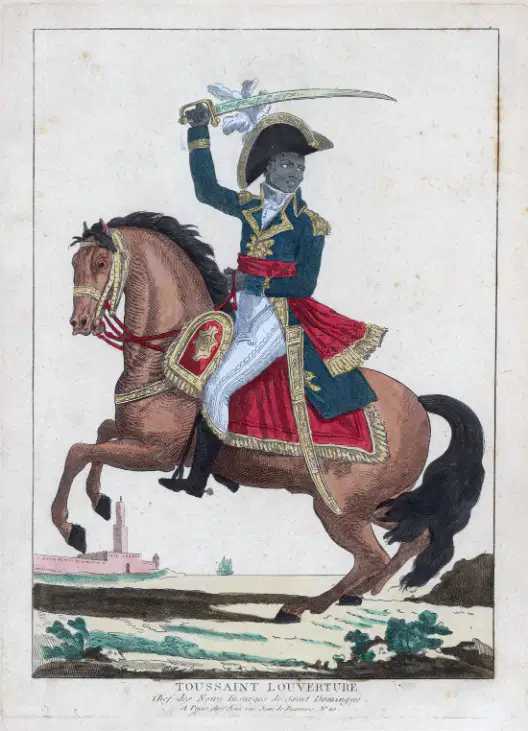
Who is depicted in the image on the right, and what was his role in the Haitian Revolution?
Toussaint Louverture, one of the leaders of the Haitian Revolution.
Jean-Jacques Dessalines, a French general who opposed the revolution.
Napoleon Bonaparte, the French emperor who supported Haitian independence.
Simón Bolívar, a South American revolutionary involved in the Haitian Revolution.
According to the passage, what was one reason President Thomas Jefferson refused to acknowledge the new nation of Haiti?
He feared that Haiti would inspire enslaved people in America to claim freedom using Enlightenment ideas.
He wanted to establish a trade alliance with Haiti first.
He believed Haiti was too far away to be of concern.
He thought Haiti would become a rival European power.

