
 Worksheets
Year 12 2025 Trial HSC Exam Prep
Total questions: 65
Worksheet time: 33mins
What is an iterative approach?
An iterative approach is a method that involves repeatedly refining a solution or process through cycles of planning, execution, and review to achieve continuous improvement.
An iterative approach is a method that completes a task in a single step without any revisions.
An iterative approach is a process that avoids feedback and review to save time.
An iterative approach is a strategy that focuses only on initial planning and never revisits the solution.
Quantitative data is ________ information that can be measured and analysed statistically, while qualitative data is ________ information that captures characteristics, qualities, or categories rather than numbers.
Quantitative data is numerical information; qualitative data is descriptive information.
Quantitative data is descriptive information; qualitative data is numerical information.
Quantitative data is categorical information; qualitative data is statistical information.
Quantitative data is subjective information; qualitative data is objective information.
What is the purpose of visualisations in data analysis?
Visualisations make complex data easier to understand and interpret by presenting it visually, helping to communicate patterns, trends, and insights quickly to support better decision making and storytelling.
Visualisations are used to replace raw data with images for aesthetic purposes only.
Visualisations are primarily used to store data securely in databases.
Visualisations are designed to slow down the analysis process by adding unnecessary steps.
An expert system for diagnosing is a computer program that mimics a human medical expert’s decision making using a ________ and ________ to analyse patient information and provide diagnostic suggestions or recommendations.
knowledge base and inference engine
database and neural network
user interface and database
sensor and actuator
Which of the following best describes blockchain technology?
A way to visualize data
A method for diagnosing diseases
A way of securely recording transactions in a digital ledger that is decentralised and distributed across many computers
A type of software privacy tool
What is software privacy?
Software privacy is about giving users control over their personal information within software, ensuring data is only shared or accessed as intended.
Software privacy is the process of making software open source for everyone to use.
Software privacy refers to the speed at which software can process data.
Software privacy is about the physical security of computer hardware.
What does software security of data mean?
Software security of data means protecting digital information from unauthorised access, misuse, or loss by using safeguards like access controls, encryption, and secure coding practices.
Software security of data means deleting all digital information regularly to prevent misuse.
Software security of data means allowing open access to all users for transparency.
Software security of data means only using physical locks to protect computers.
What is an unstructured data set?
An unstructured data set is information in different formats like emails, photos, and social media posts, without a fixed layout, making it hard to organise or analyse using regular database tools.
An unstructured data set is a collection of numbers arranged in rows and columns, easily processed by spreadsheets.
An unstructured data set is a type of data that only contains numerical values and no text.
An unstructured data set is a database table with a fixed schema and predefined fields.
What is a decision tree?
A decision tree is a simple flowchart like diagram used to make decisions by breaking down a problem into a series of yes/no questions or choices, leading from one decision point to multiple possible outcomes.
A decision tree is a type of tree found in forests that helps in environmental studies.
A decision tree is a mathematical formula used to calculate probabilities in statistics.
A decision tree is a computer program that automatically solves all types of problems without human input.
What is a Gantt chart used for?
A Gantt chart is a project management tool used to visually show the schedule of tasks over time, including their start and end dates, progress, and dependencies, helping teams plan, track, and coordinate work efficiently.
A Gantt chart is a financial tool used to calculate company profits and losses over a fiscal year.
A Gantt chart is a marketing tool used to analyze customer demographics and market trends.
A Gantt chart is a software tool used to design website layouts and user interfaces.
What is an implementation plan?
A clear step-by-step guide that explains who will do what, when, and with what resources to achieve a project goal.
A list of potential risks that may affect a project.
A summary of the project's final outcomes and results.
A document that only describes the project's budget.
What is a flowchart?
A simple diagram that shows the steps and decisions in a process using symbols and arrows to make it easier to understand and follow.
A type of computer program used to solve mathematical equations.
A written report that summarizes business meetings.
A list of rules for writing computer code.
The formula to calculate the average of a range of cells in Excel is _________. Example: =AVERAGE(A1:A5)
=AVERAGE(range)
=SUM(range)
=MEAN(range)
=AVG(range)
The formula to look up a value in a table in Excel is _________.
=VLOOKUP(lookup_value, table_range, column_index, [range_lookup])
=SUM(range)
=IF(logical_test, value_if_true, value_if_false)
=AVERAGE(range)
The formula to return one value if a condition is true and another if it is false in Excel is _________.
=IF(logical_test, value_if_true, value_if_false)
=SUMIF(range, criteria, sum_range)
=VLOOKUP(lookup_value, table_array, col_index_num, [range_lookup])
=COUNTIF(range, criteria)
The role of the inference engine in expert systems is to:
apply logical rules to the knowledge base to derive new information
store facts and rules for the system
input data from users into the system
display the final output to the user
Prototypes are used to inform requirements and limitations of an enterprise system by:
Allowing stakeholders to visualize and refine system features before full development.
Ensuring the final system is delivered without any changes.
Eliminating the need for user feedback during development.
Guaranteeing that all requirements are met without further testing.
A suitable combination of development approaches for the proposed system should be recommended and justified.
A combination of Agile and Waterfall approaches can be recommended for flexibility and structured phases.
Only the Waterfall approach should be used for all types of systems.
Prototyping alone is sufficient for complex system development.
RAD is the only approach suitable for any proposed system.
Big Data is defined by three key characteristics: ______, Variety, and Velocity.
Volume
Value
Visibility
Vulnerability
Big Data is defined by three key characteristics: Volume, ______, and Velocity.
Variety
Vision
Vividness
Vulnerability
Big Data is defined by three key characteristics: Volume, Variety, and ______.
Velocity
Vividness
Vulnerability
Vacuity
Explain what data modeling is in the context of operations.
Data modeling is the process of creating diagrams or structures that represent how data is organised, stored, and related within a system. It helps ensure that data can be easily accessed, updated, and analysed as needed for operations.
Data modeling is the process of physically storing data in warehouses for backup purposes only.
Data modeling refers to the encryption of data to ensure security during transmission.
Data modeling is the process of deleting unnecessary data from a system to save space.
What does automation of systems in operations mean?
Automation of systems in operations means using technology, like software, machines, or AI, to perform routine business tasks automatically without human intervention. This increases efficiency, reduces errors, and speeds up processes in everyday operations.
Automation of systems in operations means hiring more employees to manually handle business tasks.
Automation of systems in operations means outsourcing all business processes to external vendors.
Automation of systems in operations means reducing the use of technology in daily business activities.
Which of the following is NOT a method used by project teams to verify and validate CRM systems?
Reviewing
Modifying
Marketing
Testing, Evaluation & Maintaining the System
Reviewing in CRM system verification involves team members carefully checking requirements, system design, and completed features to ensure the CRM system aligns with ________ and user expectations.
business needs
technical jargon
random data
marketing slogans
What is the purpose of modifying in the context of CRM system verification and validation?
Modifying involves updating and refining the CRM system to fix problems or meet new requirements when issues or gaps are found during reviews.
Modifying means deleting the CRM system entirely and starting from scratch whenever a minor issue is detected.
Modifying refers to ignoring any issues found during reviews and proceeding with the original system.
Modifying is about documenting problems without making any changes to the CRM system.
Evaluation and maintaining in CRM systems only involves testing before launch.
True
False
Describe how testing is conducted in CRM system verification and validation.
Testing is conducted using approaches like unit, integration, and user acceptance testing to confirm all features work as intended and data is accurate.
Testing is only conducted by reviewing user manuals and documentation.
Testing is performed solely by the development team without user involvement.
Testing is limited to checking the system’s visual appearance and interface design.
Method of Implementation - The role of intelligent systems is to:
Enhance decision-making and automate complex tasks
Increase manual labor in processes
Reduce the use of technology in organizations
Limit data analysis capabilities
Data scale means the ________ and complexity of data organisations handle, from small sets to massive big data that need special systems to store and analyse.
size
color
shape
location
Ethics means managing data responsibly by protecting privacy, ensuring accuracy, avoiding misuse, being transparent, and following laws to maintain trust and ________.
fairness
profit
speed
competition
Which method of implementation involves completely replacing the old system with the new one at once, with intelligent systems helping by quickly detecting problems and assisting users during the switch?
Direct
Parallel
Phased
Pilot
Which method of implementation involves both systems running together until the new one is trusted, with intelligent systems comparing results, spotting errors, and signaling when it’s safe to move fully to the new system?
Direct
Parallel
Phased
Pilot
Which method of implementation introduces the new system in steps, with intelligent systems monitoring progress, finding issues, and helping the transition go smoothly at each stage?
Direct
Parallel
Phased
Pilot
Which method of implementation tests the new system in one area first, with intelligent systems analysing feedback, spotting problems early, and suggesting improvements before wider rollout?
Direct
Parallel
Phased
Pilot
What does Machine Learning help computers do in the context of analysing big data?
Machine Learning helps computers spot patterns and predict outcomes from lots of complex data quickly.
Machine Learning helps computers store data without any analysis.
Machine Learning helps computers slow down data processing.
Machine Learning helps computers ignore patterns in data.
Statistical Modelling explains relationships in data and checks results using what?
maths, especially with smaller, organised sets
random guessing
historical anecdotes
visual inspection
Which of the following best describes the main benefit of using OLAP (Online Analytical Processing) to analyse data?
It helps users explore and analyse large, complex sets of data by arranging information into cubes with different dimensions.
It only works with small datasets.
It is used for making phone calls.
It is a type of hardware device.
OLAP tools pre-organise and summarise data, allowing users to get answers and spot trends much faster than with traditional reporting.
True
False
What is one hardware component used in intelligent systems that provides an immersive environment for training, simulation, or interactive experiences?
VR (Virtual Reality) Headset
Printer
Barcode Scanner
Webcam
Which hardware component in intelligent systems captures real-world images or documents for processing visual information?
Camera/Scanner
Speaker
Printer
Microphone
What is one strategy to maintain data quality by periodically reviewing and updating data to remove duplicates, correct errors, and ensure information is accurate and complete?
Regular Data Cleaning
Data Encryption
Data Visualization
Data Archiving
What is one strategy to maintain data security by limiting data access based on user roles and setting permissions and passwords?
Access Controls
Data Encryption
Data Backup
Network Monitoring
Which of the following is an online communication system that allows sharing and collaboration for remote working?
Google Docs
Discord
Zoom
Microsoft Teams
Google Docs enables multiple users to create, edit, and comment on documents simultaneously in real time, supporting ______ and collaboration.
teamwork
competition
isolation
conflict
Microsoft Teams combines chat, video meetings, file sharing, and integration with other apps to facilitate ______ and collaboration within remote teams.
communication
competition
segregation
isolation
How has ecommerce impacted shopping and social interaction? Ecommerce has made shopping more _______ and accessible but can reduce face-to-face social interaction, impact local businesses, and raise concerns about digital exclusion for those without internet access.
convenient
expensive
complicated
limited
Which of the following is NOT an ethical issue related to ecommerce?
Protecting customer privacy
Ensuring honest advertising
Increasing product prices
Preventing online scams
Promoting fair treatment of workers and suppliers
Legally: What must businesses comply with in ecommerce? Businesses must comply with laws on consumer rights, privacy (like the Australian _______ Principles), copyright, and online trading standards.
Privacy
Taxation
Advertising
Competition
Addressing the issues: Which of the following is a recommended action for organisations to address social, ethical, and legal concerns in ecommerce?
Design accessible platforms to include all users
Ignore privacy safeguards
Avoid following regulations
Exclude some users from platforms
Organisations should use strong privacy safeguards, secure data practices, and _______ marketing.
honest
aggressive
misleading
intrusive
Addressing the issues: Which of the following is NOT a way to address ecommerce concerns?
Follow relevant regulations
Keep policies up to date
Educate staff to ensure compliance
Ignore ethical conduct
________ occurs when the data gathered doesn’t fairly represent the whole group or subject because of how people or samples are chosen or how information is recorded.
Data Collection Bias
Random Sampling
Data Normalization
Statistical Inference
Fill in the blank: ________ occurs when how or where data is stored causes some information to be lost, duplicated, or distorted, affecting fairness and accuracy.
Data Storage Bias
Algorithmic Bias
Sampling Bias
Measurement Bias
________ occurs when those analysing the data unintentionally favour results that confirm their beliefs or ignore conflicting evidence, leading to wrong conclusions.
Data Analysis Bias
Sampling Error
Measurement Bias
Random Variation
Which SQL query selects the FirstName and LastName of all patients from the Patient table who were born after January 1, 2000, and orders the results alphabetically by LastName?
SELECT FirstName, LastName FROM Patient WHERE BirthDate > '2000-01-01' ORDER BY LastName;
SELECT FirstName, LastName FROM Patient WHERE BirthDate < '2000-01-01' ORDER BY LastName;
SELECT FirstName, LastName FROM Patient WHERE BirthDate > '2000-01-01' ORDER BY FirstName;
SELECT FirstName, LastName FROM Patient WHERE BirthDate = '2000-01-01' ORDER BY LastName;
Refer to the table of flowchart symbols. What does an oval represent in a flowchart?
Input/Output
Start/end
Process
Decision
Refer to the table of flowchart symbols. Which symbol is used to indicate a decision in a flowchart?
Rectangle
Parallelogram
Diamond
Oval
Refer to the table of flowchart symbols. A parallelogram in a flowchart represents ________.
Input/Output
Process
Decision
Connector
What is the function of arrows in a flowchart?
Represents a process
Indicates a decision
Shows relationships between shapes
Represents input or output

Refer to the flowchart example for a hospital. What is the first step when a patient arrives at the hospital?
Record Health Condition
Get Register
Patient Registered?
Assign Doctor
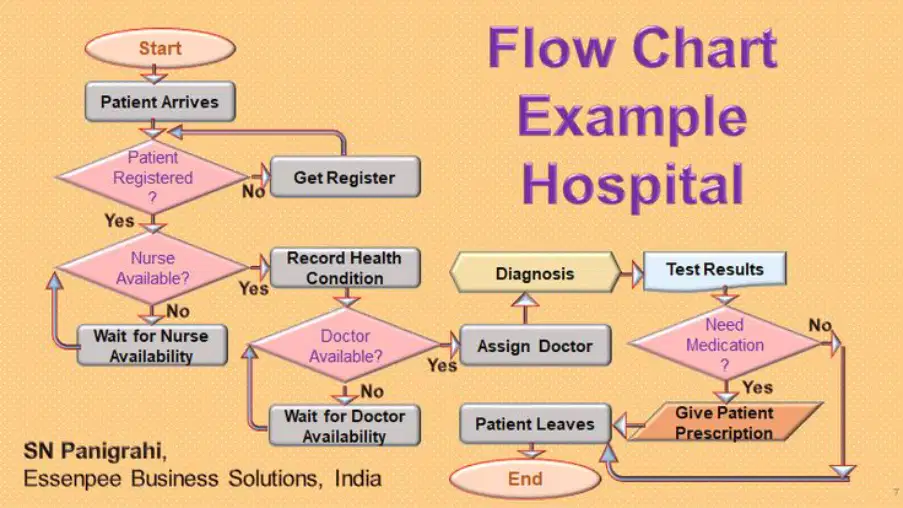
If a nurse is not available, what happens next?
Assign Doctor
Wait for Nurse Availability
Record Health Condition
Patient Leaves
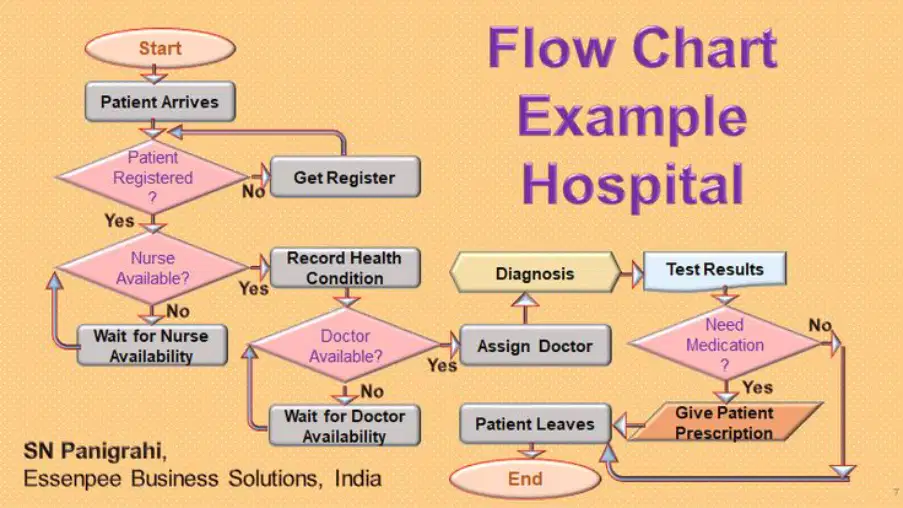
If the patient needs medication after test results, what is the next step?
Give Patient Prescription
Schedule another test
Discharge the patient immediately
Refer to physical therapy
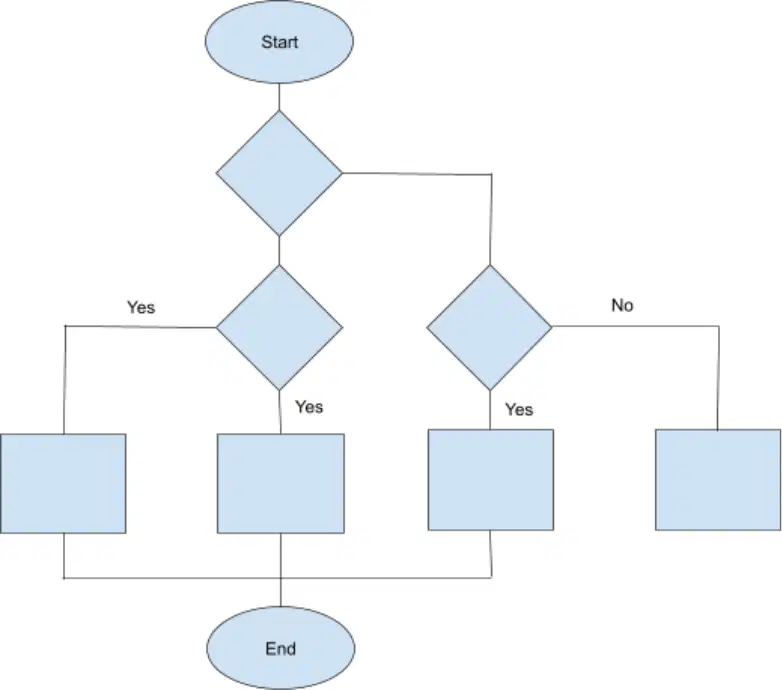
What shape is used to represent the start and end points in the flowchart?
Rectangle
Diamond
Oval
Parallelogram
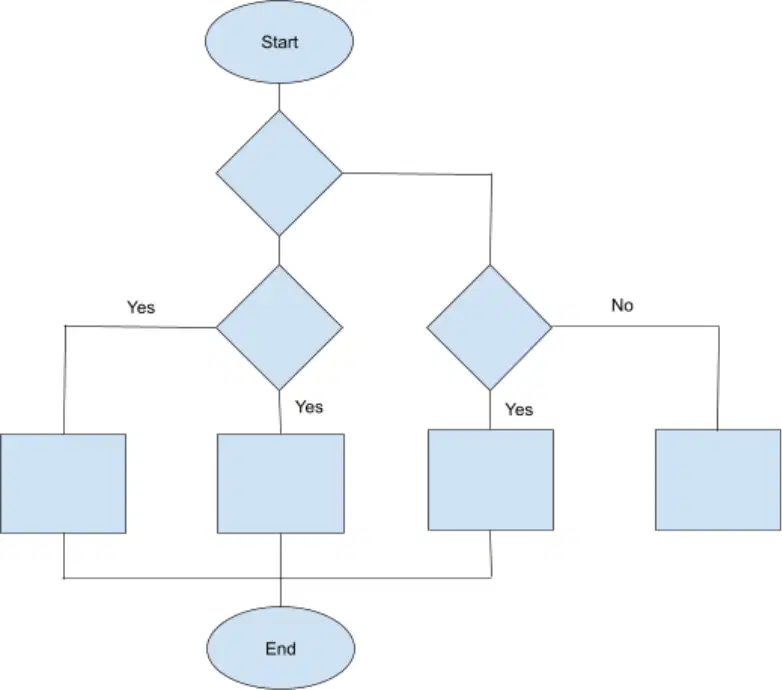
In a flowchart, what does a diamond shape represent?
A decision point
A process step
A start/end point
A connector

