
 Worksheets
Electricity
Total questions: 35
Worksheet time: 44mins
Which is an example of how we use electricity?
Battery
Solar panels
Light bulb
Wind turbine
Electricity is a form of energy involving the flow of atoms.
True
False
Electrical energy is generated by separating electric charges.
True
False
What are the two types of electricity?
Static and electrons
Current and voltage
Series and parallel
Static and current
What 3 things does a circuit need for current to flow?
energy source, energy user, wires
energy source, switch, wires
energy source, energy user, switch
energy user, switch, wires

In a circuit diagram, this symbol represents a
switch
multimeter
battery
globe

Which light globe(s) would never light up?
A
B,C,D
A,B,C,D
None
Voltage is the measure of the...
difference in electrical energy between 2 parts of a circuit
amount of electric charge that flows through a circuit
What is used to measure electric current?
Voltmeter
Ammeter
Wattmeter
pH meter

What type of circuit is this?
Series
Parallel
Simple
In a series circuit, how is the brightness of a light globe affected when another globe is connected?
It gets brighter
It stays the same
It gets dimmer
It goes out
Why are Christmas lights wired in parallel?
It is cheaper to make
You can make longer strands
It uses less electricity
If a light breaks, the others keep working

If the current in an electrical circuit is constant, what will happen to the voltage if the resistance is increased?
Voltage will increase
Voltage will decrease
Voltage will stay the same

If you increase the voltage across a resistor, what will happen to the current?
Current will increase
Current will decrease
Current will stay the same

If you increase the size of the resistor and keep the voltage the same, what will happen to the current?
Current will increase
Current will decrease
Current will stay the same
Which of the following charge pairs would repel each other? (Choose all that apply)
positive and negative
negative and negative
positive and positive
negative and positive
Determine how the following factor would affect the amount of resistance: longer wire
increase resistance
decrease resistance
would not affect resistance
Determine how the following factor would affect the amount of resistance: insulating material
increase resistance
decrease resistance
would not affect resistance
Determine how the following factor would affect the amount of resistance: thick wire
increase resistance
decrease resistance
would not affect resistance
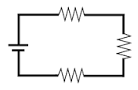
What type of circuit is this?
Series
Parallel
Simple
In a series circuit, how is the brightness of a light bulb affected when another bulb is connected?
It gets brighter
It stays the same
It gets dimmer
It goes out
Which of the following materials that is not a good electrical conductor?


Two unlike charges_________
Attract each other
Neutralize each other
Repel each other
Have no effect on each other

Which is the electrical symbol for a wire?


Which is the electrical symbol for one battery?


