
 Worksheets
8.4 - 8.8 Comparing health status and human development
Total questions: 12
Worksheet time: 8mins
Which indicator is used to classify countries as high-, middle- or low-income?
Gross National Income
Gross National Income (per capita)
Gross Domestic Product (GDP)
Total income earned by citizens
Discrimination refers to when:
People of minority races experience slurs and violence.
Females are treated worse than males.
A person or group experiences poorer/worse treatment than others.
A person or group experiences better treatment than others.
Compared to high-income countries, low-income countries often have:
Higher mortality rates
Higher levels of burden of disease
A lower life expectancy
All of the above
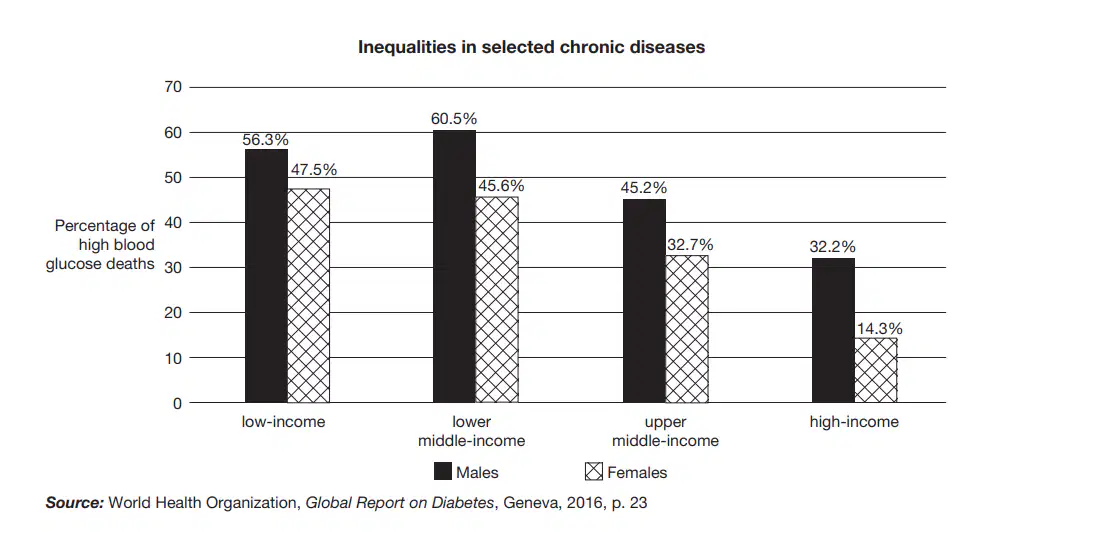
The graph shows the percentage of deaths that were attributed to high blood glucose levels for males and females aged 20–69 years according to country income group in 2012.
In which country income group is the percentage of high blood glucose deaths the highest for males?
Low-income
Lower-middle income
Upper-middle income
High-income
Which of the following correctly identifies one economic, one social, and one environmental characteristic of low-income countries?
Low GNI per capita Limited access to education
High rates of deforestation
High GNI per capita
Advanced healthcare systems
Low levels of pollution
Wide range of industries
High literacy rate, Abundant natural resources
High income inequality
A universal healthcare system Low levels of unemployment
What is a double burden of disease?
A double burden of disease is characterised by high rates of communicable diseases as well as high rates of non-communicable diseases.
A double burden of disease refers to the presence of only non-communicable diseases in a population.
A double burden of disease is when a country has eradicated all infectious diseases.
A double burden of disease means having only rare genetic disorders in a population.
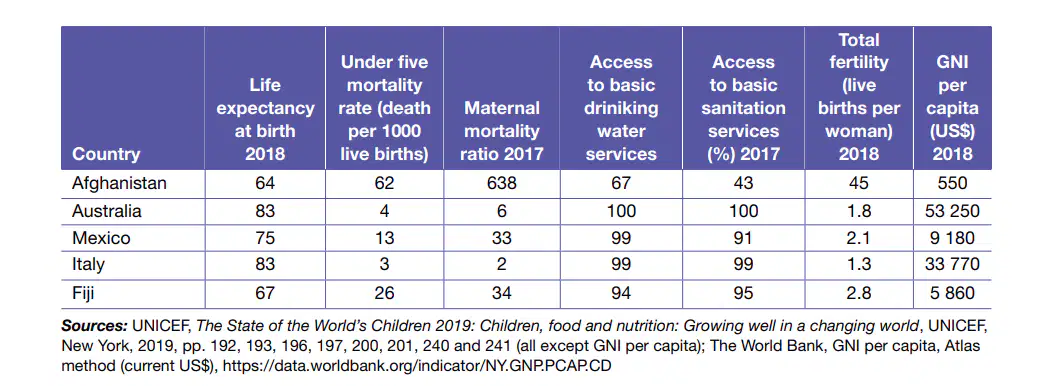
From the data, country/ies that would be classified as a middle-income country would be:
Afghanistan
Australia
Mexico
Italy
Fiji
Which of the following is an impact of not having access to basic sanitation services?
More people open defecating in waterways such as rivers.
Girls who are menstruating avoiding going to school
More girls at risk of physical or sexual violence at nighttime
All of the above
Which of the following is an impact of not having access to safe water?
More children attending school.
More children (particularly girls) spending majority of their days collecting water instead of attending school.
Less children experiencing malnutrition.
Lower levels of water-borne diseases in the community.
An impact of an individual or family living in poverty is:
More likely to be employed in a decent, well-paid job
Unable to afford to send any or all children to school
Better housing conditions due to less overcrowding.
None of the above.
When a country has a high proportion of their population in relative poverty, which services or infrastructure may they struggle to provide for their citizens?
Public education system
Social housing
Universal healthcare systems
Water systems
All of the above
An impact of discrimination for minority races, religions, sexual orientations and gender identities is:
More likely to experience physical violence or slurs in the community
More likely to be denied employment opportunities
Less likely to have political representation in government
Less likely to be able to access appropriate healthcare
All of the above

