
 Worksheets
Space
Total questions: 87
Worksheet time: 45mins
Kepler's First law states that each planet moves in a _ orbit
elliptical
circular
spherical
triangular
The longest dimension in an ellipse is called
major axis
minor axis
focus
radius
What symbol is used to define half the length of a major axis
e
a
S
l/2
half the length of a major axis is known as
half-major axis
minor axis
semi-major axis
focus

In the ellipse shown, there are four line segments, two blue and two red. Compare the total length of the blue line segments to that of the total length of the red line segments.
blue length > red length
blue length < red length
blue length = red length
An ellipse has how many foci?
1
2
3
4
What symbols are used for the two foci of an ellipse?
O and O'
F and F'
A and B
S and S'
True or false. the sun is located at one of the foci of the elliptical orbit of a planet revolving around it.
True
False
The center of an ellipse has a symbol:
C
O
e
a
The distance of each focus from the center of the ellipse is given by ea, where e is called the
eccentricity
ecliptic
elasticity
unit radius
The value of eccentricity e has a range from
0 to 10
-1 to 1
0 to 100
0 to 1
When the eccentricity e = 0, the shape is a
perfect ellipse
circle
oblong
point
Which planet has the lowest eccentricy, and thus have an orbit around the sun that's closest to a circle.
Mercury
Venus
Earth
Mars
Which planet has the highest eccentricity at 0.206
Mercury
Venus
Jupiter
Saturn
The point in the planet's orbit closest to the sun is called
perihelion
aphelion
exhilion
trahedion
The point in a planet's orbit most distant from the sun is called
perihelion
aphelion
exhilion
trahedion
Newton showed that for a body acted on by an attractive force proportional to r21 , the only possible closed orbits are an ellipse or a _
circle
parabola
hyperbola
triangle

A planet moves along its elliptical orbit from point a to point b. If dθ is a very small angle swept by a line segment that joins the center of the ellipse to these points, then we can approximate the green shaded area to be the area of a _
ellipse
circle
rectangle
triangle

Since points a and b form an arc length in this orbit, what is its length?
rdθ
r2dθ
dθr
dθr2

What is the formula for the area of the green shaded triangle (dA), given the arc length and the radius.
21r2dθ2
21rdθ2
21rdθ
21r2dθ

The rate at which this area is swept out, dA/dt, is called the _
area velocity
arc length velocity
sector velocity
orbital velocity
Which one is the right formula for sector velocity in an elliptical orbit
dtdA=2 1r2 dt2d2θ
dtdA=2 1r dtdθ
dtdA=2 1r2 dtdθ
dtdA=2r 1dtdθ
What does Kepler say about the sector velocity of an orbiting planet?
it is the same at all points in the orbit
the sector velocity is greater when the planet is far from the sun
the sector velocity is greater when the planet is close to the sun
the sector velocity is random across all points in the orbit
dtdA=2 1r2 dtdθ
In this formula, when the planet is close to the sun,
r is small and dtdθ is big
r is big and dtdθ is small
r and dtdθ are both small
r and dtdθ are both big
dtdA=2 1r2 dtdθ
In this formula, when the planet is far from the sun
r is small and dtdθ is big
r is big and dtdθ is small
r and dtdθ are both small
r and dtdθ are both big
Which of the following is one of Kepler's Laws of Planetary Motion?
Planets move on elliptical orbits with the Sun at one focus.
The gravitational force between two objects decreases as the distance increases.
An object in motion remains in motion.
Inner planets orbit in a different direction than outer ones.
An ellipse is drawn around two points called the…
aphelion
perihelion
axis
foci
Suppose the gravitational force between two massive spheres is 100 N. If the first mass is tripled (3m_1) , what is the new force between the masses?
33 N
50 N
100 N
200 N
300 N
Suppose the gravitational force between two massive spheres is 70 N. If the distance between the spheres is cut in half (½ d), what is the force between the masses?
280 N
140 N
70 N
35 N
17.5 N
The gravitational force of Earth on an object DOES NOT depend upon the object’s mass.
True
False
If you travel outside our solar system, then you can escape the gravitational force of Earth.
True
False
Kepler’s 2nd Law states that the area swept out by a planet’s motion will be the same regardless of where it is in its orbit. A comet moves much faster when it is closer to the Sun than when it is further out from the Sun. What is the primary cause in the change of the comet’s orbital velocity?
Jupiter's gravitational field.
The sun's solar wind.
The sun's gravitational field.
Saturn's magnetic field.
The Moon orbits the Earth as the Earth orbits the Sun. The Moon’s orbit is elliptical, and changes its distance from the Earth by around 10 over the course of an orbit. Any ellipse has two centers, which are called foci. For the Moon’s orbit, what must exist at one of the two foci?
The Earth
The Sun
The Moon
Mars


The period of revolution measures what?
Time it takes to make one complete spin.
Time it takes to go around the Sun once.
Distance from the Sun to the planet

What do Kepler's Laws help explain?
Planetary motion
The order of the Universe
The Big Bang Theory
Hubble's Law

What does Kepler's 1st Law (Law of Ellipses) help explain?
The shape of Earth's orbit
The directly proportional relationship between Earth's distance from the sun & its orbital speed
The area covered by Earth's sweeping orbit in equal time periods
The order of the planets in our solar system

What does Kepler's 2nd Law (Law of Equal Area) help explain?
The shape of Earth's orbit
The area covered by Earth's sweeping orbit in equal time periods
The directly proportional relationship between Earth's distance from the sun & its orbital speed
The order of the planets in our solar system

What does Kepler's 3rd Law (Harmonic Law) help explain?
The shape of Earth's orbit
The area covered by Earth's sweeping orbit in equal time periods
The directly proportional relationship between Earth's distance from the sun & its orbital speed
The order of the planets in our solar system
Which of the following has an eccentricity of zero?
a straight line
a large ellipse
a circle
a small ellipse

Which of the these would have an eccentricity of 1
a straight line
a large ellipse
a circle
a small ellipse
Which of the following is more elliptical based off of its eccentricity?
.0035
.035
.35
.53
How would the orbit of a satellite change if its mass increased?
Its orbit would become more elliptical.
Its orbit would become less elliptical.
Its orbit would stay the same.
If a space shuttle orbiting Earth wanted to orbit closer to the surface (decrease the orbit) would they need to speed up or slow down?
Speed up
Slow down
What is the primary composition of asteroids?
Ice and dust
Rock and metal
Gas and plasma
Water and organic compounds
Which of the following best describes the orbit of a comet?
Circular and close to the Sun
Elliptical and far from the Sun
Parabolic and within the asteroid belt
Hyperbolic and near the Earth
What is the main difference between a meteoroid and a meteor?
A meteoroid is larger than a meteor
A meteoroid is in space, while a meteor is in Earth's atmosphere
A meteor is made of ice, while a meteoroid is made of rock
A meteor is a comet, while a meteoroid is an asteroid
How do asteroids primarily affect Earth?
By causing solar eclipses
By impacting Earth's surface and causing craters
By altering Earth's magnetic field
By changing Earth's orbit around the Sun
What is the origin of most comets in our solar system?
The Kuiper Belt and Oort Cloud
The asteroid belt between Mars and Jupiter
The rings of Saturn
The surface of the Moon
Which of the following is a characteristic feature of a comet?
A solid metallic core
A tail that always points away from the Sun
A circular orbit around the Earth
A dense atmosphere
What is the primary reason meteors burn up upon entering Earth's atmosphere?
Friction with atmospheric gases
Collision with other meteors
Exposure to sunlight
Gravitational pull of the Earth
Which of the following statements is true about the asteroid belt?
It is located between Earth and Mars
It contains only icy bodies
It is located between Mars and Jupiter
It is the origin of all comets
What is the typical structure of a comet?
A rocky core with a gaseous atmosphere
A nucleus, coma, and tail
A solid metal surface with a magnetic field
A liquid core with a solid crust
How do meteoroids differ from asteroids in terms of size?
Meteoroids are generally smaller than asteroids
Meteoroids are generally larger than asteroids
Meteoroids and asteroids are the same size
Meteoroids are gaseous, while asteroids are solid
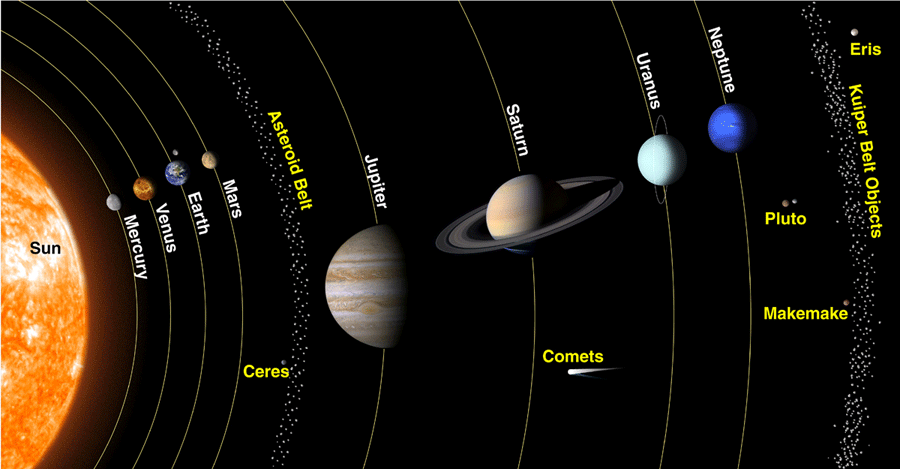
What is the asteroid belt?
A ring of asteroids around the sun
A fictional concept with no scientific basis
A region of space between the orbits of Mars and Jupiter where most of the asteroids in our solar system are found.
A belt worn by astronauts to protect from asteroid impacts
What are the main components of the asteroid belt?
Comets and meteors
Moons and satellites
Gas giants and dwarf planets
Asteroids and minor planets
How did the asteroid belt form?
Leftover material from the early solar system
Remnants of a destroyed planet
Result of a collision between two planets
Debris from a passing comet
What is the role of Jupiter in the formation of the asteroid belt?
Jupiter's gravity attracted the asteroids to form the belt
Jupiter's magnetic field pushed the asteroids into the belt
Jupiter's gravity prevented the formation of a planet in the asteroid belt.
Jupiter's atmosphere caused the asteroids to collide and form the belt
What are the theories about the formation of the asteroid belt?
Alien intervention and manipulation
Gravitational influence of Jupiter and collision of planetesimals
Volcanic eruptions and tectonic activity
Impact of solar winds and radiation
How do scientists believe the asteroid belt was formed?
Result of a collision between two planets
Remnants of a destroyed planet
Leftover material that never formed into a planet
Debris from a passing comet
What are the characteristics of asteroids in the asteroid belt?
Rocky and metallic objects
Icy and gaseous objects
Hollow and porous objects
Liquid and molten objects
What is the size range of asteroids in the asteroid belt?
Tiny grains to a few meters
Small pebbles to hundreds of kilometers
Dozens of kilometers to thousands of kilometers
Millions of kilometers to billions of kilometers
What is the current understanding of the asteroid belt's formation?
Scientists believe that the asteroid belt is the remnant of a failed planet formation process.
The asteroid belt was formed by a collision between two planets
The asteroid belt is a result of a black hole sucking in matter
The asteroid belt is made up of debris from a supernova explosion
What are the implications of studying the asteroid belt for understanding the early solar system?
Insights into the formation and evolution of the early solar system
Predicting the future trajectory of the asteroid belt
Exploring the possibility of life on Mars
Understanding the composition of the outer planets

