
 Worksheets
Patient Assessment Quiz
Total questions: 80
Worksheet time: 40mins
What is the first step in patient assessment according to the text?
Determining the patient's medical history
Checking the patient's vital signs
Determining if the scene is safe
Asking for the patient's chief complaint
Which of the following is NOT mentioned as part of the patient assessment process in the text?
Initial impression of the patient
Performing surgery
Chief complaint
Medical history
Why is it important to create an assessment that works best for you and is organized?
To impress the patient
To ensure the assessment is streamlined and calm
To make the process longer
To avoid using medical history
Patient assessment means:
Evaluating a patient's condition to determine their medical needs.
Prescribing medication without an examination.
Ignoring patient history and symptoms.
Only checking vital signs without further evaluation.
What is the first step in patient assessment according to the document?
Determining the patient's medical history
Determining the safety of the scene
Checking the patient's vital signs
Administering first aid
Why is it important to wear a traffic vest at the scene of a traffic accident?
To identify yourself as a medical professional
To ensure personal safety
To keep warm in cold weather
To signal for help
What should be considered when approaching a patient at an accident scene?
The patient's medical history
The stability of the scene
The patient's insurance details
The type of vehicle involved
How should bystanders be managed at a medical scene?
Allow them to assist with patient care.
Ensure they do not interfere with patient care.
Ignore them completely.
Ask them to leave immediately.
What is the first priority according to standard precautions?
Treating all patients
The safety of yourself and other first responders
Wearing gloves
Using eye protection
According to standard precautions, how should all patients be treated?
As non-infectious
As potentially infectious
As already treated
As immune
What does "Nature of Illness" refer to in patient assessment?
The specific diagnosis of the patient
The general type of illness the patient is experiencing
The treatment plan for the patient
The patient's medical history
What does "Mechanism of Injury" involve in the context of patient assessment?
Identifying the patient's symptoms
Understanding the forces that act on the body to cause damage
Determining the patient's recovery time
Analyzing the patient's lifestyle choices
What should you observe to determine how sick a patient is during a medical assessment?
Chief complaint, respirations, pulse, mental status, skin color/condition
Blood pressure, temperature, weight, height
Diet, exercise routine, sleep pattern, hydration level
Family history, allergies, medication list, occupation
In a trauma assessment, what additional factors should be considered besides medical signs?
Mechanism of injury and obvious signs of trauma
Patient's age and gender
Patient's dietary habits and exercise routine
Patient's family medical history and occupation
Why is it important to quickly determine if a patient is critical?
To manage resources and scene time effectively
To ensure the patient is comfortable
To gather more information about the patient's lifestyle
To document the patient's medical history accurately
What is the purpose of establishing a field impression during patient assessment?
To diagnose the patient's condition definitively
To determine the patient's current problem
To prescribe medication immediately
To perform surgery
Which of the following is essential for establishing a field impression?
Performing surgery
Asking the right questions and performing assessments
Prescribing medication
Ignoring the patient's history
What should a patient assessment style be based on?
Personal preference without any guidelines
Sound medical practice and organization
Random selection of procedures
Patient's immediate demands
Why is it important to assess a patient's problems quickly and thoroughly?
To ensure the patient is comfortable
To identify the patient's problems and set care priorities
To avoid unnecessary paperwork
To reduce the cost of treatment
What is one of the most important pieces of information you can obtain during a patient assessment?
The patient's chief complaint
The patient's favorite color
The patient's shoe size
The patient's favorite food
What should you determine first when you arrive at a scene for a patient assessment?
If the scene is safe
The patient's favorite movie
The patient's age
The patient's occupation
Why is it important to create an organized assessment during a patient evaluation?
To impress the patient
To streamline the process and keep it calm
To make it more complicated
To confuse the patient
What does the acronym SAMPLE stand for in patient assessment?
Signs, Allergies, Medications, Past medical history, Last oral intake, Events leading up
Symptoms, Allergies, Medications, Past medical history, Last oral intake, Events leading up
Signs, Allergies, Medications, Past medical history, Last oral intake, Examination
Symptoms, Allergies, Medications, Past medical history, Last oral intake, Examination
Which assessment technique involves listening to the sounds of the body?
Inspection
Palpation
Auscultation
Observation
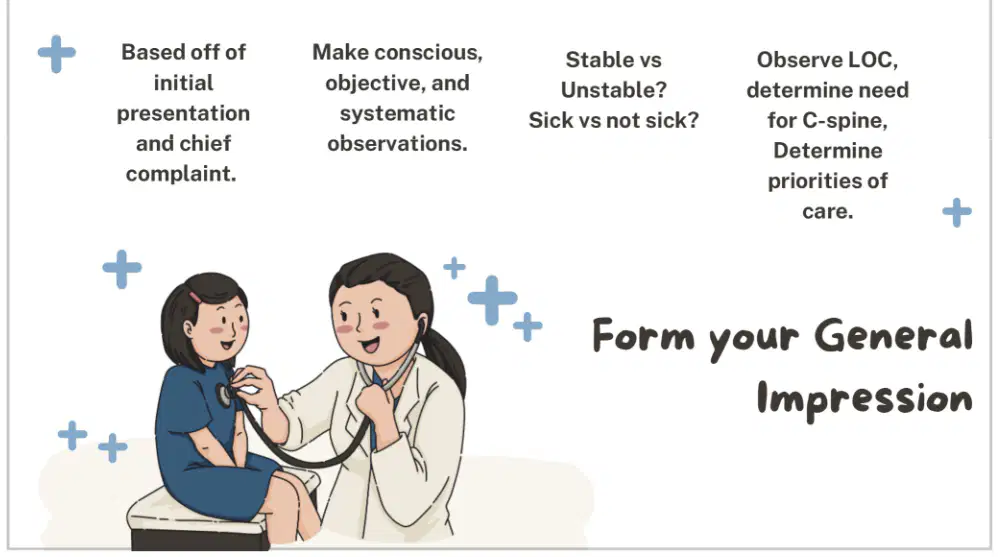
What is the primary survey in patient assessment?
The most time-sensitive portion of the assessment process.
A detailed examination of the patient's medical history.
A comprehensive lab test analysis.
A follow-up appointment scheduling.
What does forming a general impression help determine in patient care?
The patient's insurance details
The priority for patient care
The patient's dietary preferences
The need for a second opinion
Within what time frame should the general impression be completed?
30-45 seconds
60-90 seconds
2-3 minutes
5-10 minutes
What does the acronym ABCDE stand for in patient assessment?
Airway, Breathing, Circulation, Disability, Exposure
Assessment, Breathing, Circulation, Diagnosis, Evaluation
Airway, Blood pressure, Circulation, Diagnosis, Examination
Assessment, Breathing, Circulation, Disability, Examination
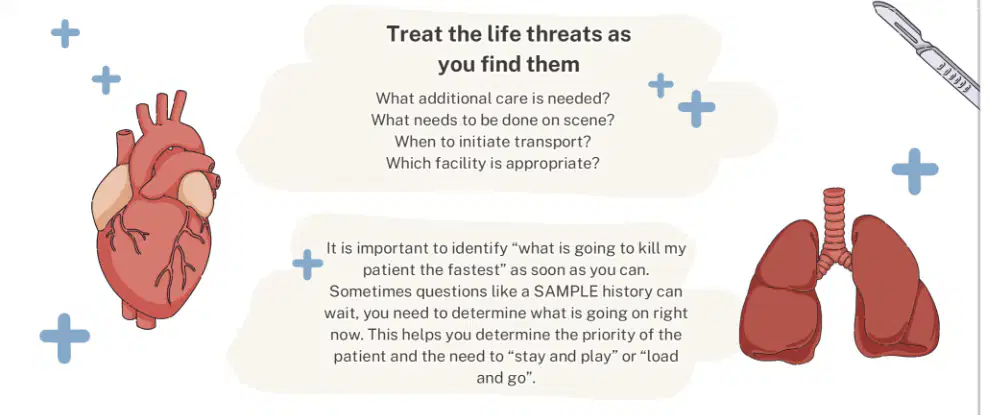
What is the primary focus when treating life threats as you find them?
Determining the patient's medical history
Identifying what will harm the patient the fastest
Ensuring the patient is comfortable
Collecting insurance information
Which of the following is NOT a consideration when treating life-threatening conditions on scene?
What additional care is needed
When to initiate transport
Which facility is appropriate
The patient's favorite food
What does the term "load and go" refer to in patient assessment?
Taking a detailed patient history
Quickly transporting the patient to a facility
Administering medication on scene
Performing a full physical examination
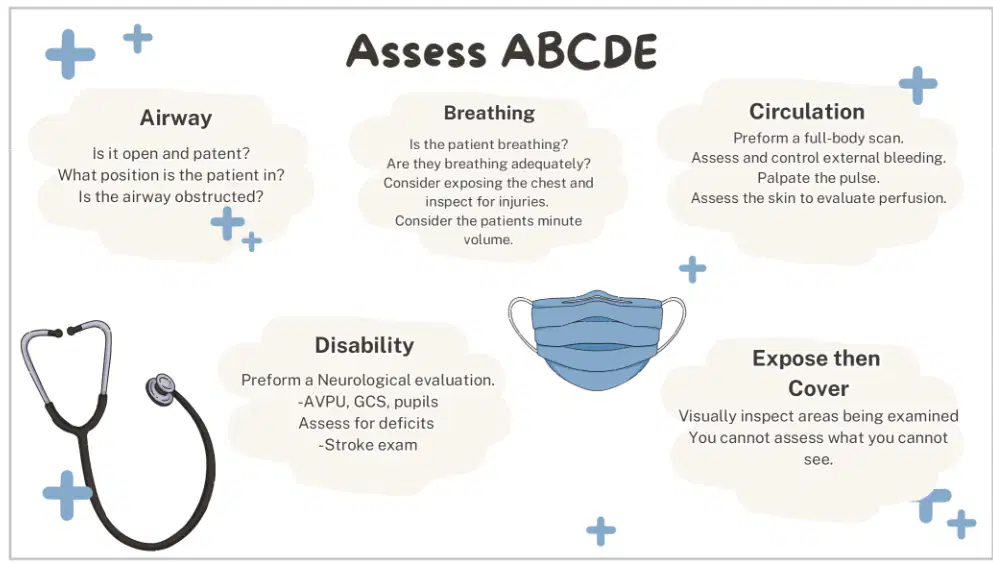
What is a clue that a patient's airway may be obstructed?
The patient is speaking in full sentences.
The patient is snoring.
The patient is laughing.
The patient is singing.
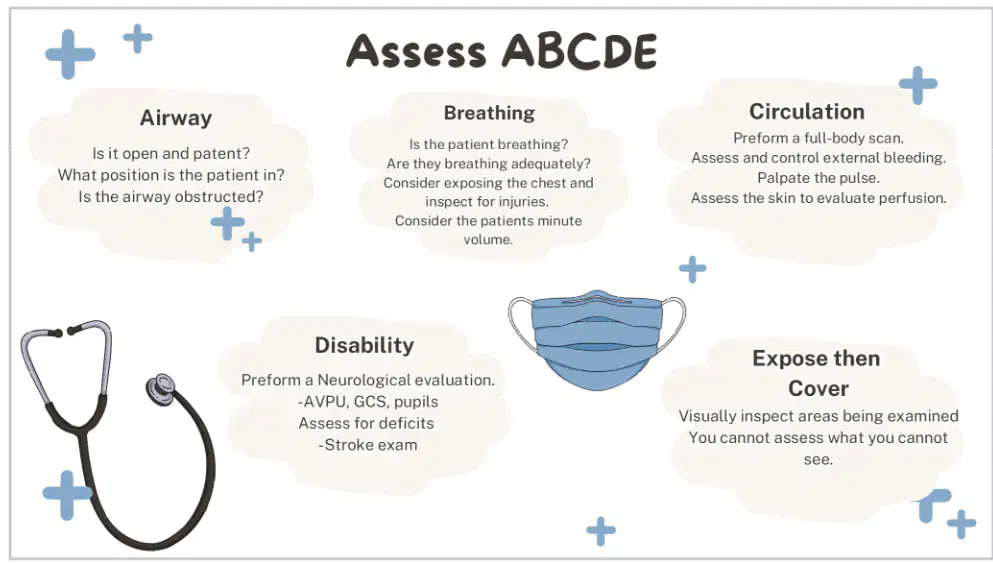
What should you assess to determine if a patient's breathing is adequate?
The patient's skin color.
The patient's heart rate.
The rate, rhythm, and quality of breathing.
The patient's blood pressure.
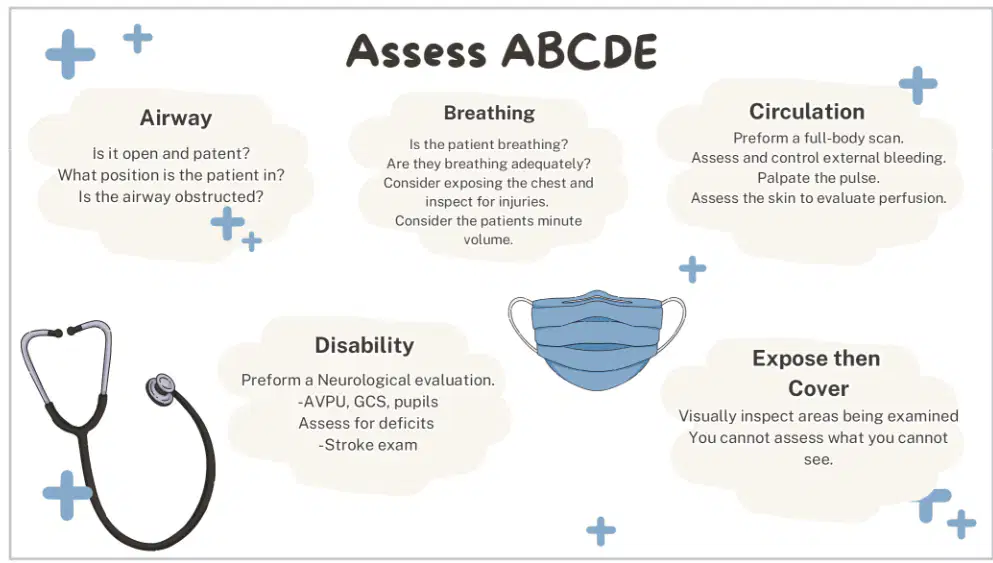
What should you do if a patient is not breathing?
Check their blood pressure.
Perform a neurological evaluation.
Breathe for the patient.
Assess their circulation.
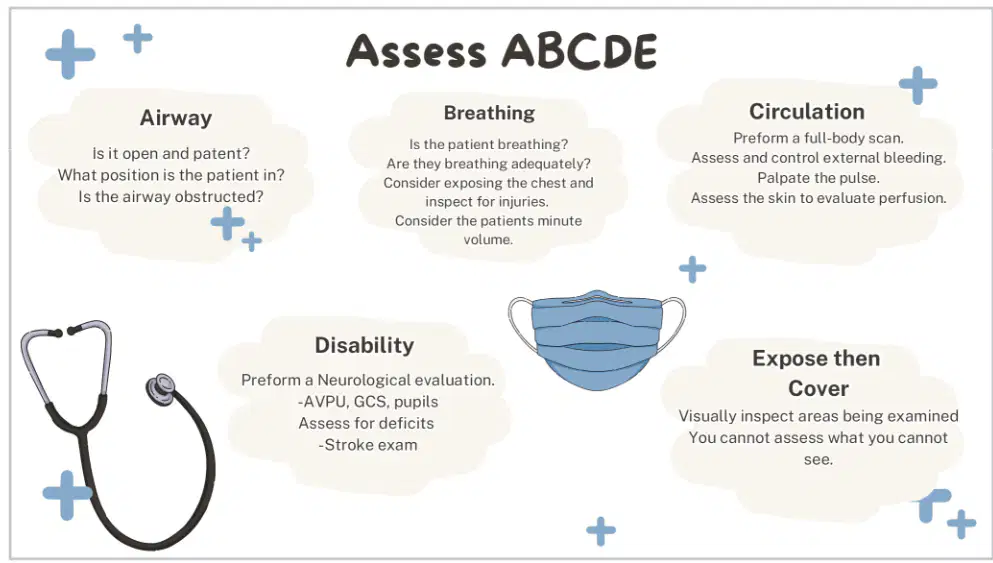
What might gurgling and bubbling sounds in a patient indicate?
The need for suctioning.
Adequate breathing.
A neurological issue.
Proper airway management.
What should you look for when assessing circulation in a patient?
Major hemorrhage and life-threatening injuries
Minor cuts and bruises
Skin texture and hair growth
Eye color and pupil size
When checking a patient's pulse, which of the following is NOT a factor to consider?
Rate
Rhythm
Quality
Skin color
Which skin color might indicate poor perfusion in a patient?
Pale, cyanotic, ashen
Warm, flushed, red
Yellow, jaundiced, bright
Green, olive, tan
What is the purpose of performing a rapid exam on a patient?
To identify any major external bleeding and immediately control life-threatening bleeding.
To assess the patient's mental state.
To check the patient's vision and hearing.
To measure the patient's height and weight.
What should be done if a patient has inadequate circulation?
Start CPR and analyze the rhythm.
Ignore the symptoms.
Wait for the patient to recover on their own.
Administer pain relief medication.
Which of the following is a medical condition that can cause sudden death?
Airway obstruction
Mild headache
Common cold
Minor cuts
What is one step to take if a patient is experiencing severe bleeding?
Control severe bleeding
Offer a glass of water
Provide a blanket
Encourage deep breathing
According to the transport decision guidelines, what should be done for priority patients at the scene?
Perform all necessary medical procedures at the scene.
Do only what is necessary at the scene and handle everything else en route.
Wait for additional medical personnel to arrive before taking any action.
Transport the patient only after stabilizing all conditions.
Which of the following conditions would classify a patient as a priority for transport?
Minor cuts and bruises
Unresponsive or experiencing a STEMI
Mild headache
Stable fracture
When would you choose to "stay and play" in a medical situation?
When immediate on-site treatment is necessary.
When the patient is stable and can be transported.
When the situation is not life-threatening.
When the patient refuses treatment.
What does "load and go" mean in emergency medical services?
Providing extensive on-site care
Immediate transportation to a medical facility
Waiting for additional help
Conducting a thorough on-site assessment
What is the primary purpose of taking a patient history during assessment?
To diagnose the patient immediately
To gain information about the patient and the events surrounding the incident
To prescribe medication
To perform a physical examination
Which type of question should be avoided during history taking?
Open-ended questions
Leading questions
Age-appropriate questions
Patient education questions
Why is a patient's history of CHF important during history taking?
It helps in prescribing the right medication.
It can lead to a different diagnosis, such as fluid overload and pulmonary edema.
It ensures the patient is comfortable.
It is irrelevant to the current symptoms.
Which of the following is a recommended technique for taking a patient's history?
Speak over the patient to maintain control.
Focus on responding rather than understanding.
Project a positive attitude as a provider.
Ignore the patient's appearance and demeanor.
What should a provider do to ensure effective communication with a patient?
Write down information without informing the patient.
Get on the patient’s level and don’t speak over them.
Respond quickly without listening.
Maintain a distant demeanor.
What is an important step when introducing yourself to a patient?
Avoid asking for their name
Use a catch-all nickname
Identify your service
Ignore their preferences
Why is it important to respect a patient's culture and/or religion?
It helps in building trust and understanding
It is not necessary in communication
It complicates the interaction
It is only important in certain situations
What should you avoid when offering reassurance to a patient?
Being cautious about what you tell them
Offering inappropriate reassurance
Validating their feelings
Encouraging conversation
How should you handle unpleasant sights, sounds, and smells from a patient who is feeling bad?
Ignore them completely
Try to keep them from the patient
Use them to assess the situation
Discuss them openly with the patient
What is a key aspect of communicating empathy to a patient?
Avoid discussing your feelings
Put yourself in the patient’s shoes
Focus only on facts
Use technical jargon
Which of the following may suggest pain, psychological distress, or fear?
Changes in body movements and facial expression
Encouraging dialogue
Avoiding medical terminology
Being a patient listener
What is a big part of being a great listener?
Being poised and confident
Being a patient listener
Using complex medical terminology
Making care decisions based on diagnostics
Why should you be mindful of facial expressions, heavy sighs, and aggressive gestures?
To encourage dialogue
To match terminology to the patient’s level of understanding
To avoid medical terminology
To assess emotional and psychological states
What should care decisions be based on?
Patient's facial expressions
Answers to your questions combined with diagnostic data
Avoiding medical terminology
Encouraging dialogue
What is the importance of gathering a patient's social history?
It helps in diagnosing allergies.
It provides valuable information about the patient's overall health.
It is used to determine the patient's diet plan.
It is necessary for prescribing medication.
How can alcohol and drug misuse affect patient assessment?
It improves the accuracy of the patient's history.
It has no effect on patient assessment.
It can mask signs and symptoms, leading to unreliable history.
It ensures the patient is more cooperative.
What is a recommended approach when discussing a patient's sexual history?
Discuss it in a public setting.
Keep questions focused and avoid interjecting opinions or biases.
Use humor to make the patient comfortable.
Avoid discussing it altogether.
What is required when dealing with cases of physical abuse, domestic abuse, and sexual assault?
Ignore the situation and move on
Report, look for clues, call for LEO, and maintain evidence
Handle it personally without involving authorities
Only report if the victim insists

How should you approach patients who have experienced domestic violence or sexual assault?
Rush them to talk about their experience
Be respectful, give them space, and let them talk at their pace
Tell them how they should feel
Avoid asking them any questions
What is one way to ensure the confidentiality of a patient's information?
Share information with nonessential personnel
Discuss patient details in public areas
Be familiar with HIPAA laws and state laws
Ignore privacy settings
Why is it important to talk to patients in private settings?
To make the conversation more casual
To ensure the confidentiality of patient information
To allow more people to join the conversation
To save time
What should you do if nonessential personnel are present during a patient discussion?
Ask them to leave the room
Include them in the conversation
Ignore their presence
Share all patient details with them
What is a potential risk when gathering information from third parties?
Increased accuracy of information
Greater chance of inaccurate information
Direct access to patient records
Immediate consent from the patient
Why is it important to evaluate your source for reliability when gathering information about patients?
To ensure the information is entertaining
To confirm the information is correct
To make the process faster
To avoid legal issues
What should you do before revealing patient information to family members?
Obtain consent from the patient
Ask the family for their opinion
Check with law enforcement
Review the patient's medical history
What should you determine about overly talkative patients?
If they are anxious
If they have a clinical cause for talkativeness
If they are depressed
If they are hostile
What is a recommended approach when dealing with patients who do not offer enough information?
Interrupt them frequently
Use closed-ended questions
Ask open-ended questions
Avoid asking questions
How should you initially expect patients with anxiety to behave?
Calm and relaxed
Somewhat anxious
Hostile and aggressive
Depressed and withdrawn
Which symptom might indicate depression in a patient?
High energy levels
Excessive talkativeness
Sleep or eating disruptions
Calm demeanor
What is a normal reaction to unfairness and harsh realities?
Calm acceptance
Anger and hostility
Indifference
Joy and happiness
What should you do if a hostile person leaves the room?
Ignore them and stay in the room.
Follow them while trying to calm them down.
Call law enforcement immediately.
Lock the door to prevent them from returning.
Which of the following is a possible reason for confusing behavior in patients?
Lack of sleep
Toxic environment
Poor diet
Dehydration
When treating patients with hearing loss, what might be necessary?
Speaking slowly and slightly louder
Using hand signals exclusively
Writing everything down
Ignoring verbal communication
What should you do if you move any furniture while treating a patient with low vision?
Leave it where it is for convenience.
Put it back exactly where you found it.
Ask the patient to move it back.
Remove it from the room entirely.

