
 Worksheets
Cosmos
Total questions: 74
Worksheet time: 57mins
What are Kepler's three laws of planetary motion?
Half of the shortest diameter of an elliptical orbit
By measuring the average distance from the sun and using the law of harmonies formula T^2=k*r^3
By dividing the distance between the two foci by the length of the major axis.
The law of ellipses 2. The law of equal areas 3. The law of harmonies
What is the law of ellipses?
A line that connects a planet to the sun sweeps out equal areas in equal time intervals.
Planetary orbits are shaped like ellipses, with the sun located at one of the two foci.
The law of ellipses 2. The law of equal areas 3. The law of harmonies
By observing the shape and size of their orbits, as well as the time it takes to complete one orbit.
What is the law of equal areas?
By measuring the average distance from the sun and using the law of harmonies formula: T^2 = k * r^3.
The time it takes for a celestial body to complete one orbit around another.
By measuring the distance between the two farthest points and the two closest points on the orbit.
A line that connects a planet to the sun sweeps out equal areas in equal time intervals
What is the law of harmonies?
By observing the shape and size of their orbits, as well as the time it takes to complete one orbit.
The square of a planet's orbital period is directly proportional to the cube of its average distance from the sun.
T^2 = k * r^3, where T is the orbital period and r is the average distance from the sun.
The average distance between a celestial body and the sun throughout its elliptical orbit
How can Kepler's laws of planetary motion be applied to analyze the motion of celestial bodies?
A The closer the eccentricity is to 0, the closer the orbit is to a perfect circle.
The two points inside the ellipse that determine its shape.
By observing how quickly a planet moves in different parts of its orbit.
By understanding that all planetary orbits are shaped like ellipses, not perfect circles.
By observing the shape and size of their orbits, as well as the time it takes to complete one orbit.
What is the orbital period?
The time it takes for a celestial body to complete one orbit around another.
The law of ellipses 2. The law of equal areas 3. The law of harmonies
Planetary orbits are shaped like ellipses, with the sun located at one of the two foci.
A line that connects a planet to the sun sweeps out equal areas in equal time intervals.
How can the orbital period be calculated using Kepler's laws?
By measuring the average distance from the sun and using the law of harmonies formula: T^2 = k * r^3.
By using the relationship between a planet's orbital period and its average distance from the sun to calculate orbital parameters.
By understanding that all planetary orbits are shaped like ellipses, not perfect circles.
The two points inside the ellipse that determine its shape.
What is the law of harmonies formula?
T^2 = k * r^3, where T is the orbital period and r is the average distance from the sun.
Half of the shortest diameter of an elliptical orbit.
It measures how elongated an elliptical orbit is.
By dividing the distance between the two foci by the length of the major axis.
What is the average distance from the sun?
By measuring the distance between the two farthest points and the two closest points on the orbit
The average distance between a celestial body and the sun throughout its elliptical orbit.
By dividing the distance between the two foci by the length of the major axis.
By observing how quickly a planet moves in different parts of its orbit.
What is the equation for the average distance from the sun?
r = (a + b) / 2, where a is the semi-major axis and b is the semi-minor axis of the ellipse.
The law of ellipses 2. The law of equal areas 3. The law of harmonies
Planetary orbits are shaped like ellipses, with the sun located at one of the two foci.
A line that connects a planet to the sun sweeps out equal areas in equal time intervals.
What is the semimajor axis?
By dividing the distance between the two foci by the length of the major axis.
Half of the longest diameter of an elliptical orbit.
By observing how quickly a planet moves in different parts of its orbit.
By using the relationship between a planet's orbital period and its average distance from the sun to calculate orbital parameters.
What is the semiminor axis?
Half of the shortest diameter of an elliptical orbit.
The average distance between a celestial body and the sun throughout its elliptical orbit.
By observing the shape and size of their orbits, as well as the time it takes to complete one orbit.
The square of a planet's orbital period is directly proportional to the cube of its average distance from the sun.
How can the semimajor axis and semiminor axis be determined?
By dividing the distance between the two foci by the length of the major axis.
The two points inside the ellipse that determine its shape.
By measuring the distance between the two farthest points and the two closest points on the orbit.
By understanding that all planetary orbits are shaped like ellipses, not perfect circles.
What is the eccentricity of an orbit?
It measures how elongated an elliptical orbit is.
r = (a + b) / 2, where a is the semimajor axis and b is the semiminor axis of the ellipse.
The average distance between a celestial body and the sun throughout its elliptical orbit.
1. The law of ellipses 2. The law of equal areas 3. The law of harmonies
How can the eccentricity be calculated?
The closer the eccentricity is to 0, the closer the orbit is to a perfect circle.
By dividing the distance between the two foci by the length of the major axis.
By observing how quickly a planet moves in different parts of its orbit.
The two points inside the ellipse that determine its shape.
What is the relationship between eccentricity and the shape of an orbit?
1. The law of ellipses 2. The law of equal areas 3. The law of harmonies
Planetary orbits are shaped like ellipses, with the sun located at one of the two foci.
A line that connects a planet to the sun sweeps out equal areas in equal time intervals.
The closer the eccentricity is to 0, the closer the orbit is to a perfect circle.
Question: How can the law of equal areas be used to analyze the motion of celestial bodies?
By observing how quickly a planet moves in different parts of its orbit.
The square of a planet's orbital period is directly proportional to the cube of its average distance from the sun.
By observing the shape and size of their orbits, as well as the time it takes to complete one orbit.
1. The law of ellipses 2. The law of equal areas 3. The law of harmonies
What are the foci of an elliptical orbit?
The two points inside the ellipse that determine its shape.
r = (a + b) / 2, where a is the semimajor axis and b is the semiminor axis of the ellipse.
The average distance between a celestial body and the sun throughout its elliptical orbit.
By measuring the average distance from the sun and using the law of harmonies formula: T^2 = k * r^3.
How can the law of ellipses be used to analyze the motion of celestial bodies?
By measuring the distance between the two farthest points and the two closest points on the orbit.
It measures how elongated an elliptical orbit is.
By understanding that all planetary orbits are shaped like ellipses, not perfect circles.
Planetary orbits are shaped like ellipses, with the sun located at one of the two foci.

Planets orbit the Sun in a shape called a(n)
circle
ellipse
focus
perihelion

An ellipse is drawn around two points called:

What has an eccentricity of zero?
#1: A perfect circle
#2: A slightly elliptical path
#3: A very elliptical path
All elliptical paths
What has the greatest eccentricity of its orbital path?
#1: A perfect circle
#2: A slightly elliptical path
#3: A very elliptical path
All elliptical paths have eccentricities of zero (e = 0)
The value of eccentricity can range from ________ to ________.
0.1 to 0.9
-1 to 0
0 to 100
0 to 1
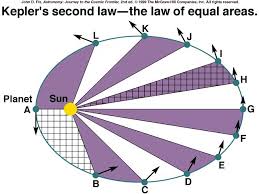

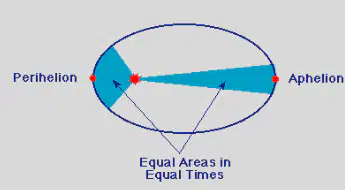
Kepler's 2nd Law deals with:


The diagram below shows a moon revolving around a planet in an elliptical orbit. At which position is the moon traveling fastest?
location 1
location 2
location 3
location 4

The diagram below shows a moon revolving around a planet in an elliptical orbit. At which position is the moon traveling slowest?
location 1
location 2
location 3
location 4
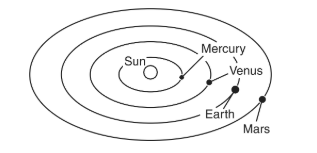
Which planet will take the least amount of time to revolve around the Sun?
Mercury
Venus
Earth
Mars

Which planet will take the most amount of time to revolve around the Sun?
Mercury
Venus
Earth
Mars

Which statement best describes Kepler’s 2nd Law of Planetary Motion?
Planets revolve around the sun over equal areas in equal time intervals.
Planetary orbits are in the shape of an ellipse.
A planet’s orbital period is proportionate to its distance from the sun.

Kepler’s 2nd Law states that the area swept out by a planet’s motion will be the same regardless of where it is in its orbit. A comet moves much faster when it is closer to the Sun than when it is further out from the Sun. What is the primary cause in the change of the comet’s orbital velocity?
Jupiter's gravitational field.
The sun's solar wind.
The sun's gravitational field.
Saturn's magnetic field.
According to Kepler's 3rd law, the square of the time it takes for an object to orbit, T, is directly related to the cube of the distance, r, between the object and what it is orbiting.
What this means is that if a satellite moves away from what it is orbiting,
the area it covers during its orbit is changing per unit of time
it must be speeding up in its linear speed
it is slowing down as its radius (distance) is increasing
Kepler's 3rd law tell us that __ would be dependent on __.
orbital period ; distance
distance ; orbital period
Kepler’s 3rd law states the square of the orbital period is proportional to the cube of the orbital radius. (T2=D3)
If a planet's orbital radius is doubled, what happens to the length of a year on that planet?
SOLVE USING Kepler’s 3rd Law: (T2=D3)
A planet orbits the Sun (or any star) in 4.4 Earth years. What is its distance from the Sun (star) in AU?
2.1 AU
2.7 AU
3.2 AU
3.9 AU
SOLVE USING Kepler’s 3rd Law: (T2=D3) *Same problem as prior...
A planet orbits the Sun (or any star) in 4.4 Earth years. What is its distance from the Sun (star) in MILES?
1.9 x 10⁸ miles
2.2 x 10⁸ miles
2.5 x 10⁸ miles
2.9 x 10⁸ miles
SOLVE USING Kepler’s 3rd Law: (T2=D3) *Same problem as prior...
A planet orbits the Sun at a distance of 7.8 AU. What is its orbital period (time) in Earth YEARS?
21.8 Earth Years
20.2 Earth Years
18.8 Earth Years
11.4 Earth Years
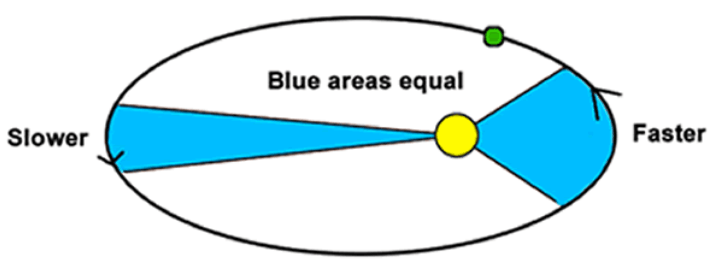

Planets orbit the Sun in a shape called _?_.
a circle
an ellipse
a focus
an oblong

An ellipse is drawn around two points called _?_.
dots
points
foci
axis

According to Kepler's 1st Law, the _?_ is at one of the foci of each planetary orbit.
the axis
the magnitude
the center
the Sun
What has an eccentricity of zero?
a straight line
a large ellipse
circle
a small ellipse

Where is the planet moving faster?
around segment A
around segment B
around either segment - the speed doesn't change
impossible to know

While traveling around its orbit, during which segment does a line from the planet to the sun sweep through the most area of space?
The area between A, B and the Sun is the largest.
The area between G, H and the Sun is the largest
the areas are equal in size
There is not enough information to determine the areas

A planet moving counterclockwise in its orbit will be increasing speed at position _?_.
P1
P2
P3
P4

The diagram below shows a moon revolving around a planet in an elliptical orbit. At which position is the moon traveling fastest?
location 1
location 2
location 3
location 4

Which planet of those shown, because of its position, will take the least amount of time to revolve around the Sun?
Mercury
Venus
Earth
Mars

A comet moves much faster when it passes closer to the Sun than when it is further away. What is the primary cause in the change of the comet’s orbital speed?
Jupiter's gravitational field.
The sun's solar wind.
The sun's gravitational field.
Saturn's magnetic field.
According to Kepler's 3rd law, the square of the time it takes a planet to orbit (T) is directly related to the cube of half the distance across the orbital ellipse (a). This means the further away from the sun a planet orbits, _?_.
the larger the constant k is.
the smaller the constant k is.
the longer the orbital period is.
the shorter the orbital period is.
According to the Heliocentric Model of the Universe (the one we use in class), __?__ is at the center of our Solar System with the planets revolving around it.
Earth
The Sun
Jupiter
Helios

The period of Jupiter is 4,344 days. This tells you how long it takes _?_.
Jupiter to orbit the sun.
Jupiter to rotate one time on its axis.
the sun to orbit Jupiter.
Earth to orbit Jupiter.

Why is Earth’s year shorter than Jupiter’s year?
the gravitational pull of Jupiter’s moons
the shape of Earth’s orbit around the Sun
the smaller distance between Earth and the Sun
the mass and density of Jupiter

In this diagram, the length of the semi-major axis is labeled with _?_.
a
x
y
F
This telescope is the first space observatory located in space.
Hubble
Voyager
Space Shuttle
Spirit and Opportunity
Cassini-Huygens was launched to study this planet
Jupiter
Saturn
Neptune
Uranus
Which space craft was specifically designed to search for planets outside the solar system?
Kepler
Spitzer
Voyager 1 and 2
Skylab
Who was the first person to travel to space and orbit Earth?
Yuri Gagarin
Laika
Buzz Aldrin
Neil Armstrong
a spacecraft that carries scientific instruments to collect and transmit data, but has no human crew is called
satellite
non optical telescope
space shuttle
space probe
The International Space Station is
a refracting telescope
an artificial satellite
a space shuttle
a space based laboratory and observatory
This is what researchers call the reverse big bang, when everything will be crushed into a black hole
globular clusters
hubble's law
reverse big bang
big crunch
Light Years are a measure of
brightness
time
mass
distance
These are the farthest known object from Earth in the Universe
nebulae
light years
quasars
dark energy
This is a large group of older stars
globular cluster
star system
star clusters
light years
In a binary system, one star is much _________ and more __________.
gassy, bloated
brighter, massive
brighter, smaller
dimmer, massive
Stars that are grouped with 3 or more are called
binary star system
triple star system
star cluster
multiple star system
What is the primary purpose of the James Webb Space Telescope?
To study the Sun's atmosphere
To observe the early universe and formation of stars and galaxies
To monitor Earth's weather patterns
To search for extraterrestrial life on Mars
Which of the following is a method used to detect exoplanets?
Gravitational lensing
Seismic activity
Volcanic eruptions
Ocean currents
What phenomenon explains the redshift observed in distant galaxies?
The Doppler effect
The greenhouse effect
The Coriolis effect
The photoelectric effect

