
NEW
Font size
 Worksheets
Unit 1 Study Guide
Total questions: 50
Worksheet time: 48mins
Star: ________
A bright light in the sky, burning gas
A planet that is burning in the sky
A moon that is reflecting light
A firefly stuck up in the sky
Sun: ________
A star that has planets orbiting around it
A planet that orbits the Earth
A large asteroid in the solar system
A comet that passes by every year
A scientist that studies the sky
astronomer
astronaut
astrologer
biologist
Constellation: ________
A collection of stars that make a picture in the sky
A single planet in the solar system
A type of comet
A phase of the moon
Solar System: ________
A sun and everything that orbits it
Only the planets around the sun
Just the sun itself
Only the moons in space
A group of stars in a galaxy
Something we use to see and study things that are too big, too small, or too dangerous to see
model
measuring cup
program
century
Gravity: ________
A force caused by Earth that pulls objects down due to its mass
A force that the Earth uses to keep us from falling off by pulling south
When a planet pulls down on an object with its atmosphere
The atmosphere pulling up on objects
To move in a path around something
Orbit
Rotate
Spin
Rotate: ________
To spin on a fixed point
To move in a straight line
To move around something in a circle
To orbit an object
Revolve: ________
Another word for orbit
Another word for spin
Another word for gravity
Another word for proximity
Day: ________
How long it takes the Earth to make one rotation (24 hours)
How long it takes the Earth to orbit the Sun (365 days)
The time between two new moons (about 29.5 days)
The time it takes for the Moon to orbit the Earth (about 27.3 days)
Year: ________
365 days
24 hours
7 days
30 days
The only time you can see stars other than the sun is:
at night
during the day
at noon
in the afternoon
The stars we see in the night sky are determined by:
our location on Earth and the time of year
the color of the stars
the age of the stars
the number of planets around the stars
We can't see stars, other than the sun, during the daytime because:
the brightness of the sun outshines them
stars disappear during the day
the stars are too far away during the day
clouds cover the stars during the day
We see different stars at different times of the year because:
the Earth orbits around the Sun, changing our view of the night sky
the stars move closer and farther from Earth throughout the year
the Sun blocks out different stars each night
the Moon's phases reveal different stars
The sun is up sometimes, but not other times, because:
the Earth rotates on its axis
the sun moves around the Earth
clouds cover the sun completely
the sun turns off at night
The moon is sometimes visible during the day because:
Its orbit sometimes places it in the daytime sky
the moon produces its own light
the sun is not as bright during the day
the earth's shadow covers the moon at night
If Earth is spinning, which way is up? Fill in the blank: Up will always be ________ from Earth, no matter where you are on Earth.
away
towards the center
parallel to the equator
in the direction of Earth's rotation
Why don't we see a lot of stars during the daytime?
brightness of the sun
distance of the moon
size of the Earth
movement of the stars
Constellation: ________
A collection of stars that make a picture in the sky
A single planet in the solar system
A type of cloud formation
A type of comet
Rotate: ________
To spin on a fixed point
To move in a straight line
To move around in a circle
To follow a path around something
Revolve: ________
orbit
rotate
spin
Day: ________
one rotation
one revolution
Year: ________
one revolution
one rotation
The stars we see in the night sky are determined by:
where Earth is located in its orbit
how far the moon is from Earth
the age of the stars
the number of planets around the stars
We see different stars at different times of the year because:
the Earth orbits around the Sun, changing our view of the night sky.
the stars move closer and farther from Earth throughout the year.
the Sun blocks out different stars each month.
the Moon's phases reveal different stars.
Samantha will not be able to see Orion during the summer because:
Orion is not visible in the night sky during the summer months.
Orion is only visible during the day in summer.
Orion disappears from the sky permanently in summer.
Orion is blocked by the Moon in summer.
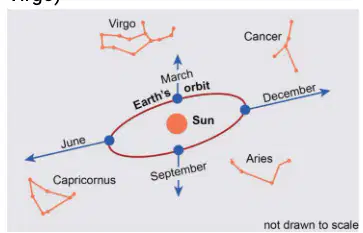
On the star diagram below, which constellation will most likely be visible in April?
Virgo
Orion
Scorpius
Aquarius
Star: A bright light in the sky, ________ gas.
burning
freezing
melting
cooling
Sun: A star that has ________ orbiting around it.
planets
moons
constellations
galaxies
Solar System: A sun and everything that ________ it.
orbits
rotates
moves away from
is facing
Constellation: A collection of ________ that make a picture in the sky.
stars
clouds
planets
comets
Day: One full rotation of the Earth - ________ hours long, including daytime and nighttime.
24 hours
12 hours
365 days
1 year
Gravity: A force that ________ things down.
pulls
pushes
lifts
throws
Explain the difference between daytime and nighttime.
Daytime is when your side of the Earth is facing the sun. Nighttime is when your side of the Earth is facing away from the sun.
Daytime is when the moon is visible. Nighttime is when the sun is visible.
Daytime is when it rains. Nighttime is when it is clear.
Daytime is when stars are visible. Nighttime is when clouds cover the sky.
What causes the daily pattern of daytime and nighttime?
The Earth's rotation (spin) causes us to go from daytime to nighttime.
The Earth's revolution around the Sun causes us to go from daytime to nighttime.
The Moon's phases cause us to go from daytime to nighttime.
Cloud movement across the sky causes us to go from daytime to nighttime.
If we are standing on the side of Earth, why don't we fall off?
Gravity is a force that pulls us toward the center of Earth.
Because the atmosphere holds us down.
Because the Earth is flat and we can't fall off the edge.
Because we are glued to the ground.
If Earth is spinning, which way is up?
Up will always be away from Earth, no matter where you are on Earth.
Up is always towards the North Pole.
Up is always towards the sun, regardless of your location.
Up changes depending on the time of day.
Star: A bright light in the sky, _________.
burning gas
frozen water
solid rock
moving car
Sun:
a star
a comet
a planet
a moon
Astronomer: A scientist that studies _____.
the sky
the plants
the Earth
Solar System: A sun and everything that ________ it.
orbits
touches
ignites
destroys
Proximity: ________ between objects.
Distance
Color
Shape
Texture
Daytime and nighttime differ because:
Daytime occurs when the sun is visible, while nighttime occurs when the sun is not visible.
Daytime is colder than nighttime.
Nighttime is when the moon is visible, while daytime is when the moon is not visible.
Daytime and nighttime have the same amount of sunlight.
We don't see a lot of stars during the daytime because:
the Sun's light is much brighter than the stars
stars disappear during the day
clouds cover all the stars
stars are only visible at night because they move away
Which of the following best describes a constellation?
A single bright star
A cloud of gas in Earth's atmosphere
A planet that orbits the Sun
A group of stars that form a pattern in the sky
Which tool would an astronomer most likely use to study distant stars?
Telescope
Compass
Microscope
Thermometer
Why does Betelgeuse look so small to us?
It is the smallest star.
It is closer than the sun.
It is so far away.
It is not a bright star.
When you are facing the sun, it is __________.
daytime
nighttime

