
NEW
Font size
 Worksheets
3rd Compilation of Grammar Quiz
Total questions: 78
Worksheet time: 59mins
English is no longer the most spoken language in the world.
True
False
Technology might reduce the need for one global language.
True
False

Spanish is losing popularity in the United States.
True
False

Hybrid communication forms only appear in formal situations.
True
False

Experts believe English will be replaced completely by other languages.
True
False
You've studied French for three years, ______?
haven't you
have you
didn't you
don't you
She isn't joining the cultural exchange program, ______?
is she
isn't she
does she
did she
They hadn't visited the language museum before, ______?
had they
hadn't they
did they
were they
We can't understand the recording without subtitles, ______?
can we
can't we
do we
will we
You don't think endangered languages are important, ______?
do you
don't you
are you
will you
The teacher rarely gives vocabulary quizzes, ______?
does she
doesn't she
did she
isn't she
Nobody attended the preservation workshop, ______?
did they
didn't they
were they
had they
You wouldn't forget to submit your essay, ______?
would you
wouldn't you
do you
will you

What is the main idea of the passage?
Language learning apps are replacing traditional teaching.
Many languages are disappearing, but preservation efforts can help.
Māori is now the most spoken language in New Zealand.
Only technology can save endangered languages.
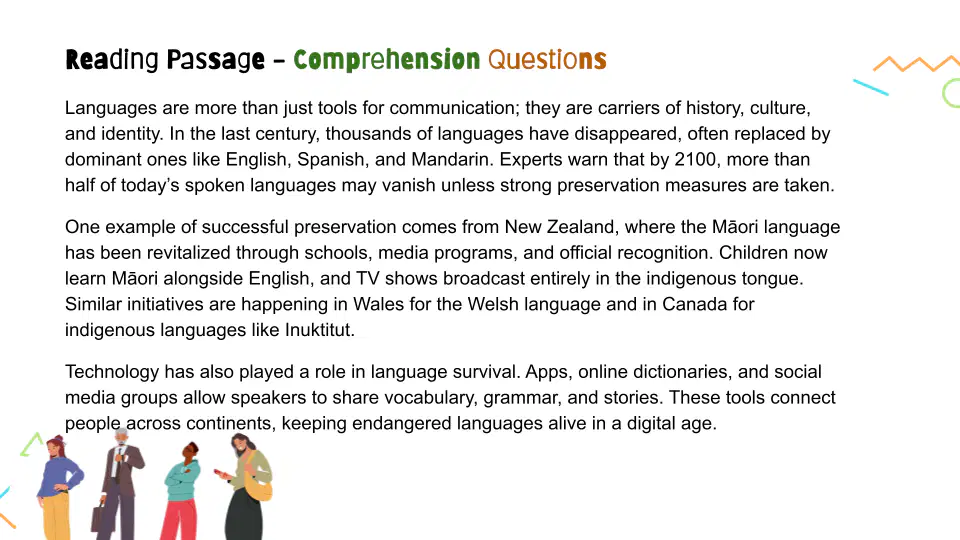
Which country is mentioned for revitalizing the Māori language?
Canada
New Zealand
Wales
South Africa
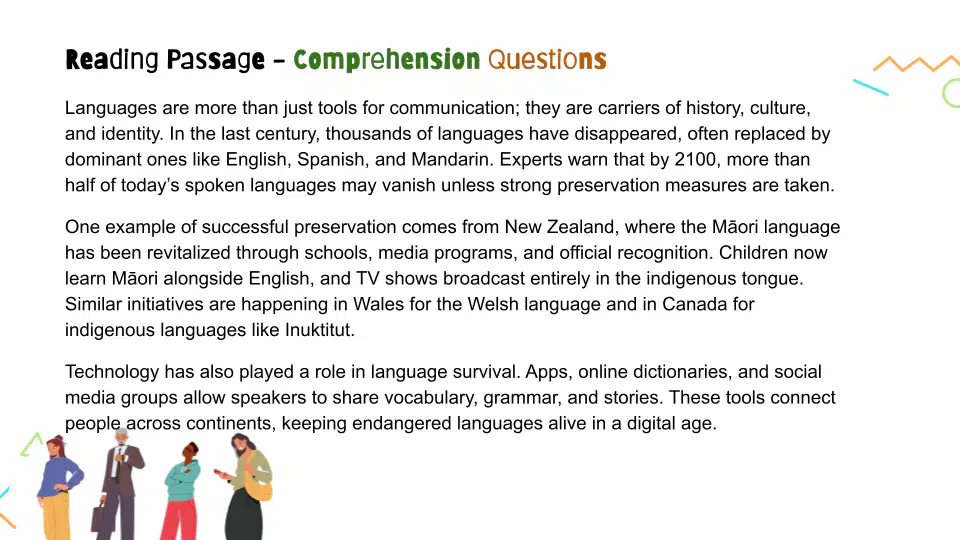
According to the passage, what do TV shows in New Zealand do?
Teach English vocabulary
Broadcast in both Māori and English
Broadcast entirely in Māori
Translate foreign films
What is one example of indigenous language preservation outside New Zealand?
Spanish in Mexico
Welsh in Wales
Japanese in Japan
French in France
What is the role of technology in the preservation of languages?
It makes people prefer global languages.
It connects speakers and shares language resources.
It replaces traditional culture.
It forces people to learn faster.
What does the author imply about language preservation?
It cannot succeed without government support.
It must focus on technology only.
It is only important in developed countries.
It is impossible in the modern world.
If people don't record their language, it ______ forever.
disappeared
would disappear
disappears
If I were fluent in Korean, I ______ work as a translator.
will
had
could be
If we had acted earlier, we ______ more dialects by now.
save
would have save
saved
will save
If you heat ice, it ______.
will melt
melt
melted
If she studied more, she ______ the grammar test.
will pass
passes
passed
If we don't protect minority languages, we ______ part of our identity.
will lose
lost
would lose
If he had joined the workshop, he ______ more confident now.
is
will be
was
If schools teach local dialects, students ______ their culture better.
understood
will understand
would understand
If I ______ my grandparents' stories, I wouldn't have forgotten them.
record
recorded
have recorded
If the internet didn't exist, we ______ access to many language resources.
won't have
don't have
didn't have
If she ______ to the conference, she will meet many linguists.
went
go
going
Direct: "We are learning about endangered languages," the teacher said. Which is correct in reported speech?
The teacher said they were learning about endangered languages.
The teacher said they are learning about endangered languages.
The teacher said we are learning about endangered languages.
The teacher said they had been learning about endangered languages.
Direct: "I will visit Wales next year," she said. Which is correct in reported speech?
She said she would visit Wales next year.
She said she would visit Wales the following year.
She said she will visit Wales the following year.
She said she would visit Wales last year.
Direct: "We studied Spanish last semester," he said. Which is correct in reported speech?
He said they studied Spanish last semester.
He said they had studied Spanish the previous semester.
He said they study Spanish last semester.
He said they have studied Spanish the previous semester.
Direct: "Do you speak more than one language?" the interviewer asked. Which is correct in reported speech?
The interviewer asked if I speak more than one language.
The interviewer asked if I spoke more than one language.
The interviewer asked if I had spoken more than one language.
The interviewer asked do I speak more than one language.
Direct: "Why are you learning Korean?" she asked me. Which is correct in reported speech?
She asked me why was I learning Korean.
She asked me why I was learning Korean.
She asked me why I am learning Korean.
She asked me why I had been learning Korean.
Direct: "Don't forget to complete the vocabulary list," he told her.
He told her to complete the vocabulary list.
He told her don't forget to complete the vocabulary list.
He told her she completes the vocabulary list.
He told her not complete the vocabulary list.
Direct: "Please review the grammar notes," the teacher said.
The teacher said please review the grammar notes.
The teacher asked us to review the grammar notes.
The teacher said to we review the grammar notes.
The teacher told to review the grammar notes.
Direct: "We can start the meeting now," he said.
He said they could start the meeting now.
He said they could start the meeting then.
He said they can start the meeting now.
He said they could start the meeting tomorrow.
Direct: "I may attend the seminar," she said.
She said she may attend the seminar.
She said she might attend the seminar.
She said she could attend the seminar.
She said she should attend the seminar.
Direct: "We have been discussing the project," they said.
They said they have been discussing the project.
They said they had been discussing the project.
They said they were discussing the project.
They said they discussed the project.
"The new law aims to ______ endangered languages by funding community classes."
delete
preserve
ignore
remove
The phrase "language extinction" is closest in meaning to:
the spread of languages
the death of languages
the translation of languages
the learning of languages
"In many countries, local dialects are slowly being ______ by national languages."
replaced
repaired
reported
repeated
"The preservation program was a ______ success, attracting hundreds of young learners."
limited
partial
remarkable
doubtful
"She is fluent in three languages" means she can:
understand basic vocabulary
speak smoothly and accurately
read only with a dictionary
memorize grammar rules quickly
"Some languages are passed on through ______ tradition, without being written down."
oral
visual
foreign
electronic
"The committee launched a campaign to raise ______ about the value of language diversity."
awareness
direction
grammar
literature
"English has become the ______ language of international air travel."
official
native
common
normal
The opposite of "preserve" is:
protect
destroy
encourage
protect
The opposite of "inclusive" is:
exclusive
diverse
equal
cooperative
The word "multilingual" is closest in meaning to:
able to speak many languages
able to speak one language
having no language skills
learning a new word
The word "revitalize" most nearly means:
weaken
destroy
restore
erase
The opposite of "minority language" is:
endangered language
dominant language
local dialect
borrowed language
The opposite of "global" is:
worldwide
local
universal
public
The word "obscure" in the sentence "The village speaks an obscure language" means:
well-known
hidden or not well-known
common
famous
The opposite of "inclusive" is:
exclusive
equal
fair
diverse
The opposite of "ancient" is:
historic
modern
old
traditional
The word "document" in "They document the language for future generations" means:
ignore
record
translate
change
(Confirmation) You believe your friend attended the conference. You ask:
Didn't you go to the conference yesterday?
You didn't go to the conference?
Didn't go to the conference?
Haven't gone to the conference?
(Polite suggestion) You think reading aloud could help. You say:
Shouldn't we read this passage aloud together?
We should read this aloud together?
Should read this aloud?
Didn't we read this aloud?
(Formal style, uncontracted) You are surprised your colleague hasn't finished a task.
Has she not completed the report yet?
She has not completed the report?
Hasn't she completed the report yet?
Not completed the report?
(Contracted form) You expect your classmate knows the answer.
Doesn't she know the answer?
She doesn't know the answer?
Does she not know the answer?
Didn't she know the answer?
(Polite opinion) You think it would be fun to visit the library.
Wouldn't it be nice to spend the afternoon in the library?
It would be nice to spend the afternoon in the library?
Wouldn't spend the afternoon in the library?
Shouldn't we spend the afternoon in the library?
(Confirmation) You believe the teacher already explained the topic.
Hasn't the teacher explained this topic before?
The teacher hasn't explained this topic before?
Has not the teacher explained this before?
Didn't the teacher explain this before?
(Polite suggestion) You want to recommend practicing pronunciation.
Wouldn't it help to practice pronunciation every day?
It would help to practice pronunciation every day?
Wouldn't practice pronunciation every day?
Didn't help to practice pronunciation every day?
If she ______ harder, she would pass the test.
studies
studied
had studied
study
If it rains tomorrow, we ______ the picnic.
will cancel
cancel
would cancel
have cancelled
If they had left earlier, they ______ the train.
will catch
would catch
would have caught
catch
If you mix red and blue, you ______ purple.
get
will get
got
have got
If she had taken the medicine, she ______ better now.
will feel
would feel
would have felt
feels
If I ______ you, I wouldn't ignore that email.
am
were
was
will be
If we don't leave soon, we ______ late for the concert.
will be
would be
are
were
Direct: "I am learning French," she said.
Reported: She said she ______ learning French.
was
is
were
will be
Direct: "Did you see the new film?" he asked.
Reported: He asked if I ______ the new film.
saw
had seen
have seen
see
Direct: "I can help you with your homework," she said.
Reported: She said she ______ help me with my homework.
could
can
will
would
Direct: "We will visit Rome next summer," they said.
Reported: They said they ______ visit Rome the following summer.
will
would
can
should
Direct: “Don’t forget to call me,” he said.
Reported: He reminded me ______ call him.
don't
not to
to not
to
Direct: “I have never been to Spain,” she said.
Reported: She said she ______ never been to Spain.
has
had
have
will have

