
 Worksheets
MDC205(RS2) FEEDBACK SESSION APRIL 2025
Total questions: 15
Worksheet time: 5mins
A 43-year-old alcoholic truck driver is diagnosed with pulmonary tuberculosis and is prescribed isoniazid, rifampicin, pyrazinamide and ethambutol.
Which of the following is the most likely side effect of the above treatment in this patient?
Red green color blindness
Nausea & vomiting
hepatotoxicity
arthalgia
A 55-year-old diabetic woman is admitted to the hospital with complications due to uncontrolled blood glucose. Recently she is diagnosed with pneumonia due to Pseudomonas aeruginosa.
Which of the following antimicrobials is most likely to be used?
Gentamycin
Meropenem
Ceftriaxone
Levofloxacin
A 55-year-old man is prescribed nicotine patches to help him with smoking cessation.
Which of the following reasons will help the patient in kicking the habit?
ease in using every day
prevents bad mood
reduces unpleasant effects.
reduces cravings.
. A 34-year-old man, presents to the Clinic with persistent fever requiring around the clock over-the-counter analgesics and cough with nasal congestion. He is diagnosed with Influenza B and prescribed a specific antiviral.
Which of the following antivirals is most likely to be used in this case?
Azidothymdine
Oseltamivir
Amantadine
Paxlovid
A 26-year-old woman having history of asthma presents to the clinic with cough and wheezing.
Which of the following drugs is most likely to be used in this case?
Codeine
Ambroxol
Chlorpheniramine
Dextromethorphan
Community-acquired pneumonia (CAP) is an acute infection of the lung. Which of the following is the most common causal organism of CAP?
Chlamydia pneumoniae
Legionella pneumophila
Mycoplasma pneumoniae
Streptococcus pneumoniae
The common cold is also known as nasopharyngitis. Which of the following statements regarding the common cold is TRUE?
Enhanced sense of taste and smell are common clinical manifestations.
A person may be genetically predisposed to the disease.
Transmission commonly occurs via contact with saliva.
Influenza viruses are the most common causal organisms.
Influenza is a historical disease with current significance in the sphere of public health. Which of the following statements regarding influenza is TRUE?
Viral damage to the respiratory epithelium lowers resistance to secondary bacterial invaders.
The neuraminidase spikes in the viral envelope enables the haemagglutination reaction used for viral detection.
Antigenic drift in the causal organism could result in an epidemic.
The causal agents are DNA viruses.
A 6-year-old boy presented with low grade fever, night sweets and blood-tinged sputum. He was suspected with primary pulmonary tuberculosis. Which of the following best describes primary pulmonary tuberculosis?
Most of the patients develop clinical disease.
Drinking of infected milk is its main mode of transmission.
It is characterized by the formation of tubercle at the apex.
It is characterized by formation of the lung lesion and the enlarged lymph nodes.
Which of the following best describes pathogenesis of pulmonary tuberculosis?
In reactivation tuberculosis, the common site of infection is at the hilus of the lung.
Serpentine cords formation in tubercle bacilli is correlated with its virulence.
Ghon complex is the characteristic feature of reactivation tuberculosis.
Most of the patients with primary tuberculosis develop clinical disease.
A 60-year-old man, a heavy smoker, presents with productive cough for 5 months duration. On physical examination, he is thin and has a barrel-shaped chest. He sits leaning forward with his lips pursed to facilitates his breathing.
Which of the following is the most histological findings in his lung?
Dilatation of air spaces with destruction of alveolar walls
Hyperplasia of bronchial mucus-secreting submucosal glands
Bronchial smooth muscle hypertrophy with proliferation of eosinophilia
Diffuse alveolar damage with leakage of protein-rich fluid into alveolar spaces
A 28-year-old woman presents with fatigue, dyspnea, non-productive cough, and cervical lymph node enlargement on both sides for 4 months duration. Lymph node biopsy shows numerous non-necrotizing granulomas.
Which of the following is the most likely diagnosis in this patient?
Idiopathic pulmonary fibrosis
Adenocarcinoima of lung
Sarcoidosis
Acute respiratory distress syndrome
A 56-year-old man has been immobilized in bed for several days after a motor vehicle accident. He had been improving, but this morning he suffered the sudden onset of pleuritic chest pain, hemoptysis, tachycardia, and dyspnea.
Which of the following underlying cause is the most like to be associated with his clinical presentations?
Arterial thrombus originating in pulmonary blood vessels
Deep venous thrombus of the lower extremities with embolization to branches of the pulmonary artery
Arterial thrombus originating in the lower extremities with migration to pulmonary veins
Mural thrombus originating in the left heart with migration to pulmonary blood vessels
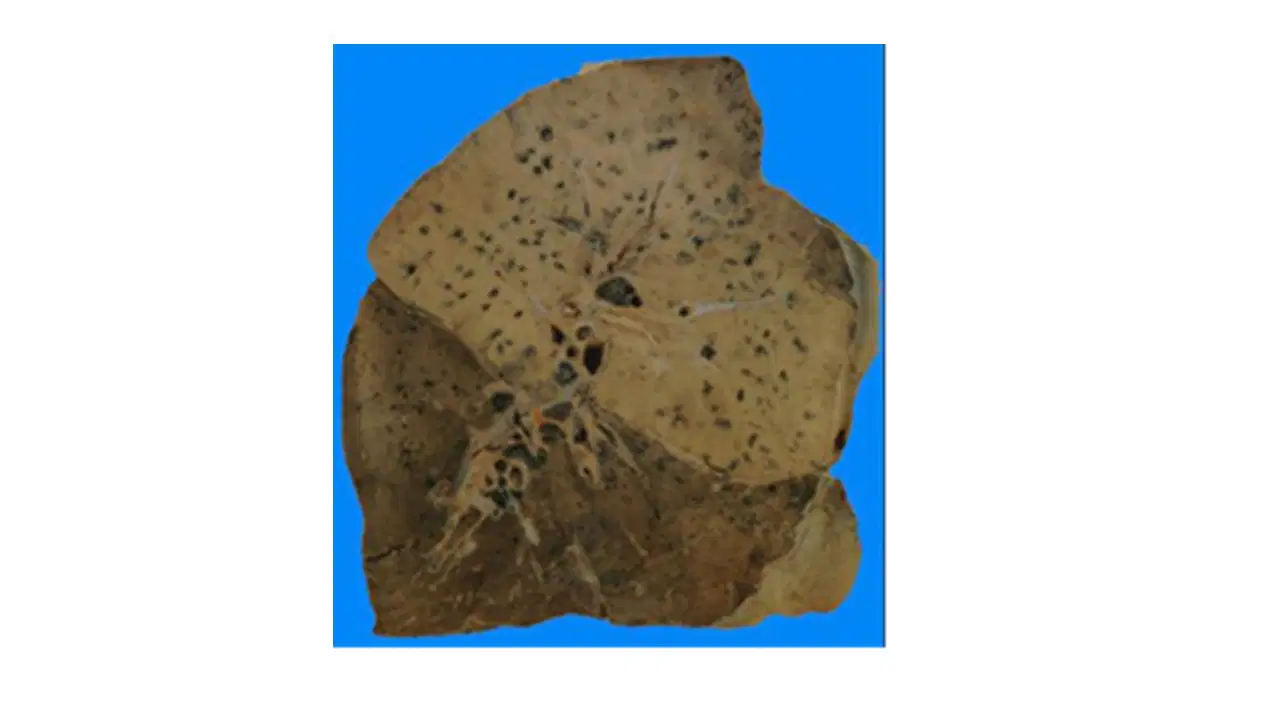
A 40-year-old alcoholic man is admitted to the hospital in severe respiratory distress with fever and rusty sputum. A chest-X ‘ ray reveals consolidation of the entire left upper lobe. The patient subsequently dies from complication of bacterial sepsis. The left lung at autopsy is shown in image.
Which of the following is the appropriate diagnosis for this patient?
Bronchopneumonia
Pulmonary abscess
Lobar pneumonia
Chronic bronchitis
A 48-year-old woman with a history of breast operation last 5 years presents with shortness of breath. On physical examination, she is afebrile and marked pallor. A chest-X’ ray reveals variable sizes of multiple, round masses in both lung. Lung biopsy shows gland – like structures lined by neoplastic cells.
Which of the followings is the most likely diagnosis for this patient?
Metastatic carcinoma
Squamoous cell carcinoma
Small cell lung carcinoma
Bronchoalveolar carcinoma

