
 Worksheets
Practice Test 01
Total questions: 40
Worksheet time: 1hrs 4mins

The reading text is for question 1 until 4
Question 1:
Which of the following best describes the central idea of the passage regarding the evolution of American federalism?
The federal government has always dominated state governments in the U.S. system.
The balance of power between the federal and state governments has shifted over time.
States have continually resisted federal power since the founding of the Constitution.
Federalism no longer plays a role in modern political debates in the United States.
The reading text is for question 1 until 4
Question 2:
What does the term “dual federalism” most likely imply based on its use in the passage?
The state and federal governments operate under the same set of rules.
State and federal governments have shared even and equal powers and responsibilities.
Each level of government maintains authority in distinct areas with minimal overlap.
The federal government exercises control over state legislation.
The reading text is for question 1 until 4
Question 3:
Which constitutional amendment is referenced to support state autonomy in modern debates?
First Amendment
Tenth Amendment
Fourteenth Amendment
Eighth Amendment
The reading text is for question 1 until 4
Question 4:
The passage suggests that federalism continues to be a contentious issue because:
The Constitution does not define state powers.
States want complete independence from the federal government, while the reality does not support to be so.
Some believe strong federal oversight is necessary while others argue for state control.
The judiciary has abolished state rights in recent years.

The speech excerpt is for question 5 until 8
Question 5:
What is the purpose of Roosevelt’s repeated use of the phrase “the only thing we have to fear is fear itself”?
To warn the public about potential military attacks on American soil
To calm the public by urging courage and collective strength during economic hardship
To criticize the government for lacking the courage to act in past crises
To explain why the United States must remain isolated from global affairs
The speech excerpt is for question 5 until 8
Question 6:
What inference can be made about Roosevelt’s leadership style based on the speech?
He believed in strict non-interventionist policies.
He emphasized optimism, direct action, and government responsibility.
He wanted to reduce the role of government during economic downturns.
He relied solely on the private sector to solve national problems.
The speech excerpt is for question 5 until 8
Question 7:
Why does Roosevelt compare the unemployment crisis to a wartime emergency?
To justify declaring war on foreign nations to create jobs
To argue that war was a more urgent problem than unemployment
To emphasize the scale of the economic crisis and the need for immediate action
To downplay the seriousness of the economic depression because he already had the New Deal as the solution
The speech excerpt is for question 5 until 8
Question 8:
Which of the following ideas is NOT supported by President Roosevelt’s speech excerpt?
Roosevelt believed the nation could overcome economic hardship with courage and action.
Roosevelt considered unemployment the nation’s greatest challenge at the time.
The president urged people to accept that prosperity was out of reach during hard times.
Strong leadership and public support are both necessary in times of national crisis.

The chart is for question 9 until 12
Question 9:
Which of the following conclusions is best supported by the data in the chart?
Improving transportation infrastructure would significantly increase voter turnout.
Time-related barriers are a greater deterrent to voting than weather-related concerns.
People primarily avoid voting due to distrust in the electoral process and the candidates.
Registration issues are the most common reason people give for not voting.
The chart is for question 9 until 12
Question 10:
What proposal would most directly address the combined concerns of those who cited “Registration problems” and “Forgot” as reasons for not voting?
Creating a same-day voter registration system with automatic reminder alerts.
Offering rides or any transportation support to polling stations on Election Day.
Increasing the number of polling stations in each district.
Promoting national debates to make elections more engaging.
The chart is for question 9 until 12
Question 11:
If a policymaker could only address one issue to improve voting turnout, which of the following should be prioritized based on the graph?
Weather preparedness programs
Voter interest campaigns
Flexible voting schedules
Candidate endorsement initiatives
The chart is for question 9 until 12
Question 12:
Based on the information in the graph, which of the following proposals might best improve the voting rate?
Distribute umbrellas to all households to encourage people to vote on rainy election days.
Send reminders to registered voters so they do not forget to vote.
Reschedule Election Day to a weekend so that people who are busy at work can be available to vote.
Provide more interesting candidates that inspire people to vote.

The reading text is for question 13 until 17
Question 13:
What is the central idea of the passage about the Great Migration?
The Great Migration caused urban decline in the South since the rural areas were more preferable.
The movement of African Americans transformed the political cultural identity of the United States.
Racial segregation disappeared as a result of the oppression and migration.
African Americans were forced to move due to legal action from southern states.
The reading text is for question 13 until 17
Question 14:
What combination of factors led to the Great Migration, according to the passage?
Better weather and agricultural jobs in the North
Industrial job opportunities in the North and oppressive conditions in the South
Southern land ownership and religious freedoms demand in almost all states.
Educational opportunities, land ownership, and climate changes
The reading text is for question 13 until 17
Question 15:
What cultural consequence did the Great Migration have?
It caused African Americans to lose their cultural identity.
It reduced racial tensions in northern cities.
It helped launch movements like the Harlem Renaissance.
It caused widespread illiteracy in northern schools.
The reading text is for question 13 until 17
Question 16:
Which of the following conclusions can be drawn from the passage?
All Americans supported the migration
The North was free of racism during the 20th century
African Americans faced different challenges in the North and the South
Migration eliminated racial inequality in the U.S. and balance of states power
The reading text is for question 13 until 17
Question 17:
What kind of map or visual aid would best enhance understanding of this passage?
A pie chart showing African American education levels
A line graph of cotton production in the South
A map showing migration routes from Southern to Northern cities
A chart of U.S. Presidents by political party

The picture is for question 18 until 21
Question 18:
Analyze how the geographic layout of U.S. time zones might affect national decision-making, particularly in sectors like transportation, media, and politics. Which of the following is the most plausible consequence?
Policies are only created according to Pacific Time to favor the tech industry.
Airlines must publish four different schedules to avoid confusion.
National elections require simultaneous closing of polls, adjusted for each zone.
Media outlets are forced to broadcast identical shows at identical hours in all zones.
The picture is for question 18 until 21
Question 19:
Based on the Earth’s rotation and the structure of time zones described, which of the following best explains why Los Angeles is earlier than New York in local time?
Los Angeles is at a higher altitude.
Time zones are based on economic activity.
The Earth rotates from east to west, so western cities experience time later.
The Earth rotates from west to east, so eastern cities experience time earlier.
The picture is for question 18 until 21
Question 20:
If a live national news broadcast begins at 5:00 P.M. Eastern Time, what time will viewers in Sacramento see the program, and what implication does this have for broadcasters scheduling prime-time content?
3:00 P.M.; Broadcasters should delay airing content in the West to match prime-time viewing hours.
2:00 P.M.; Broadcasters must adjust programming to avoid airing during non-peak hours.
4:00 P.M.; Viewers in Sacramento receive live broadcasts earlier than those in New York.
5:00 P.M.; All U.S. time zones receive live broadcasts simultaneously.
The picture is for question 18 until 21
Question 21:
If it is 4:00 P.M. in Chicago and a student in Albuquerque calls a classmate in New York, what time will it be for the classmate? What does this imply about coordinating activities across regions?
3:00 P.M.; There is no time difference between Albuquerque and New York.
6:00 P.M.; Students need to consider time zones when scheduling national virtual meetings.
5:00 P.M.; Time zones only affect international calls.
4:00 P.M.; All U.S. time zones align during daylight saving time.
Drag and drop the correct answer to the sentence for question 22 and 23
Question 22:
Countries often engage in trade because it allows them to specialize in producing goods for which they have a (a) advantage. By doing so, they can trade with other nations and obtain goods that would be more (b) to produce domestically.
Drag and drop the correct answer to the sentence for question 22 and 23
Question 23:
Every economic decision involves an opportunity cost - the value of the (a) best alternative given up. For example, if a person chooses to go to college full-time instead of working, the opportunity cost includes both the income they would have earned and the work experience they (b) .

The speech excerpt is for question 24 until 27
Question 24:
Which of the following best describes the rhetorical strategy Sojourner Truth uses in her speech?
Appealing to legal statutes about slavery and the abolitionist
Quoting religious scripture directly
Repeating a personal question to challenge social assumptions
Listing voting records of Congressmen
The speech excerpt is for question 24 until 27
Question 25:
Which of the following best explains the rhetorical strategy used by Sojourner Truth when repeating the phrase “And ain’t I a woman?” throughout the speech?
To question whether her experiences align with and supported by those of other enslaved women.
To emphasize the contradiction between societal ideals of womanhood and her own experience.
To argue that women should be treated equally regardless of race.
To show that women deserve protection and special treatment in public spaces.
The speech excerpt is for question 24 until 27
Question 26:
What conclusion can be drawn about the intersection of gender and race from Truth’s speech?
Gender equality was more important than racial justice to women of the time.
Truth believed Black men received more protection and rights than Black women.
Black women were excluded from both the privileges of white womanhood and the rights afforded to men.
The speech reflects that Truth was accepted as both a woman and a worker, but not as an politician in her community.
The speech excerpt is for question 24 until 27
Question 27:
How does Sojourner Truth challenge contemporary societal norms through her personal testimony?
By glorifying the role of women in agriculture and manual labor.
By using her suffering to argue that women should not work outside the home.
By using her strength and motherhood to challenge femininity stereotypes.
By expressing religious devotion to advocate for traditional gender roles.

The reading text is for question 28 until 32
Question 28:
What is the primary reason the government enforces antitrust laws in a market economy?
To increase profits for corporations
To protect workers from labor strikes
To prevent monopolies
To limit exports and control trade deficits
The reading text is for question 28 until 32
Question 29:
Which of the following is an example of a government providing a public good?
Creating a stock market index
Building and maintaining highways
Subsidizing the oil industry
Setting minimum wage laws
The reading text is for question 28 until 32
Question 30:
Which of the following best expresses the central idea of the passage?
Government intervention in the economy is a necessary evil that should be eliminated.
Market economies can function better with government regulation that balances freedom and fairness.
The best economies are those with total government control over the business cycle of the industries.
Economic crises are caused primarily by monopolies and trade.
The reading text is for question 28 until 32
Question 31:
How does the passage define the term “externality”?
A type of tax collected from foreign corporations
A financial regulation imposed on banks to set the limits of loans and their interest rates to prevent from downfall
A cost or benefit that affects people who are not directly involved in an economic transaction
An unintended benefit of a well-run economy
The reading text is for question 28 until 32
Question 32:
What conclusion can be drawn about the relationship between market efficiency and social equity in this passage?
Markets always promote fairness better than governments.
Efficiency and equity are unrelated in economic policy.
Government may sacrifice some efficiency to improve fairness.
Free markets create perfect social conditions.
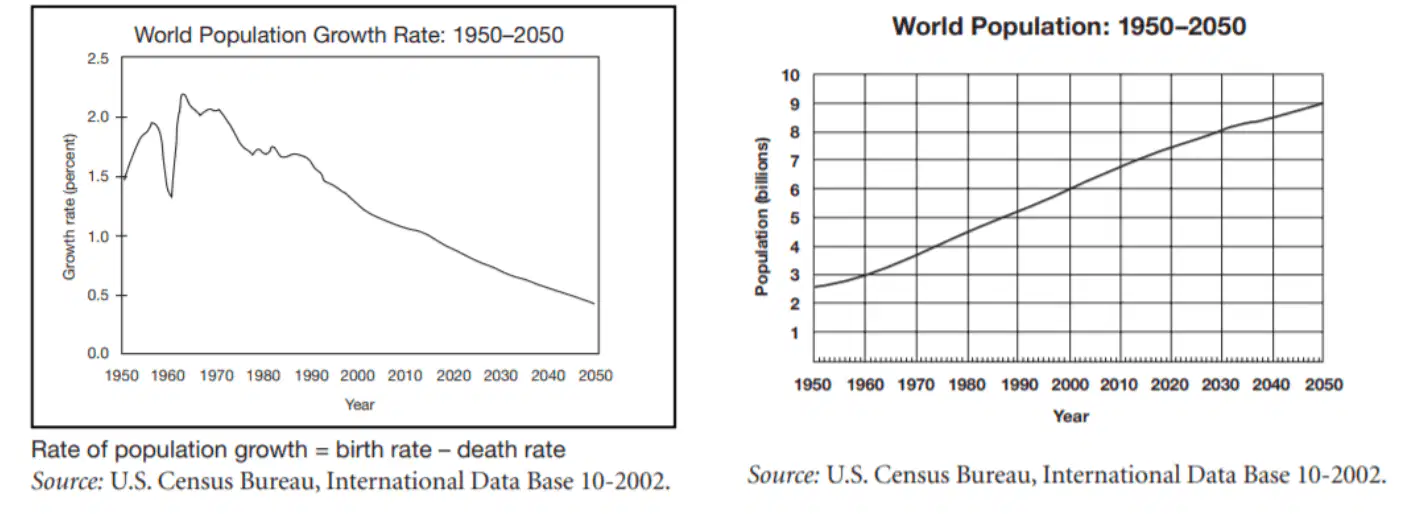
The chart is for question 33 until 35
Question 33:
What conclusion can be drawn from the relationship between the two charts over time?
A decreasing population growth rate results in an immediate population decline.
The world population increases steadily even as the population growth rate decreases.
The population growth rate and world population always increase at the same rate.
Slower growth rate means the population stops growing after 2020.
The chart is for question 33 until 35
Question 34:
Which of the following best explains why the world population continues to rise despite a falling growth rate?
Death rates have increased more than birth rates.
Migration between countries has contributed to the growth of the global population by adding to the number of people residing in new regions
A positive growth rate means more births than deaths, so the total population still grows.
The population data excludes birth and death rates after 2000.
The chart is for question 33 until 35
Question 35:
Around which year does the population growth rate begin a consistent downward trend, and how is this trend reflected in the population chart?
Around 1955; the population sharply decreases.
Around 1970; the population remains constant.
Around 1975; the population continues to rise but at a slower pace.
Around 2000; the population plateaus.
Question 36:
A student is deciding whether to buy a new phone or save money for college. She compares the costs and benefits of each option. In the end, she chooses to save the money. This process illustrates how individuals make economic decisions.
Put the steps of decision-making into the correct order!
Identify alternatives
Compare costs and benefits
Make a decision
Question 37:
Match each economic term to its correct definition!
The condition of having limited resources but unlimited wants.
Scarcity
The value of the next best alternative that is given up.
Opportunity Cost
A situation in which prices rise and money loses value.
Inflation
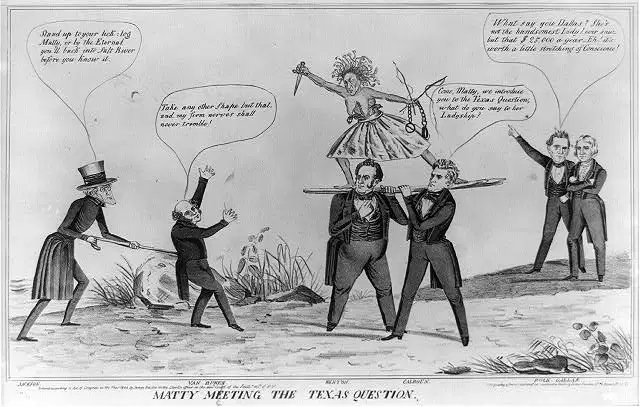
The context for the picture:
This 1844 political cartoon satirizes how Democrats handled the issue of Texas annexation. Texas is personified as a wild, dangerous woman: symbolizing war, chaos, and slavery. Martin Van Buren appears fearful and hesitant to accept her, while supporters like Calhoun and Benton try to push him toward annexation. In contrast, Polk and Dallas appear motivated by political gain, while Andrew Jackson pressures Van Buren from behind.
Question 38:
What does the cartoonist imply by portraying Texas as a threatening woman holding weapons and chains?
That annexation was seen as a peaceful opportunity
That Texas would bring wealth and order to the U.S.
That annexation could lead to war and expand slavery
That women were gaining political influence
The context for the picture:
This 1844 political cartoon satirizes how Democrats handled the issue of Texas annexation. Texas is personified as a wild, dangerous woman: symbolizing war, chaos, and slavery. Martin Van Buren appears fearful and hesitant to accept her, while supporters like Calhoun and Benton try to push him toward annexation. In contrast, Polk and Dallas appear motivated by political gain, while Andrew Jackson pressures Van Buren from behind.
Question 39:
How does Martin Van Buren’s body language and dialogue reflect his stance on Texas annexation?
He is boldly defending Texas.
He is hesitant and trying to avoid the issue.
He is unaware of the Texas issue.
He is enthusiastically accepting the idea.
The context for the picture:
This 1844 political cartoon satirizes how Democrats handled the issue of Texas annexation. Texas is personified as a wild, dangerous woman: symbolizing war, chaos, and slavery. Martin Van Buren appears fearful and hesitant to accept her, while supporters like Calhoun and Benton try to push him toward annexation. In contrast, Polk and Dallas appear motivated by political gain, while Andrew Jackson pressures Van Buren from behind.
Question 40:
What does Polk’s comment about the $25,000 salary suggest about his motivation for supporting annexation?
He views annexation as a moral duty.
He supports it mainly for national security.
He sees personal and political gain in supporting annexation.
He believes it will end slavery.

