
Font size
 Worksheets
Biology Chapter 2 Review
Total questions: 31
Worksheet time: 21mins
The major subatomic particles that make up an atom are:
Protons, neutrons, and electrons
Molecules, ions, and atoms
Quarks, leptons, and bosons
Photons, gluons, and neutrinos
Isotopes of an element have the same chemical properties because:
they have the same number of electrons
they have different numbers of protons
they have different numbers of neutrons
they have different atomic numbers
The differences between ionic bonds and covalent bonds are:
Ionic bonds involve the transfer of electrons, while covalent bonds involve the sharing of electrons.
Ionic bonds involve the sharing of electrons, while covalent bonds involve the transfer of electrons.
Both ionic and covalent bonds involve the sharing of electrons only.
Ionic bonds and covalent bonds both involve the transfer of electrons only.
A molecule is said to be “polar” when:
it has an uneven distribution of electrical charge.
it has an equal distribution of electrical charge.
it contains only one type of atom.
it cannot form bonds with other molecules.
Water is such a good solvent because:
it is a polar molecule, allowing it to dissolve many substances
it is nonpolar and does not interact with other molecules
it has a high density, making it absorb substances easily
it is always found in a solid state
A buffer is important to cells because:
It helps maintain a stable pH in the cell environment.
It provides energy for cellular processes.
It transports oxygen throughout the cell.
It breaks down waste products in the cell.
The properties of carbon that explain its ability to form different large and complex structures are:
Its ability to form four covalent bonds, bond with many elements, and create chains and rings
Its inability to bond with other elements
Its low reactivity and inability to form chains
Its tendency to form only ionic bonds
Which of the following lists the four major categories of macromolecules and describes their basic structures and primary functions?
Carbohydrates, lipids, proteins, nucleic acids; each has a unique structure and function in living organisms.
Sugars, salts, acids, bases; all provide energy for cells.
Vitamins, minerals, water, fiber; all are used for building cell walls.
Enzymes, hormones, antibodies, pigments; all are types of proteins.
Changes that occur to chemical bonds during a chemical reaction include:
Bonds are broken and new bonds are formed.
Bonds remain unchanged throughout the reaction.
Only new bonds are formed, no bonds are broken.
Only bonds are broken, no new bonds are formed.
The change in energy of a chemical reaction predicts whether or not the reaction will occur because:
A reaction is likely to occur if it results in a decrease in energy.
A reaction is likely to occur if it results in an increase in energy.
Energy change has no effect on whether a reaction will occur.
A reaction will only occur if there is no change in energy.
The role of enzymes is to:
Speed up chemical reactions in living things without being consumed
Slow down chemical reactions in living things
Provide energy for chemical reactions in living things
Change the products of chemical reactions in living things
Match the following macromolecule to its function
short term energy
carbohydrate
long term energy storage
lipid
stores genetic information
nucleic acid
control the rate of a reaction and regulate cell processes
protein
In the atom, which particles are in constant motion around the nucleus?
protons
protons and neutrons
neutrons
electrons
Which type of bonds holds two or more water molecules together?
covalent bonds
van den Waals forces
hydrogen bonds
ionic bonds
Which type of macromolecule stores genetic information?
carbohydrates
proteins
lipids
nucleic acids
Which type of macromolecule regulates cell processes or transports material into and out of cells?
carbohydrates
lipids
proteins
nucleic acids
Which are catalysts of reactions in living things?
enzymes
lipids
carbohydrates
substrates
What changes during a chemical reaction between two compounds?
number of atoms
chemical bonds
total mass
total energy
Which is a primary function of glucose molecules?
to make up the structure of cell membranes
to act as a catalyst for chemical reactions
to encode genetic information
to provide energy for cell activities
What structural feature does glucose share with larger carbohydrates?
a ratio of 1 carbon atom to 2 hydrogen atoms to 1 oxygen atom
the presence of double covalent bonds between carbon atoms
strong bonds between carbon atoms that cannot be broken
ionic bonds between carbon atoms and oxygen atoms
Roger is comparing a model of a sugar molecule to a model of an amino acid. Which of the following evidence statements would be supported by the two models?
Sugars and amino acids are made of exactly the same elements
Sugars and amino acids have the same structure
Sugars and amino acids are made of the same elements except amino acids also contain nitrogen
Sugars and amino acids are made of the same elements except sugars also contain phosphorus
Many cells make and use an enzyme, called catalase, to facilitate the decomposition of hydrogen peroxide (H2O2). The products of the decomposition are hydrogen (H2) and oxygen (O2).
What is the effect of catalase on the decomposition of hydrogen peroxide?
It decreases the activation energy needed to start the reaction
It decreases the total energy released by the reaction
It increases the total energy absorbed by the reaction
It changes the ratio of the amounts of the two products
Many cells make and use an enzyme, called catalase, to facilitate the decomposition of hydrogen peroxide (H2O2). The products of the decomposition are hydrogen (H2) and oxygen (O2).
Which of these changes to the cell would cause the greatest reduction in the activity of catalase?
a decrease in the concentration of hydrogen and oxygen
an increase in the concentration of hydrogen peroxide
an increase or decrease in pH beyond normal range
a return of pH to the normal range
Water has many special properties, such as a high heat capacity and cohesive behavior. Which of the following best explains why water has these properties?
The atoms of a water molecule are held together by ionic bonds
Water is polar and forms hydrogen bonds
Water is a weak acid and acts as a buffer
Water molecules join together to form polymers
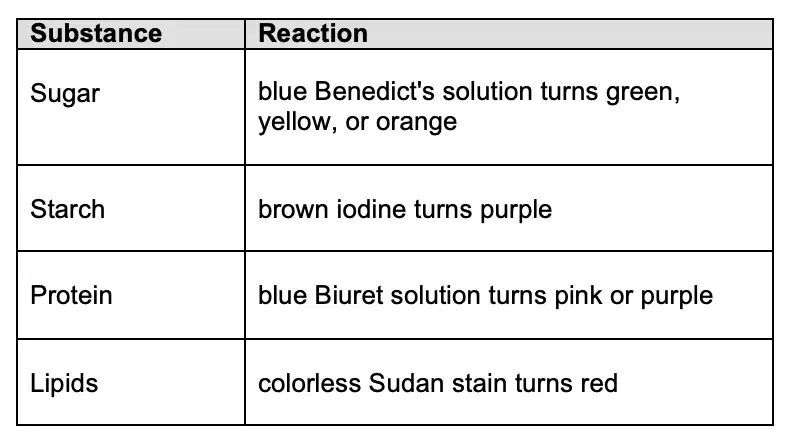
Lee and Marisol are conducting a science experiment to identify different kinds of macromolecules in food. They prepare the following table to help them remember the chemical reactions that indicate the presence of each type of macromolecule they’re studying.
Suppose that one of the substances they’re testing turns bright red when they add a few drops of Sudan stain. What is the basic molecular structure of the substance?
glycerol combined with long chains of fatty acids
strings of amino acids held together with peptide bonds
short carbon chain or ring in which the ratio of carbon, hydrogen, and oxygen is 1:2:1
polymer made up of many monosaccharides

The diagram shows the chemical structure of a nucleotide. How does a polymer of nucleotides encode genetic information?
by the sequence of nitrogenous bases
by the sequence of 5-carbon sugars
by attaching sulfur groups to the phosphate groups
by attaching carbohydrates to the 5-carbon sugars
A cellular enzyme is effectively deactivated by an increase in temperature of 10°C. Which is the most likely mechanism of the deactivation?
The enzyme, which is a carbohydrate, breaks apart into glucose molecules
The enzyme, which is a protein, breaks apart into individual amino acids
The enzyme changes shape and is no longer able to bind the substrate
The enzyme reacts with the substrate to produce side products
Which observation directly illustrates the adhesive properties of water?
water droplets forming beads on a waxy surface
ice floating on liquid water
a body of water changing temperature slower than the surrounding air
the water surface forming a U-shape inside a glass tube
Match the following term to its definition
energy input that is needed for a reaction to begin
activation energy
substance that speeds up the rate of a chemical reaction
catalyst
protein catalyst that speeds up the rate of specific biological reactions
enzyme
reactant of an enzyme-catalyzed reaction
substrate
Organize these options into the right categories
short term energy storage
breads & pastas
fruits
glucose
long term energy storage
form biological membranes
oils & waxes
control rate of reactions
regulate cell processes
enzymes
amino acids
fatty acids
monosaccharides
DNA
stores genetic information
nucleotide
Match the following term to its definition
small chemical unit that makes up a polymer
monomer
molecule composed of many monomers; makes up macromolecules
polymer
attraction between molecules of the same substance
cohesion
force of attraction between different kinds of molecules
adhesion

