
 Worksheets
Pre-Quiz: Cosmology
Total questions: 27
Worksheet time: 14mins
Name
Class
Date
1.
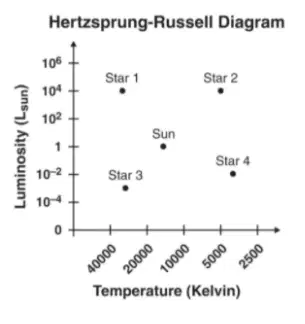
I n the Hertzsprung-Russell diagram, the luminosity and surface temperature of the Sun and other stars. Based on the diagram, which of these conclusions about Star 4 is most likely correct?
a)
It is hot and dim.
b)
It is cool and dim.
c)
It is hot and bright.
d)
It is cool and bright
2.
Which list is correctly ordered from largest to smallest?
a)
star - solar system - galaxy - universe
b)
universe - galaxy - solar system - star
c)
universe - solar system - galaxy - star
d)
star - solar system - universe - galaxy
3.
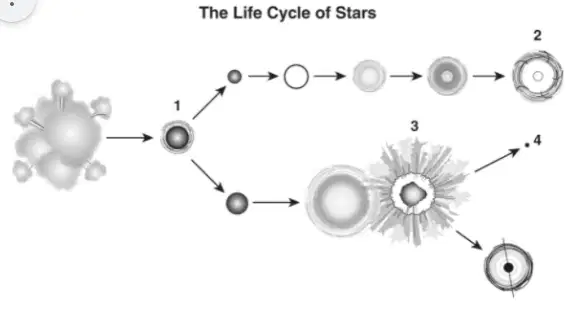
The stages of stars are illustrated in the diagram. Which numbered stage represents a protostar?
a)
1
b)
2
c)
3
d)
4
4.
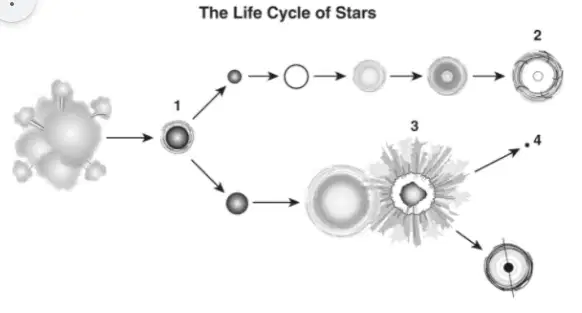
The stages of stars are illustrated in the diagram. Which numbered stage represents a supernova?
a)
1
b)
2
c)
3
d)
4
5.
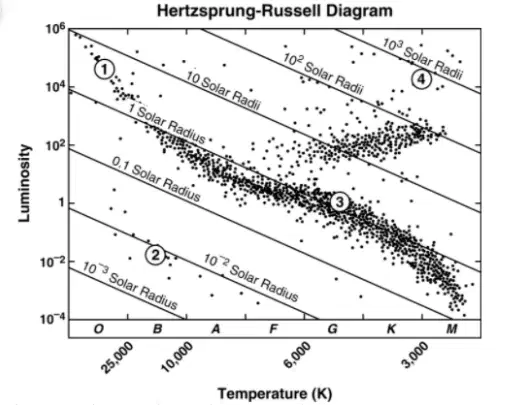
The diagram below shows a Hertzsprung-Russell Diagram. Which of these locations on this HR diagram most likely represents main sequence stars?
a)
1
b)
2
c)
3
d)
4
6.
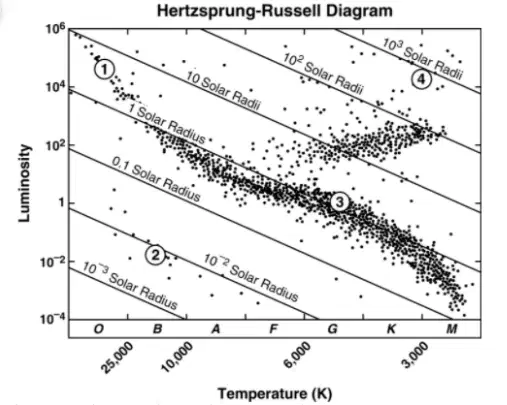
The diagram below shows a Hertzsprung-Russell Diagram. Which of these locations on this HR diagram most likely represents a blue star?
a)
1
b)
2
c)
3
d)
4
7.
Astronomers have found evidence for the existence of a supermassive black hole in the center of a giant elliptical galaxy M87. What is thought to cause black holes to form?
a)
the collapse of a high mass star
b)
the gravity of a large nebula
c)
the death of a low mass star
d)
the combining of material from the planets
8.
Which elements compose the highest percentage of a star's composition?
a)
Hydrogen
b)
Helium
c)
Lithium
d)
Carbon
e)
Oxygen
9.
More massive stars generally have shorter lifetimes than less massive stars because massive stars
a)
are older
b)
formed earlier than smaller stars
c)
use fuel much faster than less massive stars do
d)
have a stronger gravitational pull on each other
10.
Gravity depends on which TWO things?
a)
Mass and weight
b)
Mass and distance
c)
Volume and density
d)
Density and mass
11.
Which of the following is evidence for the Big Bang Theory?
a)
The universe is expanding
b)
Most stars show redshift
c)
Microwave radiation was found to be leftover from the Big Bang
d)
Evidence of a massive black hole was found dating back around 14 billion years ago
12.
Which type of galaxy is a thin disk composed of stars, gas, and dust with a central bulge of older stars.
a)
Spiral
b)
Elliptical
c)
Irregular
d)
Spherical
13.
What is the difference between the Big Bang Theory and the Nebular Theory?
a)
The Big Bang Theory explains the beginning of the universe and the Nebular Theory explains the beginning of our solar system
b)
The Nebular Theory explains the beginning of the universe and the Big Bang Theory explains the beginning of our solar system
c)
The Big Bang Theory is an updated version of the Nebular Theory
d)
The Big Bang Theory and The Nebular Theory are essentially the same thing, the terms are interchangeable
14.
The scientific belief for the formation of the universe is called
a)
HR diagram
b)
Nebular Theory
c)
Big Bang
d)
Hubble's Theory
15.
An eccentricity of one looks like a
a)
flattened oval
b)
a perfect circle
c)
a star
d)
an infinity sign
16.
Eccentricity is
a)
the path of a planet around the sun
b)
the path of a sun around the planets
c)
the path the moon takes around the sun
d)
the path the sun takes around the moon
17.
Planets move faster when further away from the Sun because the gravity is stronger.
a)
True
b)
False
18.
Kepler's 3rd law explains
a)
the farther away the planet is from the sun, the longer it's year
b)
the farther away the planet is from the sun, the longer it's day
c)
the closer the planet is from the sun, the longer it's year
d)
the closer the planet is from the sun, the longer it's day
19.
What is nuclear fusion?
a)
how a star is made
b)
how the universe was created
c)
how our solar system was created
d)
the combination of marshmallows
20.
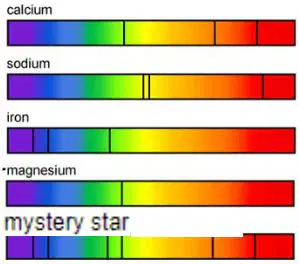
Which elements are NOT present in this star based on the spectrum below?
a)
Iron
b)
Sodium
c)
Calcium
d)
Magnesium
21.
During nuclear fusion, how many hydrogen atoms combine to create a helium atom?
a)
One
b)
Two
c)
Three
d)
Four
22.
Requirement(s) for a planet to be habitable are:
a)
distance from the sun
b)
size of the planet
c)
complex chemicals
d)
an atmosphere
e)
absence of liquid water
23.
You get the most hours of sunlight during June and July. What hemisphere are you in?
a)
Northern
b)
Southern
24.
When a hemisphere is tilted away the sun, the season that is occurring is
a)
summer
b)
winter
25.
What is redshift?
4 lines
26.
What is the heaviest element that a star can make before it starts using energy instead of creating energy?
4 lines
27.
How did you feel about this test?
(Horrible = 1, Amazing = 5)
(Horrible = 1, Amazing = 5)
a)
1
b)
2
c)
3
d)
4
e)
5
100 %

