
 Worksheets
Principles of HS_Unit 1 Review Game
Total questions: 80
Worksheet time: 40mins
Which of the following is NOT listed as a pathway in Health Science according to the provided material?
Therapeutic Services
Diagnostic Services
Engineering Services
Biotechnology
Which pathway in health science is most likely to involve working with patient records and data management?
Health Informatics
Support Services
Therapeutic Services
Biotechnology
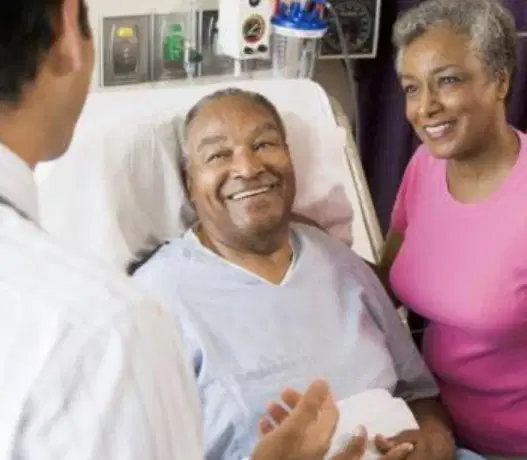
Which of the following is an example of a new medical advancement or technology that might be used in a healthcare facility?
MRI scanning machine
Bandages
Stethoscope
Thermometer
Why is it important to consider the methods and treatments used at a healthcare facility when someone requires medical treatment?
To understand how technology and advancements improve patient care
To know the color of the hospital walls
To find out what food is served in the cafeteria
To learn about the hospital's location
If a family member received a treatment that used new technology, what might be a benefit of this advancement?
Faster recovery and more accurate diagnosis
More expensive hospital food
Longer waiting times
Less comfortable hospital beds
Which of the following best describes the main idea of the passage about the evolution of healthcare?
Healthcare has remained unchanged over the past 100 years.
Advancements in medicine and new attitudes have shaped healthcare in the past century.
Only technology has influenced healthcare.
Healthcare is only about treating diseases.
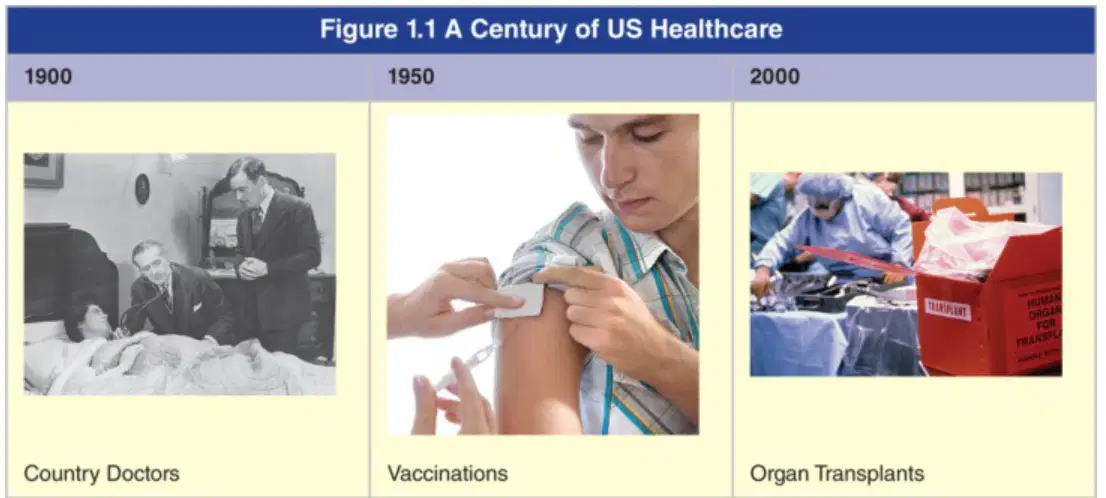
According to the image, what was a significant healthcare development around the year 1950?
Organ transplants
Country doctors making house calls
Vaccinations
Telemedicine
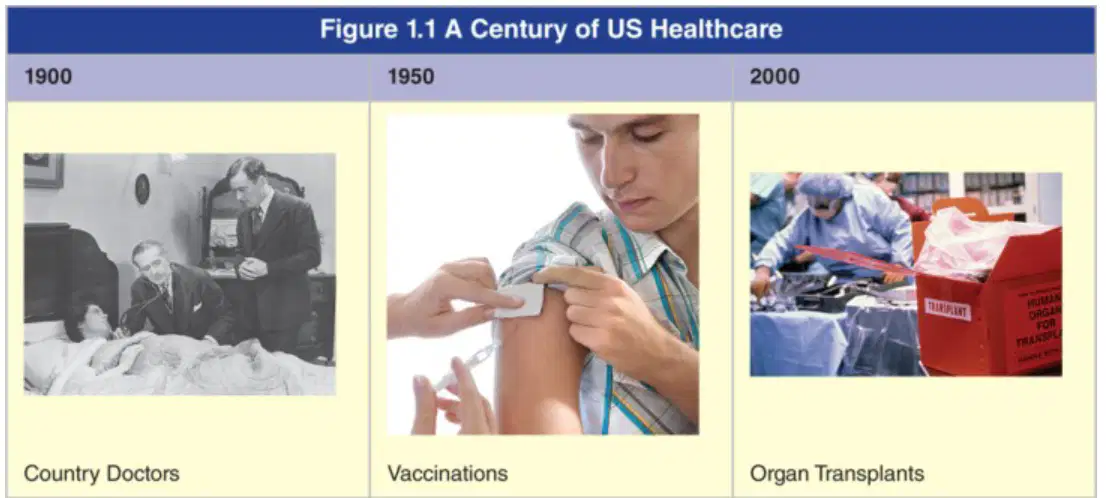
How does the figure illustrate the changes in US healthcare from 1900 to 2000?
By showing the same medical practice repeated over time
By highlighting key advancements at different points in time
By focusing only on rural healthcare
By comparing healthcare costs
Based on the information provided, what can be inferred about the role of medical research in healthcare?
Medical research has slowed the progress of healthcare.
Medical research has guided advancements and new attitudes in healthcare.
Medical research is only important for doctors.
Medical research is unrelated to healthcare beliefs.
Which of the following best describes the main limitation of doctors 100 years ago?
Doctors could diagnose and provide information, but generally unable to cure disease
Doctors could perform advanced surgeries
Doctors had access to penicillin and insulin
Doctors used X-rays for diagnosis
What significant medical advancements were available 50 years ago that were not available 100 years ago?
Better drugs such as penicillin and insulin, X-rays, and vaccinations
Advanced robotic surgeries and gene editing
Telemedicine and wearable health devices
Laser eye surgery and organ transplants
How has the approach to medical advancements changed from 50 years ago to today?
Today, there are more advanced technological treatments and constant discoveries, while 50 years ago, advancements were limited to better drugs and X-rays.
Today, doctors only provide information, while 50 years ago, they could cure all diseases.
Today, only vaccinations are available, while 50 years ago, there were no drugs.
Today, there are fewer advancements compared to 50 years ago.
Based on the progression shown, what can be inferred about the future of medical advancements?
Further advancements and discoveries will likely continue to be made.
Medical advancements will stop progressing.
Doctors will rely only on information from 100 years ago.
Technological treatments will become less important.
Which of the following is NOT mentioned as a medical advancement from 50 years ago?
Gene editing
Penicillin
Insulin
X-rays
Compare the role of home visits in medical care a century ago to today. What is a key difference?
Doctors today make more home visits than before.
Doctors a century ago made home visits, while today it is less common.
Home visits have always been rare.
Home visits are only for emergencies now and in the past.

Which of the following best describes holistic care?
Therapies that treat only the physical symptoms of a disease
Therapies that treat the patient as a whole person, considering physical, social, mental, and spiritual well-being
Therapies that focus only on medication and surgery
Therapies that ignore the patient's mental health
Which of the following is a characteristic of new attitudes and beliefs in healthcare?
Rejection of alternative therapies
Greater acceptance of a holistic approach to the treatment of disease
Focus only on traditional medicine
Ignoring the patient's social well-being
Holistic care includes which types of therapies?
Only surgical therapies
Only pharmaceutical therapies
Alternative, complementary, and integrative therapies
Only physical therapies
Why might a holistic approach be considered more comprehensive than traditional approaches to disease treatment?
It only treats the symptoms of disease
It focuses solely on the physical aspect of health
It assesses and treats the individual's physical, social, mental, and spiritual well-being
It ignores the patient's mental and spiritual needs
Which of the following is considered a future trend in healthcare?
Herbal medicine
Genomic medicine
Traditional surgery
Homeopathy
What is the main focus of regenerative medicine as a future trend?
Preventing diseases through vaccines
Repairing or replacing damaged tissues and organs
Improving hospital management
Reducing healthcare costs
How might technology impact the future of medicine?
By making traditional treatments obsolete
By enhancing diagnosis, treatment, and patient care
By eliminating the need for doctors
By increasing the use of herbal remedies
Explain how genomic medicine could change the way diseases are treated in the future.
By using only natural remedies
By personalizing treatments based on an individual's genetic makeup
By focusing only on infectious diseases
By avoiding the use of technology
How does gene therapy work according to the information provided?
By inserting a new gene to replace an abnormal gene
By removing all genes from a patient
By using only traditional medicines
By ignoring genetic information
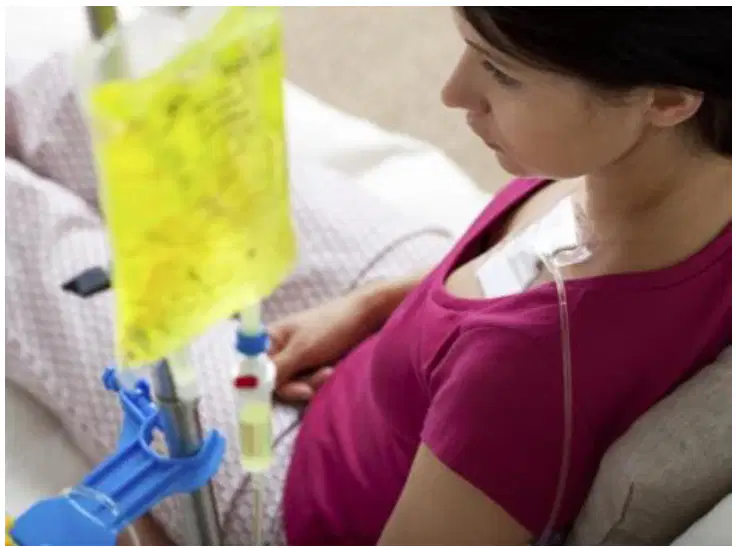
Which of the following diseases is an example of a condition that genomic medicine might be used to treat?
Hepatitis B
Influenza
Common cold
Chickenpox
Why might genomic medicine be considered for treating diseases like heart disease and cancer?
Because these diseases can have genetic components that influence their development and treatment.
Because they are caused by bacteria.
Because they are always contagious.
Because they only affect older adults.
What is the main goal of regenerative medicine?
To create living tissue to replace tissue or organ functions lost due to age, disease, injury, or birth disorder
To prevent all diseases from occurring
To develop new types of medication for pain relief
To improve physical fitness through exercise
Which type of cells are primarily used in regenerative medicine to create new tissue?
Red blood cells
Stem cells
Muscle cells
Nerve cells
Regenerative medicine could potentially help treat which of the following conditions?
Heart disease and diabetes
Common cold and flu
Broken bones only
Allergies and asthma

Which of the following is a current issue in healthcare in the United States?
Decreasing healthcare costs
Affordability: healthcare costs continue to rise
Universal access to healthcare
Overabundance of healthcare providers
Why is accessibility considered a current issue in healthcare?
Everyone has access to good healthcare
Not everyone has the money or ability to access good healthcare
Healthcare is free for all citizens
There are too many healthcare facilities
What is the main purpose of health maintenance organizations (HMOs) and preferred provider organizations (PPOs)?
To provide a structured way to manage healthcare services and costs
To create new medical treatments
To replace all private insurance companies
To eliminate the need for doctors
Which law was enacted to make healthcare more affordable and accessible in the United States?
Affordable Care Act
Diagnostic-related groups
Health maintenance organizations
Preferred provider organizations
Which of the following best describes a "career cluster"?
A group of similar occupations and industries that share a core set of basic knowledge and skills
A single occupation requiring advanced training
A list of unrelated jobs in different industries
A set of hobbies and interests
What is the main difference between a career cluster and a career pathway?
Career clusters are smaller than career pathways
Career pathways are groups of specialized occupations within a career cluster
Career clusters require more specific training than pathways
Career pathways include unrelated jobs
Which of the following is NOT listed as a career pathway under the Health Science career cluster?
Health Informatics
Therapeutic Services
Financial Services
Diagnostic Services
Why might a student choose to follow a specific career pathway within a career cluster?
To gain more specialized knowledge, skills, and training for a particular occupation
To avoid learning any new skills
To work in unrelated industries
To reduce the amount of training required
Which of the following is an example of a career pathway in the Health Science cluster?
Biotechnology Research and Development
Business Management
Culinary Arts
Information Technology
Which of the following is NOT one of the Health Science Career Pathways listed in the material?
Health Informatics Services
Therapeutic Services
Engineering Services
Diagnostic Services
If a student is interested in working with technology and data in healthcare, which Health Science Career Pathway would be most appropriate for them?
Therapeutic Services
Health Informatics Services
Support Services
Diagnostic Services
A hospital is looking to improve patient care by developing new medical treatments and equipment. Which Health Science Career Pathway should they focus on?
Support Services
Diagnostic Services
Biotechnology Research and Development
Therapeutic Services

Support Services in health science are most likely to include which of the following roles?
Laboratory technician
Medical coder
Hospital janitor
Pharmacist
Who were the earliest to keep accurate health records?
Greeks
Romans
Egyptians
Jewish
Who is known as The Father of Medicine?
Hippocrates
Einstein
Joseph Lister
Louis Pasteur
Who invented the microscope?
Hippocrates
Florence Nightingale
Anton van Leeuwenhoek
Joseph Lister
What is Edward Jenner known for?
Developed smallpox vaccination
Invented microscope
Father of Medicine
Invented stethoscope
Who discovered x-rays?
Florence Nightingale
Rene Laennec
Joseph Priestly
Wilhelm Roentgen
The ancient Chinese are credited with using what technique still used today by healthcare professionals?
acupuncture
amniocentesis
bloodletting
trepanation
During which time period did the bubonic plague occur?
Dark Ages
Middle Ages
Renissance
16th Century
Which of the following people developed the antibiotic Penicillin?
Wilhelm ron Roentgen
Francis Crick
Sir Alexander Fleming
Joseph Lister

Who was considered the founder of "modern nursing"?
Elizabeth Blackwell
Clara Burton
Florence Nightengale

Who founded the American Red Cross?
Clara Burton
Florence Nightengale
Rene Laennec
They were known as the first to develop public health, sanitation systems and filtration systems.
Romans
Chinese
Greek
Egyptians
This time period was known as the "rebirth of the science of medicine"?
Dark ages
Middle ages
Renaissance
18th Century
Which of the following time periods had the most advances in medicine and healthcare?
Dark Ages
19th Century
The Renaissance
20th Century
Which ancient civilization is known for developing early surgical techniques that influenced modern medicine?
Romans
Greeks
Egyptians
Chinese
What is a primary benefit of using electronic health records in modern healthcare?
They replace all medical equipment
They improve the accuracy and accessibility of patient information
They increase paperwork for hospitals
They eliminate the need for doctors
Which of the following best describes the role of biotechnology in health science?
Cleaning hospital facilities
Developing new drugs and therapies using living organisms
Managing patient billing
Providing only physical therapy
Which of the following is an example of how technology has improved patient care?
Fewer treatment options available
Increased paperwork for patients
Longer hospital stays for all patients
Electronic health records allow for better information sharing
What is a key feature of a holistic approach to healthcare?
Treating all patients the same way
Ignoring the patient's lifestyle
Considering mental, social, and spiritual health along with physical health
Focusing only on physical symptoms
Which of the following is an example of a holistic approach in healthcare?
Focusing solely on surgical interventions
Addressing a patient's physical, mental, and social needs
Prescribing medication without considering mental health
Treating only the physical symptoms of a disease
What was a major impact of the invention of the microscope on medicine?
It led to the discovery of anesthesia
It made surgery obsolete
It replaced the need for stethoscopes
It allowed doctors to see and study microorganisms
Which healthcare career pathway is primarily responsible for diagnosing diseases?
Support Services
Health Informatics
Diagnostic Services
Therapeutic Services
Which of the following is an example of a career cluster in the healthcare field?
Finance
Information Technology
Hospitality and Tourism
Health Science
What is the primary benefit of choosing a career pathway within a career cluster?
It provides experience in unrelated fields
It eliminates the need for further education
It guarantees immediate employment
It allows for focused training and preparation for a specific type of job
Which statement best explains the relationship between career clusters and career pathways?
Career pathways are specialized routes within broader career clusters
Career clusters only include entry-level jobs
Career clusters are more specific than career pathways
Career pathways and clusters are unrelated
Which ancient civilization is credited with developing the earliest known surgical techniques?
Chinese
Greeks
Egyptians
Romans
What is one major impact of the discovery of antibiotics on public health?
Increased spread of infectious diseases
Significant reduction in deaths from bacterial infections
Elimination of all viruses
Decrease in vaccination rates
Which of the following best describes the focus of biotechnology research and development in healthcare?
Improving hospital food services
Managing patient billing and insurance
Cleaning and maintaining hospital facilities
Developing new medical technologies and treatments
Which of the following is an example of a recent technological advancement in healthcare?
Bloodletting
Telemedicine platforms
Herbal poultices
Leech therapy
What is the main purpose of the Diagnostic Services pathway in Health Science?
To develop new medical devices
To provide direct patient care and treatment
To determine the causes of illnesses and diseases through testing and evaluation
To manage healthcare facilities
Which of the following statements best describes the impact of genomic medicine on patient care?
It eliminates the need for any medical testing
It replaces all traditional medical practices
It allows for treatments to be tailored to each individual's genetic profile
It focuses only on environmental factors
Who is credited with inventing the first practical stethoscope used in healthcare?
Joseph Lister
Sir Alexander Fleming
Edward Jenner
René Laennec
Which of the following best describes the purpose of Diagnostic Services in the Health Science career cluster?
To maintain hospital facilities
To determine the causes of illnesses and injuries
To provide financial advice to patients
To develop new medications
What is a major benefit of using telemedicine in modern healthcare?
It only works in urban areas
It increases the cost of healthcare
It eliminates the need for any medical professionals
It allows patients to receive care remotely
Which of the following is a challenge faced by patients in the U.S. healthcare system today?
Universal health insurance coverage
Easy access to affordable medications
Rising out-of-pocket expenses for medical care
Shorter hospital wait times for all patients
What is one potential advantage of using telemedicine in healthcare?
Improved access to care for people in remote areas
Limited communication with healthcare providers
Increased travel time for patients
Higher risk of infection from in-person visits
Which role is typically part of the Diagnostic Services pathway in Health Science?
Radiologic technologist
Hospital chef
Pharmacy cashier
Physical education teacher

