
 Worksheets
Civics Unit 1 Topic 1 Review
Total questions: 55
Worksheet time: 29mins
What is the key difference between a monarchy and a constitutional monarchy?
Monarchs in a constitutional monarchy serve for life
Constitutional monarchies limit the monarch’s power by law
Monarchs in constitutional monarchies are elected
Monarchies allow all citizens to vote
In an autocracy, who holds political power?
Elected representatives
Religious leaders
A single person with complete control
Small groups of elites
Which government type goes the farthest in restricting personal freedoms?
Autocracy
Monarchy
Totalitarianism
Oligarchy
Fascism is best described as:
A democratic government with free elections
A government that shares power with religious leaders
An authoritarian system emphasizing nationalism and state control
A monarchy with strict succession rules
In a presidential system, unlike a parliamentary system:
The head of state and head of government are the same person
The head of state is chosen by the legislature
The prime minister holds ceremonial duties only
The monarch shares power with the legislature
Which scenario best represents a unitary system?
States have equal power with the central government
The central government makes most decisions and gives limited authority to local governments
Local governments are fully independent
Citizens control both local and national governments directly
In a federal system, such as the U.S., power is:
Held entirely by the states
Shared between central and state governments
Granted only to the central government
Controlled by the military
A confederate system gives most political power to:
Central government
State or local governments
Elected national leaders
Religious institutions
The main advantage of having the president as both head of state and head of government is:
It limits presidential power
It unifies national representation and policymaking in one leader
It reduces the need for legislatures
It allows monarchs to control policy
A bicameral legislature differs from a unicameral legislature because:
It has no elected members
It has two houses or chambers instead of one
It is always stronger than the executive branch
It exists only in dictatorships
Which economic system emphasizes private ownership and profit?
Communism
Capitalism
Socialism
Theocracy
Review:Match the following Pictures with the correct System of government

Parliamentary

Confederal

Unitary

Federal
Which statement best explains why government is necessary?
To guarantee equal wealth for all people
To maintain order, resolve conflicts, and provide services individuals can’t provide alone
To replace all private organizations
To control citizens’ beliefs
Which example shows government promoting public health and safety?
A restaurant’s owner chooses its menu
A city health department inspects restaurant kitchens
A private club sells memberships
A company sets prices for its products
The social contract is the idea that government exists because:
Rulers inherit power from their parents
People give up some freedoms in exchange for protection and benefits
Armies conquer and hold power
Judges write all laws
Who argued that people are naturally selfish and need a strong, absolute ruler to prevent chaos?
Rousseau
Locke
Hobbes
Montesquieu
Max Weber defined government as holding a “monopoly of the legitimate use of physical force.” What does that mean?
Only dictators can lead
Government alone may lawfully use force to enforce laws and defend the community
Citizens may freely use force whenever they wish
Laws are unnecessary
Which action best serves the common good?
Selling public parks to private resorts
Repressive censorship of newspapers
Funding a public museum and maintaining city parks
Granting voting rights to only a few families
Which statement best distinguishes governance from government?
Governance is any group’s oversight; government is political authority making decisions for a community
Governance is military power; government is charity
Governance requires elections; government does not
Governance is only in monarchies
What can we infer about Athenian democracy from its citizenship rules?
It included all residents equally
It was direct and participatory but exclusive—only certain male citizens could participate
It allowed enslaved persons to vote
It used only random selection with no rules
After a hurricane, which statement best explains why multiple levels of government are involved?
Only local government can respond
Only federal government can respond
Local plans address immediate needs; the state coordinates resources; the federal government provides funding and expertise
Private companies handle all disaster response
Politics is best defined as:
Military decision-making
The process of debate, compromise, and competition to decide what government will do and who leads
Private business strategy
Judicial review of laws
Which government activity best prevents conflicts from escalating into violence?
Collecting art
Operating courts and enforcing laws through legitimate policing
Closing all schools
Eliminating elections
Which policy aligns most with John Locke’s ideas?
Government exists mainly to conquer neighbors
Government must protect natural rights (life, liberty, property); people may replace an unjust government
People must surrender all rights to rulers
Citizens should never question authority
Which statement reflects Rousseau’s view?
People are naturally brutish
The ruler alone decides the common good
People are sovereign; government should express the general will; resisting unjust government can be a duty
Rebellion is never justified
Which statement best contrasts Hobbes, Locke, and Rousseau on the right to rebel?
Hobbes: yes; Locke: no; Rousseau: no
Hobbes: no; Locke: yes; Rousseau: yes (even a duty)
Hobbes: yes; Locke: yes; Rousseau: no
All three reject rebellion
Which of the following is not a core reason governments are necessary?
Providing infrastructure and public goods
Ensuring public health and safety
Resolving disputes and maintaining order
Making everyone’s income identical
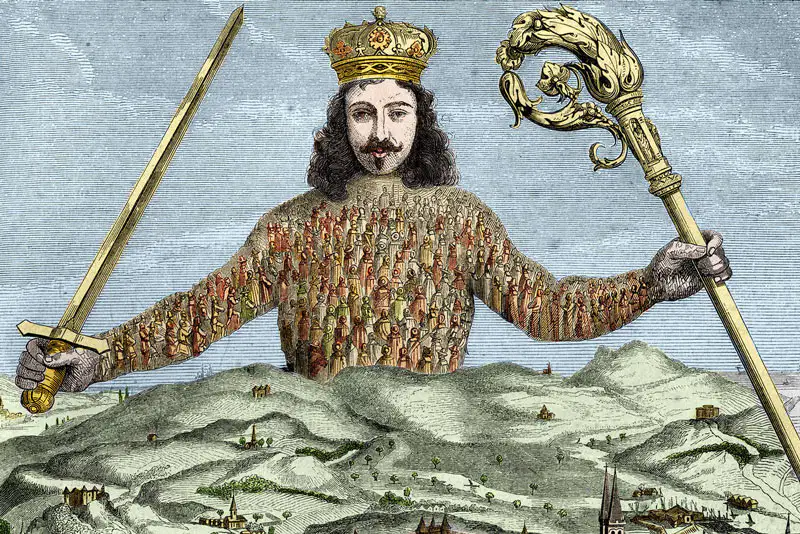
Which political idea was this image made to illustrate?
a sovereign derives their right to rule from the people.
Kings are like giants: they are monsters who terrorize their subjects.
Both cities and the countryside are important to a country's well-being.
Kings should be prepared to go to war at any time on behalf of their people.
Which political idea was this image made to illustrate?
a sovereign derives their right to rule from the people.
Kings are like giants: they are monsters who terrorize their subjects.
Both cities and the countryside are important to a country's well-being.
Kings should be prepared to go to war at any time on behalf of their people.
Which term would be used by later writers to describe the relationship depicted in this illustration?
separation of powers
checks and balances
divine right of kings
social contract
Use the quote to answer the question. "Because men enter society to protect their natural rights, when the government tries to take away or destroy the people's life, liberty, or property, the government puts itself in a state of war with the people." --John Locke, Second Treatise of Government, 1689
Which of the following did Locke believe about this "state of war"? Select two correct answers.
The government had failed in its purpose.
A foreign government would surely take over.
The state of nature would replace civil society.
The people would go to war with other nations.
There would no longer be an obligation to obey the government.
Use the quotation to answer the question.
"The people have made themselves masters of everything through decrees of the Assembly and decisions of the law courts, in which they hold the power."--Aristotle, The Athenian Constitution, 322 BCE
Which term describes the political system that Aristotle describes here?
autocracy
democracy
oligarchy
theocracy
Use the quotation to answer the question.
"The people have made themselves masters of everything through decrees of the Assembly and decisions of the law courts, in which they hold the power."--Aristotle, The Athenian Constitution, 322 BCE
Which people "held the power" under this system in ancient Athens?
all free men and women
free men who were citizens
residents of Athens age 14 and older
members of a small, hereditary ruling class
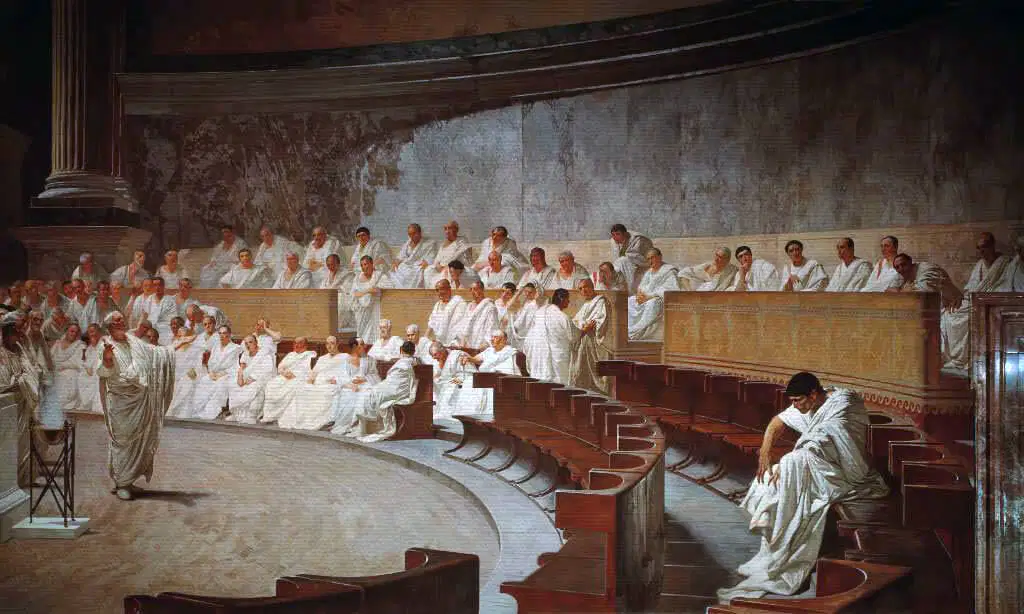
What was the official role in Roman society of the people depicted in this painting?
members of a ceremonial priesthood
oligarchs who directly made and enforced laws
advisors to other political leaders and lawmakers
judges who presided over lawsuits between private citizens
What does the change in the role of these people during the Roman Empire indicate about a larger shift in the government of ancient Rome?
Citizens now had a larger role in selecting leaders.
Government had become less representative of the people.
Democratic ideals had begun to play a more important role.
Power sharing had begun to take place across different levels of government.
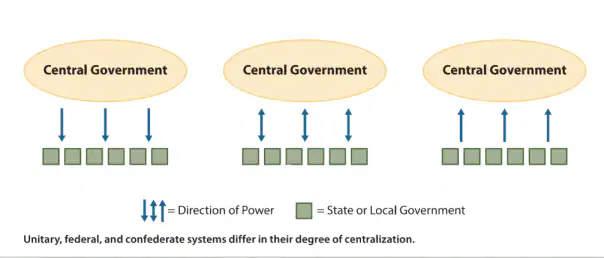
Use the image to answer the question. Which term describes the system of government shown at the left of the diagram?
confederate
federal
unicameral
unitary
Use the image to answer the question. Which part of the diagram matches the structure of the US government?
the left panel, with downward arrows
the central panel, with bidirectional arrows
the right panel, with upward arrows
all of the panels
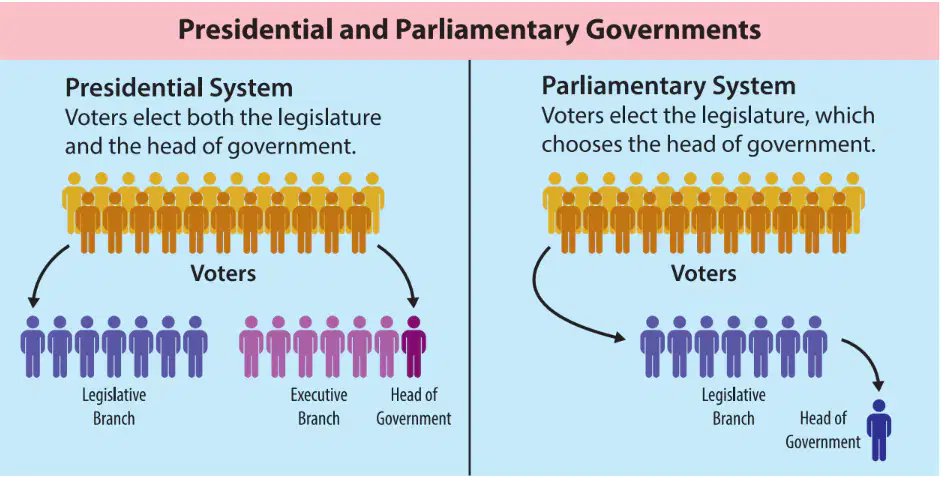
Use the diagram to answer the question.
The United Kingdom follows the parliamentary system of government. Based on this fact, which of these is a difference between the United Kingdom and the United States?
Parliament is popularly elected, but Congress is not.
British voters have no say in who leads their government.
The president is elected by citizens, but the prime minister is not.
The United States has an executive branch of government; the United Kingdom does not.

Use the quotation to answer the question. Which is an example of a US government practice that differs from Montesquieu's description of the three branches?
The president must ask Congress to authorize a declaration of war.
The Supreme Court settles disputes, including some between private individuals.
An executive agency controls the flow of people and goods across US borders.
Congress drafts and enacts new legislation to cope with the social effects of an emerging technology.
Use the quotation to answer the question. Which of these parts of the US government corresponds to the second branch in Montesquieu's analysis?
the Senate
the president
the Supreme Court
the House of Representatives
Use the quotation to answer the question. Which of these terms describes the principle that Montesquieu says is necessary for freedom?
the separation of powers
the costitution principle
the Montesquieu doctrine
the three-branches theory
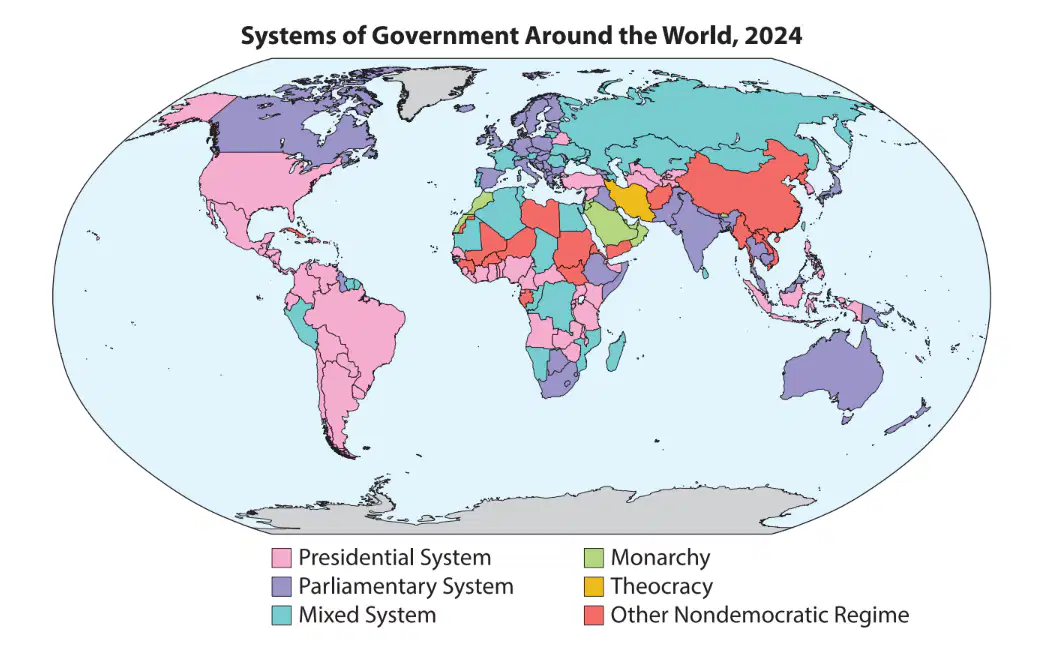
Use the map to answer the question.
Based on the categories used in the map, which continents have the greatest variety of systems of government?
Select the two correct answers.
Asia
Africa
Australia
North America
South America
What is the supreme law of the land in the United States?
Bill of Rights
Declaration of Independence
Constitution
Articles of Confederation
What does the Constitution do?
Creates political parties
Establishes the framework for the American government, defines its powers, and protects the basic rights of citizens
Grants the president unlimited power
Decides state tax rates
What does the phrase common good refer to?
Laws that only benefit the wealthy
Things a society is expected to provide or protect for everyone’s benefit
Personal freedoms only
The majority’s opinion
Which of the following is an example of a decision that serves the common good?
Selling park land to create a private resort
Repressive censorship
Protecting freedom
Allowing only some citizens to vote
What would happen if we had no government at all?
Everything would run smoothly
Chaos; important things wouldn’t get done
Everyone would be richer
There would be more cooperation
What type of government does the United States have?
Absolute monarchy
Republic and democracy
Dictatorship
Theocracy
How can citizens actively participate in government?
Voting
Contacting representatives
Campaigning
All of the above
Governance is best defined as:
The group that makes laws for a country
The act of overseeing and directing the resources, actions, and responsibilities of a group or place
Military rule
Voting in elections
Government is:
Any club or organization
The group or organization that makes decisions on behalf of the people in a political unit
The same as a monarchy
Only found in democracies
Why do people often disagree about the level of services government should provide?
More services cost more in taxes; fewer services cost less in taxes
People disagree about who should be president
Services always cause inflation
Services are free for everyone
What type of democracy did Athens have?
Representative democracy
Direct democracy
Constitutional monarchy
Parliamentary democracy
In the Roman Republic, what was the Senate’s official role?
To create all laws
To give advice to other parts of government
To elect emperors
To control the military only
Which statement correctly compares Athens and Rome?
Both had direct democracy
Athens used direct democracy; Rome used representative democracy
Rome had no elected leaders
Athens allowed women to vote

