
 Worksheets
Topic 4 Weekly Quiz - 21st Aug
Total questions: 10
Worksheet time: 36mins
The treasurer of a London-based insurance company expects that 3 years from today the company will receive GBP 800,000. The treasurer plans to invest the funds for 1 year after that and decides to lock in a rate of return on the funds at today's forward rate for the period. The current 3-year and 4-year spot rates are 1.5% and 2% respectively, and the company can borrow and lend at these rates. Assuming continuous compounding, how much interest income will the company earn in the 1-year period beginning 3 years from today, and what transactions should the treasurer enter into today in order to lock in this return?
Borrow at the 3-year spot rate and Invest at the 4-year spot rate to earn a return of GBP 28,000.
Invest at the 3-year spot rate and borrow at the 4-year spot rate to earn a return of GBP 16,000.
Borrow at the 3-year spot rate and Invest at the 4-year spot rate to earn a return of GBP 28,119.
Invest at the 3-year spot rate and borrow at the 4-year spot rate to earn a return of GBP 28,000.
A hedge fund manager who holds a portfolio of interest rate-sensitive positions has just received an economist's report forecasting a significant shift in interest rates. Accordingly, the manager wants to change the fund's interest rate exposure by investing in fixed-income securities with negative duration. Which of the following positions should the fund manager take?
A long position in a callable corporate bond
A long position in a putable corporate bond
An interest rate swap paying fixed and receiving LIBOR plus a spread
An interest rate swap paying LIBOR plus a spread and receiving fixed
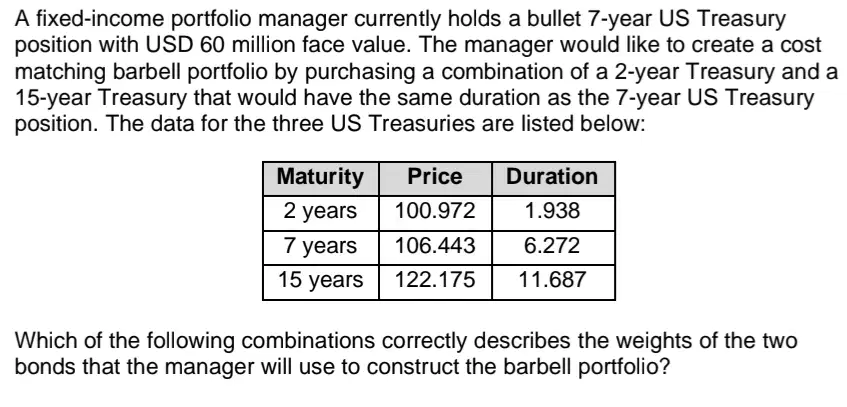
Weight of 2 year 14.22% and weight of 15 year is 85.78%
Weight of 2 year is 44.46% Weight of 15 year is 55.54%
Weight of 2 year is 55.54% Weight of 15 year is 44.46%
Weight of 2 year is 85.78% Weight of 15 year is 14.22%
A bond fund manager has requested quotes from a bond dealer on two bonds, Bond X and Bond Y, with the same maturity date and coupon rate. The dealer informs the manager that Bond X trades at a spread of 30 bps over the Treasury market, while Bond Y trades at a spread of 70 bps. Which of the following statements is a correct conclusion for the manager to make?
Bond X earns a lower return than that of the comparable Treasury bond, since its spread serves to increase the discount rate of its cash flows.
The price of Bond X is currently higher than the price of Bond Y.
To equate the present value of Bond Y's cash flows to its face value, 70 bps would need to be added to the yield to maturity of a Treasury bond with comparable maturity.
The spread differential indicates that there is a 0.4% difference in price between Bond X and Bond Y.
A portfolio manager uses a valuation model to estimate the value of a bond portfolio at USD 125.00 million. The term structure is flat. Using the same model, the portfolio manager estimates that the value of the portfolio would increase to USD 127.70 million if all interest rates fall by 20 bps and would decrease to USD 122.20 million if all interest rates rise by 20 bps. Using these estimates, which of the following is the effective duration of the bond portfolio closest to?
5.5
11
22
44
An analyst has been asked to check for arbitrage opportunities in the Treasury bond market by comparing the cash flows of selected bonds with the cash flows of combinations of other bonds. A 1-year zero-coupon bond is priced at USD 97 and a 1-year 7% coupon bond with semi-annual payments is priced at USD 102. Using a replication approach, what should be the price of a 1-year 6% coupon Treasury bond that pays semi-annually?
USD 97.71
USD 101.04
USD 101.29
USD 102.86
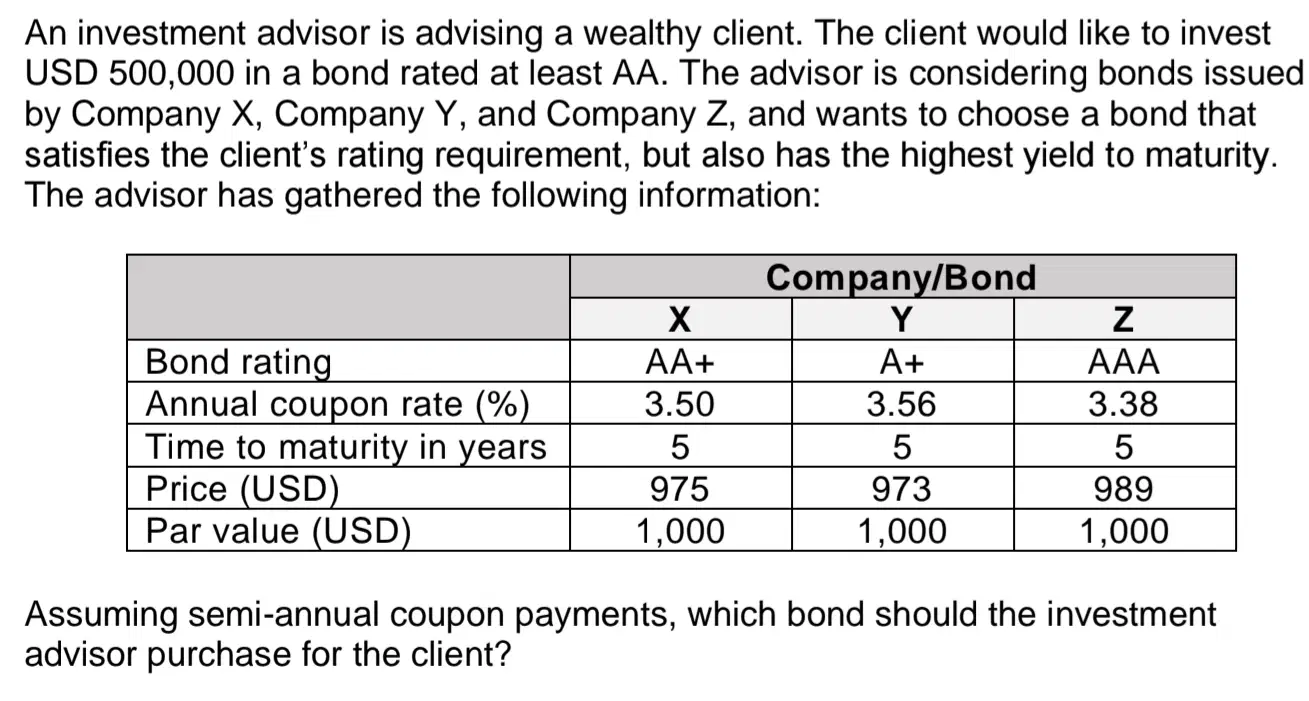
Bond X
Bond Y
Bond Z
Either Bond X or Bond Z
An investment analyst is calculating the forward bucket 01 of a bond. The bond pays a 5% coupon annually, has a face value of CNY 100,000, and matures in 3 years.
The analyst notes that the forward rate curve is flat at 3% (with all forward rates calculated for 1-year periods), and uses two forward buckets of 0-2 years and 2-3 years. What is the forward bucket 01 of the bond for the 2-3 year bucket, assuming an upward shift in interest rates of 1 basis point?
CNY 9.33
CNY 19.11
CNY 20.04
CNY 27.98
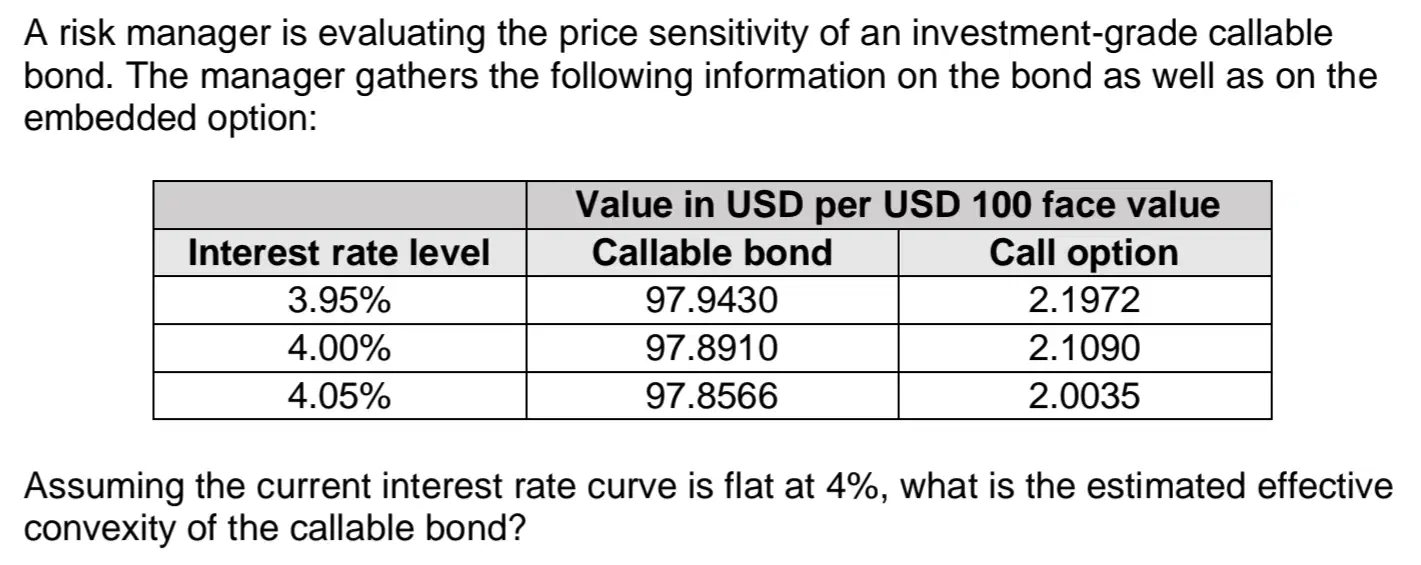
18
36
179
719.2
The cash prices of 6-month and one-year Treasury bill are 97.0 and 93.0. A 1.5-year 6% Treasury bond sells for 98.5. Calculate the 18-month spot rates assuming semi-annual compounding.
7.38%
6.18%
7.07%
7.39%

