
 Worksheets
UNIT TEST: CONSTITUTION (OMS)
Total questions: 72
Worksheet time: 2hrs 29mins
Which of the following was the first representative assembly in the American colonies?
The Federalist Papers were written by Alexander Hamilton, James Madison, and John Jay.
The main impact of their essays was that they —
helped secure the ratification of the US Constitution
The Federalist Papers were written by Alexander Hamilton, James Madison, and John Jay.
The main impact of their essays was that they —
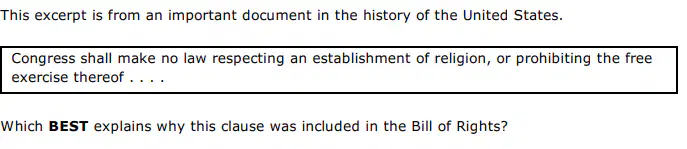
Congress shall make no law respecting an establishment of religion, or prohibiting the free exercise thereof . . . .
Which BEST explains why this clause was included in the Bill of Rights?
To protect religious freedom and Americans had a tradition of religious toleration.
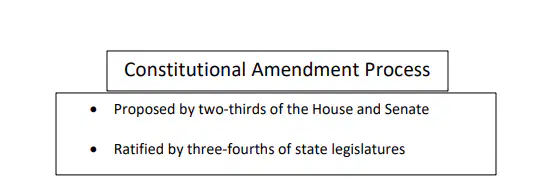
Which of the following BEST describes the purpose for amending the Constitution?
to revise the original wording of the Constitution
to clarify specific laws passed by Congress
to ensure the Constitution adapts to changing times
to grant additional powers to the President
Which statement BEST explains why the Intolerable Acts were important to the American Revolution?
They united the colonies against British oppression, and the idea of independence from Britain
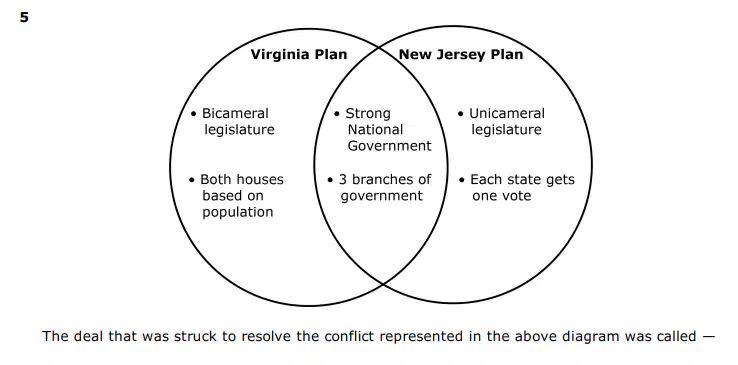
The deal that was struck to resolve the conflict represented in the above diagram was called —
What of the following is an example of the unalienable right...
How did the 1st Amendment protection of religious freedom affect US society in the early history of the country?
It prevented the government from making laws prohibiting the practice of certain religious beliefs.
Which of the following was one reason that George Mason refused to sign the U.S. Constitution?
The without a Bill of Rights, it did not protect the rights of individuals from potential abuse by the government.
How does the First Amendment strengthen democracy in the United States?
The First Amendment strengthens democracy by ensuring freedom of expression and express opinions and influence government decisions.
The Three-Fifths Compromise supported slavery by —
It supported slavery by increasing representation for slaveholding states. That enslaved people were not equal to free people when determining representation.
What geographic factor most encouraged the growth of cities like New York and Boston?
Which principle was established by the Supreme Court case Marbury vs. Madison?
Which of the following was one reason that George Mason refused to sign the U.S. Constitution?
The absence of a Bill of Rights, it did not protect the rights of individuals from potential abuse
How does the First Amendment strengthen democracy in the United States?
The First Amendment strengthens democracy by allowing citizens to express opinions and influence government decisions

The geographical conditions listed above BEST characterize which colonial region?
How does the First Amendment strengthen democracy in the United States?
Which description is an example of an unalienable right from the Declaration of Independence?
The right to life, liberty, and the pursuit of happiness.
Rights that are inherent to all people and cannot be taken away
What is one way the ideas from the English Bill or Rights are reflected in the US system of Government?
People have the right to petition the government for a grivance.
How does the First Amendment strengthen democracy in the United States?
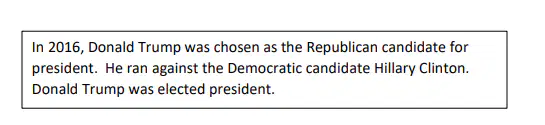
Which principle of government gives the American people the right to elect their leadership every four years?
A. Popular sovereignty
B. Separation of powers
C. Checks and balances
D. Federalism
Why would slave states be in favor of counting slaves as part of their total population?
to be required to pay less in taxes
to have more representation in the Legislative Branch
to gain more military presence in their areas
to charge lower prices for their goods

This was this addressed in the U.S. Constitution with the —
Quartering Act
(4 Walls)
The Northwest Ordinance was an act that provided rules for governing the Northwest Territory and paved the way for -
admission of new states to the Union
ratification of the U.S. Constitution
expansion of slavery to northern states
industrialization of the northern U.S.
George Mason and the Anti-Federalists were unwilling to ratify the Constitution before it contained a bill of rights because:
they wanted to ensure individual rights were protected.
they believed the Constitution was perfect as it was.
they wanted a stronger central government.
they supported the monarchy.
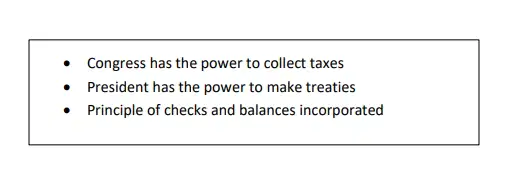
The bulleted list below is in response to issues that arose under the -
Three-Fifths Compromise
Declaration of Independence
Articles of Confederation
Magna Carta
Which description is an example of an unalienable right from the Declaration of Independence?
The right to Life, Liberty and Happiness

The information contained in the graphic organizer above supports the creation of which constitutional amendment?
First Amendment
Third Amendment
Fourth Amendment
Sixth Amendment
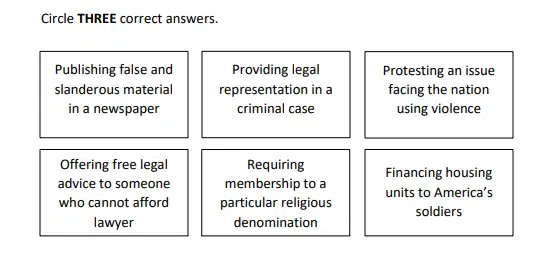
This graphic organizer describes an amendment in the Bill of Rights. Which detail demonstrates limits placed on the First Amendment?
Circle THREE correct answers.
Publishing false and slanderous material in a newspaper
Offering free legal advice to someone who cannot afford lawyer
Protesting an issue facing the nation using violence
Providing legal representation in a criminal case
Requiring membership to a particular religious denomination
How did the Articles of Confederation ensure that state governments would have more power over the national government?
States would partner with local Native tribes to defend their land.
Congress needed the approval of all states to pass amendments.
Executive actions required judicial approval.
The president advised state leaders regarding foreign trade.

Why would an Anti-Federalist have supported the above statement?
Anti-Federalists believed in a strong central government.
Anti-Federalists wanted a great American empire.
Anti-Federalists believed in a strong state government.
Anti-Federalists were loyal to the King of England.
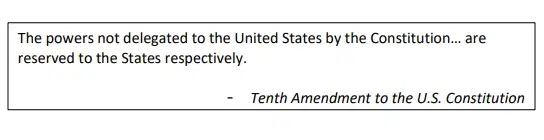
The ideas outlined in the amendment above reflect which principle of government?
Popular sovereignty
Republicanism
Judicial review
Federalism
"Nothing is more certain than the necessity of government, that whenever and however it is instituted, the people must cede to it some of their natural rights... It is well worthy of consideration therefore, to all general purposes, be one nation, under one federal government..."
- Federalist No.2
Which idea is BEST demonstrated above?
The power of the federal government belongs to the states.
The United States should have a strong, central government.
The United States should continue to operate as a confederacy.
The people of the United States do not need their natural rights protected.
Which of the following represents a protection guaranteed under the First Amendment?
Probable cause needed to obtain a search warrant
Excessive bail and fines cannot be imposed
Right to trial by jury in civil cases
Freedom of choice regarding religious membership
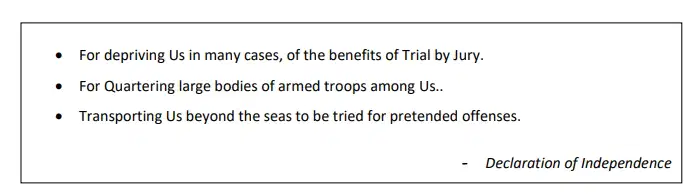
How did the Founding Fathers address these colonial grievances and protect the rights of American citizens?
Article III of the Constitution, which establishes the court system.
They are listed in the Declaration of Independence.
The problems are corrected in the Bill of Rights.
Article I of the Constitution, which allows Congress to tax.

Which of the following completes the graphic organizer about the Fifth Amendment, which includes: Protection from double jeopardy, No self-incrimination, and ?
Right to trial by jury
Due process of law
No cruel and unusual punishment
No unreasonable search and seizure
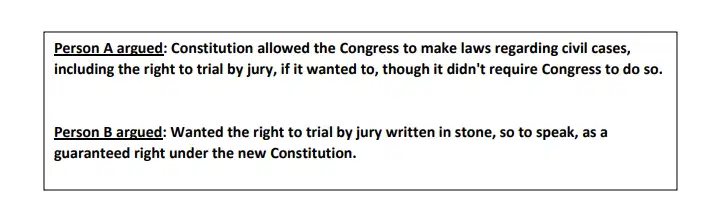
How can Person A and B BEST be classified?
A Northerner and Southerner arguing over the concept of states’ rights included in the Ninth Amendment.
A Federalists and Anti-Federalist arguing over the concept of the structure of the judicial branch.
A Northerner and Southerner arguing over ideas eventually included in the First Amendment.
A Federalist and Anti-Federalist arguing over ideas eventually included in the Seventh Amendment.
Which of the following scenarios BEST shows a violation of the Eighth Amendment?
The Gault brothers were accused of vandalizing their school. The boys were found guilty and received a punishment of 20 hours of community service.
Gerald Gault was caught cheating on his U.S. History test. He was given a zero on the test and had to serve two one-hour detentions.
The Gault brothers were accused of online bullying. They were accused of harassment and required to attend four counseling sessions.
Ronald Gault was caught shoplifting a book from his school’s book fair. He was arrested and punished with eight years in a juvenile detention center.
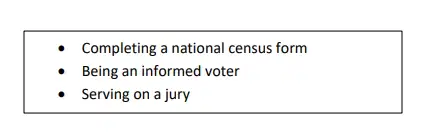
The bulleted actions above are identified as -
instances of civil disobedience
requirements of U.S. citizens once they turn 16
examples of responsible citizenship
unalienable rights granted to all humans
"During the Revolutionary War era, the British recognized that the colonists would use their weapons to defend themselves, so the British made efforts to confiscate as many weapons as they could without obtaining a writs of assistance."
Which constitutional amendment would have protected colonist against British?
Second Amendment
Fourth Amendment
Sixth Amendment
Tenth Amendment
"Does any man suppose that one general national government can exist in so extensive a country as this? I hope that a government may be framed which may suit us...the question then will be, whether a consolidated government can preserve the freedom and secure the rights of the people."
George Mason, 1788
in the importance of protecting individual liberties
a chief executive was needed to govern effectively
each state was capable of governing itself
altering the Articles of Confederation was unnecessary
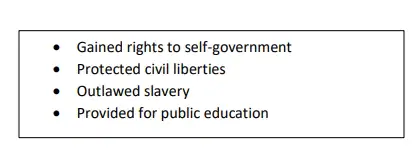
The above are important provisions outlined in which historical document?
Virginia Plan
Declaration of Independence
New Jersey Plan
Northwest Ordinance
Which of the following BEST describes religious freedom under the First Amendment?
A. Americans are required to follow a national religion.
B. Americans have the right to pray in public places.
C. Americans can be fined for not exercising their religious freedom.
D. Americans have the right to practice whatever religion they choose.

A written change to the Constitution
Preamble
Article
Amendment
Confederation

This author is expressing her opinion about -
recalling members of Congress
impeaching the President
disobeying the Supreme Court
amending the Constitution


Which government principle is illustrated in this diagram?
Federalism
Popular sovereignty
Republicanism
Separation of powers


The structure of our government as three branches is reflective of this constitutional principle:
Popular sovereignty
Separation of powers
Limited government
The social contract

Select One Correct Answer.
F
G
H
J


The ___ amendment grants us FIVE rights: The freedom of speech, press, religion, assembly, and to petition the government.
1st
3rd
5th
7th

F
G
H
J

F
G
H
J

Which principle of U.S. government is illustrated in the sequence shown?
Judicial Review
Checks and Balances
Popular Sovereignty
Federalism

F
G
H
J

Which term is defined as the system created to keep any one branch of government from becoming too powerful?
Popular Sovereignty
Checks and Balances
Federalism
Suffrage
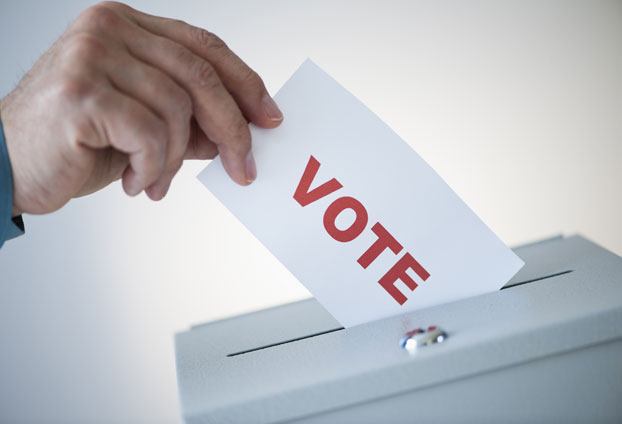


The Declaration of Independence states that the government gets its power from the people.
This is an example of ____.
judicial reveiw
separation of powers
federalism
popular sovereignty

Which government principle is shown?
Republicanism
Popular Sovereignty
Federalism
Separation of Powers

Which ideas in our constitition address the US mentioned in this excerpt from the Declaration of Independence?
People choose government officials in elections
There are three branches of government
People have freedom of religion
There are nine members of the Supreme Court

Which constitutional principle created the three branches of government?

A
B
C
D

A
B
C
D

A
B
C
D

