
 Worksheets
Physical Science: Ch 4: Gravity and Satellite Motion
Total questions: 40
Worksheet time: 3600secs
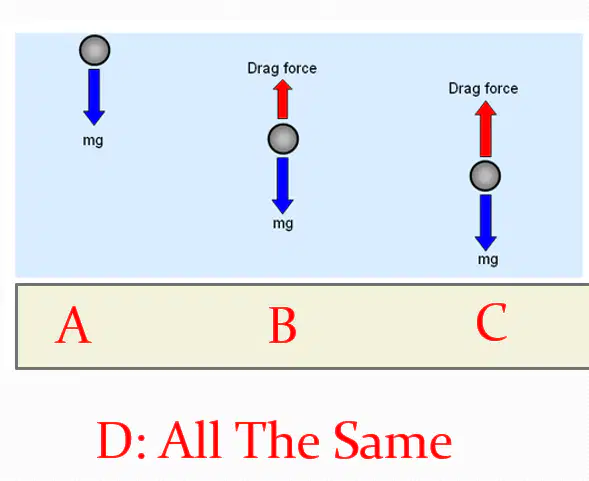
NOT in a vacuum; there is friction with the air/atmosphere:
1) The ball's acceleration is 10 m/s/s
2) The greatest weight
3) Acceleration is 0 m/s/s
1: A
2: D
3: C
1: A
2: D
3: B
1: B
2: D
3: C
1: B
2: A
3: C
1: D
2: A
3: A
NOT in a vacuum; there is friction with the air/atmosphere:
1) Constant velocity
2) Acceleration is > 0 but < 10 m/s/s
1: C
2: B
1: C
2: D
1: B
2: D
1: B
2: A
1: D
2: A
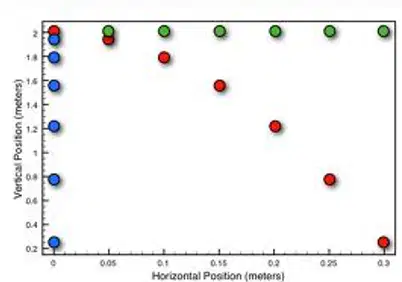
What is the graphic displaying?
All objects, regardless of mass, fall with the same acceleration in a vacuum
Air resistance
Two components to projectile motion
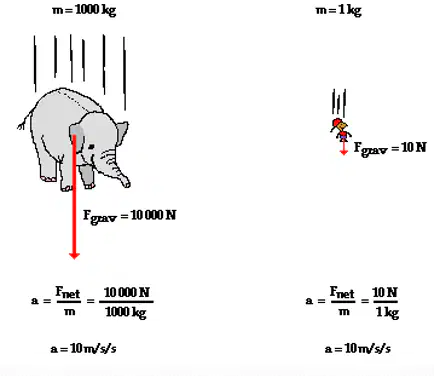
What is the graphic displaying?
All objects, regardless of mass, fall with the same acceleration in a vacuum
Air resistance
Two components to projectile motion
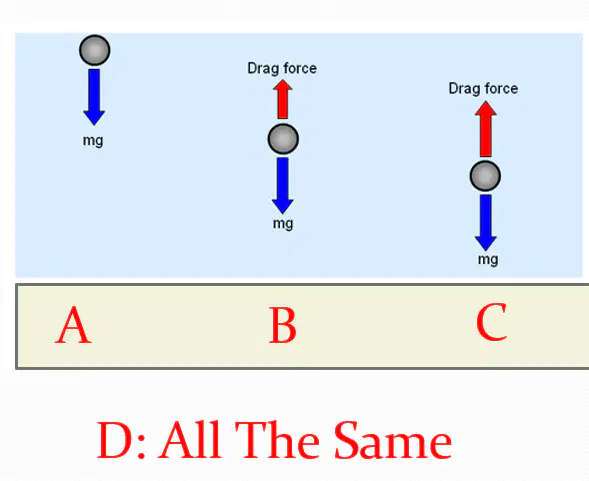
What is the graphic displaying?
All objects, regardless of mass, fall with the same acceleration in a vacuum
Air resistance
Two components to projectile motion
T / F: An object could have two forces acting on it, yet they cancel each other to zero, and the object still has velocity.
T / F: An object could have two forces acting on it, yet they cancel each other to zero, and the object can have zero velocity.
1: T
2: T
1: F
2: F
1: T
2: F
1: F
2: T
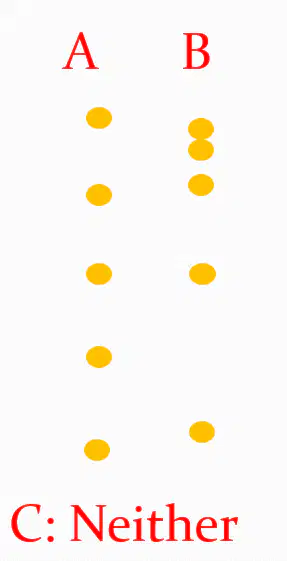
1) Which object covers the same distance each second?
2) Which travels with constant velocity?
3) Which travels with constant acceleration?
4) Which covers more distance than the preceding second?
5) Which is in free-fall?
1: A
2: A
3: B
4: B
5: B
1: A
2: A
3: A
4: B
5: B
1: A
2: A
3: B
4: B
5: A
1: B
2: A
3: B
4: B
5: B
1: A
2: A
3: B
4: A
5: A
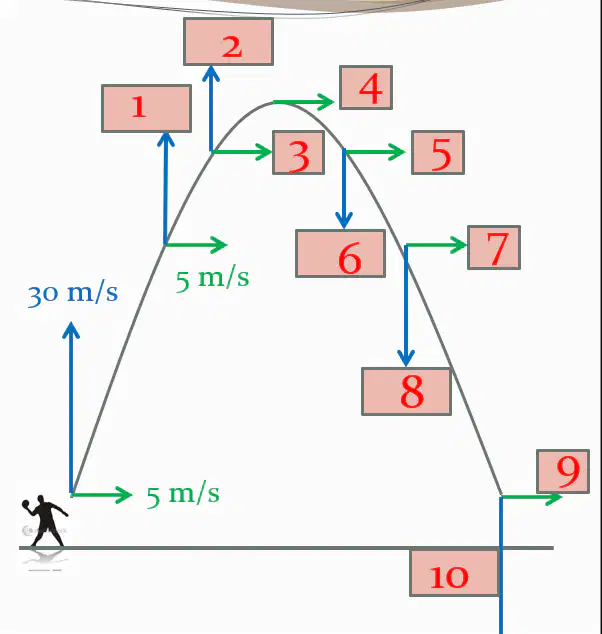
What are the speeds for 1-5?
1: 20 m/s
2: 10 m/s
3: 5 m/s
4: 5 m/s
5: 5 m/s
1: 10 m/s
2: 0 m/s
3: 5 m/s
4: 5 m/s
5: 5 m/s
1: 20 m/s
2: 10 m/s
3: 5 m/s
4: 10 m/s
5: 15 m/s
1: 5 m/s
2: 5 m/s
3: 5 m/s
4: 10 m/s
5: 15 m/s
1: 5 m/s
2: 5 m/s
3: 10 m/s
4: 20 m/s
5: 30 m/s
What are the speeds for 6-10?
6: 10 m/s
7: 5 m/s
8: 20 m/s
9: 5 m/s
10: 30 m/s
6: 5 m/s
7: 10 m/s
8: 5 m/s
9: 20 m/s
10: 5 m/s
6: 0 m/s
7: 5 m/s
8: 10 m/s
9: 5 m/s
10: 20 m/s
6: 20 m/s
7: 5 m/s
8: 30 m/s
9: 5 m/s
10: 40 m/s
6: 10 m/s
7: 5 m/s
8: 10 m/s
9: 5 m/s
10: 10 m/s
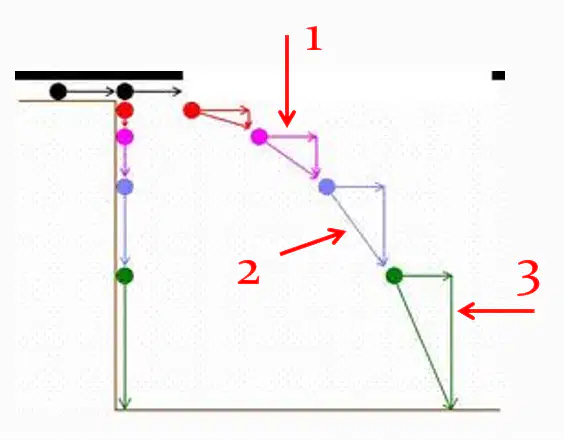
A) Horizontal Component
B) Vertical Component
C) Resultant of two vectors
1: A
2: C
3: B
1: A
2: B
3: C
1: B
2: C
3: A
1: C
2: A
3: B
1: B
2: A
3: C
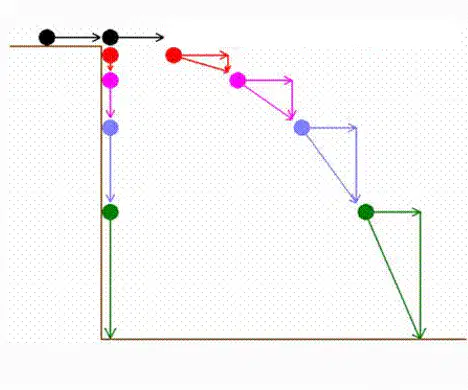
1) Which component of motion is constant?
2) Which is changing?
3) Which does gravity affect?
4) Which does inertia control?
A: Horizontal B: Vertical
1: A
2: B
3: B
4: A
1: B
2: A
3: A
4: B
1: A
2: A
3: B
4: B
1: A
2: A
3: B
4: A
1: B
2: B
3: B
4: A
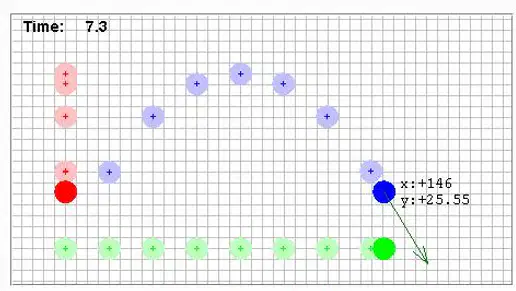
1) The green represents: 2) The red represents:
3) The blue represents: 4) Which component accelerates?
5) Which has constant velocity? 6) Inertia is being exemplified by:
7) Which is gravity influencing?
A: Vertical B: Horizontal C: Trajectory
1: B
2: A
3: C
4: A
5: B
6: B
7: A
1: A
2: B
3: C
4: B
5: A
6: A
7: B
1: B
2: B
3: C
4: A
5: A
6: B
7: A
1: A
2: A
3: C
4: B
5: B
6: A
7: A
1: C
2: A
3: B
4: A
5: B
6: B
7: A

1) Which is accelerating quickly?
2) Which is decelerating?
3) Which represents no motion?
4) Which is neither accelerating nor decelerating?
1: B
2: A
3: E
4: C
1: D
2: A
3: E
4: C
1: B
2: A
3: C
4: E
1: A
2: B
3: E
4: C
1: B
2: D
3: E
4: C
In one hand is a gun, pointed straight ahead. In the other hand, I am holding a bullet at the same height of the gun. If I shoot the gun at the same time as I let go of the bullet, will both bullets hit the ground (assuming a flat surface) at the same time?
Yes, gravity pulls down both bullets with the same force and resulting acceleration, regardless of horizontal motion
No, the large horizontal speed of the bullet greatly delays the bullet's impact to the surface
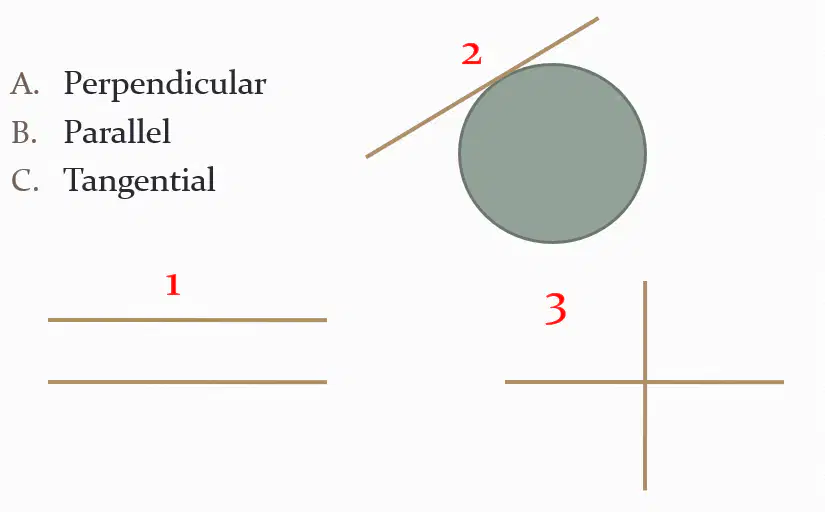
A) Perpendicular
B) Parallel
C) Tangential
1: B
2: C
3: A
1: A
2: B
3: C
1: C
2: B
3: A
1: B
2: A
3: C
1: A
2: C
3: B
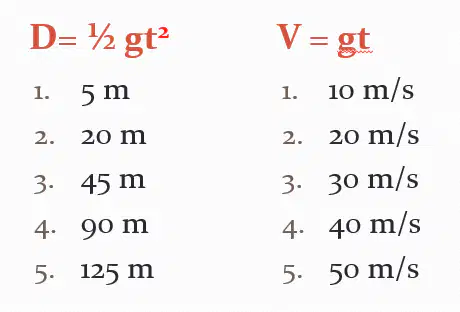
Properties of a falling object:
1) Which value is increasing at a constant rate?
A) Distance B) Velocity
2) Which value is increasing at a variable rate?
A) Distance B) Velocity
1: B
2: A
1: A
2: B
Properties of a falling object:
1) After 10 seconds, what is the distance traveled of the falling object?
2) After 10 seconds, what is the velocity of the falling object?
1: 500 m
2: 100 m/s
1: 1000 m
2: 100 m/s
1: 500 m
2: 10 m/s/s
1: 50 m
2: 100 m/s
1: 100 m/s
2: 500 m

No matter how fast the pitcher throws the ball (horizontal component), gravity will still pull it down 5 meters in one second (the vertical component).
T / F
True
False
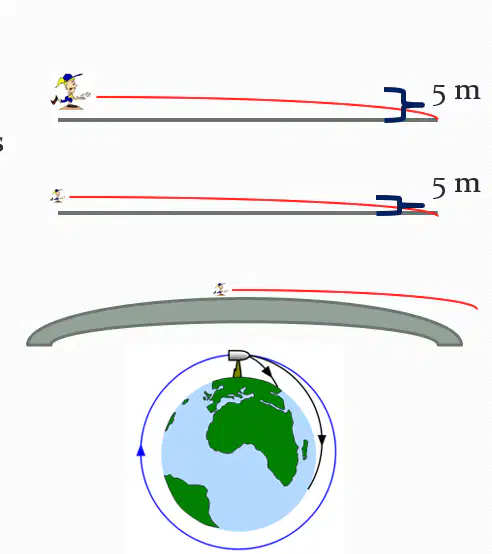
Going from projectile to ___.
But Earth is not an ___ long, flat plane.
On average, Earth curves 5 meters for every ___ meters.
So if the pitcher was Superman, he could throw a pitch from Mt. Everest at 8 km/s, and the ball would circle Earth and hit him in the back of the ___. (Ignoring air ___)
1: satellite
2: infinitely
3: 8000
4: head
5: friction
1: satellite
2: infinitely
3: 5
4: head
5: friction
1: trajectory
2: infinitely
3: 8000
4: head
5: friction
1: satellite
2: friction
3: 8000
4: head
5: infinitely
1: head
2: infinitely
3: 8000
4: satellite
5: friction
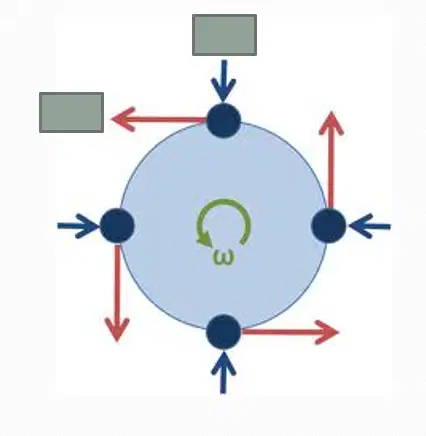
What do the blue arrows represent?
What do the red arrows represent?
1: Gravity
2: Tangential velocity
1: Tangential velocity
2: Gravity
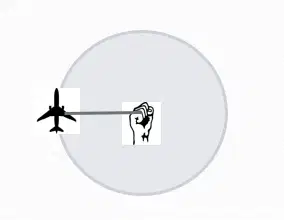
Without the centripetal (center directed) force provided by the closed hand, what will be the trajectory of the plane?


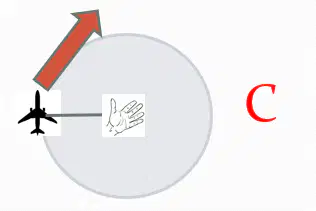
Circular Motion
Applying a force ___to its direction of motion causes the object to change direction but not speed.
Earth’s gravitational force causes a satellite in circular orbit to change direction but not ___.
Circular motion requires the application of a constant force directed toward the ___of the circle.
1: perpendicular
2: speed
3: center
1: parallel
2: speed
3: center
1: perpendicular
2: acceleration
3: tangent
1) Directional value 2) Dimensionless value
3) Two can cancel each other to zero 4) Can never be canceled out
5) Velocity 6) Speed
7) Friction 8) Force
A: Scalar B: Vector
1: B
2: A
3: B
4: A
5: B
6: A
7: A
8: B
1: A
2: B
3: A
4: B
5: A
6: B
7: B
8: A
1: B
2: A
3: A
4: B
5: B
6: A
7: A
8: B
1: B
2: A
3: B
4: A
5: B
6: A
7: B
8: A
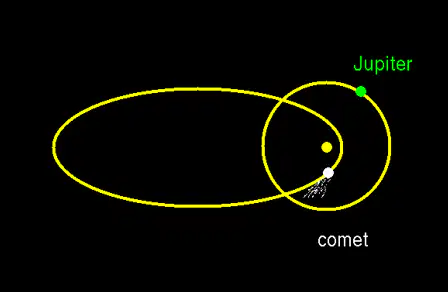
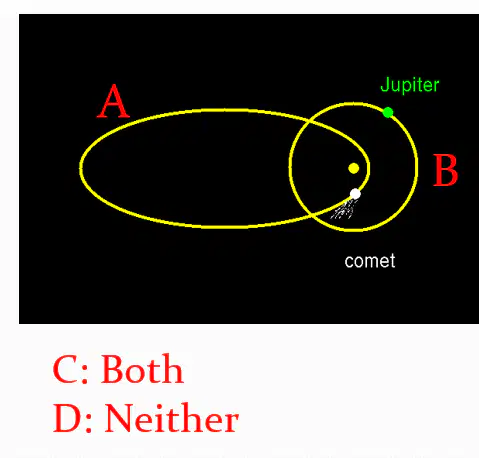
1) The type of orbit for Jupiter?
2) The type of orbit for a comet?
1: Circular (mostly)
2: Elliptical
1: Elliptical
2: Circular (mostly)

1) T/F: Actually, all the planets move in slightly elliptical orbits.
2) T/F: Pluto moves in a more extreme elliptical orbit than the 8 planets.
3) T/F: Pluto's orbit is inclined 17 degrees from the elliptical plane the 8 planets travel in.
4) T/F: Comets move in circular (mostly) orbits.
1: T
2: T
3: T
4: F
1: F
2: F
3: F
4: T
1: T
2: F
3: F
4: F
1: T
2: T
3: F
4: F
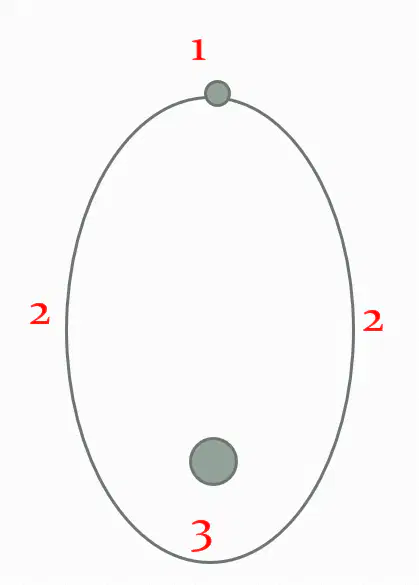
Acceleration = change in velocity
Velocity = speed and direction
1) Which orbit displays acceleration for its orbiting object?
2) T/F: A car driving in a circle with a constant speed is accelerating.
1: C
2: T
1: A
2: T
1: B
2: T
1: C
2: F
1: A
2: F

1) The velocity of the planet is ___ to its orbital path/trajectory around the Sun.
2) The force of gravity is ___ to its orbital motion.
A: Perpendicular B: Parallel C: Tangential
1: C
2: A
1: C
2: B
1: A
2: A
1: A
2: B
1: A
2: C
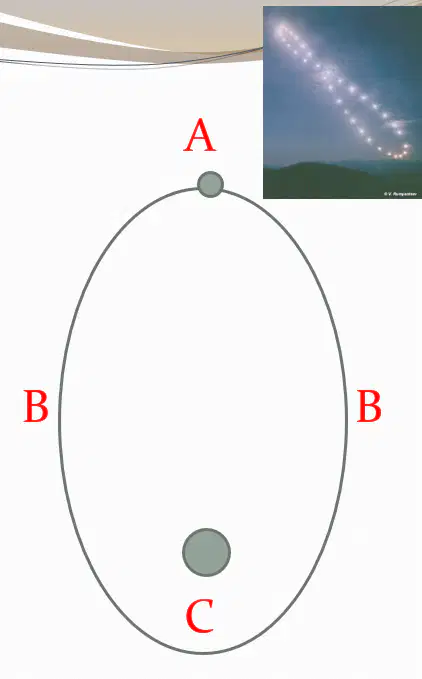
Energy Is Always Conserved. It May Change Form, But the Total Is Always the Same
A: PE 50 joules, KE 50 joules
B: PE 90 joules, KE 10 joules
C: PE 10 joules, KE 90 joules
1: B
2: A
3: C
1: A
2: B
3: C
1: A
2: C
3: B
1: B
2: C
3: A
1: C
2: A
3: B
Energy Is Always Conserved. It May Change Form, But the Total Is Always the Same
1) Where does the satellite have the fastest speed?
2) The slowest speed?
1: 3
2: 1
1: 1
2: 3
1: 2
2: 2
A picture of the Analemma for the northern hemisphere.
1) If Earth has an elliptical orbit, do the hours of daylight change at a constant rate? Y or N
2) Where is Earth located in its orbit in the month of June?
3) In the month of December?
1: N
2: A
3: C
1: Y
2: A
3: C
1: N
2: C
3: A
1: Y
2: B
3: C
1: N
2: A
3: B
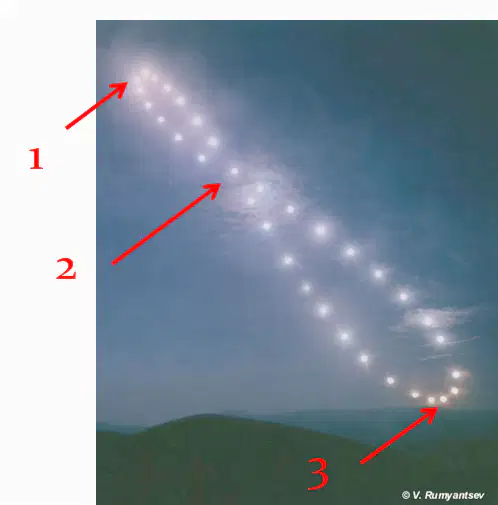
Analemma (Northern Hemisphere)
A) March 22 and September 22
B) Dec 21
C) June 21
1: C
2: A
3: B
1: B
2: A
3: C
1: A
2: B
3: C
1: C
2: B
3: A
1: B
2: C
3: A
1) What creates the seasons (summer, fall, winter, spring)?
2) What creates the day and night cycle?
3) What creates the analemma being uneven?
A: Earth's elliptical orbit B: Earth's rotation C: Earth's 23.5 degree tilt of its axis
1: C
2: B
3: A
1: B
2: C
3: A
1: A
2: B
3: C
1: C
2: A
3: B
1: B
2: A
3: C
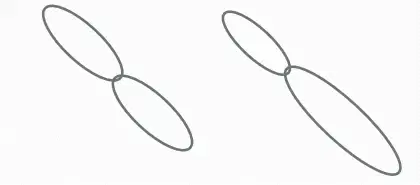
Would Earth have an even/equal analemma structure if the planet had a perfectly circular orbit around the Sun?
Yes
No

1) Energy Is Always Conserved. It May Change Form, But the Total Is Always ___.
2) Perigee
3) Apogee
1: the same
2: B
3: A
1: less
2: B
3: A
1: more
2: A
3: B
1: zero
2: A
3: B
1) Energy is measured in units of ___.
2) Power is measured in units of ___.
3) Force is measured in units of ___.
1: joules
2: watts
3: Newtons
1: Newtons
2: joules
3: watts
1: watts
2: joules
3: Newtons
1: joules
2: Newtons
3: watts

The Universal Law of Gravitation:
1) If either of the masses increase, the gravitational force ___.
2) If the distance between the masses increases, the gravitational force ___.
3) If the distance between the masses decreases, the gravitational force ___.
1: increases
2: decreases
3: increases
1: decreases
2: increases
3: decreases
1: increases
2: increases
3: decreases
1: decreases
2: decreases
3: increases

What is the resulting effect on the strength of the gravitational force between these two objects?
Answer 1, 3, 5
1: 10
3: 1/4
5: 4
1: 1/10
3: 4
5: 1/4
1: 10
3: 1/2
5: 4
1: 10
3: 1/4
5: 1/4
1: 10
3: 1/4
5: 1/2
What is the resulting effect on the strength of the gravitational force between these two objects?
Answer 2, 4, 6
2: 100
4: 1/9
6: 25
2: 10
4: 1/9
6: 25
2: 100
4: 1/3
6: 25
2: 100
4: 1/9
6: 50
2: 10
4: 1/3
6: 50

What is the resulting change in the strength of the force of gravitation between these two masses?
Answer 7, 9, 11
7: 1
9: 1/100
11: 40
7: 2
9: 1/100
11: 40
7: 1
9: 1/10
11: 40
7: 1
9: 1/100
11: 20
7: 1
9: 1/100
11: 1/40
What is the resulting change in the strength of the force of gravitation between these two masses?
Answer 8, 10, 12
8: 20
10: 8
12: 50
8: 1/20
10: 8
12: 50
8: 20
10: 1
12: 50
8: 20
10: 8
12: 100
8: 20
10: 2
12: 50

