
 Worksheets
002300 KIA
Total questions: 30
Worksheet time: 15mins
Four inductance connected in parallel, what will the equivalent inductance (Lt) of the circuit be?
Less than the smallest individual inductor in the series
Bigger than the biggest individual inductor in the series
Will be the same though out the circuit
Bigger than the smallest individual inductor in the series
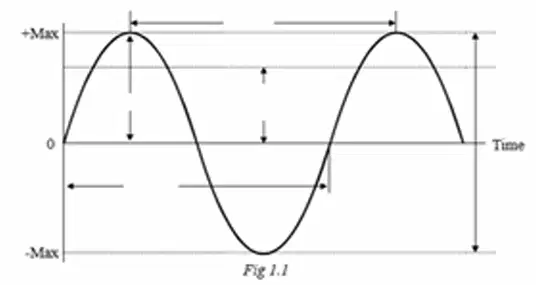
Refer to figure the positive or negative maximum value is known as?
RMS value
Peak Value
Peak to Peak value
Average value
What is the unit of time?
Hertz
Seconds
Volts
Amps
What is the unit of charge?
Farad (F)
Volts (V)
Coulomb (C)
Ohm (Ω)
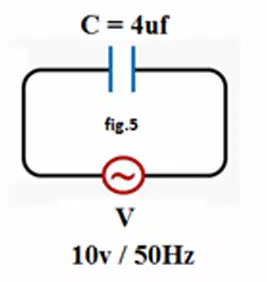
Calculate the capacitive reactance (Xc) of the circuit in figure
795.78 Ω
1.256 Ω
795.78 K Ω
1.256 m Ω
Four capacitors connected in parallel, what will the equivalent capacitance (Ct) of the circuit be?
Less than the smallest individual capacitance in the series
Bigger than the biggest individual capacitance in the series
Will be the same though out the circuit
Bigger than the smallest individual capacitance in the series
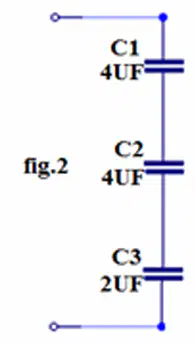
Calculate the total capacitance (Ct) of the circuit in figure.
10uF
1uF
0.1uF
10mF
Four inductance connected in series, what will the equivalent inductance (Lt) of the circuit be?
Less than the smallest individual inductor in the series
Bigger than the biggest individual inductor in the series
Will be the same though out the circuit
Bigger than the smallest individual inductor in the series
Calculate frequency of a waveform given its Periodic Time (T) = 1 us.
0.1 MHz
1 MHz
1 KHz
0.1 KHz
Calculate the total inductance (Lt) of the circuit in fig.3.
8mH
8H
0.063mH
0.63mH
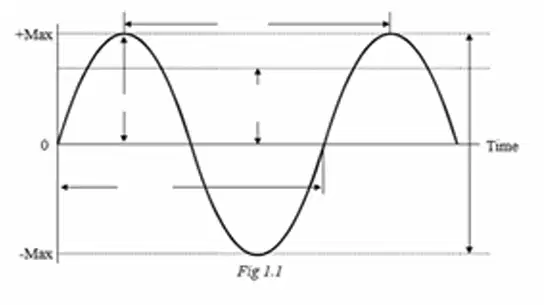
Refer to fig.1.1; one complete variation of the waveform is known as:
Cycle
Frequency
Cycles per minute
Frequency per minute
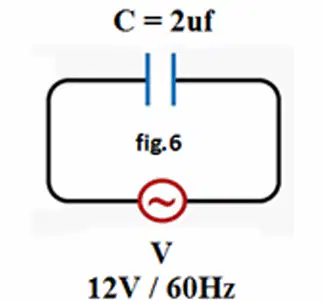
Calculate the capacitive reactance (Xc) of the circuit in fig.6.
1326.29 Ω
0.7539 m Ω
1326.29 K Ω
132.629 Ω
Three capacitors connected in series, what is the total charge (Qt) across each capacitor?
The charge will be the same value though out the circuit.
The charge is smaller in C1 then C2 and C3.
The charge will be different value though out the circuit.
The charge is bigger in C1 then C2 and C3.
Calculate frequency of a waveform given its Periodic Time (T) = 20s.
0.05 Hz
0.5 Hz
5 Hz
0.005 Hz
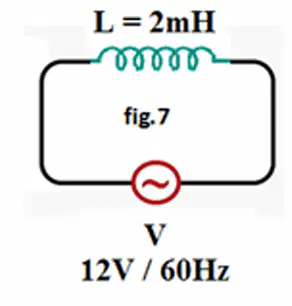
Calculate the inductive reactance (XL) of the circuit in fig.7.
0.754 Ω
1.326 Ω
7.54 Ω
0.1326 Ω
Calculate the Periodic Time (T) of a waveform given its frequency =1 KHz.
1 ms
1 s
1 us
1 ps
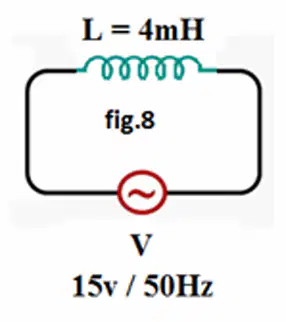
Calculate the inductive reactance (XL) of the circuit in fig.8.
1.26 Ω
0.794 Ω
0.126 Ω
7.94 Ω
Three capacitors connected in parallel, what is the total capacitance (Ct) of the circuit?
Ct =C1 +2 +C3
1/Ct =1/C1 + 1/C2 + 1/C3
Ct =C1 =C2 =C3
Ct =C1 x C2 x C3
Four capacitors connected in series, what will the equivalent capacitance (Ct) of the circuit be?
Less than the smallest individual capacitance in the series
Bigger than the biggest individual capacitance in the series
Will be the same though out the circuit
Bigger than the smallest individual capacitance in the series
What is the unit of frequency?
Hertz
Seconds
Volts
Amps
Calculate the Periodic Time (T) of a waveform given its frequency = 2 KHz.
2ms
0.5ms
2s
0.5s
Three inductance connected in series, what is the total inductance (Lt) of the circuit?
Lt = L1 +L2 +L3
1/Lt = 1/L1 + 1/L2 + 1/L3
Lt = L1 =L2 =L3
Lt = L1 xL2 xL3
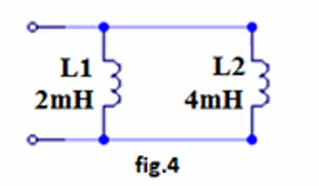
Calculate the total inductance (Lt) of the circuit in fig.4.
0.133 mH
1.33mH
1. 5 mH
0.15 mH
Three inductance connected in parallel, what is the total inductance (Lt) of the circuit?
Lt =L1 +L2 +L3
1/Lt =1/L1 +1/L2 +1/L3
Lt =L1 =L2 =L3
Lt =L1 xL2 xL3
Three capacitors connected in parallel, what is the total charge (Qt) across each capacitor?
Qt = Q1 +Q2 +Q3
1/Qt = 1/Q1 +1/Q2 +1/Q3
Qt =Q1 =Q2 =Q3
Qt =Q1 xQ2 xQ3
Three inductance connected in series, what is the total voltage (Vt) across each inductor?
Vt = V1 +V2 +V3
1/Vt = 1/V1 + 1/V2 + 1/V3
Vt = V1 =V2 =V3
Vt = V1 x V2 x V3
What is the unit of inductance?
Farad (F)
Volts (V)
Henry (H)
Ohm (Ω)
Three capacitors connected in series, what is the total capacitance (Ct) of the circuit?
Ct = C1 +2 +C3
1/Ct = 1/C1 +1/C2 +1/C3
Ct = C1 =C2 =C3
Ct = C1 xC2 xC3
how is the RMS value calculated?
63% x Peak Value
0.707 x Peak value
63% x Peak to Peak value
0.707 x Peak to Peak value
the number of cycles completed in one second is known as?
frequency
cycle
periodic time
peak value

