
 Worksheets
BIOTECH FIRST QUARTER ASSESSMENT 8-STE
Total questions: 45
Worksheet time: 2hrs 53mins

Modern Applications of Biotechnology
Farmers today use biotechnology to grow crops resistant to pests, while doctors use biotechnology to produce insulin for patients with diabetes. Biotechnology also helps clean polluted water using microorganisms.
Which BEST describes biotechnology?
Using machines to increase crop yield
Application of technology to living organisms for useful purposes
Growing plants only in soil-free environments
Developing new fertilizers for plants
Modern Applications of Biotechnology
Farmers today use biotechnology to grow crops resistant to pests, while doctors use biotechnology to produce insulin for patients with diabetes. Biotechnology also helps clean polluted water using microorganisms.
Which is a product of biotechnology used in medicine?
Penicillin
Vitamin C tablets
Human insulin produced by bacteria
Calcium supplements
Modern Applications of Biotechnology
Farmers today use biotechnology to grow crops resistant to pests, while doctors use biotechnology to produce insulin for patients with diabetes. Biotechnology also helps clean polluted water using microorganisms.
Which of the following is NOT an example of biotechnology?
Fermentation of milk to make yogurt
Breeding drought-resistant rice
Boiling water to kill germs
Using bacteria to produce vaccines
Environmental Biotechnology
Scientists are developing bacteria that can eat oil spills in the ocean. These bacteria help protect aquatic life by reducing pollution.
The use of bacteria to remove oil from the ocean is called:
Bioremediation
Photosynthesis
Fossil fuel conversion
Bioaccumulation
Environmental Biotechnology
Scientists are developing bacteria that can eat oil spills in the ocean. These bacteria help protect aquatic life by reducing pollution.
What is the MAIN benefit of bioremediation?
Reduces soil fertility
Produces more fossil fuels
Cleans up environmental pollutants naturally
Increases greenhouse gases
Environmental Biotechnology
Scientists are developing bacteria that can eat oil spills in the ocean. These bacteria help protect aquatic life by reducing pollution.
Why is biotechnology important in agriculture?
It prevents farmers from using irrigation systems
It allows production of genetically modified crops resistant to pests
It increases soil erosion
It prevents farmers from using fertilizers
Environmental Biotechnology
Scientists are developing bacteria that can eat oil spills in the ocean. These bacteria help protect aquatic life by reducing pollution.
A student claims: “All biotechnology products are harmful.” Is this TRUE or FALSE?
TRUE, because all biotechnology is artificial
FALSE, because many biotechnology products improve health and food production
TRUE, because biotechnology destroys the environment
FALSE, because biotechnology has no effect on humans
Mutations in DNA
A mutation is a change in the DNA sequence. Some mutations are harmful, like those causing genetic disorders, while others may be beneficial, such as resistance to certain diseases.
Which is an example of a harmful mutation?
Blue eyes in humans
Sickle cell anemia
Increased resistance to malaria
Variation in flower color
Mutations in DNA
A mutation is a change in the DNA sequence. Some mutations are harmful, like those causing genetic disorders, while others may be beneficial, such as resistance to certain diseases.
Which type of mutation results when one base in the DNA is replaced with another?
Deletion
Substitution
Insertion
Duplication
Mutations in DNA
A mutation is a change in the DNA sequence. Some mutations are harmful, like those causing genetic disorders, while others may be beneficial, such as resistance to certain diseases.
Which of the following statements about mutations is CORRECT?
All mutations are harmful
Mutations never occur in humans
Mutations may be neutral, harmful, or beneficial
Mutations only occur in plants
Mutations in DNA
A mutation is a change in the DNA sequence. Some mutations are harmful, like those causing genetic disorders, while others may be beneficial, such as resistance to certain diseases.
What will most likely happen if a mutation occurs in a gene that codes for a protein?
The protein may function normally, or it may not function properly
The gene will disappear from the DNA
The organism will immediately die
Nothing will ever change
Mutations in DNA
A mutation is a change in the DNA sequence. Some mutations are harmful, like those causing genetic disorders, while others may be beneficial, such as resistance to certain diseases.
A mutation that causes resistance to antibiotics in bacteria is considered:
Harmful
Beneficial
Neutral
Deadly
Mutations in DNA
A mutation is a change in the DNA sequence. Some mutations are harmful, like those causing genetic disorders, while others may be beneficial, such as resistance to certain diseases.
Which BEST explains why genetic mutations are important in evolution?
They always kill harmful organisms
They provide variation that can lead to adaptation
They prevent reproduction in organisms
They reduce biodiversity
DNA and the Genetic Code
DNA carries instructions for making proteins using sequences of nitrogen bases (A, T, G, C). A codon is a set of three bases that codes for a specific amino acid. For example, the codon AUG codes for methionine, the start of protein synthesis.
How many bases are in one codon?
1
2
3
4
DNA and the Genetic Code
DNA carries instructions for making proteins using sequences of nitrogen bases (A, T, G, C). A codon is a set of three bases that codes for a specific amino acid. For example, the codon AUG codes for methionine, the start of protein synthesis.
Which codon always starts translation in protein synthesis?
UAA
UAG
AUG
GUA
DNA and the Genetic Code
DNA carries instructions for making proteins using sequences of nitrogen bases (A, T, G, C). A codon is a set of three bases that codes for a specific amino acid. For example, the codon AUG codes for methionine, the start of protein synthesis.
If the DNA sequence is TAC, what will be the complementary mRNA codon?
AUG
ATG
UAC
GUA
DNA and the Genetic Code
DNA carries instructions for making proteins using sequences of nitrogen bases (A, T, G, C). A codon is a set of three bases that codes for a specific amino acid. For example, the codon AUG codes for methionine, the start of protein synthesis.
Which of the following correctly matches DNA bases?
A–C, G–T
A–T, G–C
A–G, T–C
A–U, G–C
DNA and the Genetic Code
DNA carries instructions for making proteins using sequences of nitrogen bases (A, T, G, C). A codon is a set of three bases that codes for a specific amino acid. For example, the codon AUG codes for methionine, the start of protein synthesis.
Which best explains the function of codons in protein synthesis?
They form ribosomes
They carry amino acids to tRNA
They provide the code for amino acids in a protein
They break down DNA molecules
DNA and the Genetic Code
DNA carries instructions for making proteins using sequences of nitrogen bases (A, T, G, C). A codon is a set of three bases that codes for a specific amino acid. For example, the codon AUG codes for methionine, the start of protein synthesis.
What happens if a codon in mRNA is changed due to mutation?
It may result in a different amino acid being added to the protein
It always produces the same protein
The DNA strand will be destroyed
Proteins will not exist anymore
From DNA to Protein
Protein synthesis occurs in two main steps: transcription and translation. In transcription, DNA is copied into mRNA in the nucleus. In translation, the mRNA is read by ribosomes, and amino acids are linked together to form a protein.
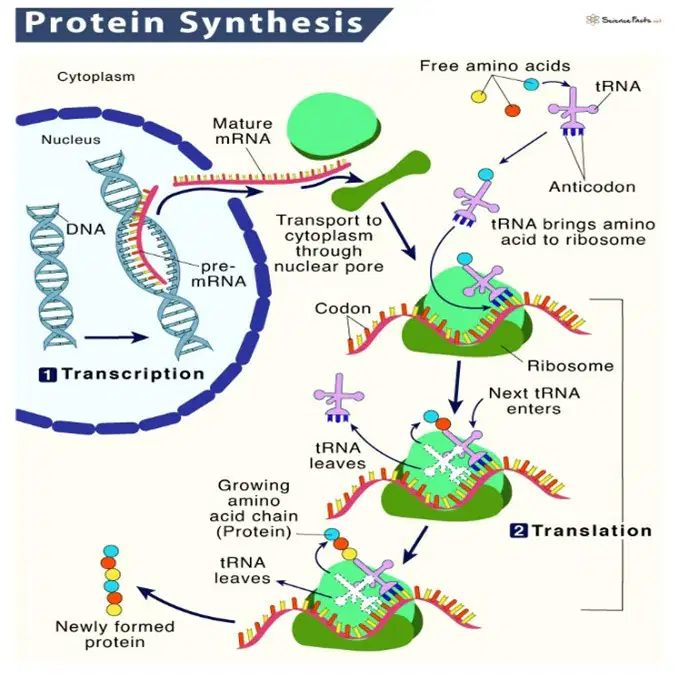
Where does transcription occur?
Ribosome
Cytoplasm
Nucleus
Cell membrane
From DNA to Protein
Protein synthesis occurs in two main steps: transcription and translation. In transcription, DNA is copied into mRNA in the nucleus. In translation, the mRNA is read by ribosomes, and amino acids are linked together to form a protein.
Where does translation occur?
Chloroplast
Ribosome
Nucleus
Mitochondria
From DNA to Protein
Protein synthesis occurs in two main steps: transcription and translation. In transcription, DNA is copied into mRNA in the nucleus. In translation, the mRNA is read by ribosomes, and amino acids are linked together to form a protein.
What is the role of mRNA in protein synthesis?
It carries the code from DNA to the ribosome
It produces amino acids directly
It breaks down the DNA strand
It destroys tRNA
From DNA to Protein
Protein synthesis occurs in two main steps: transcription and translation. In transcription, DNA is copied into mRNA in the nucleus. In translation, the mRNA is read by ribosomes, and amino acids are linked together to form a protein.
What is the role of tRNA during translation?
It copies DNA into mRNA
It carries amino acids to the ribosome
It makes the protein directly
It stores energy for the cell
From DNA to Protein
Protein synthesis occurs in two main steps: transcription and translation. In transcription, DNA is copied into mRNA in the nucleus. In translation, the mRNA is read by ribosomes, and amino acids are linked together to form a protein.
Which of the following is the correct sequence in protein synthesis?
Translation → Transcription → Protein
Transcription → Translation → Protein
DNA → Protein → RNA
RNA → DNA → Protein
From DNA to Protein
Protein synthesis occurs in two main steps: transcription and translation. In transcription, DNA is copied into mRNA in the nucleus. In translation, the mRNA is read by ribosomes, and amino acids are linked together to form a protein.
A student observed that after transcription, mRNA leaves the nucleus. Why is this step important?
It allows mRNA to be destroyed by enzymes
It ensures DNA leaves the nucleus
It allows ribosomes in the cytoplasm to read the code
It prevents proteins from being made
Aquatic Biotechnology
Aquatic biotechnology is used to develop faster-growing fish, improve water quality, and produce biofuels from algae. Scientists also use DNA analysis to monitor fish populations and protect endangered species.
Which of the following is an application of aquatic biotechnology?
Producing drought-resistant rice
Using algae to produce biofuels
Growing corn with added vitamins
Using yeast in bread making
Aquatic Biotechnology
Aquatic biotechnology is used to develop faster-growing fish, improve water quality, and produce biofuels from algae. Scientists also use DNA analysis to monitor fish populations and protect endangered species.
Why is aquatic biotechnology important for food security?
It increases fish production to feed more people
It reduces fish supply in the market
It eliminates biodiversity in aquatic ecosystems
It prevents fish from reproducing
Aquatic Biotechnology
Aquatic biotechnology is used to develop faster-growing fish, improve water quality, and produce biofuels from algae. Scientists also use DNA analysis to monitor fish populations and protect endangered species.
Which aquatic organism is widely studied for biofuel production?
Sharks
Algae
Frogs
Jellyfish
Aquatic Biotechnology
Aquatic biotechnology is used to develop faster-growing fish, improve water quality, and produce biofuels from algae. Scientists also use DNA analysis to monitor fish populations and protect endangered species.
How does DNA analysis help protect endangered fish species?
By changing their habitat
By monitoring their population and genetic diversity
By reducing their reproduction
By removing them from the ecosystem
Aquatic Biotechnology
Aquatic biotechnology is used to develop faster-growing fish, improve water quality, and produce biofuels from algae. Scientists also use DNA analysis to monitor fish populations and protect endangered species.
What is the main challenge of using aquatic biotechnology for farming fish?
Lack of DNA in aquatic organisms
Risk of diseases and environmental impact
Limited growth of algae
Fish cannot reproduce naturally
Aquatic Biotechnology
Aquatic biotechnology is used to develop faster-growing fish, improve water quality, and produce biofuels from algae. Scientists also use DNA analysis to monitor fish populations and protect endangered species.
Which of the following is an ethical issue related to aquatic biotechnology?
Increased food production
Risk of genetic modification affecting wild species
Better water quality
Higher profits for farmers
Types of Cells
Cells are the basic units of life. Eukaryotic cells (plant and animal) have a nucleus and membrane-bound organelles, while prokaryotic cells (like bacteria) do not. Plant cells have cell walls and chloroplasts, while animal cells lack them.
Which structure is present only in plant cells?
Cell membrane
Mitochondria
Chloroplast
Ribosome
Types of Cells
Cells are the basic units of life. Eukaryotic cells (plant and animal) have a nucleus and membrane-bound organelles, while prokaryotic cells (like bacteria) do not. Plant cells have cell walls and chloroplasts, while animal cells lack them.
Which organelle is known as the “powerhouse of the cell”?
Ribosome
Chloroplast
Mitochondrion
Nucleus
Types of Cells
Cells are the basic units of life. Eukaryotic cells (plant and animal) have a nucleus and membrane-bound organelles, while prokaryotic cells (like bacteria) do not. Plant cells have cell walls and chloroplasts, while animal cells lack them.
Which cell structure controls the entrance and exit of substances?
Cell wall
Cell membrane
Nucleus
Cytoplasm
Types of Cells
Cells are the basic units of life. Eukaryotic cells (plant and animal) have a nucleus and membrane-bound organelles, while prokaryotic cells (like bacteria) do not. Plant cells have cell walls and chloroplasts, while animal cells lack them.
Which is the site of protein synthesis in cells?
Ribosome
Golgi body
Vacuole
Lysosome
Types of Cells
Cells are the basic units of life. Eukaryotic cells (plant and animal) have a nucleus and membrane-bound organelles, while prokaryotic cells (like bacteria) do not. Plant cells have cell walls and chloroplasts, while animal cells lack them.
Which structure contains genetic material in eukaryotic cells?
Nucleus
Cytoplasm
Ribosome
Mitochondria
Types of Cells
Cells are the basic units of life. Eukaryotic cells (plant and animal) have a nucleus and membrane-bound organelles, while prokaryotic cells (like bacteria) do not. Plant cells have cell walls and chloroplasts, while animal cells lack them.
What is the major difference between eukaryotic and prokaryotic cells?
Prokaryotes have a nucleus; eukaryotes do not
Eukaryotes have a nucleus; prokaryotes do not
Prokaryotes have chloroplasts; eukaryotes do not
Both lack DNA
Types of Cells
Cells are the basic units of life. Eukaryotic cells (plant and animal) have a nucleus and membrane-bound organelles, while prokaryotic cells (like bacteria) do not. Plant cells have cell walls and chloroplasts, while animal cells lack them.
Which organelle is responsible for photosynthesis?
Ribosome
Chloroplast
Golgi apparatus
Mitochondrion
Types of Cells
Cells are the basic units of life. Eukaryotic cells (plant and animal) have a nucleus and membrane-bound organelles, while prokaryotic cells (like bacteria) do not. Plant cells have cell walls and chloroplasts, while animal cells lack them.
Which organelle packages and distributes proteins in the cell?
Ribosome
Vacuole
Golgi apparatus
Nucleus
Types of Cells
Cells are the basic units of life. Eukaryotic cells (plant and animal) have a nucleus and membrane-bound organelles, while prokaryotic cells (like bacteria) do not. Plant cells have cell walls and chloroplasts, while animal cells lack them.
Which is an example of a prokaryotic cell?
Amoeba
Bacterium
Onion cell
Human muscle cell
Types of Cells
Cells are the basic units of life. Eukaryotic cells (plant and animal) have a nucleus and membrane-bound organelles, while prokaryotic cells (like bacteria) do not. Plant cells have cell walls and chloroplasts, while animal cells lack them.
Which cell structure provides rigid support in plant cells?
Cell wall
Vacuole
Cytoplasm
Mitochondria
Types of Cells
Cells are the basic units of life. Eukaryotic cells (plant and animal) have a nucleus and membrane-bound organelles, while prokaryotic cells (like bacteria) do not. Plant cells have cell walls and chloroplasts, while animal cells lack them.
Which organelle helps in breaking down waste in animal cells?
Ribosome
Lysosome
Vacuole
Endoplasmic reticulum
Types of Cells
Cells are the basic units of life. Eukaryotic cells (plant and animal) have a nucleus and membrane-bound organelles, while prokaryotic cells (like bacteria) do not. Plant cells have cell walls and chloroplasts, while animal cells lack them.
Which organelle stores water and nutrients in plant cells?
Vacuole
Nucleus
Golgi body
Ribosome
Types of Cells
Cells are the basic units of life. Eukaryotic cells (plant and animal) have a nucleus and membrane-bound organelles, while prokaryotic cells (like bacteria) do not. Plant cells have cell walls and chloroplasts, while animal cells lack them.
Which statement is TRUE about both plant and animal cells?
Both contain mitochondria
Both have cell walls
Both have chloroplasts
Both lack a nucleus
Types of Cells
Cells are the basic units of life. Eukaryotic cells (plant and animal) have a nucleus and membrane-bound organelles, while prokaryotic cells (like bacteria) do not. Plant cells have cell walls and chloroplasts, while animal cells lack them.
Which structure is absent in animal cells but present in plant cells?
Ribosome
Mitochondria
Chloroplast
Endoplasmic reticulum

