
 Worksheets
7th Unit 1 : A New Nation
Total questions: 34
Worksheet time: 23mins
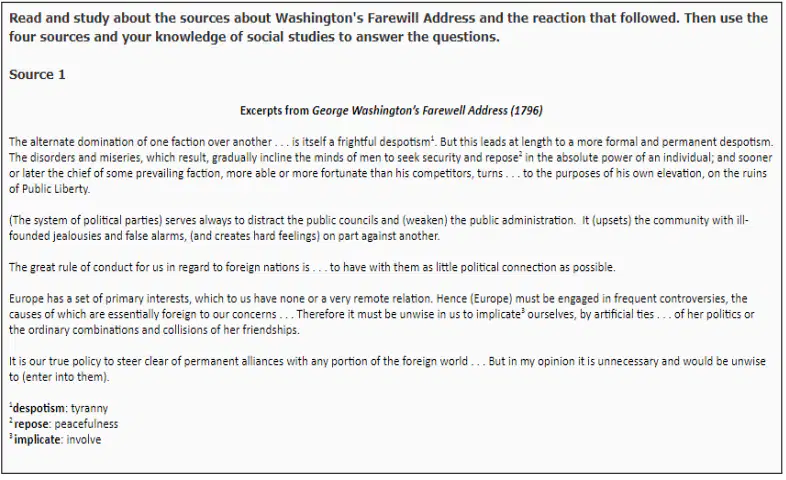
How did America respond after Washington delivered his Farewell Address?
When Washington spoke, the Republican and Democratic parties were already well-established and remained in place.
When Washington spoke, there were several smaller parties in the country, which later merged into the Republican and Democratic parties.
After Washington spoke, the two political parties in the United States decided to disband.
After Washington spoke, several parties came and went until the modern two-party system arose around the time of the Civil War.
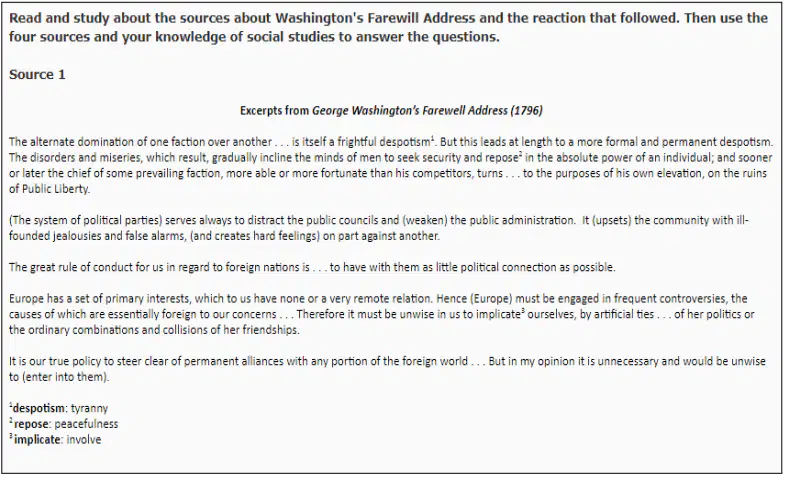
Why did Washington talk about foreign policy in his Farewell Address?
Washington wanted to limit trade with Europe so U.S. industries could expand.
Washington believed that a military alliance with France was the best policy for the future.
Washington wanted to establish exclusive trading treaties with countries in Europe.
Washington was trying to keep the United States out of European conflicts.
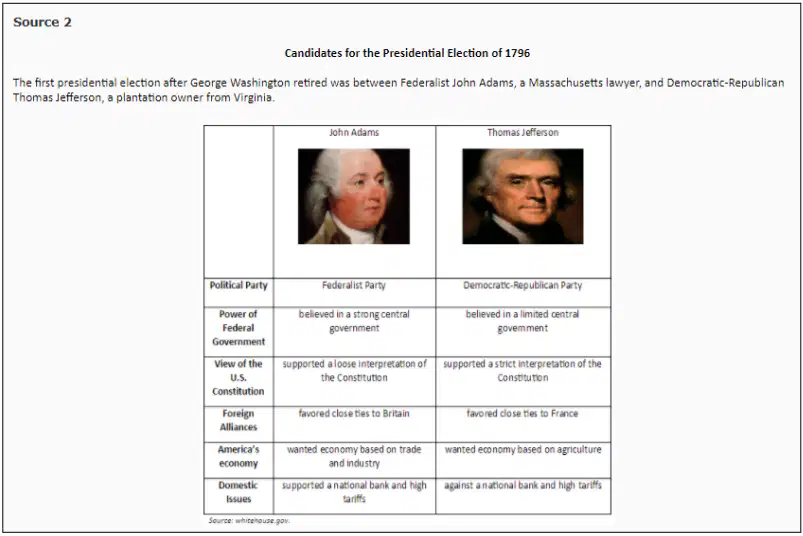
Which statement describes the main reason Thomas Jefferson opposed the Federalist Party over the issue of a national bank?
Jefferson believed the Constitution did not give the federal government power to create a national bank.
Jefferson thought the federal government should divide power by creating more than one national bank.
Jefferson believed the economy of the United States would be stronger if each state continued to provide its own banks.
Jefferson thought creating a national bank would be too expensive and would drive the federal government into debt.
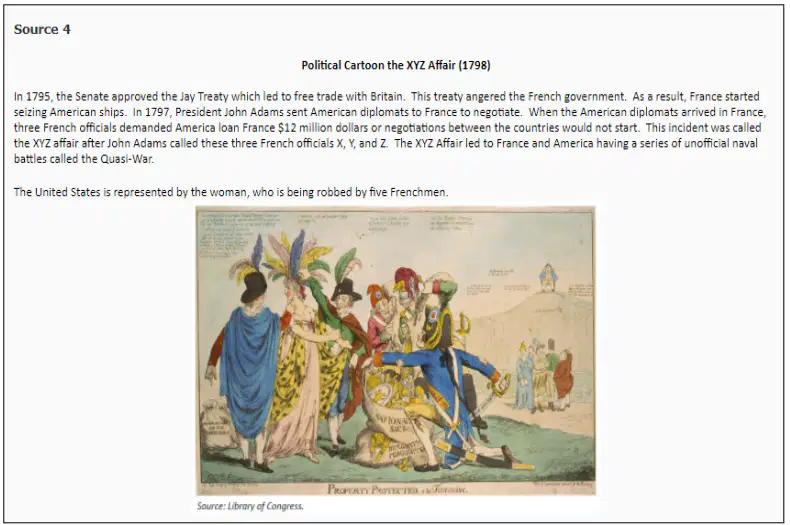
How did President John Adams change American foreign policy following the XYZ Affair of 1797?
He asked Congress to officially declare war on France which started the Quasi-War.
He ordered attacks on all British merchant and cargo ships in the Atlantic Ocean.
He increased the size of the army and navy to protect from French naval attacks.
He supported France over Great Britain in the French Revolutionary Wars.
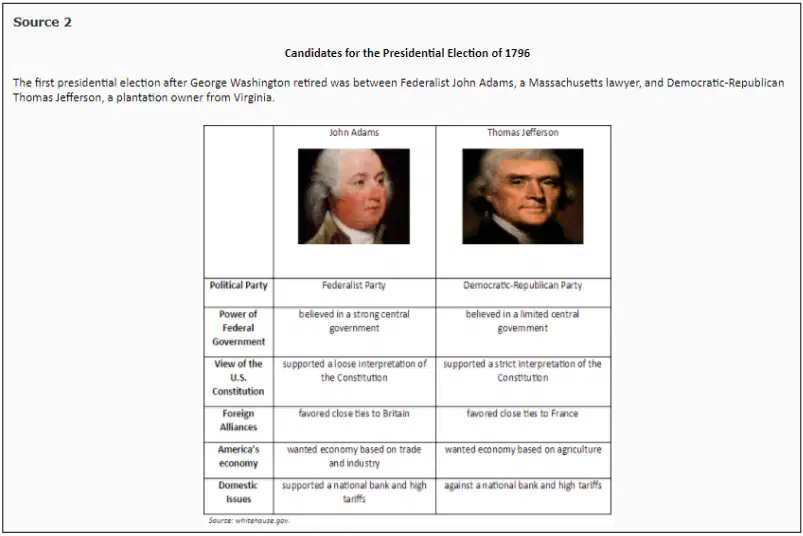
Which statement best explains why a majority of factory owners supported the Federalist Party?
Factory owners were against the national bank because it would loan money to slave owners.
Factory owners believed higher tariffs on all imports would increase American industry.
Factory owners supported closer ties to Britain to open up new markets for American goods.
Factory owners wanted increased tension with France, so they could sell America war supplies.
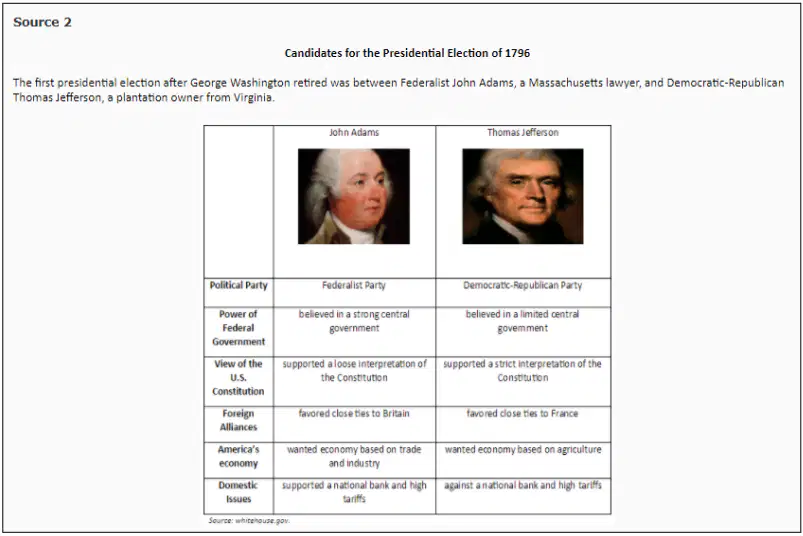
Which of the following statements explains how Federalists and Democratic-Republicans viewed each other? Select the two correct answers.
Democratic-Republicans opposed the Federalist plan to raise taxes because it would hurt merchants.
Federalists worried Democratic-Republicans wanted to take money from the wealthy to give to the poor.
Federalists believed Democratic-Republicans read the constitution in a very narrow way.
Federalists argued against the Democratic-Republicans' plan to create a national bank because it would take power from the states.
Democratic-Republicans believed Federalists were favoring wealthy manufacturers over small farmers.
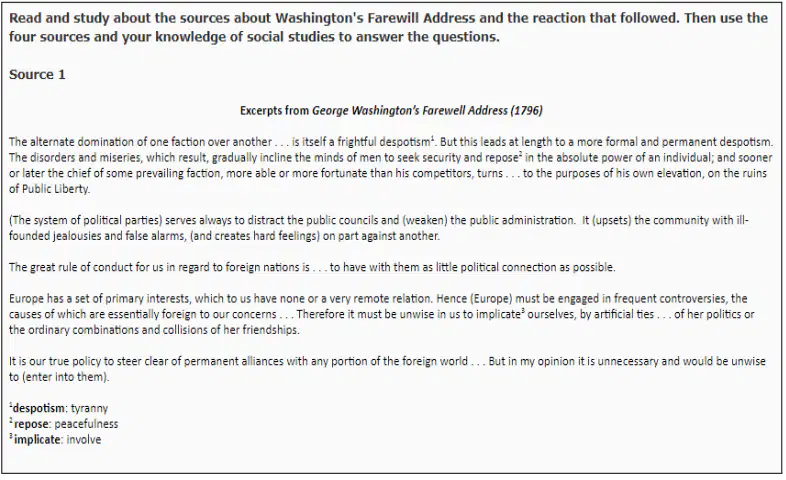
Why did Washington mention the development of political parties in his Farewell Address? Select the two correct answers.
Washington believed political parties would increase corruption throughout the U.S.
Washington believed political parties would divide American citizens
Washington believed political parties would lead to one political party having too much governmental power
Washington believed political parties would align themselves with different European countries
Washington believed political parties would allow for a better exchange of ideas in government
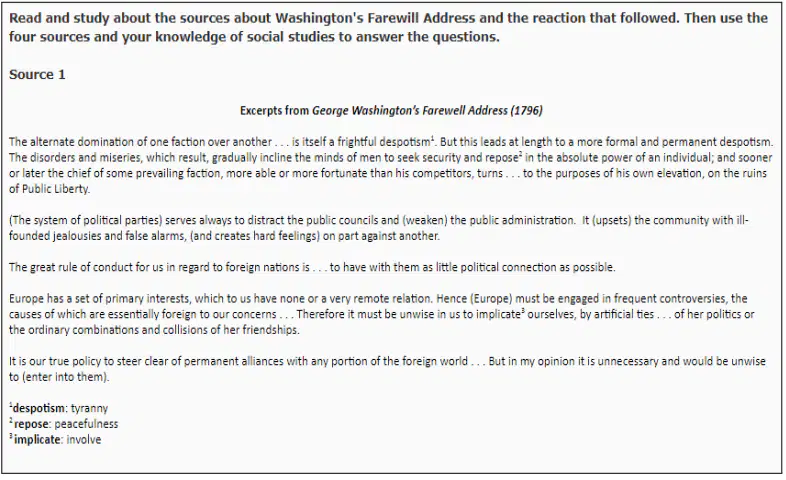
In Washington's Farewell Address, what did he predict about the future of America?
It would become a monarchy
It would face problems due to political parties
It would have no international trade
It would become isolated
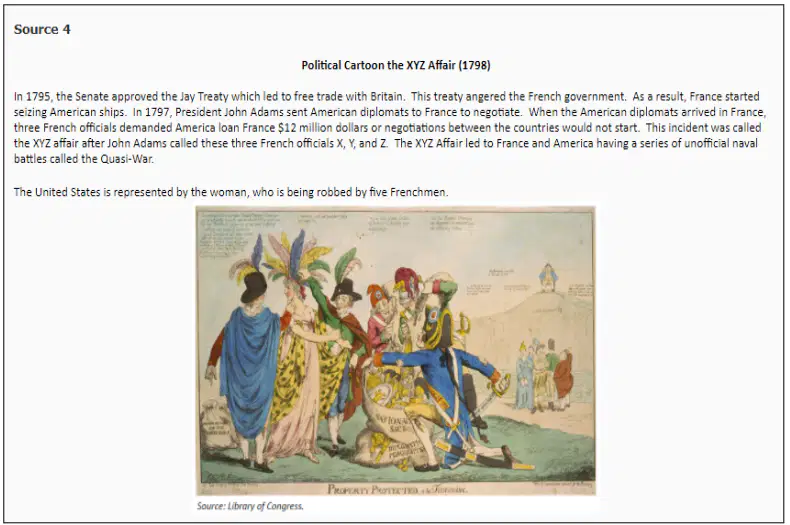
Using Source 4, why would the Federalist Party support stronger ties to Britain over France?
Federalist believed trade with Britain was vital to the Southern economy.
Federalists were angry with France over the Treaty of Paris of 1783.
Federalists saw British government as a model aristocracy that America should follow.
Federalists saw the French government as a corrupt government trying to bully a new nation.
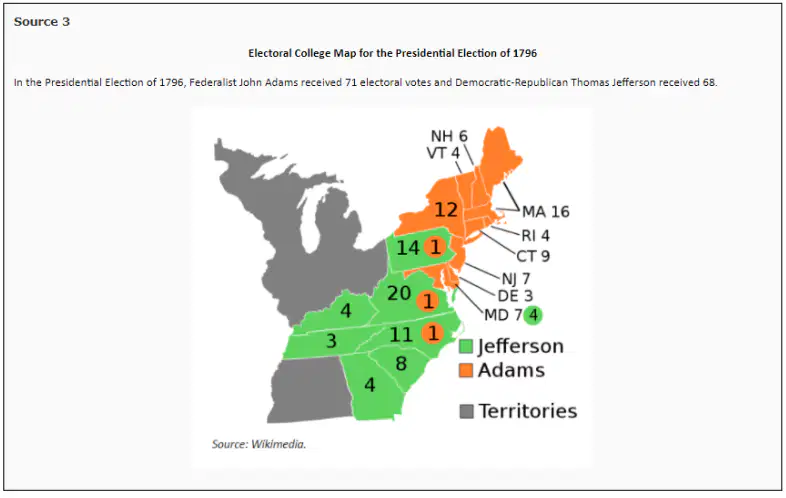
Which statement can best be concluded using Source 3?
Southerners supported higher taxes on imports.
Northerners supported closer ties with France.
Southerners wanted America to become an agrarian society.
Northerners believed in a strict-interpretation of the Constitution.
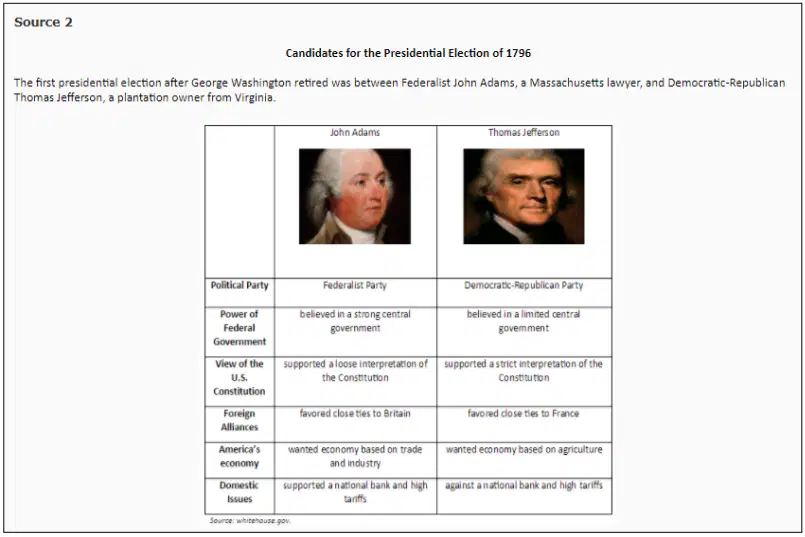
Which of the following statements explains how Federalists and Democratic-Republicans viewed each other?
Select the two correct answers.
Democratic-Republicans opposed the Federalist plan to raise taxes because it would hurt merchants.
Federalists worried Democratic-Republicans wanted to take money from the wealthy to give to the poor.
Federalists believed Democratic-Republicans read the constitution in a very narrow way.
Federalists argued against the Democratic-Republicans' plan to create a national bank because it would take power from the states.
Democratic-Republicans believed Federalists were favoring wealthy manufacturers over small farmers.
What was Alexander Hamilton's role in the government?
Secretary of the State
Secretary of Defense
Secretary of Education
Secretary of the Treasury
What did Jay's Treaty do?
Settled disputes that had risen between the US and Britain during the 1790's
Declared the war with Alexander Jay to be a draw and a ceasefire to exist.
Banned all taxes on whiskey so people could get their drink cheaper once more.
Helped farmers by no longer taxing their cash crops.
Decisions that President Washington made that would influence the decision making of future Presidents are known as:
Precedents
Antecedents
Amendments
Predicates
President George Washington began the custom of consulting with department heads, such as Secretary of State and Secretary of the Treasury, as a group. What did this practice create?
the creation of the Supreme Court
the creation of the Cabinet
the creation of the Senate
the creation of the House of Representatives
For decades after, the United States generally followed the precedent set by George Washington in regard to foreign policy. Which of the following best characterizes that policy?
a position of containment
a position of neutrality
a position of aggression
a position of indifference
In what way did President George Washington set an important precedent?
by recognizing Washington, DC, as the nation's capital
by issuing the first pocket veto
by stepping down after two terms
by establishing the State of the Union address
What title did Washington prefer to go by?
His Highness
Mr. President
Protector of our Liberties
His Excellency
Washington set a precedent by giving a yearly speech called..
The State of the Union
The Farewell Address
Inaugural Speech
His Oath
Match the correct descriptions to the views of the Federalist vs. Democratic-Republican political parties.
Alexander Hamilton
Thomas Jefferson
Loose interpretation of Constitution
Strict interpretation of Constitution
Supported Great Britain
Strong central government
Support for a national bank
Emphasis on manufacturing/trade
Support for farming
Opposition to a national bank
Emphasis on states' rights
Support for France
This person was in favor of the Federal government taking on the debts of the states.
Jefferson
Hamilton
What were the key terms and conditions of Jay's Treaty?
Withdrawal of British troops from the Northwest Territory, establishment of trading relations, resolution of issues related to American shipping and British seizure of American ships
Establishment of British military bases in the Northwest Territory, imposition of heavy tariffs on American goods, increase in British seizure of American ships
Expansion of British territory into the Northwest Territory, restriction of American trade, increase in British seizure of American ships
Withdrawal of French troops from the Northwest Territory, establishment of trading relations with France, resolution of issues related to French seizure of American ships
Congress passed the _________ to set up the number of federal courts and the courts' location.
Judiciary Act of 1789
The Constitution
Kentucky and Virginia Resolutions
Alien and Sedition Acts
The ________ stated that the U.S. would not take sides with any European countries who were at war with one another.
Neutrality Proclamation
Treaty of Greenville
Jay's Treaty
Pinckney's Treaty
The bribe offer where French agents made unreasonable demands to U.S. diplomats is called the __________.
XYZ affair
ABC affair
Alien and Sedition Acts
Kentucky and Virginia Resolutions
The president was allowed to remove foreign residents he thought were involved in treason or secret plots against the government by the _________.
Alien Act
Sedition Act
Immigrant Act
Foreigner Act
The ________ said U.S. citizens could not "write, print, speak, or publish" false or hostile words against the government.
Alien Act
Sedition Act
Freedom of Speech Act
1st Amendment

What was the significance of the Whiskey Rebellion?
What was the purpose of the National Bank?
Why was the Electoral College created to choose the President instead of direct popular vote?
To ensure representation of smaller states and prevent uniformed voters/demagogues.
Why was the 12th amendment created?
Due to the Election of 1800 ending in a tie and to prevent Presidents and their V.P. being from different political parties.
Due to the Election of 1800 in which the transfer between political parties was violent.
To get rid of the Electoral college and move to direct voting of citizens to choose president.
To end political parties to heed George Washington's warning in his Farewell Address.
What was the significance of Marbury v. Madison?
Established the principle of judicial review.

