
NEW
Font size
 Worksheets
Modern Atomic Theory
Total questions: 17
Worksheet time: 9mins
Which observation provided Albert Einstein the clue that he needed to explain the photoelectric effect?
Light is made up of extremely small particles.
Particles that are emitted from a strip of metal are electrons.
Shining light on a metal strip produces emissions.
Energy of electrons depends on light’s frequency, not intensity.
This flow chart shows the amount of energy that is emitted by each type of light:
ultraviolet > blue light > yellow light > red light
In an experiment, shining which type of light on a strip of metal would be least likely to produce the photoelectric effect?
ultraviolet light
dim blue light
bright red light
bright yellow light
Which equation was used by Albert Einstein to explain the photoelectric effect?
E = mc²
E = hv
E = h/v
E = m/c2
Which statement about Niels Bohr’s atomic model is true?
Higher orbits have lower energies.
Each orbit has a specific energy level.
Electrons can exist in any energy level.
Orbits close to the nucleus have no energy.
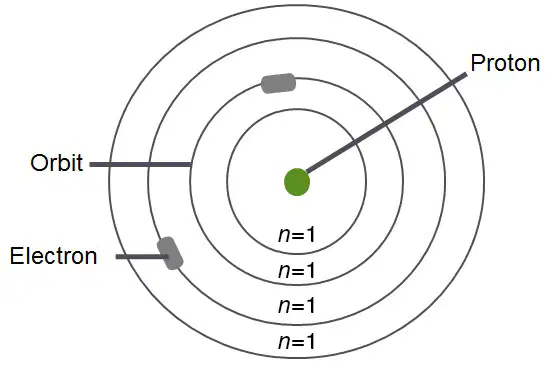
The diagram shows Niels Bohr’s model of an atom. What happens when the electron moves from the first energy level to the second energy level?
Energy is absorbed, and an emission line is produced.
Energy is released, and an emission line is produced.
Energy is absorbed by the atom.
Energy is lost from the atom.
According to the Bohr model of an atom, what happens when an electron moves from the second energy level to the third energy level and then back to the second energy level?
Energy is absorbed and then stored in the atom.
Energy is released and then absorbed to form an absorption line.
Energy is absorbed and then released to form an emission line.
Energy is released from the atom, and the outer level is weakened.
The emission spectrum of hydrogen shows discrete, bright, colored lines. Which characteristic of the Bohr model is best supported by this observation?
Energy is released when an electron moves to a higher energy level.
Smaller atoms have fewer spectral lines than larger atoms.
The energy of an electron increases with distance from the nucleus.
Electrons cannot exist in locations other than in specific orbits.
The Bohr model of the atom explained why emission spectra are discrete. It could also be used to explain the photoelectric effect. Which is a correct explanation of the photoelectric effect according to the model?
Electrons are emitted with more speed when brighter light strikes them.
Electrons need small amounts of energy to be released from an atom.
Electrons move between levels only if they are hit by the right frequency of light.
Electrons need specific amounts of energy to jump levels and be emitted.
Which statement describes a major drawback of the Bohr model that caused scientists to replace it?
It worked only for helium and larger atoms.
It did not identify the distance between an electron and the nucleus.
It contradicted the Heisenberg uncertainty principle.
It stated that spectral lines of atoms are similar.
Which atomic model states that it is impossible to know the exact location of electrons around the nucleus?
Bohr model
Dalton model
plum pudding model
electron-cloud model
Natalie observes these characteristics in the model of an atom.
(i) includes positive charge
(ii) contains electrons
(iii) explains the photoelectric effect
(iv) suggests the probable location of electrons
Which model is Natalie most likely examining?
Bohr model
Dalton’s model
plum pudding model
electron-cloud model
Which statement about the electron-cloud model is true?
It is the currently accepted atomic model.
It can easily be replaced by existing models.
It specifies the location and momentum of an electron.
It does not explain the formation of emission lines.
The modern-day quantum model of the atom is better than John Dalton’s model because it
has set electron orbits.
has positive and negative particles in the nucleus.
can be represented in one dimension.
answers many questions about atoms.
Which event would be impossible to explain by using John Dalton’s model of the atom?
An iron atom emits particles when it is struck by light.
An oxygen atom combines with two hydrogen atoms to form water.
An acid reacts with a base to form salt and water.
The atoms in sodium metal react with water.
Light of a certain energy shines on a metal and causes electrons to be emitted. Based on the research of Albert Einstein, what change would most likely result in stopping the emission of electrons from this metal?
an increase in the intensity of the light
a decrease in the intensity of the light
the use of light that has a higher frequency
the use of light that has a lower frequency
A change in which property of light will have no effect on whether or not the photoelectric effect occurs?
frequency
energy
intensity
wavelength
How does the electron-cloud model describe electrons?
The exact position of an electron can be known.
An electron can be found at certain distances from the nucleus.
An electron has a high probability of being in certain regions.
Each electron follows a specific path around the nucleus.

