wayground logo

Free Printable Worksheets

Font size

S
M
L
XL
Worksheets

Ch 9 Photosynthesis

Total questions: 30

Worksheet time: 15mins
Name
Class
Date
1.
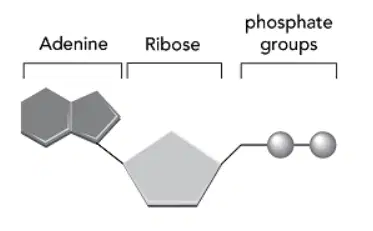
The diagram shows the structure of adenosine diphosphate (ADP). What describes the conversion of ADP to ATP?
a)
an input of energy as both phosphate groups detach
b)
a release of energy as one phosphate group detaches
c)
a release of energy as a third phosphate group is attached
d)
an input of energy to attach a third phosphate group
2.
Stuart is listing the changes to matter and energy that occur during the process of photosynthesis. Which of these examples should he include in his list?
a)
nuclear changes that convert hydrogen and oxygen into carbon
b)
chemical changes that convert carbohydrates into smaller molecules
c)
changes that convert light energy into chemical energy stored in carbohydrates
d)
changes that convert chemical energy into heat and light
3.
Nancy is explaining why chlorophyll is classified as a plant pigment and how it is useful in photosynthesis. Which property of chlorophyll would be most appropriate for her to cite?
a)
chlorophyll’s ability to absorb light
b)
chlorophyll’s green color
c)
chlorophyll’s presence in chloroplasts
d)
chlorophyll’s reactivity with oxygen
4.
Yasmine is asked to describe the structural organization of chloroplasts. She writes the following sentence: "A chloroplast contains thylakoid stacks, called stroma, that are surrounded by fluid-filled grana." Which change to the sentence is necessary to make the sentence accurate?
a)
Replace "grana" with "chlorophyll."
b)
Replace "stroma" with "chlorophyll."
c)
Exchange the positions of "stroma" and "grana."
d)
Exchange the positions of "thylakoid" and "stroma."
5.
Xavier is describing the role of electron carriers, such as NADP+, in photosynthesis. Which property of NADP+ should Xavier cite?
a)
the chemical bonds formed by electrons in its molecular structure
b)
its ability to accept and release high-energy electrons and a hydrogen ion
c)
its reactivity with oxygen, water, and carbon dioxide
d)
its ability to emit a stream of electrons in a nuclear reaction
6.
What BEST describes the role of light in the overall process of photosynthesis?
a)
Light provides the energy for breaking apart sugars into small molecules.
b)
Light provides the energy for assembling small molecules into sugars.
c)
Light accepts the energy that is released by small molecules.
d)
Light accepts the energy that is released by sugars.
7.
By analyzing this equation, which property of photosynthesis can be identified?
a)
the chemical changes that occur during the light-independent reactions
b)
the chemical changes that occur during the light-dependent reactions
c)
the source of carbon atoms in the carbohydrate product
d)
the identities and roles of electron carriers
8.
During photosynthesis, what best describes the role of the compound with the chemical formula C6H12O6?
a)
a product that is not useful because of its low-energy chemical bonds
b)
a product that is useful because of its high-energy chemical bonds
c)
a reactant that is useful because of its high-energy chemical bonds
d)
either a product or a reactant, depending on whether the cell needs to store energy or release energy
9.
What BEST describes the roles of photosystem I and photosystem II in the process of photosynthesis?
a)
They form ATP as hydrogen ions cross the thylakoid membrane.
b)
They absorb sunlight and distribute the energy as heat.
c)
They transfer electrons from a series of intermediates to form NADPH.
d)
They absorb sunlight and transfer the energy to electrons.
10.
Which is the role of the electron transport chain in the process of photosynthesis?
a)
cycling electrons between photosystem I and photosystem II
b)
adding energy to the electrons that enter photosystem I
c)
carrying electrons from photosystem II, to photosystem I, to NADP+
d)
removing electrons from the chloroplast
11.
During the light-dependent reactions of photosynthesis, which event must occur for ATP synthase to function properly?
a)
Hydrogen ions must pass through a channel within ATP synthase.
b)
Molecular oxygen must combine with ATP synthase.
c)
A molecule of ATP must release a phosphate group to become ADP.
d)
Photosystem I and photosystem II must be deactivated.
12.
Daniel is developing a model of the light-independent reactions of photosynthesis, also known as the Calvin cycle. How should the model show how carbon compounds enter and exit the cycle?
a)
enter as glucose, exit as carbon dioxide
b)
enter as glucose, exit as 3-carbon molecules
c)
enter as carbon dioxide, exit as 3-carbon molecules
d)
enter as elemental carbon, exit as 6-carbon molecules
13.
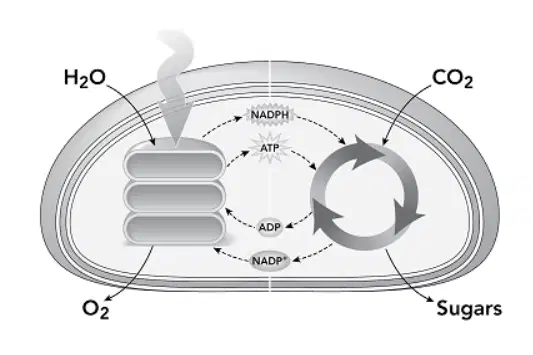
William is developing the model shown below to illustrate the process of photosynthesis. He plans to use the model to explain how photosynthesis transforms both energy and matter. In a key or legend for the model, how should William describe the roles of NADPH and ATP in the light-independent reactions?
a)
providing the oxygen for sugar molecules
b)
providing the carbon for sugar molecules
c)
absorbing the energy of light and transferring it to electrons
d)
supplying the energy necessary to assemble sugar molecules
14.
The model includes a wavy arrow to show light striking the thylakoids. Which label for the wavy arrow would be MOST USEFUL for communicating the role of light in photosynthesis?
a)
Light is radiated from the chloroplast during the light-independent reactions.
b)
Light energy is cycled within the thylakoid.
c)
The chloroplast reflects the green wavelengths of light.
d)
Light is the energy source for converting ADP to ATP, and NADP+ to NADPH.
15.
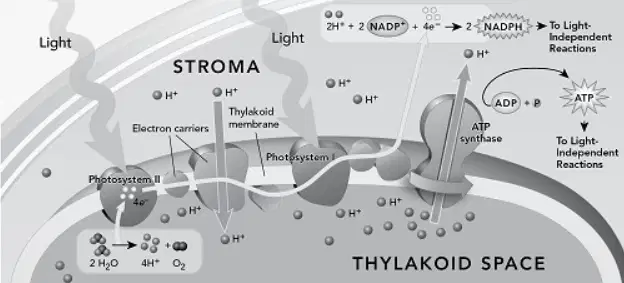
In both photosystem I and photosystem II, light energy is used to excite electrons. The two photosystems were named in the order of their discovery, and not in the order of their work in the light-dependent reactions. Photosystem II comes first in the sequence of events that moves electrons from water molecules to their destination, NADP+. Hydrogen ions travel with the electrons, and they combine with NADP+ to form NADPH. The process is summarized in this diagram. In the diagram, an arrow leads from the splitting of water, to the two photosystems, and then to NADP+. What process is represented by this arrow?
a)
the formation of high-energy sugars
b)
the cycling of light energy within the photosystems
c)
the movement of electrons along the electron transport chain
d)
the conversion of electrons into sunlight
16.
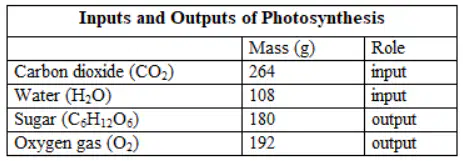
A research scientist designs an experiment to measure the inputs and outputs of photosynthesis, by mass, for a representative plant over a certain time. The scientist’s predictions for the results are shown in the table. If the scientist's predictions are shown to be accurate, then which conclusion about photosynthesis do they support? (HINT: Apply scientific principles such as the Law of Conservation of Mass.)
a)
All of the matter in water is converted into oxygen gas.
b)
All of the matter in carbon dioxide is converted into oxygen gas.
c)
All of the matter in carbon dioxide is converted into sugars.
d)
Some but not all of the matter in carbon dioxide is converted into sugars.
17.
Under normal conditions, gases diffuse through small holes in the leaves of a plant. When the weather is very hot and dry, plants may close these openings to conserve water. How are the closures most likely to affect photosynthesis?
a)
They increase the rate of photosynthesis by increasing the amount of water in the leaf.
b)
They decrease the rate of photosynthesis by preventing carbon dioxide from entering the leaf.
c)
They increase the rate of photosynthesis by increasing the amount of oxygen in the leaf.
d)
They have little or no effect on photosynthesis because gases do not take part in the process.
18.
Plants depend on a wide variety of carbon compounds, including carbohydrates, lipids, and proteins. What BEST describes the role of photosynthesis in producing these compounds?
a)
Photosynthesis produces ATP and NADPH that can be converted into other compounds.
b)
Photosynthesis produces 12-carbon molecules that can be broken apart into smaller compounds.
c)
Photosynthesis produces 3-carbon molecules that can be converted into other compounds.
d)
Photosynthesis directly produces all classes of carbon compounds.
19.
Researchers have been developing an artificial leaf, a device that mimics the actions of photosynthesis. The artificial leaf harnesses the energy of sunlight and uses it to provide energy for a series of chemical reactions. Potential products include hydrogen gas (H2) and methane gas (CH4). What is one way that the chemical processes of the artificial leaf are similar to photosynthesis?
a)
The products are molecules made of 5 atoms at the most.
b)
The products contain carbon, but not oxygen.
c)
The products contain high-energy chemical bonds.
d)
Carbon dioxide is released as a waste product.
20.

Which statement best explains the importance of the light-dependent reactions in photosynthesis?

a)

They produce glucose directly from carbon dioxide.

b)

They convert oxygen into carbon dioxide.

c)

They break down glucose to release energy.

d)

They generate ATP and NADPH needed for the Calvin cycle.

21.

What is the main function of chlorophyll in the process of photosynthesis?

a)

To store glucose molecules

b)

To transport water throughout the plant

c)

To release carbon dioxide from the leaf

d)

To absorb sunlight and transfer energy to electrons

22.

During photosynthesis, which molecule acts as the primary electron donor in the light-dependent reactions?

a)

Oxygen

b)

Glucose

c)

Water

d)

Carbon dioxide

23.

Which of the following best describes the role of water in the light-dependent reactions of photosynthesis?

a)

It transports carbon dioxide to the chloroplast.

b)

It acts as a source of electrons and protons.

c)

It stores energy in the form of glucose.

d)

It absorbs sunlight directly.

24.

What would most likely happen to the rate of photosynthesis if a plant received only green light?

a)

The plant would produce more oxygen than usual.

b)

The rate would remain unchanged.

c)

The rate would decrease because chlorophyll reflects green light.

d)

The rate would increase significantly.

25.

Which statement correctly compares the light-dependent and light-independent reactions of photosynthesis?

a)

Both reactions occur in the stroma of the chloroplast.

b)

The light-dependent reactions require sunlight, while the light-independent reactions do not.

c)

The light-dependent reactions use carbon dioxide to make glucose.

d)

The light-independent reactions produce ATP and NADPH.

26.

Which of the following is a direct product of the Calvin cycle in photosynthesis?

a)

Oxygen gas

b)

ATP

c)

Glucose

d)

3-carbon sugars

27.

What is the primary purpose of splitting water molecules during the light-dependent reactions?

a)

To produce glucose

b)

To release electrons and protons for the electron transport chain

c)

To absorb carbon dioxide

d)

To generate ATP directly

28.

Which structure within the chloroplast is the site of the light-dependent reactions?

a)

Grana matrix

b)

Cell wall

c)

Thylakoid membrane

d)

Stroma

29.

Which of the following best explains why plants appear green to the human eye?

a)

Chlorophyll absorbs green wavelengths of light.

b)

Chlorophyll transmits all colors except green.

c)

Chlorophyll stores green pigments in the stroma.

d)

Chlorophyll reflects green wavelengths of light.

30.

Which of the following changes would most likely decrease the rate of photosynthesis in a plant?

a)

Increasing the amount of available carbon dioxide

b)

Decreasing the intensity of light

c)

Providing more water to the plant

d)

Raising the temperature to an optimal level