
NEW
Font size
 Worksheets
Unit 1: Chapter 1 Medieval Europe
Total questions: 70
Worksheet time: 35mins
What is the term for a social structure marked by the dominance of the father in the family?
patriarchy
matriarchy
oligarchy
democracy
What is the term relating to the Middle Ages in Europe, also known as the 'Dark Ages'?
Medieval Period
Renaissance
Industrial Age
Modern Era
What is the term for the upper or noble class whose members' status is usually inherited?
aristocracy
proletariat
bureaucracy
peasantry
What is the term for people in a Christian church, such as priests, who carry out religious duties?
clergy
congregation
choir
ushers
What is the term for an organization that has existed for a long time and promotes a particular cause?
institution
novelty
fad
startup
What is the ability to read called?
literacy
numeracy
oratory
dexterity
What is the term for something decorated by hand with designs?
illuminated
engraved
printed
sculpted
What is the term for a person with power and influence who controls land given to them by a king?
lord
serf
merchant
peasant
What is the term for a soldier on horseback who serves a king or other ruler?
Knight
Archer
Squire
Footman
What is the term for powerful families that hold fiefs and titles?
nobility
peasants
merchants
artisans
What is the system of government in which land is exchanged for loyalty and services called?
feudalism
democracy
monarchy
republic
What is the term for a person who receives land from a ruler and in return promises to fight for the ruler?
vassal
serf
monarch
merchant
What is a plot of land exchanged for loyalty to a ruler called?
fief
manor
serfdom
guild
What is a large country house and its surrounding land, built on a hill for protection, called?
manor
cottage
bungalow
apartment
What is the term for a person living on a feudal estate who was required to work for the lord of the manor?
serf
vassal
knight
lord
What is the term for land plowed but with nothing planted for a period in order to restore the land's fertility?
fallow
arable
terrace
pasture
What is a group of craftspeople who control a certain craft called?
guild
colony
clan
union
Who is the leader of the Catholic Church (Highest Power)?
Pope
Cardinal
Bishop
Archbishop
What is the term for a high ranking member of the Catholic Church?
Bishop
Deacon
Monk
Layperson
What is the term for a person who lived a simple religious life, copied religious books, and educated others about religion?
Monk
Merchant
Knight
Farmer
What is the term for a group of monks who lived together?
Monastery
Convent
Abbey
Hermitage
What is the term for women who lived a simple religious life and educated others?
Nuns
Priests
Monks
Deacons
What is the term for a community where nuns lived?
Convent
Monastery
Abbey
Temple
What is the definition of 'Alliance'?
A) A group of countries controlled by a single ruler
B) People skilled at making certain things
C) Partnership of different countries
What is the definition of 'Artisan'?
A) People skilled at making certain things
B) Partnership of different countries
C) Group of countries controlled by a single ruler
What is the definition of 'Empire'?
Partnership of different countries
Group of countries controlled by a single ruler
People skilled at making certain things
The Roman Empire collapsed because of _________
decades of invasion by German barbarian tribes
a sudden volcanic eruption in Rome
the rise of the Mongol Empire
the invention of gunpowder in China
Life for people in the political class was different from the lives of other Romans. Political class enjoyed ________, lived in large homes with servants. Other Romans (commoners) lived simple lives, poorly built homes and worked every day.
parties
farming
hunting
trading
The 1,000 years after the fall of the Roman Empire in Europe are called the ________.
Middle Ages
Renaissance
Industrial Revolution
Age of Enlightenment
What were the THREE important groups that shaped life in medieval Europe?
Church, Aristocracy, Commoners
Merchants, Artisans, Peasants
Knights, Monks, Farmers
Kings, Soldiers, Traders
The Church was important after the fall of Rome because ________.
it was the only major institution that survived
it controlled all trade routes in Europe
it was responsible for the fall of Rome
it was the largest military power in the region
List the things the Roman government had once done that were no longer done after the fall of Rome.
building/repairing roads, carrying out laws, paying for public buildings/ships
growing crops, herding animals, making pottery
writing poetry, painting murals, composing music
trading spices, mining gold, weaving cloth
A monastery is ________.
a place where monks lived
a place where kings lived
a place where soldiers trained
a place where merchants traded
How did monasticism change Europe?
Monasticism changed Europe because before Monasticism, Christianity was only in European cities. As it spread in Europe, it brought Christianity to the countryside.
Monasticism changed Europe by introducing new forms of government to the continent.
Monasticism changed Europe by abolishing all religious practices.
Monasticism changed Europe by encouraging the spread of paganism.
The 2 major roles of monasteries in Medieval Europe were:
Providing religious services and preserving knowledge
Leading armies and collecting taxes
Building castles and training knights
Organizing trade routes and markets
10. Charlemagne was ______ of the Franks (group of people living near the Rhine River).
king
priest
merchant
soldier
He was chosen to be the emperor of the Holy Roman Empire because ______.
he was protective of Christianity and great at organizing and managing people
he was the oldest son of the previous emperor
he was the wealthiest noble in the region
he was born in Rome
Charlemagne is remembered for ______, bringing Europe into a new period of unity and strength, focusing on education/learning.
helping the church increase power
defeating the Mongol Empire
inventing the printing press
discovering the New World
Charlemagne played a significant role in shaping Medieval Europe by:
uniting much of Western Europe and promoting learning and culture
dividing Europe into smaller kingdoms and discouraging education
isolating his empire from the rest of Europe
abolishing Christianity in his territories
Saint Benedict's (father of Western Monasticism) changes did the following:
(a) helped hospitals and poor schools (b) helped monasteries become centers for spreading Christianity
(a) promoted the worship of Roman gods (b) discouraged education in monasteries
(a) established military orders (b) banned all forms of charity
(a) encouraged isolation from society (b) destroyed ancient manuscripts
Feudalism was an agreement between the ______, the lords, the knights, and the serfs.
king
merchant
bishop
mayor
16. The ______ was the ruler of all.
king
servant
merchant
farmer
17. The ______ was a person with power who controlled the land given to him by the king, supported the king, and was powerful.
Lord
Serf
Merchant
Peasant
The king would give the lord a large amount of land called a ______, in return for his services.
fief
manor
serf
guild
19. ______ were soldiers on horseback who served the king, protectors of the kingdom, in return they received fiefs for their service.
Knights
Serfs
Merchants
Monks
What are the four levels of the Feudal Triangle?
Kings, Nobles, Knights, Peasants
Kings, Lords, Merchants, Peasants
Kings, Priests, Knights, Peasants
Kings, Nobles, Merchants, Peasants
Define vassal: A vassal is _________.
a person who received land from the king and in return promises to fight for the king
a person who rules over a kingdom without any obligations
a merchant who trades goods between villages
a priest who leads religious ceremonies
Define serf: A serf is _________.
servants, people living on a feudal estate who work for the lord of the manor
a member of the royal family
a wealthy merchant in the city
a traveling knight

The feudal system is structured in levels, each with its own advantages. Which of the following best describes the advantage of each level in the feudal system?
Each level provided protection and land in exchange for loyalty and service.
Each level was responsible for creating new laws for the kingdom.
Each level was allowed to choose the king or queen.
Each level could freely trade with foreign nations without restrictions.
What is a manor?
A small village
A large countryside house and land (castle/manor house+estate/land)
A city market
A church building
Which of the following are responsibilities of the Lord of the Manor towards the manor's serfs?
Allowed serfs to use the land, protected the people on the manor
Provide a mill to grind grain
Provided farming equipment
All of the above
Which of the following are responsibilities of serfs toward the lord of the manor?
Worked in fields, produce food for the lord
Gave part of everything they grew/produced to the lord
Could not leave the estate or marry without permission
All of the above
The three-field rotation system involved which of the following?
One third of the land was left fallow
Another third was planted in autumn
The final third was planted in spring
All of the above
27. The three field rotation system ________ crop production. New farming equipment was developed (plow.)
doubled
reduced
eliminated
delayed
28. Guilds were a group of ________ who controlled a certain craft.
craftspeople
farmers
soldiers
merchants
29. Churches made money by holding ________ on their land.
fairs
sermons
weddings
markets
Feudalism and manorialism played which role in the economy of Medieval Europe?
They structured land ownership and agricultural production.
They promoted industrialization and urbanization.
They encouraged free-market capitalism.
They eliminated social hierarchies.
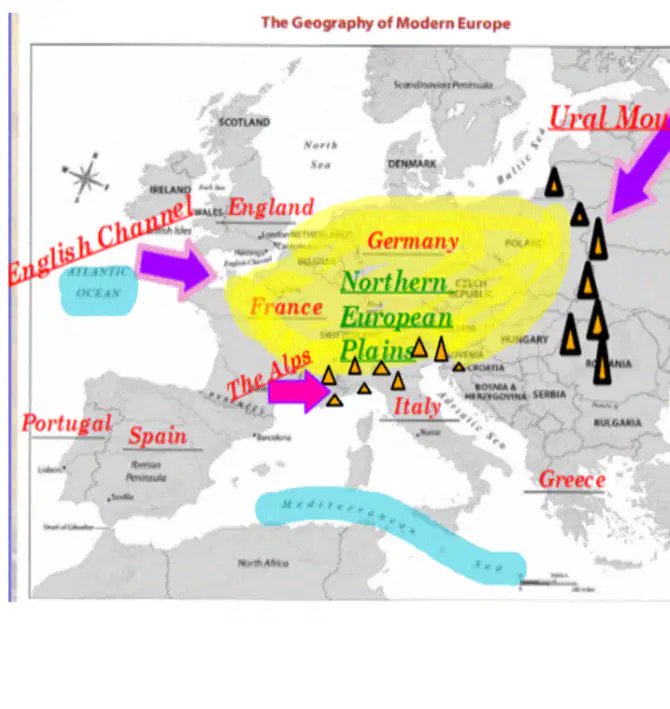
Identify the location of The Alps on the map of Modern Europe provided.
The Alps are located in southern Europe, stretching across countries such as France, Switzerland, Italy, and Austria, as shown on the map.
The Alps are located in northern Europe, primarily within Norway and Sweden, as shown on the map.
The Alps are located in eastern Europe, mainly in Ukraine and Belarus, as shown on the map.
The Alps are located in western Europe, covering most of Spain and Portugal, as shown on the map.
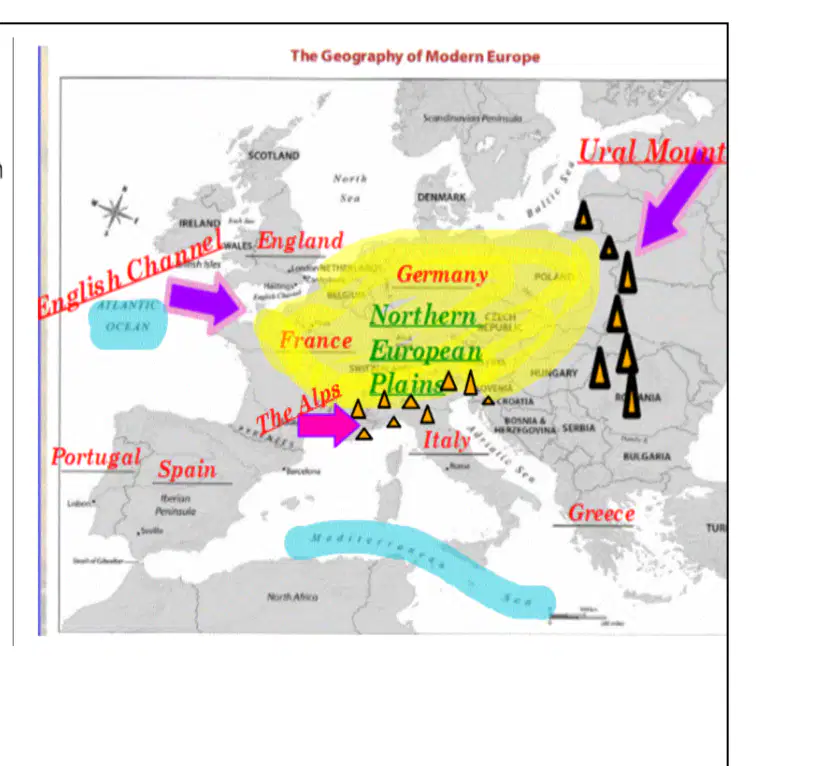
Identify the location of The Atlantic Ocean on the map of Modern Europe provided.
The Atlantic Ocean is located to the west of Europe, bordering countries such as Portugal, Spain, France, and the United Kingdom, as shown on the map.
The Atlantic Ocean is located to the east of Europe, bordering countries such as Russia and Ukraine, as shown on the map.
The Atlantic Ocean is located to the south of Europe, bordering countries such as Italy and Greece, as shown on the map.
The Atlantic Ocean is located in the center of Europe, surrounded by landlocked countries, as shown on the map.
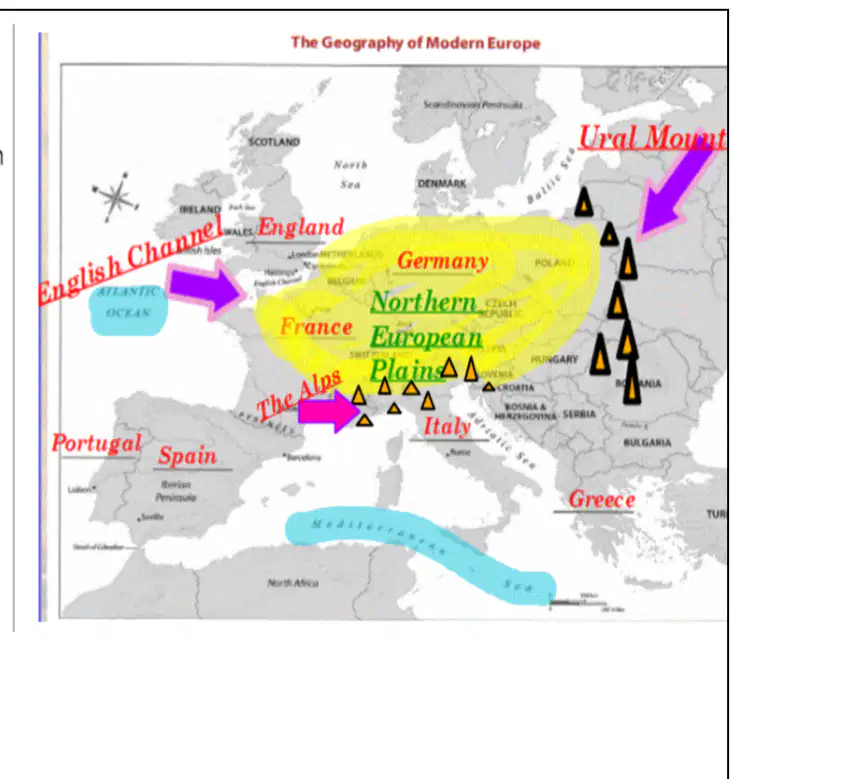
Identify the location of The Northern European Plain on the map of Modern Europe provided.
The Northern European Plain is highlighted in yellow and stretches across northern Germany, Poland, and into Russia, as shown on the map.
The Northern European Plain is highlighted in green and covers only the Iberian Peninsula, as shown on the map.
The Northern European Plain is highlighted in blue and is limited to the Italian Peninsula, as shown on the map.
The Northern European Plain is highlighted in red and is found only in Scandinavia, as shown on the map.
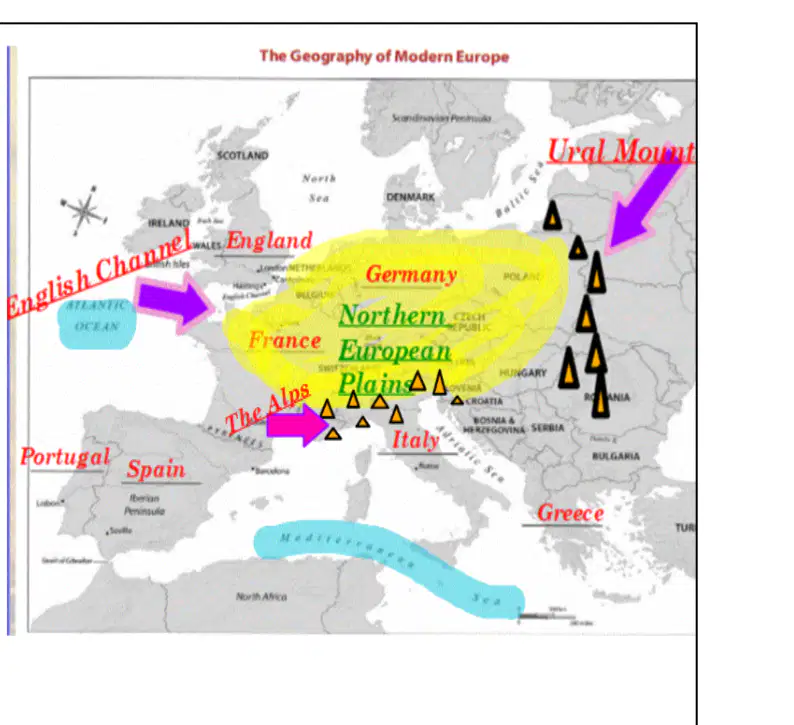
Identify the location of The English Channel on the map of Modern Europe provided.
The English Channel is the body of water between southern England and northern France, as shown on the map.
The English Channel is the mountain range running through central Europe, as shown on the map.
The English Channel is the large inland sea in eastern Europe, as shown on the map.
The English Channel is the river flowing through southern Spain, as shown on the map.
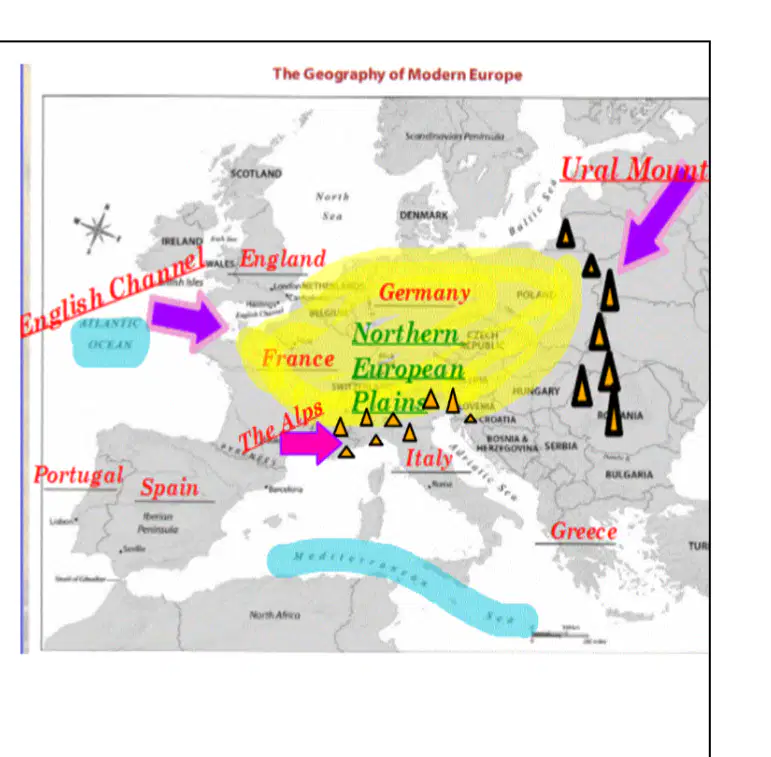
Identify the location of The Ural Mountains on the map of Modern Europe provided.
The Ural Mountains are located in western Russia, forming the boundary between Europe and Asia, as shown on the map.
The Ural Mountains are located in southern France, near the Mediterranean coast, as shown on the map.
The Ural Mountains are located in northern Italy, forming the border with Switzerland, as shown on the map.
The Ural Mountains are located in eastern Spain, near the border with Portugal, as shown on the map.
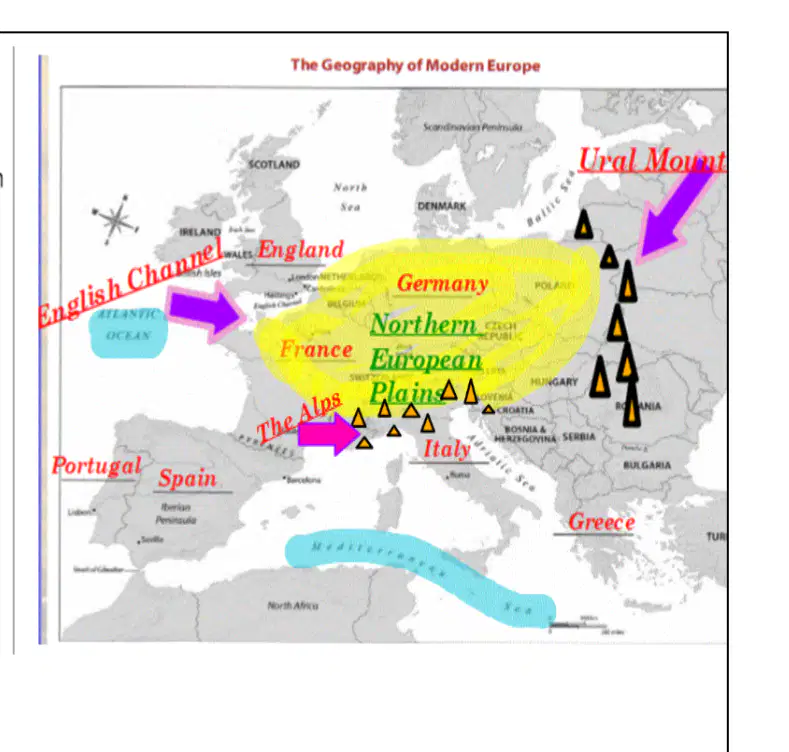
Identify the location of The Mediterranean Sea on the map of Modern Europe provided.
The Mediterranean Sea is located to the south of Europe, bordering countries such as Spain, France, Italy, and Greece, as shown on the map.
The Mediterranean Sea is located to the north of Europe, bordering countries such as Norway, Sweden, and Finland, as shown on the map.
The Mediterranean Sea is located in central Europe, bordering countries such as Germany, Poland, and Austria, as shown on the map.
The Mediterranean Sea is located to the east of Europe, bordering countries such as Russia and Ukraine, as shown on the map.
Medieval Europe (5.9): Geography in Medieval Europe was characterized by which of the following features?
A landscape of forests, mountains, and rivers
Vast deserts and tropical rainforests
Large urban cities and skyscrapers
Flat plains with little water sources
Medieval Europe (5.9): Religion in Medieval Europe was primarily characterized by which of the following?
The dominance of Christianity
The spread of Buddhism
The rise of Islam as the main religion
The worship of ancient Greek gods
Medieval Europe (5.9): Which of the following is an achievement of Medieval Europe?
Gothic architecture
Space exploration
Printing press invented in China
Discovery of penicillin
Medieval Europe (5.9): Politics in medieval Europe was primarily characterized by which of the following?
Feudalism
Democracy
Absolute monarchy
Republicanism
Medieval Europe (5.9): The economy of Medieval Europe was primarily based on which of the following?
Agriculture
Industrial manufacturing
Modern banking
Digital technology


Which of the following is a synonym for serf?
Monk
Noble
Peasant
Manor

