
 Worksheets
Newtons Laws of Motion/Forces of Flight Test
Total questions: 20
Worksheet time: 13mins

What does Newton's First Law of Motion state about an object at rest?
It will remain at rest unless a net force acts on it.
It will start moving on its own.
It will change direction without any force.
It will increase in speed over time.
What does Newton's Second Law explain?
How forces change the motion of objects
How objects remain at rest
How energy is conserved
How gravity affects objects
What is the formula for Newton's Second Law?
F = m + a
F = m / a
F = m × a
F = a / m
What does Newton's Third Law of Motion state?
For every action, there is an equal and opposite reaction.
An object in motion stays in motion unless acted upon by an external force.
Force equals mass times acceleration.
Energy cannot be created or destroyed.
Which of the following is an example of Newton's Third Law of Motion?
A car accelerating on a highway.
A swimmer pushing water backwards to move forward.
A book resting on a table.
A ball rolling down a hill.
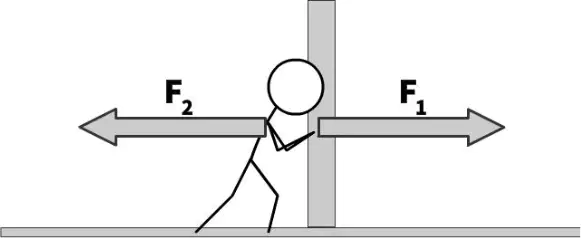
What does Newton's Third Law state about forces?
Forces always act in pairs; for every action, there is an equal and opposite reaction.
An object in motion stays in motion unless acted upon by an external force.
The force of gravity acts between all masses.
Energy cannot be created or destroyed, only transformed.
Which force resists the motion of an aircraft by acting backward?
Lift
Thrust
Drag
Weight
Which of the following is NOT true about weight?
It is caused by the presence of a massive second object
It is the same as mass
It is a consequence of the universal law of gravitation
It is directly proportional to the product of two masses
What is the primary cause of weight in an airplane?
Air pressure differences
Earth's gravitational pull
Speed of the airplane
Shape of the wings
What is the primary purpose of the shape of an airplane's wings?
To reduce drag
To create lift
To increase speed
To decrease weight
What is the force that propels an aircraft forward?
Drag
Thrust
Gravity
Lift
Which force is responsible for moving an aircraft or rocket?
Drag
Thrust
Weight
Buoyancy
What does the term "propel" mean?
To stop or slow down
To drive or cause to move forward
To turn around
To lift off the ground
What are the four forces acting on an airplane as shown in the diagram?
Lift, Gravity, Speed, Friction
Lift, Weight, Thrust, Drag
Thrust, Gravity, Pressure, Lift
Drag, Speed, Weight, Pressure
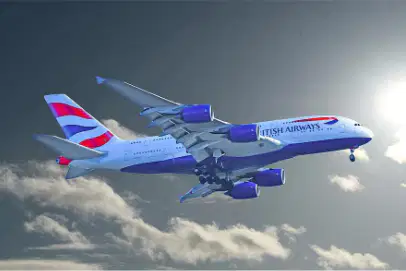
How does Newton's third law relate to flight?
The wing is pushed downward by the air.
The air is deflected upward by the wing.
A force is produced in the opposite direction moving the jet forward.
The jet engine does not produce any force.
Which force acts upward to counteract the weight of an airplane?
Friction
Drag
Lift
Thrust
According to Newton's First Law, what happens to an object in motion if no external force acts on it?
It will accelerate
It will continue moving at constant velocity
It will change direction
It will stop immediately

Look at the diagram of the airplane. The arrows represents airflow around the wing of the airplane. Label where you would find the different pressures.

