
 Worksheets
AP Biology Unit 1 - Quizizz Questions
Total questions: 29
Worksheet time: 32mins
Which property of water allows plants to transport water from roots to leaves against gravity?
Adhesion
High heat of vaporization
Surface tension
Density anomaly of ice
Which type of macromolecule is primarily responsible for storing genetic information?
Carbohydrates
Lipids
Proteins
Nucleic acids
Which of the following is true about saturated fats?
They contain double bonds in their fatty acid chains.
They are solid at room temperature.
They are typically found in plants.
They are healthier than unsaturated fats.
Hydrogen bonds between water molecules are primarily responsible for which property?
Nonpolarity
Cohesion
Ionic interactions
Hydrophobic exclusion
Which of the following best describes a dehydration synthesis reaction?
Breaking down polymers by adding water
Building polymers by removing water
Breaking down monomers without water
Forming hydrogen bonds between molecules
Which type of bond forms between the complementary bases of DNA?
Ionic
Covalent
Hydrogen
Peptide
In the fluid mosaic model of the plasma membrane, phospholipids are arranged so that:
Hydrophobic tails face the outside environment
Hydrophilic heads face the interior of the bilayer
Hydrophilic heads face aqueous environments inside and outside the cell
Proteins are absent from the membrane
Which carbohydrate is the primary structural component in plant cell walls?
Starch
Glycogen
Cellulose
Chitin
Which of the following elements is found in proteins but not carbohydrates or lipids?
Carbon
Nitrogen
Hydrogen
Oxygen
Which macromolecule has the greatest diversity of functions in the cell?
Carbohydrates
Lipids
Proteins
Nucleic Acids
A phospholipid has:
Two hydrophobic heads and one hydrophilic tail
Two hydrophilic heads and one hydrophobic tail
One hydrophobic head and two hydrophilic tails
One hydrophilic head and two hydrophobic tails
Which functional group is characteristic of amino acids?
Hydroxyl (-OH)
Amino (-NH₂) and carboxyl (-COOH)
Phosphate (-PO₄)
Carbonyl (-C=O)
In DNA, the complementary base pairing rule states that:
A. A pairs with T, and G pairs with C
B. A pairs with G, and T pairs with C
C. A pairs with U, and G pairs with C
D. A pairs with T, and G pairs with U
Which of the following is a polymer of glucose used by animals for energy storage?
Starch
Cellulose
Glycogen
Water’s ability to stabilize temperature is due to its:
Low heat capacity
High heat capacity
Nonpolar nature
High density
How is biological information coded in DNA?
In the hydrogen bonding
In the sequence of nitrogen bases (base pairs)
In the phosphate and sugars backbone
In the 5'-3' side
Which of the following correctly describes a dehydration reaction between amino acids?


Which macromolecule is this the chemical structure of?
Carbohydrate
Nucleic Acid
Lipid
Protein

A student makes a Venn diagram to compare thefunctions of carbohydrates and lipids. Which cellular function of carbohydrates and lipids should be placed in the shared section of the Venn diagram?
hormone production
structural support of cell walls
energy storage
catalyst of chemical reactions

Just under an orca's skin lies a thick layer of blubber. Blubber helps insulate a whale from heat loss. Based on this information, which biomolecule is blubber primarily made of?
Lipids
Nucleic Acids
Proteins
Carbohydrates
Which of the following describes the primary structure of a protein molecule?
Which part of the amino acid determines its function?
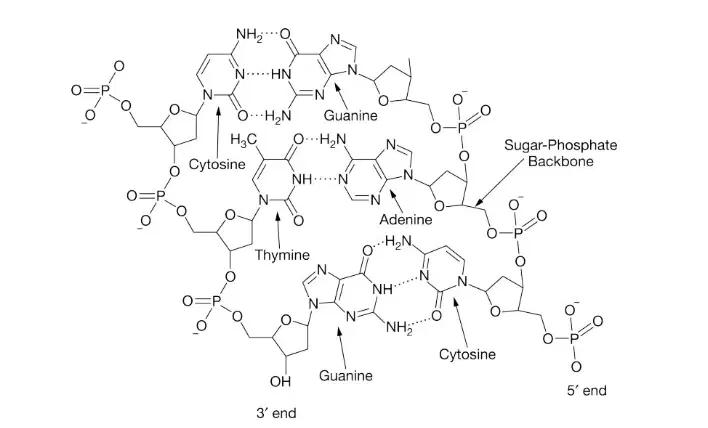
What molecule is shown in the image?
What type of bond forms from a dehydration reaction?

