
 Worksheets
Practice - Ocean Currents, Tides, and Waves
Total questions: 23
Worksheet time: 23mins
What is upwelling?
Which diagram shows the Pacific Ocean during an El Nino event?
What does hypoxic mean?
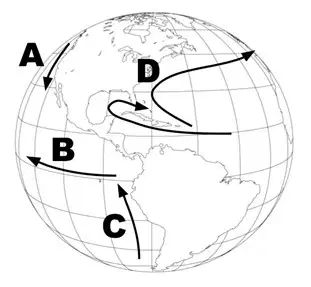
Which current pictured is called The Gulf Stream?
A
B
C
D
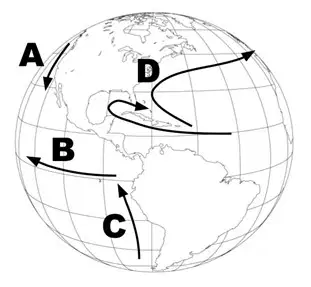
Which currents pictured are cold water currents? Select ALL of the choices that are correct.
A
B
C
D

What does the blue line represent in the Thermohaline circulation?
Warm salty water
Warm water
Cold water
Cold salty water
The ocean conveyer belt is also called thermohaline circulation because it is driven by
During an El Nino year, the tradewinds
There is more cloud formation and rainfall over
cold ocean water
warm ocean water
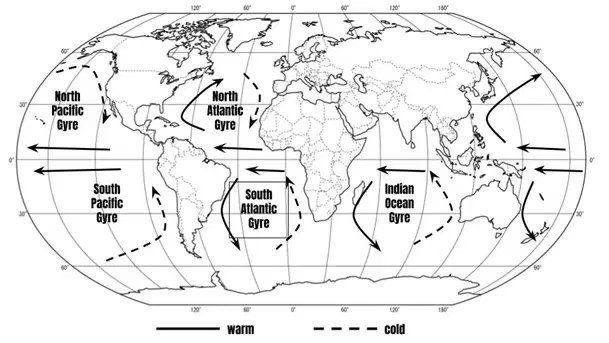
Coral reefs generally require warm water to survive and grow. Based in this information, which of these locations would be more likely to have coral reefs?
The East Coast of Australia
The West Coast of Australia
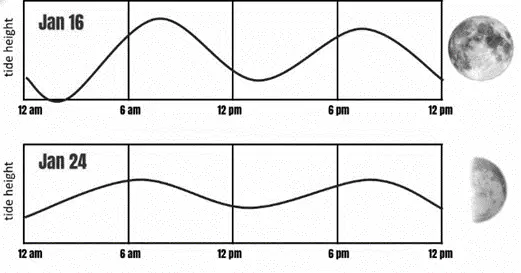
On which date was there a spring tide?
Jan 16
Jan 24
On which date was the tidal range the smallest?
Jan 16
Jan 24

The tide in this picture is a (a) .
During this tide, the high/low tides will be (b) than usual.

The tide in the picture is a (a) .
During this tide, the high/low tides will be (b) than usual.
Which conditions produce the largest ocean waves?
strong winds that blow for a long time over a great distance
weak winds that blow for short periods of time with a short fetch
strong winds that blow for short periods of time over great distances
strong winds that blow for short periods of time over small distances
strong winds that blow for short periods of time with a short fetch
What is the result of wave motion on water particles?
Water particles barely move forward; they move in a circular pattern.
Water particles are pushed down as they move side to side.
Water particles barely move forward as they move up and down.
Water particles are pushed forward as they move up and down.
Match the following
factor that "drives" ocean currents
temp & salinity differences
factor that "drives" ocean waves
wind
factor that "drives" ocean tides
gravitational pull by the moon
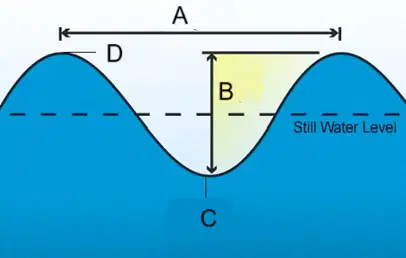
Identify the parts of a wave.
crest
D
trough
C
height
B
wavelength
A
What happens as a deep water wave moves close to the shore and starts to "feel" the bottom? Select ALL of the answers that are correct.
its speed increases
its speed decreases
its height inreases
its height decreases
its wavelength increases


Surface currents move heat and moisture throughout the Earth system. They can be warm or cold.
Warm surface currents usually begin near the _____.
Cold surface currents usually begin near the ______.
Equator : Poles
Poles : Equator

A large rotating ocean current is called a:
tsunami
gyre
wave
swell

