wayground logo

Free Printable Worksheets

Font size

S
M
L
XL
Worksheets

Unit 3: Industrial and Gilded Age

Total questions: 75

Worksheet time: 39mins

Name
Class
Date
1.

What was the Industrial Age?

a)

A) A period when American business took off and expanded

b)

B) A period when American business declined

c)

D) A period of peace

2.

Which of the following is NOT a characteristic of the Industrial Age?

a)

Factories

b)

Immigration

c)

Big business

d)

Decline in urbanization

3.

The Gilded Age happened during the ________ Age.

a)

Industrial

b)

Bronze

c)

Information

4.

What does 'corruption' mean?

a)

When business, politics, etc. become dishonest and often bribery is involved

b)

A type of machine

c)

A kind of factory

5.

Why is it called the Gilded Age?

a)

Because the outside looked nice, but the inside was not.

b)

Because it was a time of great equality for all.

c)

Because gold was discovered everywhere in America.

d)

Because it was a period of peace and no corruption.

6.

Electricity was used to power machines that were used in ________.

a)

factories

b)

schools

c)

hospitals

7.

By using machines instead of people, factories were able to produce more goods at a ________ pace.

a)

faster

b)

slower

c)

random

8.

What did Thomas Edison invent?

a)

The telephone

b)

The first effective lightbulb

c)

The radio

d)

The steam engine

9.

Who invented the telephone?

a)

Thomas Edison

b)

Alexander Graham Bell

c)

Nikola Tesla

d)

Henry Ford

10.

The lightbulb is powered by ________.

a)

electricity

b)

water

c)

wind

d)

sunlight

11.

What is kerosene used for according to the passage?

a)

Kerosene is used in lamps with a flame for light.

b)

Kerosene is used as a food ingredient.

c)

Kerosene is used to water plants.

d)

Kerosene is used to make clothes.

12.

What does the word 'effective' mean?

a)

To last longer

b)

Developed or created something new

c)

Produced the intended result

d)

To be able to talk and share information

13.

What does the word 'extended' mean?

a)

To last longer

b)

Developed or created something new

c)

Produced the intended result

d)

To be able to talk and share information

14.

What did the Bessemer Process enable steel to be?

a)

Produced more quickly and stronger.

b)

Made more expensive and brittle.

c)

Turned into gold easily.

d)

Used only for decorative purposes.

15.

Steel became more ________ and ________ due to the Bessemer Process.

a)

affordable; accessible

b)

expensive; rare

c)

brittle; weak

d)

heavy; unstable

16.

What was steel used to build after the Bessemer Process was developed?

a)

Skyscrapers and railroads.

b)

Bridges and tunnels.

c)

Ships and airplanes.

d)

Dams and canals.

17.

The Bessemer Process and other ________ made it possible for industries and ________ to grow.

a)

technological innovations; Big Business

b)

agricultural reforms; Small Farms

c)

political movements; Local Governments

d)

military strategies; Armed Forces

18.

Within a few years, what did railroads do as a result of the Bessemer Process?

a)

Railroads were connecting more places than ever before.

b)

Railroads stopped expanding and reduced their routes.

c)

Railroads switched entirely to steam-powered engines.

d)

Railroads became less important for transportation.

19.

Big Business —

a)

something that is reasonably priced or not very expensive

b)

readily available, able to obtain easily

c)

the development of new technology that changes a process

d)

large businesses that are for profit and during the Industrial and Gilded Ages heavily involved in politics

20.

Who are entrepreneurs?

a)

People who used their own money and took financial risks to build businesses and industries

b)

People who regulate the economy

c)

People who purchase other companies

d)

People who grow quickly

21.

Vertical Integration is when _________

a)

one company purchases another company that does either the step before or after them (e.g., a mining company may be purchased by a smelting company)

b)

a company merges with a competitor to increase market share

c)

a company outsources its production to a foreign country

d)

a company sells its products directly to consumers without intermediaries

22.

Horizontal Integration is when _________

a)

a company purchases other companies that do the same thing (e.g., a mining company purchasing another mining company)

b)

a company expands its operations into different industries

c)

a company merges with suppliers or distributors

d)

a company outsources its core business functions

23.

Laissez-Faire is when the government is hands-off and stays out of business.

a)

True

b)

False

24.

The economy was able to regulate itself and production was based on supply and demand.

a)

True

b)

False

25.

What is the main purpose of Vertical and Horizontal Alignment in business?

a)

To grow companies and run other companies out of business

b)

To regulate the economy

c)

To take financial risks

d)

To maintain and operate normally

26.

What does the term 'Laissez-Faire' refer to in the context of U.S. government policy?

a)

A hands-off approach to the economy by the government.

b)

A policy of government control over all businesses.

c)

A system of high tariffs and trade barriers.

d)

A focus on government-funded social programs.

27.

Corruption in business can most often be found in which of the following?

a)

Bribes

b)

Creating monopolies

c)

Abuses

d)

All of the above

28.

What is the definition of 'bribes' as they happened in political machines.

a)

Giving money or promising to do something in return for a favor.

b)

Refusing to accept any gifts or favors.

c)

Reporting illegal activities to authorities.

d)

Volunteering for community service without expecting anything in return.

29.

Monopolies are when you control the entire supply of a service or product.

a)

True

b)

False

30.

Entrepreneurs began to take advantage of Laissez-Faire by:

a)

Organizing and managing new businesses with their own money

b)

Avoiding risks

c)

Relying on government funding

d)

Closing businesses

31.

What happened to businesses that were in competition with big business during the formation of monopolies?

a)

They either closed or sold to big business.

b)

They formed alliances with labor unions.

c)

They expanded into international markets.

d)

They received government subsidies.

32.

What did the government eventually do about monopolies?

a)

Encouraged them

b)

Made them illegal

c)

Ignored them

d)

Supported them

33.

What is a trust?

a)

When one company owns several smaller companies

b)

When the government owns all companies

c)

When companies compete fairly

d)

When companies are illegal

34.

Trusts were monopolies in ________. (Fill in the blank)

a)

disguise

b)

public

c)

danger

d)

law

35.

What was the purpose of the Sherman Anti-Trust Act?

a)

To encourage trusts

b)

To end trusts (or break-up monopolies)

c)

To support monopolies

d)

To help immigrants

36.

Political Machines developed with the rise of Big Business and the large number of ________ coming into the country.

a)

immigrants

b)

factories

c)

politicians

d)

railroads

37.

Define: Political Machine

a)

An organization controlled by a boss and has the support of a group who votes the way the boss tells them to, often the voters are given favors for their votes.

b)

A government agency responsible for enforcing laws and regulations.

c)

A type of voting system where each person has multiple votes.

d)

A political party that only exists during election years.

38.

Fill in the blank: ______ means money earned for a job.

a)

Wages

b)

Expenses

c)

Loans

d)

Bills

39.

Who were some of the entrepreneurs who grew rich and powerful during the Industrial and Gilded Ages?

a)

Andrew Carnegie, John D. Rockefeller, J.P. Morgan, Cornelius Vanderbilt

b)

Thomas Edison, Nikola Tesla, Henry Ford, Alexander Graham Bell

c)

Bill Gates, Steve Jobs, Elon Musk, Jeff Bezos

d)

Mark Zuckerberg, Larry Page, Sergey Brin, Sundar Pichai

40.

What term describes entrepreneurs who took advantage of both their customers and employees and used ruthless business tactics to get what they wanted?

a)

Captains of Industry

b)

Robber Barons

c)

Philanthropists

d)

Innovators

41.

Fill in the blank: Captains of Industry made large amounts of money and made ________ to society during the Industrial and Gilded Ages.

a)

contributions

b)

complaints

c)

threats

d)

demands

42.

Andrew Carnegie owned the ________ Steel Corporation.

a)

Carnegie

b)

Morgan

c)

Rockefeller

d)

Vanderbilt

43.

Robber Barons often used ruthless business tactics to get what they wanted.

a)

True

b)

False

44.

What does the term 'ruthless business tactics' mean?

a)

They did what they had to do even if it was wrong, often cruel and without mercy

b)

They always followed the law

c)

They were always kind to their employees

d)

They donated all their profits to charity

45.

Who owned Standard Oil and controlled almost all of the production of oil?

a)

J.P. Morgan

b)

Cornelius Vanderbilt

c)

John D. Rockefeller

d)

Andrew Carnegie

46.

J.P. Morgan is considered to be a Captain of Industry and a _________

a)

Robber Baron

b)

Philanthropist

c)

Entrepreneur

d)

Bank Teller

47.

Cornelius Vanderbilt created a shipping and railroad empire.

a)

True

b)

False

48.

As Big Business and Industry grew, what happened to the gap between the rich and the poor?

a)

It decreased

b)

It stayed the same

c)

It grew

d)

It disappeared

49.

What is the name of the essay or paper written by Andrew Carnegie that discussed the responsibility of wealthy people to help those less fortunate?

a)

The Gospel of Wealth

b)

The Wealth of Nations

c)

The Social Contract

d)

The Spirit of Philanthropy

50.

Giving back and making charitable donations is called what?

a)

Philanthropy

b)

Geography

c)

Astronomy

d)

Photography

51.

Many Captains of Industry practiced philanthropy.

a)

True

b)

False

52.

What are Push Factors for immigration?

a)

Push Factors for immigration are things that make people want to leave a country, usually bad things like war, famine, poverty, unemployment, political unrest, religious persecution, censorship, etc.

b)

Push Factors for immigration are things that attract people to a new country, such as job opportunities, better living conditions, and freedom.

c)

Push Factors for immigration are government policies that encourage people to stay in their home country.

d)

Push Factors for immigration are cultural celebrations that promote national pride and unity.

53.

Famine is when there is not enough food for everyone or a shortage of food, causing widespread starvation.

a)

True

b)

False

54.

Poverty is ________.

a)

not making enough money to pay for even standard things like housing and food

b)

having an abundance of luxury goods

c)

earning more than enough for all expenses

d)

living in a mansion with servants

55.

Unemployment means ________.

a)

being without a job

b)

earning a high salary

c)

owning a business

d)

retiring early

56.

Political Unrest is when ________.

a)

the government is unstable

b)

the weather is pleasant

c)

everyone agrees on policies

d)

the economy is booming

57.

Fill in the blank: Pull Factors for immigration are things that make people want to go to ________ country.

a)

another

b)

their own

c)

the same

d)

a nearby

58.

Which of the following is NOT usually considered a pull factor for immigration?

a)

A) Political stability

b)

B) No wars

c)

C) Employment opportunities

d)

D) Lack of food

59.

What is a labor union?

a)

A group of business owners

b)

Workers who joined together due to common interests

c)

A type of sweatshop

d)

A group of skilled immigrants

60.

True or False: Most Gilded Age factory workers were paid low wages and had to work long hours.

a)

True

b)

False

61.

Why did labor unions form?

a)

Labor unions formed because workers wanted to create safer working conditions, increase pay, and reduce their work hours.

b)

Labor unions formed to help employers increase profits and reduce employee benefits.

c)

Labor unions formed to encourage longer working hours and lower wages.

d)

Labor unions formed to eliminate all workplace rules and regulations.

62.

Leaders of the Labor Unions spoke out against Big Business for getting rid of competition, unsafe working conditions, and for paying very low wages.

a)

True

b)

False

63.

By joining a union, what were members able to do with their employers?

a)

Work longer hours

b)

Have collective bargaining

c)

Receive immediate raises

d)

Avoid strikes

64.

True or False: Immigrants faced crowding, disease, and unsanitary conditions in cities.

a)

True

b)

False

65.

What was the name of the infamous political machine boss in New York City during the Gilded Age?

a)

Charles Guiteau

b)

William "Boss" Tweed

c)

Cornelius Vanderbilt

d)

Charlie Goodnight

66.

Why was the Pendleton Act passed by President Arthur?

a)

To stop Chinese immigrants from coming into the U. S.

b)

To put Native Americans on reservations

c)

For Civil Service reform and exams for civil service jobs

d)

To stop Easterners from moving out West

67.

What was the purpose of Hull House?

a)

It provided social services to the community and helped immigrants adapt to society.

b)

It was a place to help farmers hull peas.

c)

It held immigrants to a higher standard of work ethics.

d)

It housed Native Americans during assimilation.

68.

Who founded Hull House?

a)

Lucius Quintus Cincinattus Lamar

b)

Ida B. Wells

c)

W. E. B. Dubois

d)

Jane Addams

69.

Select which traits were a part of urban life during the Gilded Age (multiple answers will be selected).

a)

disease

b)

overcrowding

c)

health

d)

tenement housing

e)

Nativism

70.

What is the process by which large numbers of people become permanently concentrated in relatively small areas forming cities; people are typically moving from rural areas to urban areas.

a)

camponification

b)

gentrification

c)

urbanization

d)

electrification

71.

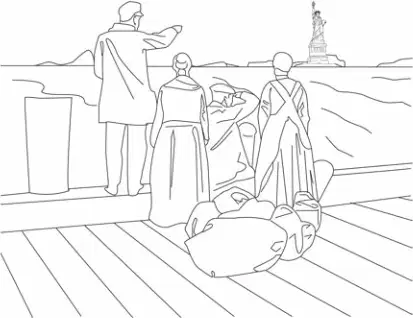
Why were people like those shown in this image hopeful about their future?

a)

Nativism and Social Darwinism were expanding in American cities.

b)

The U.S. social security system provided financial and medical benefits.

c)

There were many jobs and business opportunities in America.

d)

American cities had large and comfortable tenement apartment buildings.

72.
Immigration push factors are…
a)
reasons people come to a new place
b)
reasons people leave their homelands
c)
reasons people begin working
d)
reasons people stop working
73.
 Immigration  pull factors are…
a)
reasons people come to a new place
b)
reasons people leave their homelands
c)
reasons people begin working
d)
reasons people stop working
74.

What are civil service jobs?

a)

legal jobs

b)

bank jobs

c)

government jobs

d)

railroad jobs

75.

How were children affected by child labor during the Gilded Age? (Select multiple answers).

a)

They had to work 11-12 hour days.

b)

They often got plenty to send home to their families.

c)

They often got hurt or killed by accidents on the job.

d)

They were underpaid.

e)

They often got promoted when they got older.