
 Worksheets
Chapter 2 Test A
Total questions: 24
Worksheet time: 12mins
Working with others to make a decision is called _____ decision-making.
collaborative
individual
impulsive
authoritative
The ability to locate, interpret, and apply information pertaining to your health is called health _____
literacy
insurance
promotion
diagnosis
A(n) _____ is someone who purchases goods and services.
consumer
producer
manufacturer
supplier
The _____ Service of the United States Department of Health and Human Services provides leadership, funding, and oversight of the healthcare system.
Public Health
Postal
Internal Revenue
Forest
A(n) _____ is an area without nearby full-service grocery stores.
food desert
urban oasis
grocery hub
market zone
Failing to achieve a goal you have set does not benefit you.
True
False
Reliable health information can usually be found on websites with URL stems of .gov, .edu, and .org.
True
False
The size or popularity of a newspaper or magazine is a good indicator of how much you can trust the information it provides.
True
False
The healthcare field employs more people than any other type of business in the United States.
True
False
People living in highly populated areas are exposed to more air and water pollution.
True
False
Which of the following goals is SMART?
Put away digital devices 30 minutes before bed every night this week.
Get a role in the school musical.
Reduce stress.
Eat more fruits and vegetables and drink more water.
Which of the following is true about the theories and health claims resulting from pseudoscience?
A. They are based on experimentation and observation.
B. They are peer-reviewed.
C. They are based on experiment results that cannot be repeated.
D. They are verified by other scientists.
A type of healthcare professional who can deliver health services, but who works under the supervision of primary care physicians, is a(n) _____.
osteopathic doctor
specialist
nurse
physician assistant
Which of the following community resources connects people to mental health professionals who can help them seek treatment?
older adult services
community centers
crisis hotlines
All of the above.
Match each key term to its definition (15–19). 15. _____ healthcare facilities in which patients reside for the duration of treatment
advocate
food desert
inpatient facilities
specialists
values
Match each key term to its definition (15–19). 16. _____ qualities or priorities one considers important
advocate
food desert
inpatient facilities
specialists
values
Match each key term to its definition (15–19). 17. _____ healthcare professionals who have additional training in treating certain types of diseases and disorders
advocate
food desert
inpatient facilities
specialists
values
Match each key term to its definition (15–19). 18. _____ to take actions that show support
advocate
food desert
inpatient facilities
specialists
values
Match each key term to its definition (15–19). 19. _____ area without nearby full-service grocery stores
advocate
food desert
inpatient facilities
specialists
values
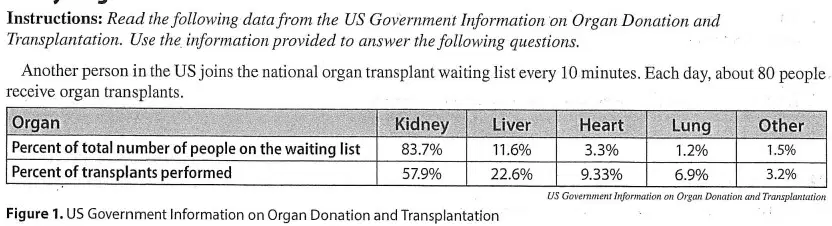
Ther were 36,518 organ transplants performed in 2018. How many heart transplants were performed:
3,407.13
21,143.92
8,253.07
1,205.09
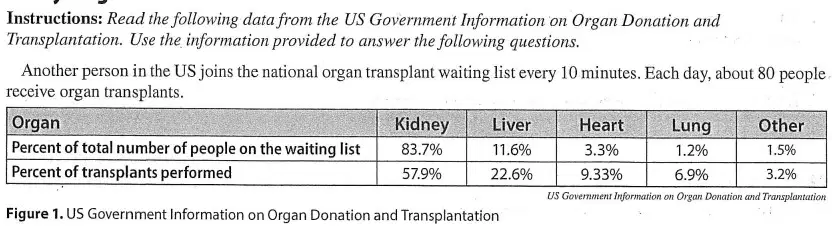
At the current rate, how many people will join the organ transplant waiting list each hour?
One person joins the organ transplant waiting list each hour.
Ten people join the organ transplant waiting list each hour.
Six people join the organ transplant waiting list each hour.
Twenty people join the organ transplant waiting list each hour.
Communities and organizations can encourage people to register to become organ donors by:
Raising awareness and providing education about organ donation.
Discouraging discussions about organ donation.
Limiting access to registration forms.
Promoting myths and misconceptions about organ donation.
The difference between science and pseudoscience is:
Science relies on evidence and experimentation, while pseudoscience lacks empirical support.
Science is based on opinions, while pseudoscience is based on facts.
Pseudoscience uses the scientific method, while science does not.
Science and pseudoscience both rely equally on rigorous testing.
Which of the following is a question examined in environmental justice?
Who is most affected by environmental hazards?
What is the boiling point of water?
How do plants perform photosynthesis?
What is the capital of France?

