
 Worksheets
AI QUIZ (CLASS 10)
Total questions: 35
Worksheet time: 35mins
Which of the following is NOT true about NLP?
a) It deals with natural language spoken and written by humans
b) It uses algorithms to extract information from human language
c) It ignores spoken language and focuses only on written language
d) It is used to make sense of human languages in a valuable manner
Which of the following is one of the earliest applications of NLP online?
a) Machine Translation
b) Email Filters
c) Voice Assistants
d) Text Summarization
What is the main purpose of a framework in problem-solving?
a) To avoid communication
b) To provide a structured, step-by-step approach
c) To increase complexity in problem-solving
d) To eliminate all human involvement
Using ethical frameworks allows individuals and organizations to:
a) Avoid making decisions
b) Make decisions that align with values and promote positive outcomes
c) Focus only on profits without ethics
d) Eliminate all stakeholder involvement
Which of the following is an example of a sector-based framework in AI?
a) Cybersecurity Framework
b) Bioethics Framework
c) Financial Reporting Standards
d) General Ethical Framework
Which of the following best describes rights-based frameworks?
a) They prioritize economic growth over human dignity
b) They focus on respecting individual autonomy, dignity, and freedoms
c) They aim to increase automation in industries
d) They eliminate the need for ethical reasoning
In the context of AI, which action aligns with a rights-based framework?
a) Designing AI that prioritizes speed over fairness
b) Ensuring AI systems do not violate human rights or discriminate
c) Ignoring user consent for faster data processing
d) Using AI solely for financial decision-making
Which term refers to intentionally causing harm or wrongdoing?
a) Non-maleficence
b) Beneficence
c) Maleficence
d) Benevolence
Beneficence is an ethical principle that focuses on:
a) Preventing harm at all costs
b) Promoting well-being and producing positive outcomes
c) Avoiding interference in decision-making
d) Ensuring no one benefits from decisions
What is the main goal of Computer Vision projects?
A) Translating audio data into visual descriptions
B) Converting digital data into analogue signals
C) Teaching machines to understand textual information
D) Converting digital visual data into computer-readable language
Which of the following is an example of anomaly detection?
a) Calculating the average heart rate over a week
b) Detecting a sudden spike in heart rate indicating a potential issue
c) Sorting heart rate data in ascending order
d) Measuring daily steps consistently
Digit recognition is commonly used in:
a) Music recommendation systems
b) Handwritten document processing like bank cheques
c) Detecting objects in videos
d) Translating languages
In a supervised learning model, what type of dataset is used?
a) Unlabelled dataset
b) Partially labelled dataset
c) Labelled dataset
d) Random dataset
Which of the following is an example of a label in the given context?
a) Student names
b) Grades assigned based on marks
c) Questions in the exam paper
d) Total number of students in the class
Which learning method does reinforcement learning primarily use?
a) Supervised learning
b) Trial-and-error
c) Clustering
d) Data annotation
Which of the following is an example of a classification model task?
a) Predicting tomorrow's exact temperature in Celsius
b) Measuring continuous temperature readings every second
c) Calculating average rainfall over the last year
d) Predicting whether tomorrow’s weather will be "hot" or "cold"
Why is salary prediction an example of regression?
a) Because the data is categorical
b) Because the output is a continuous value
c) Because the data is discrete and labeled
d) Because the prediction is only Yes or No
Association Rule learning is a type of:
a) Supervised learning
b) Unsupervised learning
c) Reinforcement learning
d) Semi-supervised learning
Which layer in a neural network is responsible for computation using weights and biases?
a) Input layer
b) Output layer
c) Hidden layer
d) Feature layer
Why are hidden layers called “hidden”?
a) They are invisible to the user and perform internal processing
b) They are visible and handle user interaction
c) They store raw input data without changes
d) They do not perform any computation
Which of the following statements about the train-test split is TRUE?
a) It divides the dataset into training and testing subsets
b) It is only used when the dataset is very small
c) It eliminates the need for model evaluation
d) It uses the same data for both training and testing
What is the term used when a model memorizes the training data and performs poorly on new data?
a) Underfitting
b) Overfitting
c) Regular Fitting
d) Perfect Fit
What is the relationship between model accuracy and model performance?
a) Inversely proportional
b) No relation
c) Directly proportional
d) Exponentially proportional
What is the role of error in machine learning?
a) To increase the complexity of the model
b) To check how inaccurately the model predicts data
c) To measure the training time
d) To optimize hardware performance
In a confusion matrix, what do the numbers in each cell represent?
a) Random numbers generated for evaluation
b) Predictions that fall into a specific actual vs predicted category
c) The number of features used in the model
d) The model’s hyperparameter values
If class 1 is assumed to be the positive class, which of the following outcomes counts as TP?
a) Actual = 1, Predicted = 1
b) Actual = 0, Predicted = 1
c) Actual = 1, Predicted = 0
d) Actual = 0, Predicted = 0
Which of the following is an example of True Negative?
a) You predicted Germany would win, and it won
b) You predicted Germany would not win, and it lost
c) You predicted Germany would not win, but it won
d) You predicted Germany would win, but it lost
What does False Positive (FP) represent in a confusion matrix?
a) The model correctly predicts the positive class
b) The model wrongly predicts the negative class as positive
c) The model correctly predicts the negative class
d) The model wrongly predicts the positive class as negative
In the satellite launch example, why is Precision important?
a) Because missing a good day (low recall) is unacceptable
b) Because we need to maximize the number of negative predictions
c) Because both FP and FN are equally dangerous
d) Because predicting a bad weather day as good (FP) can be disastrous
What is the formula for Precision?
a) TP/ TP + FN
b) TP / TP + FP
c) TN / TN + FP
d) TP + TN / All Predictions
What does the F1 Score combine into a single metric?
a) Accuracy and Precision
b) Recall and Accuracy
c) Precision and Recall
d) True Positives and False Negatives
A teacher's marks prediction system predicts the marks of a student as 80, but the actual marks obtained by the student are 90. What is the absolute error in the prediction?
a) 10
b) 5
c) 20
d) 100
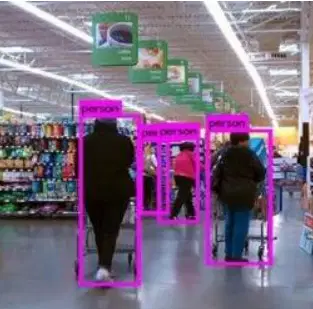
This is CV used in
a) Face filters
b) Medical Imaging
c) Retail
d) Schools
Which of the following is a common application of Object Detection?
a) Speech recognition
b) Machine translation
c) Image retrieval and automated vehicle parking systems
d) Text summarization
In a grayscale image, what does the value 0 represent?
a) White
b) Gray
c) Black
d) Transparent

