
 Worksheets
Polynomial Graphs
Total questions: 48
Worksheet time: 3hrs 13mins
f(x) = -5x4 - 2x2 + 8
Right side: Rises
Right side: Falls
Right side: Rises
Right side: Falls
*a positive leading coefficient
*zeros: 9, 3, -2, 0
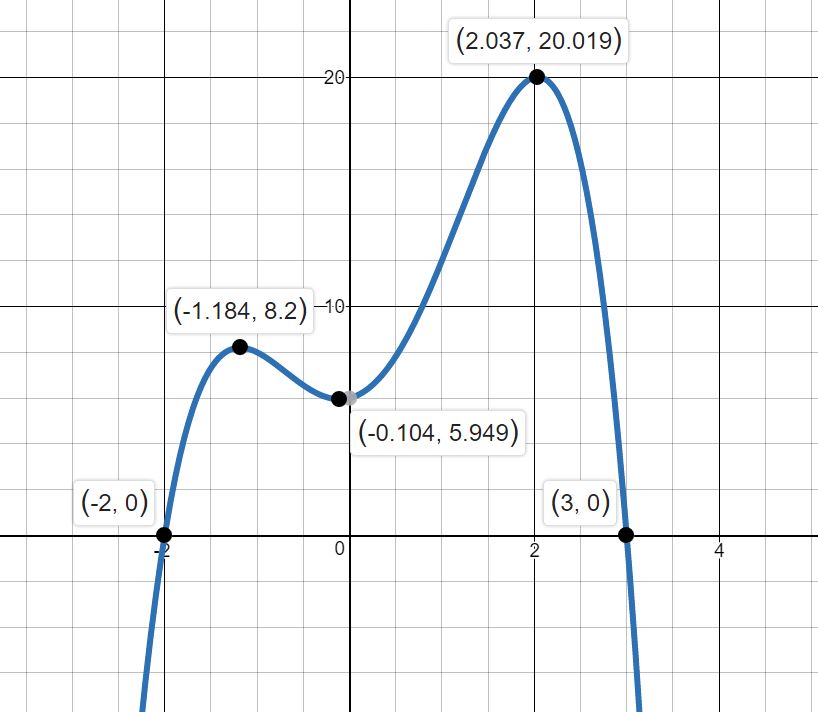
f(x) = -x4 + x3 + 5x2 + x + 6


Even or Odd degree?
even
odd
zeros of the polynomial
y = 3(x + 4)(x + 1)(x - 3)?
f(x) = -5x4 - 2x2 + 8
Right side: Rises
Right side: Falls
Right side: Rises
Right side: Falls
f(x) = 2x2 + 6x5 + 10x
Right side: Rises
Right side: Rises
Right side: Falls
Right side: Falls

Identity the domain and the range of the linear graph.
D= (∞, - ∞)
R= (∞, - ∞)
D= (-∞, ∞)
R= (0, 2)
D= (-∞, ∞)
R= (-∞, ∞)
none of the above

Identify the coordinates of the y-intercept.
(0,1)
(1,0)
(0,0)
There is not a y-intercept

The end behavior of the following is graph is ______________ .
x → −∞, y → ∞
x → ∞, y → ∞
x → −∞, y → - ∞
x → ∞, y → ∞
x → −∞, y → - ∞
x → ∞, y → - ∞
none of the above
P(x)=3x4-7x2-2x7-x+4?

As x --> -∞, f(x) --> ____
As x --> +∞, f(x) --> ____
-∞
-∞
+∞
+∞


For the given polynomial graph, which is the relative maximum?
(1,8)
(2,1)
(1,2)
(-1,-2)

How would you describe the point at (0,6)?
Relative Minimum
Absolute Minimum
Relative Maximum
Absolute Maximum
How would you describe the point at (0,6)?
Relative Minimum
Absolute Minimum
Relative Maximum
Absolute Maximum

Which of the following does this graph not have?
absolute max
absolute min
relative max
relative min
Which of the following does this graph not have?
absolute max
absolute min
relative max
relative min

What is the Range of the function being graphed?
(-∞, ∞)
[7, ∞)
(-∞, 7]
(-1, 1)
(-∞, 7)
What is the Domain of the function being graphed?
(-∞, ∞)
[7, ∞)
(-∞, 7]
(-1, 1)
(-∞, 7)

What is the absolute minimum point on the polynomial graph?
There is not an absolute minimum
(-4,-1.5)
(-1.5,-4)
- ∞

8x7 - 6x5 + 4x3 + 2x + 1 = 0


What is the interval of decrease for Graph #8?
(-∞, 0) ∪ (2, ∞)
(0, 2)
(-∞, 2)
(2, ∞)
What is the interval of decrease for Graph #8?
(-∞, 0) ∪ (2, ∞)
(0, 2)
(-∞, 2)
(2, ∞)

How many increasing and decreasing intervals are there in this graph?
2 increasing, 2 decreasing
1 increasing, 2 decreasing
2 increasing, 1 decreasing
1 increasing, 1 decreasing

What are the increasing and decreasing intervals of the graph?
Increasing = (-1.5, 0) & (1.5, ∞)
Decreasing = (-∞, -1.5) & (0, 1.5)
Increasing = (-∞, -1.5) & (0, 1.5)
Decreasing = (-1.5, 0) & (1.5, ∞)
Increasing = (-∞, -1.5) & (1.5, ∞)
Decreasing = (-1.5, 0) & (0, 1.5)
Increasing = (-1.5, 0) & (0, 1.5)
Decreasing = (-∞, -1.5) & (1.5, ∞)

What are the increasing intervals?
(- ∞, 0) & (2, ∞ )
(-1, 0) & (2,4)
(0,2) & (-3, -7)
(-8, -3) & (-7, 8)

What are the decreasing intervals on the graph?
(-∞, 0) & (-4, ∞)
(-∞, -1) & (1, ∞)
(-∞, -2) & (2, ∞)
(-∞, 0) & (4, ∞)

What are the increasing and decreasing intervals of the graph?
Increasing = (-∞,-3), (-1,2), (4, ∞)
Decreasing = (-3,-1), (2,4)
Increasing = (-3,-1), (2,4)
Decreasing = (-∞,-3), (-1,2), (4, ∞)
Increasing = (-∞,-3), (-1,2),
Decreasing (-3,-1), (2,4), (4, ∞)
Increasing = (-∞, 2), (-3, 1), (-1, ∞)
Decreasing (2, -3), (1, -1)

Identify where the function is decreasing.
x < -4 , x > 1
-4 < x < 1
-6 < x < 7.5
All Real Numbers


Identify the decreasing interval:
(0, 4)
(1, 0) U (1, 4)
(-1, 1)
(-∞, -1) U (1, ∞)
What are the extrema of the graph?
Max = (2, -3), (1, 2)
Min = (-3, -1), (-1, 4)
Max = (-3, -1), (-1, 4)
Min = (2, -3), (1, 2)
Max = (-1, -3), (4, -1)
Min = (-3, 2), (2, 1)
Max = (-3, 2), (2, 1)
Min = (-1, -3), (4, -1)
f(x) = (x-5)(2x+3)(7x-4)(x+6)
If the zeros of a polynomial are -1, 3, and 7 then what does the polynomial look like in factored form?
(x-1)(x+3)(x+7)
(x+1)(x-3)(x-7)
-x2 + 3x + 7
(x-1)
If the zeros of a polynomial are -1, 3, and 7 then what does the polynomial look like in factored form?
(x-1)(x+3)(x+7)
(x+1)(x-3)(x-7)
-x2 + 3x + 7
(x-1)
What are the zeros in (x-5)(x+4)
4 and -5
5 and -4
-4 and -5
no zeros
f(x) = -x(x+1)(x-3)
f(x) = -x4 + x3 + 5x2 + x + 6
State the y-intercept.
y = 2x5 + 3x4 – 5x2 + 3x
-90
90
3
0

