
 Worksheets
Electromagnetic radiation
Total questions: 28
Worksheet time: 26mins

Which property of light determines its color in the visible spectrum?
Wavelength (λ)
Amplitude
Speed
Photon count
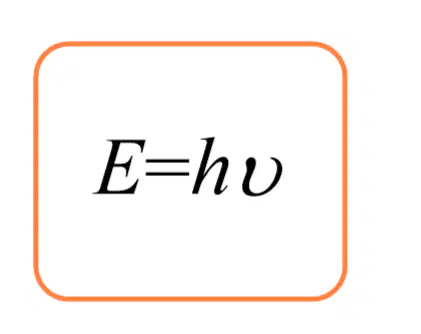
The energy of a photon is directly proportional to:
Its wavelength
Its frequency
Its mass
Its speed

Red light has longer wavelength but lower energy than blue light.
True
False
In Bohr’s model, when electrons move from n = 3 → n = 2, they:
Emit energy as light
Absorb energy as light
Stay at the same energy level
Lose protons
Name one real-world example where emission spectra are used.
Fireworks, neon lights, analyzing starlight, forensic flame tests
Measuring air pressure in tires
Calculating speed of a car
Determining the boiling point of water
Which transition in hydrogen gives off the highest energy photon?
n = 5 → n = 4
n = 4 → n = 3
n = 3 → n = 2
n = 2 → n = 1
The Bohr model explains why atoms emit line spectra rather than continuous spectra.
True
False
Electrons absorb energy to move to:
Lower energy levels
Higher energy levels
The same energy levels
The nucleus
Radio Waves
Have the longest wavelengths
Infrared waves
Associated with thermal energy
Visible Light
The only wavelengths humans can see
Ultraviolet Light
Too much can cause sunburn
X-rays
Stopped by dense material, like bone
Label the parts of the atom:
neutrons
nucleus
electrons
protons
According to the Bohr model, what is the main reason for the line spectra of hydrogen?
Electrons are in fixed orbits with quantized energy levels.
Electrons emit continuous spectra when they transition between orbits.
Electrons are in random orbits with varying energy levels.
Electrons absorb energy and move to higher orbits indefinitely.
Which of the following transitions in the hydrogen atom results in the emission of visible light?
n = 4 → n = 3
n = 2 → n = 1
n = 5 → n = 4
n = 3 → n = 2
What happens to the energy of a photon if its wavelength decreases?
It becomes zero
It stays the same
It decreases
It increases
According to the Bohr model, what causes an electron to move from a higher energy level to a lower one?
Emission of a photon
Loss of a neutron
Increase in atomic mass
Absorption of a photon
What is the wavelength and color of the emitted
photon, due to a transition in a hydrogen atom from
the 𝑛 = 3 state to the 𝑛 = 2 state?
486 nm Green
656 nm Red
486 nm Blue
434 nm Violet
First, a review--match the following
Proton
positive charge
Neutron
neutral charge
Electron
negative charge
Atomic number
number of protons
Nucleus
center of an atom
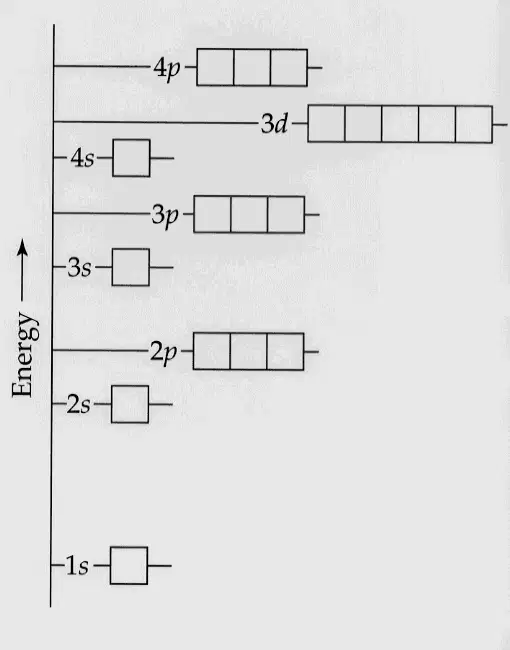
The short-hand electron configuration of Sodium is
[He]2s1
[Ne]3s1
[Ar]4s1
[Ne]3s2 3p3
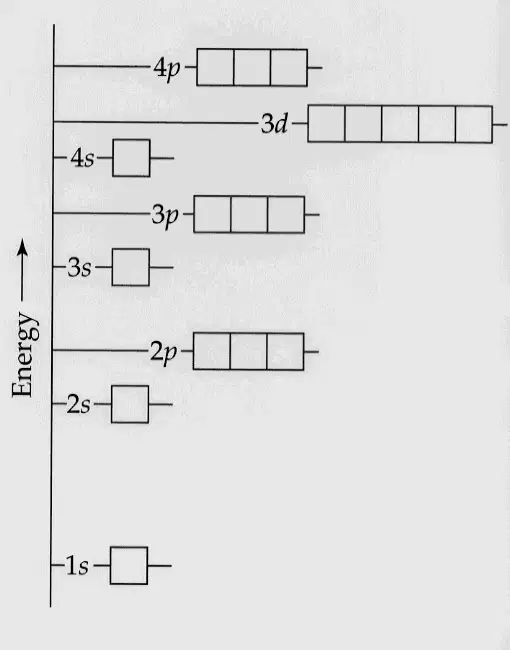
The short-hand electron configuration of potassium ion (K+) is __
[He]2s1
[Ne]3s1
[Ne] 3s2 3p6
[Ar] 3s1
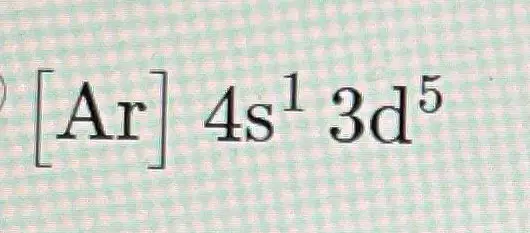
which element is represented by the short-hand electron configuration given here?
Iron atom, Fe
Chromium atom (Cr)
Copper atom (Cu)
Manganese atom

Match the following elements and the type of elements:
s-block elements
Na, Mg, K, Ca
p-block elements
B, C, N, O, F, Ne
d-block elements
Cr, Fe, Cu, Ni, zn
Abigail, Scarlett, and Charlotte are working on a science project about elements. They have a model of an atom with the electron configuration: 1s22s22p63s23p64s23d10. They need to identify which element this atom represents for their project. Can you help them?
Zinc
Copper
Nickel
Germanium
Noah, Samuel, and Sophia are studying chemistry together. They are trying to figure out the electron configuration of an oxygen atom. Which of the following options is correct?
1s22s22p63s2, 3p64s23d104p5
1s22s22p4
1s22s22p6
1s22s22p63s23p64s23d1
Abigail is studying the electron configuration of an atom in her chemistry class. She learns that the configuration is 1s22s22p6. Maya, her classmate, asks her about the total number of electrons in the atom. What should Abigail tell Maya?
3
6
8
10
Hannah, Charlotte, and Rohan are studying chemistry together. They are discussing atomic structure and Hannah asks, 'What is the maximum number of electrons that an S orbital can have in an atom?'
1 electron
2 electrons
3 electrons
4 electrons
James, Aria, and Olivia are studying chemistry together. They come across a question about electron capacity in orbitals. They want to know how many electrons can the d sublevel(orbital) hold?
8
10
2
4
Mason, Liam, and Nora are discussing the energy levels of subshells s, p, d, and f. They all agree that these subshells have the same energy as long as they are in the same principal shell.
True
False

James is studying orbital diagrams and comes across one that seems incorrect. What is incorrect about the orbital diagram he found?
Both arrows in the 2p box should be pointing up
There are too many electrons in the 1s orbital
In the 2p boxes, there should only be 1 electron in the first 2p box and one in the 2nd 2p box
All the arrows should be pointing up
Rohan, Abigail, and Jackson are studying chemistry and discussing the f orbital. How many electrons total can be found in the f orbital?
2
6
10
14

