
 Worksheets
Cell Structure and Function Study Guide 9-2-26
Total questions: 28
Worksheet time: 20mins
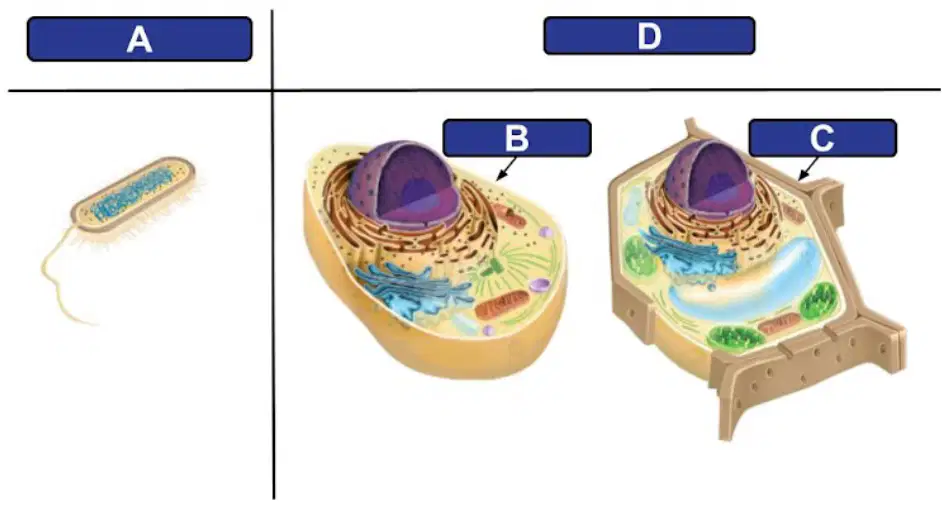
Which label in the diagram represents a prokaryotic cell?
A
B
C
D

Which label in the diagram represents a plant cell?
C
A
B
D

Which label in the diagram represents an animal cell?
B
A
C
D

Which of the following labels in the diagram represents a eukaryotic cell?
D
A
B
C

Which label in the diagram represents the lipid bilayer of the cell membrane?
Label A
Label B
Label C
Label D

Which label in the diagram corresponds to membrane proteins?
Label A
Label B
Label C
Label D

Which label in the diagram indicates the hydrophilic head of the lipid molecule?
Label A
Label B
Label C
Label D

Which label in the diagram shows the hydrophobic tail of the lipid molecule?
Label A
Label B
Label C
Label D
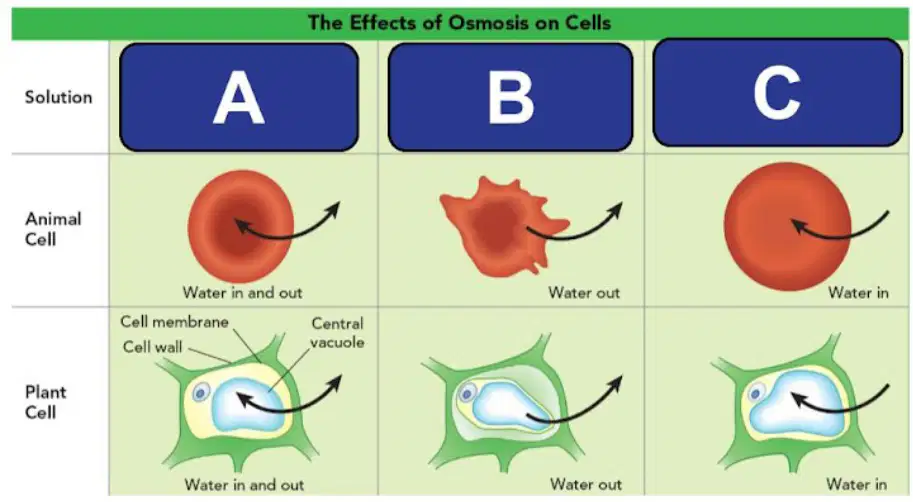
Complete the following matching section based on the image below.
A: Isotonic, B: Hypertonic, C: Hypotonic
A: Hypertonic, B: Isotonic, C: Hypotonic
A: Isotonic, B: Hypotonic, C: Hypertonic
A: Hypotonic, B: Isotonic, C: Hypertonic
Which cell structure is not enclosed by a membrane and houses genetic material?
Ribosomes
Cytoplasm
Golgi apparatus
Nucleoid
Which organelle modifies, sorts, and packages proteins into lipids and vesicles, and is only found in eukaryotic cells?
Ribosomes
Cytoplasm
Golgi apparatus
Nucleus
What is the gel-like substance that fills the cell and contains the organelles (and was purple in the onion cells)?
Ribosomes
Cytoplasm
Golgi apparatus
Nucleoid
Which cell structure has its own membrane and houses genetic information, acting as the control center of the cell?
Ribosomes
Cytoplasm
Golgi apparatus
Nucleus
Which cell structure is responsible for protein synthesis and is found in both prokaryotic and eukaryotic cells?
Ribosome
Nucleus
Mitochondria
Cell wall
Which process is defined as the diffusion of water across a selectively permeable membrane from high to low concentrations?
Simple diffusion
Facilitated diffusion
Osmosis
Endocytosis
What is the process that moves a large amount of materials by forming a vacuole or pockets around it (from low to high concentration)?
Exocytosis
Endocytosis
Osmosis
Facilitated diffusion
Which process moves a large amount of materials by having a vacuole fuse with the cell membrane (from low to high concentration)?
Endocytosis
Simple diffusion
Exocytosis
Osmosis
What is the process called when molecules move from high to low concentrations through transport proteins in the cell membrane?
Facilitated diffusion
Simple diffusion
Endocytosis
Exocytosis
Which of the following best describes the difference between active and passive transport?
Active transport moves molecules from high to low concentration, while passive transport moves them from low to high.
Passive transport requires energy, while active transport does not.
Active transport requires energy to move molecules from low to high concentration, while passive transport moves molecules from high to low without using energy.
Both active and passive transport require energy to move molecules across the membrane.
What do active and passive transport have in common?
Both help maintain homeostasis by transporting materials across the cell membrane.
Both move substances from low to high concentration.
Both require energy to function.
Both always move substances out of the cell.
Which of the following is a key difference between prokaryotic and eukaryotic cells?
Eukaryotic cells have a true nucleus and are generally larger and more complex, while prokaryotic cells lack a nucleus and are smaller and simpler.
Prokaryotic cells have a nucleus, while eukaryotic cells do not.
Both prokaryotic and eukaryotic cells have mitochondria to produce energy.
Prokaryotic cells are always multicellular, while eukaryotic cells are always unicellular.

Which of the following is the best independent variable to answer the guiding question?
The initial mass of the potato
The amount or concentration of salt in the solution
The final mass of the potato after osmosis
The percent change in potato mass
Claim: If the amount of salt increases, then the percent change in the mass of the potato will decrease because the concentration of water is lower outside the plant cell than inside the cell.
Does this evidence support the claim and why?
Yes, because the graph shows that as the concentration of salt increases, the percent change decreases.
No, because the data shows that the potato gained mass, meaning water moved into the plant cells instead of out.
Yes, because the graph shows that as the concentration of salt increases, the percent change increases.
No, because osmosis only affects solute movement, not water movement.

The cell shrunk in size, which means it was placed in a ____ solution.
Isotonic
Hypertonic
Hypotonic


What type of solution is the blue cell immersed in?
isotonic - water moves in and out equally
hypertonic - water will move out of the cell
hypotonic - water will move into the cell

