
 Worksheets
Electromagnetic Radiation Worksheet #1
Total questions: 46
Worksheet time: 23mins
Which of the following has a constant value for all electromagnetic radiation?
frequency
mass
origin
velocity
wavelength
When considering the electromagnetic spectrum, photons of a radio broadcast have relatively:
high energy and long wavelengths
high energy and short wavelengths
high frequency and low energy
low energy and long wavelengths
low energy and short wavelengths
When light is refracted through a prism, the following colors are emitted. Which has the longest wavelength?
blue
orange
red
ultraviolet
yellow
The principal difference between x-rays and gamma rays is their:
energy
frequency
origin
velocity
wavelength
Which of the following most closely represents the term attenuation?
absorption of x-rays
deflection of x-rays
light absorbed in black glass
light reflected from a mirror
light transmitted through frosted glass
The energy of an x-ray photon is directly proportional to its:
frequency
mass
velocity
wavelength
The four properties of photons are ______, ______, ______, and ______.
size, shape, spin, mass
frequency, mass, amplitude, wavelength
frequency, wavelength, velocity, amplitude
refraction, velocity, spin, amplitude
The intensity of radiation on an object is reduced with distance because the radiation
reduces its velocity.
increases in wavelength.
loses its energy.
is spread out over a greater area.
The lowest energy range of the electromagnetic spectrum is
sound waves.
radio waves.
gamma rays.
microwaves.
Electromagnetic energy is similar to sound vibrations, but it is the _____ itself
that is vibrating, not an eardrum or air molecules.
Energy
Wave
Amplitude
Wavelength
The energy that is vibrating travels in an electromagnetic
Energy
Length
Wave
Top
The ___ is the height of the wave, A wave with a large amplitude is generally stronger than a wave with a small amplitude.
Wave
Length
Amplitude
Energy
An important characteristic of light waves, and all electromagnetic energy is wavelength. This is the____ of one wave,
Length
Top
Amplitude
Velocity
This is the Length of one wave, measured from top of one wave to the___ top of the next wave.
Amplitude
Length
Wave
Top
A property of energy created by the vibrations of photons.
Wave
Speed of light
Velocity
Hertz
A field created by the vibrations of electromagnetic energy.
Amplitude
Velocity
Electromagnetic field
Wave
The height of a wave.
Electromagnetic field
Hertz
Amplitude
Frequency
The length of one wave, measured from the top of one wave to the top of the next.
Wavelength
Frequency
Speed of light
Amplitude
approximately 3 x 10® m/s
Frequency
Wavelength
Speed of light
Hertz
The number of waves that go by a given point in one second or cycle.
Frequency
Wavelength
Electromagnetic spectrum
Speed of light
The range of electromagnetic energy in wavelengths.
Wavelength
Electromagnetic field
Amplitude
Electromagnetic Spectrum
The Si unit of measurement for frequency.
Hertz
Speed of light
Velocity
Amplitude
intensity of energy diminishes by a factor of the square of the distance from its source.
Inverse square law
Absorbed
Photons
Excitation
A type of heat radiation.
Translucent
Absorbed
Infrared light
Refraction
a packet/bundle of energy with no mass.
De-excitation
Photon
Opaque
Transmitted
the "bending" of light rays as they pass through one clear medium to another.
Translucent
Attenuated
Excitation
Refraction
the state of an atom when something makes an e- jump to a higher shell.
Translucent
Infrared light
Excitation
Photon
the condition that occurs when an excited atom returns to its normal state.
De-excitation
Absorbed
Excitation
Opaque
photons are stopped by a substance.
Attenuated
Infrared light
Translucent
Absorbed
photons pass through a substance.
Excitation
Transmitted
Attenuated
Inverse square law
some photons are absorbed, but some are transmitted through a substance.
Refraction
De-excitation
Attenuated
Photon
the property of a substance that totally absorbs light rays.
Opaque
Transmitted
Refraction
Inverse square law
the property of a substance that partially absorbs, or attenuates, light rays.
Excitation
Attenuated
Translucent
Wavelength
the result fast moving electrons striking the atoms of certain metals.
X-rays
Electron volt
Radiolucent
Gamma rays
a type of electromagnetic radiation at the high end of the spectrum, originating
in the nuclei of atoms.
Ionizing radiation
Radiolucent
Gamma rays
X-rays
the property of a substance that allows x-rays to partially pass through it.
Roentgenogram
Radiopaue
Electron volt
Radiolucent
the property of a substance that does not allow x-rays to pass through it.
electron volt
Radiopaque
X-rays
Gamma rays
radiation that has the power to change atoms into ions by knocking out
electrons.
Radiolucent
Radiopaque
Roentgenogram
Ionizing radiation
term for radiograph
Gamma rays
X-rays
Roentgenogram
Ionizing radiation
unit of photon energy
Electron volt
Radiolucent
Radiopaque
Ionizing radiation

12?
E
F
G
H

13?
A
B
C
D

14?
A
B
C
D

15?
A
B
C
D

16?
A
B
C
D
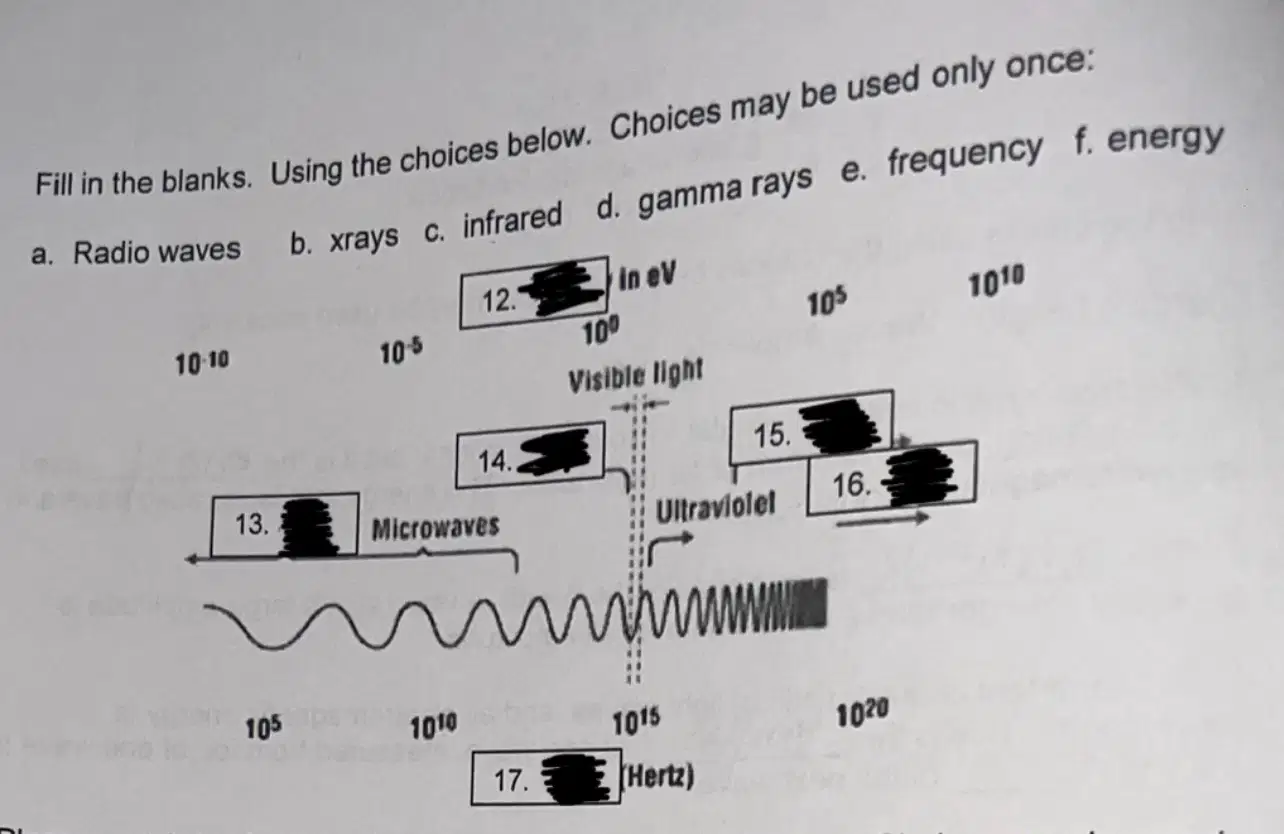
17?
E
F
G
H

