
 Worksheets
aerodynamic 1
Total questions: 47
Worksheet time: 16mins
Name
Class
Date
1.
Static pressure acts:
a)
only in direction of the flow
b)
only perpendicular to the direction of the flow
c)
in all directions
d)
only in the direction of the total pressure
2.
Which one of the following statements about Bernoulli's theorem is correct?
a)
The dynamic pressure decreases as static pressure decreases
b)
The total pressure is zero when the velocity of the stream is zero
c)
The dynamic pressure increases as static pressure decreases
d)
The dynamic pressure is maximum in the stagnation point
3.
In a convergent tube with an incompressible sub-sonic airflow, the following pressure changes will occur: Ps = static pressure; Pdyn = dynamic pressure; Ptot = total pressure.
a)
Ps increases, Pdyn decreases, Ptot remains constant
b)
Ps decreases, Pdyn increases, static temperature increases
c)
Ps decreases, Pdyn increases, Ptot remains constant
d)
Ps decreases, Ptot increases, static temperature decreases
4.
Consider subsonic incompressible airflow through a venturi: I. The dynamic pressure in the undisturbed airflow is higher than in the throat; II. The total pressure in the undisturbed airflow is higher than in the throat.
a)
I is incorrect, II is incorrect.
b)
I is correct, II is incorrect.
c)
I is correct, II is correct.
d)
I is incorrect, II is correct.
5.
The lift formula is:
a)
L= W
b)
L= CL 1/2 q V2 S
c)
L= n W
d)
L= CL 2 q V2 S
6.
The terms 'q' and 'S' in the lift formula are:
a)
dynamic pressure and the area of the wing
b)
static pressure and dynamic pressure
c)
static pressure and wing surface area
d)
square root of surface and wing loading
7.
An aeroplane performs a straight and level horizontal flight at the same angle of attack at two different altitudes. (all other factors of importance being constant, assume ISA conditions and no compressibility effects)
a)
the TAS at the higher altitude cannot be determined
b)
the TAS at both altitudes is the same
c)
the TAS at the higher altitude is lower
d)
the TAS at the higher altitude is higher
8.
Total pressure is:
a)
measured at a small hole in a surface, parallel to the local stream
b)
static pressure minus the dynamic pressure
c)
static pressure plus the dynamic pressure
d)
1/2 rho V2
9.
What are the two main properties of air used to ascertain air density?
a)
Pressure and Density altitiude.
b)
Pressure and Temperature.
c)
Temperature and Pressure altitude.
d)
Temperature and Humidity.
10.
When an aeroplane with the centre of gravity forward of the centre of pressure of the combined wing / fuselage is in straight and level flight, the vertical load on the tailplane will be:
a)
zero because in steady flight all loads are in equilibrium.
b)
upwards.
c)
downwards because it is always negative regardless of the position of the centre of gravity.
d)
downwards.
11.
Following a disturbance, an aeroplane oscillates about the lateral axis at a constant amplitude. The aeroplane is:
a)
statically stable - dynamically neutral
b)
statically unstable - dynamically neutral
c)
statically stable - dynamically unstable
d)
statically unstable - dynamically stable
12.
Which part of an aeroplane provides the greatest positive contribution to the static longitudinal stability?
a)
The fuselage.
b)
The engine.
c)
The wing.
d)
The horizontal tailplane.
13.
Rolling is the rotation of the aeroplane about the:
a)
vertical axis
b)
lateral axis
c)
longitudinal axis
d)
wing axis
14.
Differential aileron deflection:
a)
equals the drag of the right and left aileron
b)
is required to achieve the required roll-rate
c)
increases the CLmax
d)
is required to keep the total lift constant when ailerons are deflected
15.
An example of differential aileron deflection during initiation of left turn is:
a)
Left aileron: 2° up; Right aileron: 5° down
b)
Left aileron: 5° up; Right aileron: 2° down
c)
Left aileron: 2° down; Right aileron: 5° up
d)
Left aileron: 5° down; Right aileron: 2° up
16.
One method to compensate adverse yaw is:
a)
a differential aileron.
b)
a balance panel.
c)
an anti-balance tab.
d)
a balance tab.
17.
Which of the following statements concerning control is correct?
a)
On some aeroplanes, the servo tab also serves as a trim tab
b)
Hydraulically powered control surfaces do not need mass balancing
c)
In a differential aileron control system the control surfaces have a larger upward than downward maximum deflection
d)
In general the maximum downward elevator deflection is larger than upward
18.
Mass-balancing of control surfaces is used to:
a)
limit the stick forces.
b)
ensure that the control surfaces are in the mid-position during taxiing .
c)
prevent flutter of control surfaces
d)
increase the stick force stability.
19.
If the elevator trim tab is deflected up, the cockpit trim indicator presents:
a)
neutral
b)
nose-down
c)
nose-left
d)
nose-up
20.
In straight and level flight, as speed is increased:
a)
the elevator and trim tab do not move.
b)
both elevator and trim tab are deflected further downwards.
c)
the elevator is deflected further upwards and the trim tab further downwards.
d)
the elevator is deflected further downwards and the trim tab further upwards.
21.
VA is:
a)
the maximum speed at which rolls are allowed.
b)
the speed at which a heavy transport aeroplane should fly in turbulence.
c)
the maximum speed at which maximum elevator deflection up is allowed.
d)
the speed that should not be exceeded in the climb.
22.
What can happen to the aeroplane structure flying at a speed just exceeding VA?
a)
It may suffer permanent deformation if the elevator is fully deflected upwards
b)
It will collapse if a turn is made.
c)
It may suffer permanent deformation because the flight is performed at too large dynamic pressure.
d)
It may break if the elevator is fully deflected upwards.
23.
How can wing flutter be prevented?
a)
By increasing the aspect ratio of the wing
b)
By mounting the engines on the fuselage
c)
By locating mass in front of the torsion axis of the wing
d)
By installing the fuel tanks in the fuselage
24.
If the nose of an aeroplane yaws left, this causes:
a)
a decrease in relative airspeed on the right wing.
b)
an increase in lift on the left wing.
c)
a roll to the left.
d)
a roll to the right.
25.
Which phenomenon is counteracted with differential aileron deflection?
a)
Aileron reversal.
b)
Sensitivity for spiral dive.
c)
Adverse yaw.
d)
Turn co-ordination.
26.
How is adverse yaw compensated for during entry into and roll out from a turn ?
a)
Differential aileron deflection
b)
Servo tabs
c)
Anti-balanced rudder control
d)
Horn-balanced controls
27.
If the sum of all the moments in flight is not zero, the aeroplane will rotate about the:
a)
neutral point of the aeroplane.
b)
centre of gravity.
c)
centre of pressure of the wing.
d)
aerodynamic centre of the wing.
28.
Positive static stability of an aeroplane means that following a disturbance from the equilibrium condition:
a)
the initial tendency is to return towards its equilibrium condition.
b)
the tendency is to move with an oscillatory motion of increasing amplitude.
c)
the tendency is to move with an oscillatory motion of decreasing amplitude.
d)
the initial tendency is to diverge further from its equilibrium condition.
29.
If the control stick of an aircraft is moved forward and to the right, the left aileron will move:
a)
up, and the elevator will move down.
b)
up, and the elevator will move up.
c)
down, and the elevator will move down.
d)
down, and the elevator will move up.
30.
During flight the yaw pedals are used to control:
a)
turning, balance, direction and slip.
b)
aircraft direction, slip and skid.
c)
direction of movement and heading.
d)
aircraft heading, balance, slip and skid.
31.
In order to perform a steady level turn at constant speed in an aeroplane, the pilot must:
a)
increase thrust/power and keep angle of attack unchanged.
b)
increase thrust/power and decrease angle of attack.
c)
increase thrust/power and angle of attack.
d)
increase angle of attack and keep thrust/power unchanged.
32.
The angle of attack (aerodynamic angle of incidence) of an aerofoil is the angle between the:
a)
chord line and the relative undisturbed airflow
b)
bottom surface and the chord line
c)
bottom surface and the relative airflow
d)
bottom surface and the horizontal
33.
The angle of attack of a two dimensional wing section is the angle between:
a)
the chord line of the aerofoil and the fuselage centreline
b)
the chord line of the aerofoil and the free stream direction
c)
the chord line and the camber line of the aerofoil
d)
the fuselage centreline and the free stream direction
34.
The angle between the airflow (relative wind) and the chord line of an aerofoil is:
a)
angle of attack
b)
same as the angle between chord line and fuselage axis
c)
climb path angle
d)
glide path angle
35.
The angle between the aeroplane longitudinal axis and the chord line is the:
a)
angle of incidence
b)
climb path angle
c)
angle of attack
d)
glide path angle
36.
The lift force, acting on an aerofoil:
a)
increases, proportional to the angle of attack until 40 degrees
b)
is mainly caused by overpressure at the underside of the aerofoil
c)
is mainly caused by suction on the upperside of the aerofoil
d)
is maximum at an angle of attack of 2 degrees
37.
Total Drag consists of
a)
Drag associated with all lift producing airframe elements
b)
Induced and Parasite Drag
c)
Induced and Form Drag
d)
Just Interference Drag
38.
Skin Friction Drag relates to;
a)
Viscosity and Boundary Layer
b)
Viscosity and Angle of Attack
c)
Angle of Attack and airspeed
d)
Airspeed only
39.
On an asymmetrical, single curve aerofoil, in subsonic airflow, at low angle of attack, when the angle of attack is increased, the centre of pressure will (assume a conventional transport aeroplane):
a)
move aft
b)
remain matching the airfoil aerodynamic centre
c)
move forward
d)
remain unaffected
40.
The location of the centre of pressure of a positive cambered wing at increasing angle of attack will:
a)
not shift
b)
shift forward
c)
shift in spanwise direction
d)
shift aft
41.
The point, where the single resultant aerodynamic force acts on an aerofoil, is called:
a)
neutral point
b)
centre of gravity
c)
aerodynamic centre
d)
centre of pressure
42.
Consider an aerofoil with a certain camber and a positive angle of attack. At which location will the highest flow velocities occur?
a)
Upper side
b)
In the stagnation point
c)
In front of the stagnation point
d)
Lower side
43.
Interference drag is the result of:
a)
separation of the induced vortex
b)
downwash behind the wing
c)
the addition of induced and parasite drag
d)
aerodynamic interaction between aeroplane parts (e.g. wing / fuselage)
44.
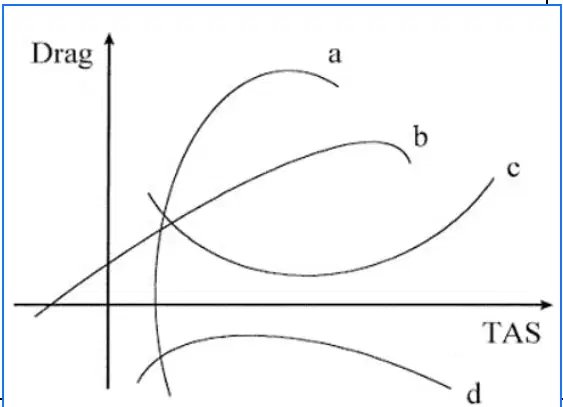
Which line represents the total drag line of an aeroplane?
a)
Line c
b)
Line d
c)
Line b
d)
Line a
45.
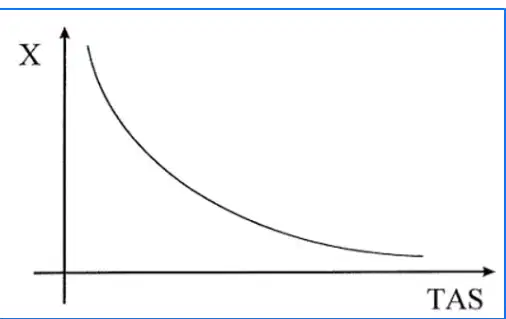
The diagram shows the parameter X versus TAS. If a horizontal flight is considered the axis X shows
a)
the induced drag
b)
the parasite drag
c)
the lift force
d)
the total drag
46.
Induced drag at constant IAS is affected by:
a)
aeroplane wing location
b)
aeroplane weight
c)
engine thrust
d)
angle between wing chord and fuselage centre line
47.
Induced drag is created by the:
a)
spanwise flow pattern resulting in the tip vortices
b)
propeller wash blowing across the wing
c)
separation of the boundary layer over the wing
d)
interference of the air stream between wing and fuselage
100 %

