
NEW
Font size
 Worksheets
N5 Marketing - Price
Total questions: 53
Worksheet time: 27mins
Which of the following is a factor to consider when setting prices for a product?
Weather conditions
Competition
Employee hobbies
Office location
Which of the following is NOT typically considered when setting prices?
Quality
Image
Production cost
Employee birthdays
Which pricing strategy involves setting prices higher than competitors to create a perception of higher quality?
Premium pricing
Low pricing
Competitive pricing
Discount pricing
Explain why a business might choose a competitive pricing strategy over a premium pricing strategy.
To attract more customers by matching competitors' prices
To increase production costs
To reduce product quality
To avoid advertising
A company wants to maximize profit per unit. Which factor should they focus on?
Reducing production cost
Increasing employee benefits
Expanding office space
Hiring more staff
Which of the following is a factor that a business must consider when deciding the price of a good or service?
The color of the product
The life cycle of the product
The number of employees
The location of the business owner
Why might a business look at the prices charged by its competitors when setting its own prices?
To copy their marketing strategies
To ensure their price is competitive in the market
To hire their employees
To use the same suppliers
Which of the following best describes the importance of the market segment in deciding the price of a product?
It determines the color of the product
It helps identify the target customers and their willingness to pay
It decides the number of products to be manufactured
It sets the company’s mission statement
A company wants to maximize its profit. Which factor should it consider when setting the price of its product?
How much profit is wanted
The number of advertisements
The color of the packaging
The number of employees
If a business cannot supply enough of a product, what impact might this have on its pricing decision?
The price may decrease due to oversupply
The price may increase due to limited supply
The price will remain the same regardless of supply
The price will be set by the government
Which of the following is a characteristic of long-term pricing strategies?
High/premium
Penetration
Promotional
Market skimming
Which of the following is NOT a short-term pricing strategy?
Cost plus
Promotional
Destroyer
Psychological
What is an example of a market/competitive pricing strategy?
Setting prices based on what competitors are charging
Setting prices based on psychological factors
Setting prices to quickly gain market share
Setting prices for a short promotional period
A company wants to quickly attract customers by offering very low prices for a limited time. Which short-term pricing strategy are they most likely using?
Penetration
Cost plus
High/premium
Market/competitive
Explain the difference between long-term and short-term pricing strategies, providing one example of each.
Long-term strategies focus on sustained pricing approaches like cost plus, while short-term strategies are temporary, such as promotional pricing.
Long-term strategies are always more expensive, while short-term strategies are always cheaper.
Short-term strategies are used only by new businesses, while long-term strategies are used by established companies.
Long-term strategies do not consider competitors, while short-term strategies do.
What is the main characteristic of a Low/Value Pricing Strategy?
The price charged is higher than competitors
The price charged is the same as competitors
The price charged is lower than competitors
The price is not important in this strategy
If a competitor is charging £4.00 for a product, what price might a business using a Low/Value Pricing Strategy charge?
£5.00
£4.50
£3.50
£4.00
Why are customers likely to buy a product that uses a Low/Value Pricing Strategy?
Because it is more expensive than competitors
Because it is the same price as competitors
Because it is cheaper than competitors
Because it is a new product
A business wants to attract more customers by using a Low/Value Pricing Strategy. What should the business do?
Increase its prices above competitors
Set its prices equal to competitors
Set its prices lower than competitors
Ignore competitors' prices
What is a key characteristic of a High/Premium Pricing Strategy?
The price charged is lower than competitors
The price charged is the same as competitors
The price charged is higher than competitors
The price is based on production cost only
If a competitor is charging £4.00 for a product, how much might a business using a High/Premium Pricing Strategy charge?
£3.50
£4.00
£4.50
£5.00
Why might customers choose to buy a product that is priced higher than competitors?
They think it is of lower quality
They think it is of higher quality
They want to save money
They are unaware of the price difference
A business sets its price above its competitors. What reasoning might the business use to justify this decision?
The product is less popular
The product is of higher quality
The product is outdated
The product is in low demand
What does a competitive/market pricing strategy primarily rely on?
Setting your price at the same level as competitors and rivals
Setting your price much higher than competitors
Ignoring competitor prices completely
Only focusing on advertising
When using a competitive/market pricing strategy, what other factors might a business compete on besides price?
Convenience, customer services, or after sales service
Only the quality of the product
The location of the business only
The color of the packaging
Why might a business choose to set its prices at the same level as its competitors?
To compete on other factors like convenience and customer service
To avoid selling any products
To make their products less attractive
To ignore market trends
What is the first step in cost plus pricing?
Setting a price based on competitors
Calculating the cost of making the product
Guessing the selling price
Asking customers what they will pay
If a business wants to make a 50% profit on a product that costs £3.00 to make, what will be the selling price using cost plus pricing?
£4.00
£3.50
£4.50
£5.00
Which of the following best describes the main advantage of cost plus pricing?
It ensures the product is always the cheapest
It guarantees the cost of making the product is covered and a profit is made
It is based on customer demand
It ignores the cost of production
A company uses cost plus pricing. The cost to make a product is £5.00 and they want a 20% profit. What is the selling price?
£6.00
£5.20
£7.00
£6.50
Explain why cost plus pricing might be a reliable method for a business to ensure profitability. Use evidence from the example provided.
It allows the business to ignore costs and focus on sales
It ensures that both the cost of making the product and the desired profit are included in the selling price
It sets prices based on what competitors charge
It only works for expensive products
Why might a company initially set its price lower than those of competitors when entering a new market?
To attract customers and gain market share
To reduce production costs
To improve product quality
To avoid government regulations
What is promotional pricing?
Charging a higher price than normal for a short period
Charging the normal price for a long period
Charging a lower price than normal for a short period
Charging the same price as competitors for a short period
Which of the following is an example of promotional pricing?
A product is always sold for £10.00
A product is normally £10.00 but is reduced to £6.00 for a short period
A product is sold for £6.00 all year round
A product is sold for £10.00 and then increased to £12.00
Why might customers be more likely to buy a product during a promotional pricing period?
Because the product is more expensive
Because the product is on special offer
Because the product is not available
Because the product is of lower quality
A store reduces the price of a product from £15.00 to £10.00 for one week. What is the likely effect on customer behavior?
Customers will ignore the product
Customers will wait for the price to increase
Customers will be more likely to buy the product because it is on special offer
Customers will think the product is not available
What does "demand orientated" pricing mean?
Setting prices based on the cost of production
Setting prices based on the level of demand at different times
Setting prices based on competitor prices only
Setting prices randomly
Which of the following is an example of a product or service that might use demand orientated pricing?
A fixed-price grocery item
An airline ticket
A book with a set retail price
A government-issued ID card
Why might the same holiday be available at different prices at different times?
Because the quality of the holiday changes
Because of fluctuating demand
Because the location changes
Because the holiday is shorter
A train ticket is shown in the image. How might demand orientated pricing affect the price of this ticket?
The price will always be the same regardless of time
The price may be higher during peak travel times and lower during off-peak times
The price depends only on the distance traveled
The price is set by the passenger
What is the main purpose of destroyer pricing?
To eliminate competition
To increase production costs
To improve product quality
To reduce advertising expenses
How do businesses use destroyer pricing to attract customers?
By setting a very low price
By offering free samples
By increasing prices
By improving packaging
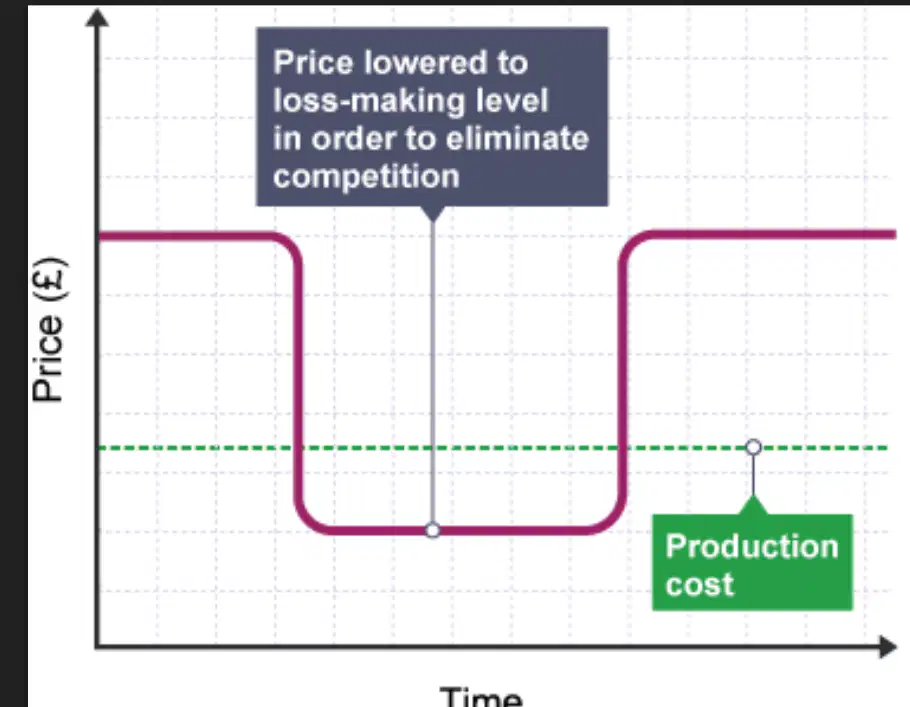
Based on the diagram, what happens to the price during destroyer pricing?
It is lowered to a loss-making level
It is increased above production cost
It remains constant
It fluctuates randomly

Why might a business choose to set prices below production cost, as shown in the diagram?
To eliminate competitors and attract their customers
To increase their own production costs
To improve product quality
To reduce the number of employees
What is the initial pricing strategy used in market skimming?
The product is launched at a high price.
The product is launched at a low price.
The product is given away for free.
The product is only available to select customers.
Why do some customers buy a product at the early stage of market skimming despite its high price?
Because they "must have it"
Because it is the only product available
Because it is heavily discounted
Because it is advertised on TV
What action does a business take when sales start to slow in a market skimming strategy?
The business raises the price
The business stops selling the product
The business lowers the price
The business changes the product
How does market skimming help a business reach more customers over time?
By increasing the price as demand grows
By gradually lowering the price so more customers can afford the product
By limiting the product to a small group
By discontinuing the product after initial sales
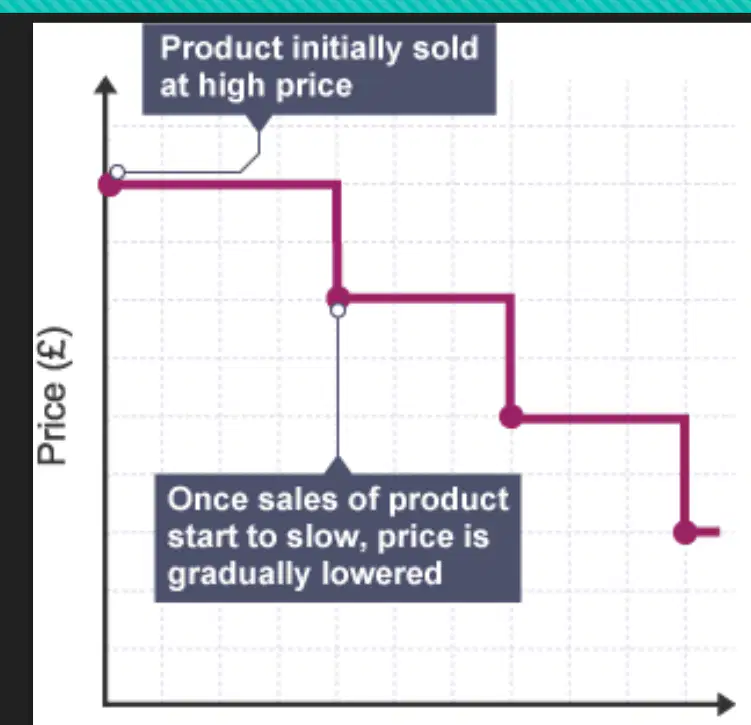
Based on the diagram, what happens to the price of a product over time in a market skimming strategy?
The price remains constant
The price increases steadily
The price decreases in steps as time passes
The price fluctuates randomly
What is psychological pricing?
Setting prices based on production costs
Setting prices to make customers think a product is cheaper than it is
Setting prices higher to increase profit margins
Setting prices based on competitor prices
Which of the following is an example of psychological pricing?
Charging £1 for a product
Charging 99p instead of £1
Offering a buy one get one free deal
Giving a discount for bulk purchases
Why do businesses use psychological pricing?
To make products seem more expensive
To make customers think the product is cheaper and encourage them to buy it
To increase production costs
To match competitor prices exactly
A business charges 99p for a product instead of £1. What is the likely effect on customers?
Customers will think the product is more expensive
Customers will ignore the price difference
Customers will think the product is cheaper and be more likely to buy it
Customers will ask for a further discount

