
 Worksheets
Linear Functions Test Review
Total questions: 87
Worksheet time: 3hrs 54mins
Find the slope of the line that passes through:
(-12, -5) and (0, -8)
1/4
-1/4
4
-4
Find the slope of the line that passes through:
(-2, 8) and (0, 8)
0
-2
2
1/2
Find the slope of the line that passes through the points (2, 4) and (6, 12)
1/2
-1/2
2
-2
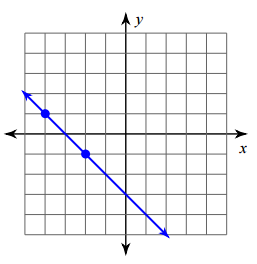
Find the slope of the line.
-2
2
-1
1
The slope of a line is 5/11. The slope of a line parallel to this line is:
-5/11
5/11
-11/5
11/5
The slope of a line is 9/10. The slope of a line perpendicular to this line is:
-9/10
9/10
-10/9
10/9


The table below gives the number of fish in a local koi pond each year.
What is the average rate of change from 2 to 5 years?
24 more fish each year
72 more fish each year
20.4 more fish each year
15 more fish each year

Tracy walks from the mall toward her home. Her distance from home at different times is shown in table.
What is the average rate of change from 1:30 pm to 2:00 pm?
-1/2 mile per hour
-1 mile per hour
-2 miles per hour
-4 miles per hour

(5, -10) and (5, -4)

What type of slope?
positive
negative
no slope (undefined)
zero

What type of slope?
positive
negative
no slope (undefined)
zero

What type of slope?
positive
negative
undefined
zero

What type of slope?
positive
negative
no slope (undefined)
zero

What is the slope?
23
−23
32
−32

Find the slope of the line. (Remember to write answer in simplest form)
36
3
62
31

Find the slope of the line.
43
−53
35
−34

What is the slope?
−21
21
2
-2
f(x)
is the same thing as ______.
y
x
input
an equation
How would you write
y=2x−3
f=2x−3
f(x)=2x−3
How do you read
f(x) ?f x
f of x
f parenthesis x
f with an x inside parenthesis
Translate the function notation into a coordinate point.
f(−1)=5
(−1,5)
(1,5)
(5,1)
(5,−1)
Translate the coordinate pair into function notation.
f(0)=8
f(0)=−8
f(8)=0
f(−8)=0
Given the function
f(x)=x+3
Evaluate:
f(−2)
f(−2)=−1
f(−2)=1
f(−2)=5
f(−2)=−5
Given
g(x)=4x−2
Evaluate:
g(−7)g(−7)=−30
g(−7)=−26
g(−7)=−36
g(−7)=26
Given:
w(x)=−10x−5
Evaluate:
w(1)
w(1)=−15
w(1)=−5
w(1)=5
w(1)=15
Given:
f(x)=6x
Find x when f(x)=−24
x=−4
x=4
x=−144
x=−6
Given:
g(x)=3x−5
Find x when g(x)=4
x=3
x=−3
x=7
x=−3
Given:
h(x)=14−8x
Find x when h(x)=−2
x=2
x=−2
x=30
x=−30
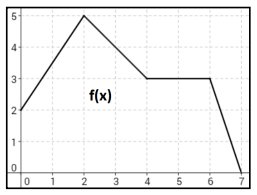
Given the graph,
find:
f(2)f(2)=5
f(2)=4
f(2)=3
f(2)=0
Given the graph,
find:
f(4)f(4)=3
f(4)=1
f(4)=2
f(4)=0
Given the graph,
find:
f(6)f(6)=3
f(6)=1
f(6)=2
f(6)=0
Given the graph,
find:
f(7)f(7)=3
f(7)=1
f(7)=2
f(7)=0
Given the graph,
find:
f(0)f(0)=7
f(0)=1
f(0)=2
f(0)=0
Given the graph,
find the value of x when:
f(x)=0x=1
x=0
x=7
x=2
Given the graph,
find the value of x when:
f(x)=5x=5
x=0
x=3
x=2

Given the graph,
find the value of x whenf(x)=5
x=7
x=6
x=5
x=3
Given the graph,
find the value of x whenf(x)=2
x=7
x=1
x=5
x=4

Remember: Range is y!

What is the DOMAIN of this graph?
-4 ≤ x ≤ 3
-1 ≤ x ≤ 4
4 < x < 3
-1 < x < 4
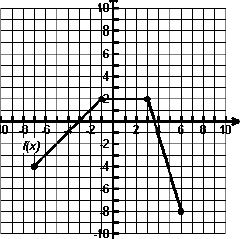
What is the range of the function?
-7≤x≤6
-7<x<6
-8<y<2
-8≤y≤2

What is the RANGE of this graph?
y < -3
y ≤ -3
y > 1
y ≥ 1
R: {0, 1, 2, -4}
R:{-4, -3, 1}
R:{1, -3, -4}
R: {1, -3, -4, 1}
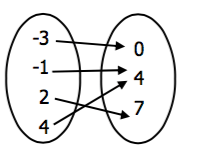


A set of ordered pairs is called what?
the domain
a relation
a function
the range
What is the domain of a relation?
the set of all x-values
the set of all y-values
Which is the set of all y-values or the outputs?
Domain
Range
Relation
Function
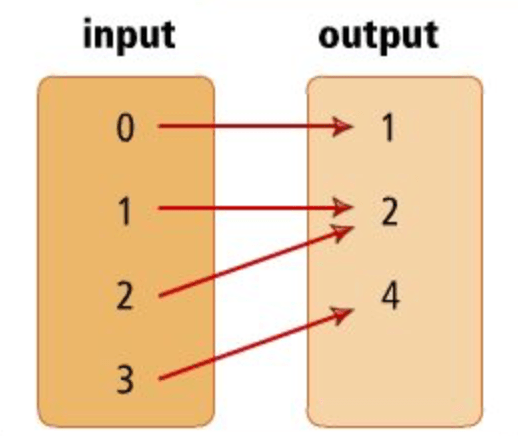
What is the range of the mapping?
{1, 2, 4}
{0, 1, 2, 3}
{0, 3}
{1, 4}
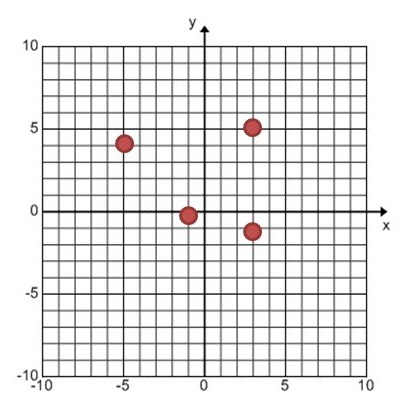
Does the graph represent a function?
Yes
No
Which relation has a domain of {3,7} and a range of {0,5} ?
(3,5), (3,7), (0,5), (0,3)
(3,0), (7,0), (3,5), (7,5)
(3,0), (3,5), (3,7), (7,5)
(7,0), (5,7), (3,5) (7,5)


Find the slope-intercept equation
y = 4x + 6
y = -4x - 6
y = 1/4x - 6
y = -1/4x + 6

Find the slope-intercept equation
y = 2x + 3
y = -2x +3
y = 1/2 x+3
y = -1/2 x+3

Find the slope-intercept equation
y = 3x + 5
y = -3x + 5
y = -1/3 x + 5
y = -1/3 x - 5

Find the slope-intercept equation
y = x - 2
y = -x - 2
y = -2x
y = -2
Find the graph of the standard form equation: 2x - 5y = -20


Find the graph of the standard form equation: 3x + 4y = -8
Find the graph of the standard form equation: 2x - y = 0
Find the graph of the standard form equation: 2x + 3y = 3

y = 4x + 6
y = -4x - 6
y = 4x - 6
y = -4x + 6

y = 2x + 3
y = -2x + 3
y = -2x + 11
y = -2x - 11

y = -1/3 x + 5
y = -1/3 x + 7
y = -1/3 x + 1
y = -1/3 x - 1

y = x - 2
y = x + 2
y = x + 8
y = x - 8

y = 2/3 x + 4
y = - 2/3 x + 4
y = -2/3 x + 1
y = -2/5 x - 1

y = 3/4 x + 2
y = 3/4 x - 2
y = -3/4 x + 2
y = -3/4 x - 2

y = 1/2 x
y = -1/2 x
y = 2x - 10
y = -2x + 6

What is the slope of this line?
m = 0
m = undefined
m = 3
m = 1/3

What is the slope of this line?
m = 0
m = undefined
m = 5
m = 1/5
What is the equation of this line?
m = 0
m = undefined
y = 5
x = 5
What is the equation of this line?
m = 0
m = undefined
x = 3
y = 3

What is the slope of this line?
m =1/2
m = 2
m = -2
m = -1/2
y = 3x - 3
These lines are...
y = 3/2x + 9
These lines are...
y = 2x + 3 through (-2, 4)

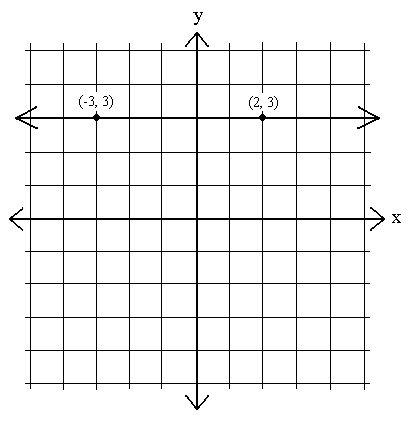

If I am looking for a line parallel to y=−3x−2 which one of these equations could it be?
y=−2x−1
y=3x−4
y=−3x+6
y=−2x−3
Slopes of parallel lines are...
opposite reciprocals.
opposites.
identical.
always 7.

