
 Worksheets
*Cell Theory/Characteristics of Life Quiz
Total questions: 20
Worksheet time: 10mins
Name
Class
Date
1.
Where do cells come from? (ACOS #1, 1a)
a)
soil
b)
other existing cells
c)
free cell formation
d)
dead cells
2.
Linnaeus's system gave how any names to each organism? (ACOS #1, 1a)
a)
two
b)
three
c)
one
d)
four
3.
In order for a species to continue, they must have a way to produce more of the species. This is called _________. (ACOS #1, 1a)
a)
evolution
b)
development
c)
homeostasis
d)
reproduction
4.
Which of the following is NOT a multicellular organism? (ACOS #1, 1a)
a)
grass
b)
amoeba
c)
mosquito
d)
worm
5.
Which of the following is an example of a response to stimuli? (ACOS #1, 1a)
a)
you are tired
b)
you are hot
c)
you eat food
d)
you are scared
6.
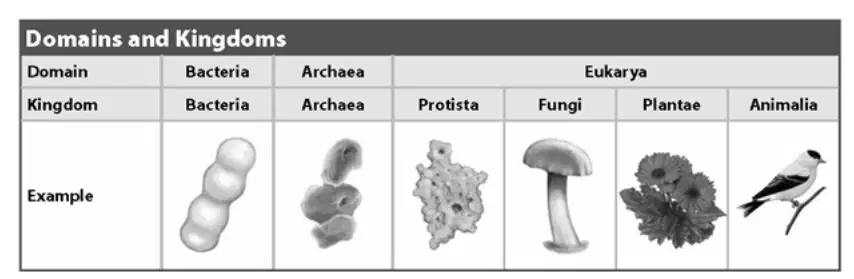
Human beings belong in which of the following Kingdoms? (ACOS #1, 1a)
a)
Protist
b)
Animal
c)
Fungi
d)
Plant
7.
The classification system most commonly used today separates organisms into _______ Kingdoms. (ACOS #1, 1a)
a)
three
b)
four
c)
five
d)
six
8.
Which of the following is NOT a method your body uses to regulate homeostasis? (ACOS #1, 1a)
a)
taking a shower
b)
sweating
c)
shivering
d)
change the flow of blood
9.
Two horses mate and produce a foal (a baby horse). This is an example of _________. (ACOS #1, 1a)
a)
growth
b)
development
c)
reproduction
d)
homeostasis
10.
How many groups did Aristotle use to classify organisms? (ACOS #1, 1a)
a)
2
b)
3
c)
4
d)
5
11.
Changes in a population that occur over very long periods of time is called... (ACOS #1, 1a)
a)
adaptations
b)
evolution
c)
changing
d)
development
12.
Which scientist discovered that all animals are made of cells? (ACOS #1, 1a)
a)
Schleiden
b)
Schwann
c)
Hooke
d)
Van Leeuwenhoek
13.
Which of the following statements is NOT part of the cell theory? (ACOS #1, 1a)
a)
Only animals are made of cells
b)
All cells are produced from others cells
c)
All living things are made of cells
d)
Cells are the basic unit of structure and function in all living things
14.
The invention of the microscope made it possible for people to discover and learn about.... (ACOS #1, 1a)
a)
skin
b)
plants
c)
animals
d)
cells
15.
Which statement is part of the cell theory? (ACOS #1, 1a)
a)
bacteria are prokaryotic cells
b)
eukaryotic cells are complex
c)
all cells come from preexisting cells
d)
humans are multicellular
16.
Which scientist discovered that all plants are made of cells? (ACOS #1, 1a)
a)
Albert Einstein
b)
Anton Van Leeuwenhoek
c)
Matthias Schleiden
d)
Robert Hooke
17.
Who looked at cork and named the cell? (ACOS #1, 1a)
a)
Robert Brown
b)
Van Leeuwenhoek
c)
Robert Hooke
d)
Francesco Redi
18.
Which of the following scientists was the first to observe bacteria (living organisms)? (ACOS #1, 1a)
a)
Matthias Schleiden
b)
Robert Hooke
c)
Anton Van Leeuwenhoek
d)
Theodor Schwann
19.
A tadpole turns into a frog over its lifetime. This is called _____. (ACOS #1, 1a)
a)
evolution
b)
homeostasis
c)
growth and development
d)
reproduction
20.
A _____ is something in the environment that causes an organism to respond. (ACOS #1, 1a)
a)
stimulus
b)
response
c)
cause
d)
effect
100 %

