
 Worksheets
High Availability and Load Balancing Quiz
Total questions: 20
Worksheet time: 10mins
Which analogy most accurately illustrates the principle of load balancing in complex systems?
Multiple checkout lanes in a busy supermarket, efficiently distributing customers.
A solitary cashier managing a long queue of impatient customers.
A secure vault requiring a unique key for access, representing exclusivity.
A narrow single-lane road congested with traffic.
In a highly available server environment, what is the most significant advantage of implementing a clustering solution?
Multiple servers function as a single entity; if one server fails, the remaining servers seamlessly take over its responsibilities.
Each server operates autonomously without any interdependence.
Servers are exclusively designated for backup purposes.
Servers are solely utilized for data storage.
What are the critical considerations for evaluating different site types (hot, warm, cold) in the context of resilience and recovery planning, and how do these considerations influence the selection of recovery strategies?
To determine the most effective recovery strategy that aligns with financial constraints, recovery time objectives, and organizational priorities.
To enhance server capacity and redundancy.
To optimize network performance and minimize latency.
To control and restrict user permissions effectively.
In the context of disaster recovery, which of the following best describes the operational state and financial implications of a cold site?
It is a fully equipped facility with real-time data access, incurring significant operational costs.
It is a semi-prepared site with moderate expenses, ready for partial recovery.
It is a bare-bones facility equipped only with essential utilities, resulting in minimal costs.
It is strategically situated in diverse geographical areas to mitigate the impact of regional catastrophes.
Which of the following options most accurately encapsulates the concept of platform diversity in a multi-cloud strategy?
Leveraging a variety of cloud service providers to mitigate the risks associated with vendor lock-in.
Implementing a heterogeneous environment with diverse operating systems and hardware to eliminate single points of failure.
Establishing mechanisms to ensure the continuity of critical operations during unforeseen disruptions.
Creating redundant backup sites across various geographic locations to enhance resilience.
What is a significant advantage of implementing multi-cloud architectures in enterprise environments?
Minimizes overall expenditure on cloud services.
Mitigates the risk of complete operational disruption stemming from vulnerabilities in a single cloud provider.
Enhances the efficiency and speed of data recovery processes.
Guarantees that all data is centralized in a single repository.
Which of the following plans are integral components of a comprehensive Continuity of Operations (COOP) strategy?
Business Continuity Plan (BCP) and Disaster Recovery Plan (DRP)
Hot site and Cold site strategies
Platform Diversity and Multi-cloud strategies
Geographic Dispersion and Clustering strategies
In the context of capacity planning for recovery, which of the following elements is essential to ensure a comprehensive strategy?
All critical components including personnel, technological resources, and physical infrastructure
Only technological resources
Only personnel
Only physical infrastructure
What are the primary reasons for implementing a robust backup strategy in an organization, particularly in the context of data integrity and business continuity?
To facilitate comprehensive data recovery in the event of loss or corruption
To enhance overall system processing efficiency
To alleviate the workload of IT personnel
To bolster the organization's network security measures
A company is evaluating the resilience of its backup systems to ensure seamless operations during unexpected failures. Which advanced method should they implement to rigorously test the effectiveness of their backup systems?
Failover testing with real-time data
Comprehensive tabletop exercise involving all stakeholders
Full-scale simulation of system failure scenarios
Continuous parallel processing with failover capabilities
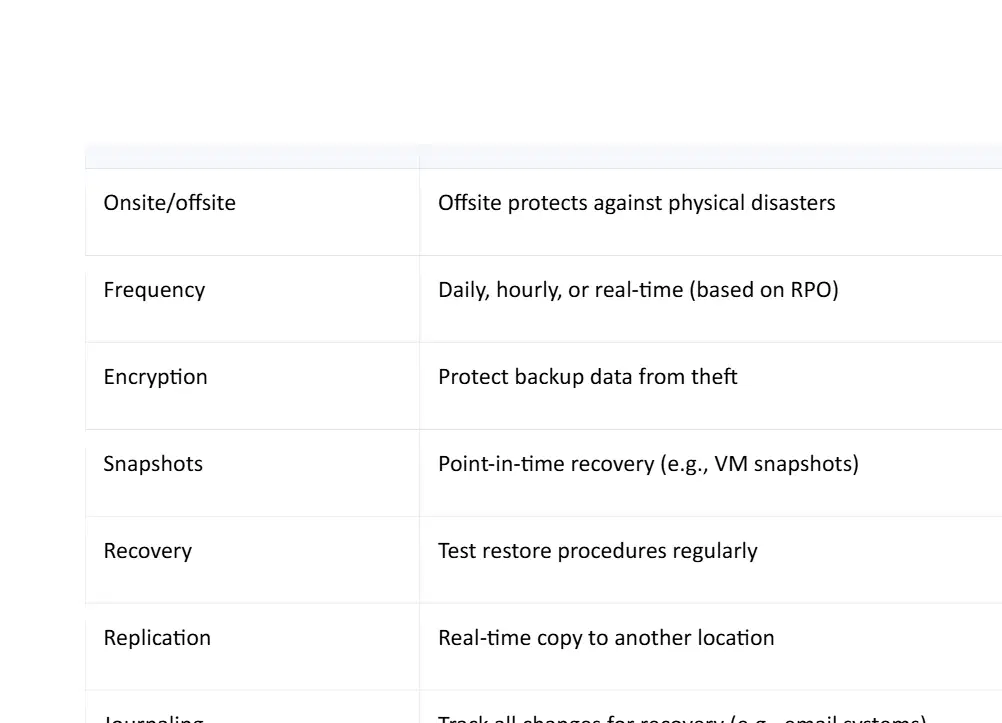
What is the most significant advantage of maintaining backups in an offsite location, particularly in the context of disaster recovery planning?
Offsite storage mitigates risks associated with localized physical disasters
Offsite storage enhances the speed of backup processes
Offsite storage can lead to reduced overall storage expenses
Offsite storage negates the necessity for data encryption
Which backup method is specifically designed to facilitate point-in-time recovery, particularly in the context of virtual machine (VM) environments, by capturing the exact state of the system at a given moment?
Snapshots
Replication
Journaling
Encryption
What are the critical reasons for conducting regular tests of data restoration procedures in an organization?
To verify that recovery processes function correctly under various scenarios
To optimize and minimize backup storage expenses
To enhance the frequency of data backups
To negate the necessity for data encryption measures
In the context of data protection strategies, what is the primary function of replication?
Continuous synchronization of data to a geographically separate site
Implementing encryption protocols for backup files
Conducting regular tests of data recovery processes
Establishing historical data states through snapshots
What is the primary role of an Uninterruptible Power Supply (UPS) in critical systems?
Ensures temporary power supply and facilitates orderly system shutdown
Delivers extended power support during prolonged outages
Secures backup data through encryption
Monitors and logs all modifications for potential recovery
In the context of disaster recovery, which type of backup site is characterized by being fully operational and ready for immediate use without any setup time?
Cold site
Warm site
Hot site
Cloud site
In the context of distributed computing, how do load balancing and clustering differ in their operational roles and objectives?
Load balancing is primarily concerned with data storage efficiency; clustering focuses on traffic distribution among servers
Load balancing optimizes traffic distribution across multiple servers; clustering enables multiple servers to function as a single entity
Load balancing serves as a redundancy mechanism; clustering enhances security protocols
Load balancing requires manual configuration; clustering operates through automated processes
What is the primary rationale behind establishing backup sites across multiple geographical regions in disaster recovery planning?
To ensure operational continuity in the event of regional catastrophes.
To enhance data transmission speeds across networks.
To minimize energy expenditures associated with data storage.
To optimize the performance of applications and services.
In the context of electrical engineering and power management, what does the acronym UPS represent?
Uninterruptible Power Supply
Universal Processing System
Unified Protection Service
Ultimate Power Source
In the context of risk management, which term specifically refers to the expected monetary loss resulting from a single occurrence of a risk event?
Single Loss Expectancy (SLE)
Annual Loss Expectancy (ALE)
Annualized Rate of Occurrence (ARO)
Value Management (VM)

