
Font size
 Worksheets
Par-Ici-Methode-de-Francais-A1 Episode 5 - Un air de famille
Total questions: 46
Worksheet time: 23mins
Match each French phrase with the correct use of the possessive determiner for a masculine singular noun.
mon père
Correct possessive determiner for 'père' (masculine singular)
ma père
Incorrect: feminine possessive determiner with 'père'
mes père
Incorrect: plural possessive determiner with 'père'
mon pères
Incorrect: singular possessive with plural noun
What is the correct possessive determiner to use for a feminine singular noun in French?
mon
ma
mes
me
Which possessive determiner would you use for a plural noun, regardless of gender, in French?
mon
ma
mes
me
According to the memo, you use "mon, ma, mes" in French when the possessor is (a) .
If you want to say "my children" in French, which is the correct phrase?
mes enfants
ma enfants
mon enfants
mes enfant
Which of the following sentences correctly uses the possessive determiner for a feminine singular noun?
Ma mère s’appelle Édith.
Mon mère s’appelle Édith.
Mes mère s’appelle Édith.
Me mère s’appelle Édith.
If you want to introduce your brother and sister in French, which of the following is correct?
J’ai un frère et une sœur.
J’ai une frère et un sœur.
J’ai des frère et sœur.
J’ai un frères et une sœurs.
Which of the following best describes the function of possessive determiners in French?
They indicate ownership or relationship to the noun
They describe the color of the noun
They show the location of the noun
They indicate the number of nouns
Which phrase would you use in French to formally ask who someone is?
Qui est-ce?
C'est qui?
Qu'est-ce que c'est?
Ce sont qui?
What is the correct French phrase to use when presenting a singular noun?
C'est
Ce sont
C'est qui?
Qu'est-ce que c'est?
How do you ask "What is this?" about an object in French in a formal way?
Qu'est-ce que c'est?
C'est qui?
Qui est-ce?
Ce sont quoi?
Which of the following is the correct use of "ce sont" in French?
To present a plural noun
To present a singular noun
To ask a question about a person
To describe an action
Associez chaque description à la bonne personne ou groupe parmi les suivants : Kim Thúy, Danièle Henkel, Boucar Diouf, et Les sœurs Boulay.
C'est Kim Thúy. C'est une écrivaine.
Kim Thúy, écrivaine
Ce sont Kim Thúy. C'est une écrivaine.
Formulation incorrecte pour Kim Thúy
C'est Les sœurs Boulay. C'est une auteure.
Les sœurs Boulay, groupe musical
Ce sont Boucar Diouf. C'est une conférencière.
Formulation incorrecte pour Boucar Diouf
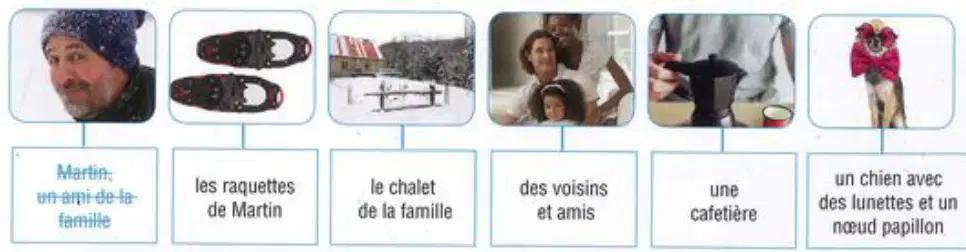
Which of the following best describes the use of "ce sont" in the context of the images?
Ce sont les raquettes de Martin.
C'est le chalet de la famille.
C'est une cafetière.
C'est un chien avec des lunettes.
Why would you use "C'est qui?" instead of "Qui est-ce?" in French?
For informal situations
For formal situations
To ask about an object
To present a plural noun
Which of the following is an example of using "c'est" to present a person?
C'est mon cousin, Jean-François.
Ce sont mes lunettes.
Qu'est-ce que c'est?
C'est qui?
Which personal pronoun would you use to replace a masculine singular noun in French?
il
elle
ils
elles
What is the correct form of the verb "avoir" for "nous" in the present tense?
nous avons
nous sommes
nous avez
nous êtes
Which verb is used in French to indicate possession or age?
avoir
être
faire
aller
If you want to say "They are single" in French, which is the correct translation?
Ils sont célibataires.
Ils ont célibataires.
Ils est célibataires.
Ils êtes célibataires.
Which pronoun would you use to replace "Les filles" in a sentence?
elles
ils
il
elle
Which verb is used to indicate nationality or profession in French?
être
avoir
faire
aller
Paul est marié. (a) habite à Ottawa.
Match each subject pronoun with the correct present tense conjugation of "être".
vous êtes
vous
vous avez
vous (avoir)
vous sommes
nous
vous sont
ils/elles
If "Gina est mexicaine. Gina habite au Québec. Gina est célibataire." Which pronoun can replace "Gina" in the second and third sentences?
Elle
Il
Ils
Elles
Match each use with the correct verb in French.
To indicate nationality, profession, or civil status
When would you use "être"?
To indicate possession or age
When would you use "avoir"?
To indicate location
When would you use "se trouver" or "être situé"?
To indicate preference
When would you use "préférer"?
Which possessive determiner would you use in French for "his father"?
sa
ses
son
leur
What is the correct possessive determiner for "her friends" in French?
son
sa
ses
leur
Which of the following statements best describes the use of "sa" in French?
It is used before a masculine singular noun.
It is used before a feminine singular noun.
It is used before a plural noun.
It is used before a verb.
If the possessor is "elle" and the noun is plural, which possessive determiner should be used in French?
son
sa
ses
leur
Why would you use "son" instead of "sa" before the word "ami" (friend) in French, even if the possessor is female?
Because "ami" is a masculine noun.
Because "ami" is a plural noun.
Because "ami" is a verb.
Because "ami" is a feminine noun.
Which of the following expressions is commonly used to make someone's acquaintance in French?
Bon appétit!
Je suis heureux de vous rencontrer.
Bonne nuit!
À la prochaine!
Match the following French phrases with their correct English meanings.
Ça va?
How's it going?
Comment allez-vous?
What is the formal way to ask "How are you?"?
Tu vas bien?
Are you doing well? (informal)
Quoi de neuf?
What's new?
Which possessive determiner would you use for "your (plural, masculine)" in French when addressing someone informally?
ton
ta
tes
votre
According to the memo, (a) are used to express politeness in French.
If you want to ask someone formally for their address in French, which question would you use?
C'est quoi ton numéro de téléphone?
Quelle est votre adresse?
Tu as des frères et des sœurs?
Ça va?
Which of the following is NOT an expression used to make someone's acquaintance in French?
Ça me fait plaisir!
Bonne nuit!
Enchanté!
Je suis content(e) de te rencontrer.
When would you use "vos" instead of "tes" in French?
When addressing a friend informally
When addressing a group formally
When talking to a child
When talking to yourself
Which of the following is a way to form a closed (yes/no) question in French?
Use intonation at the end of the sentence
Always start with "comment"
Only use "où" at the beginning
Place the verb at the end of the sentence
What is the function of "est-ce que" in French questions?
It is used to form open-ended questions
It is used to form closed (yes/no) questions
It is used to express negation
It is used to indicate possession
Which of the following is an example of a closed (yes/no) question in French?
Où habitez-vous ?
Est-ce que vous êtes dentiste ?
Comment vous appelez-vous ?
Combien d’enfants avez-vous ?
How do you form an open-ended question in French in a formal or written context?
Place the interrogative word at the end of the sentence
Use "est-ce que" at the beginning
Place the interrogative word at the beginning, followed by the verb and pronoun
Use only intonation
Among the following, (a) is NOT a French interrogative word used to form open-ended questions.
Selon la note, comment répond-on à une question fermée (oui/non) en français ?
Avec une explication détaillée
Avec une réponse oui ou non
En répétant la question
En posant une autre question
In the context of the document, the main difference between a closed and an open question in French is that (a) .
Which of the following is an example of an open-ended question in French?
Est-ce que vous êtes marié ?
Avez-vous des enfants ?
Où habitez-vous ?
Êtes-vous mécanicien ?

