
 Worksheets
Fiqh 1
Total questions: 55
Worksheet time: 28mins
What is the definition of an obligatory (Wajib/Fard) action in Islamic law?
An action that Allah commands strictly.
An action that Allah loves but did not make mandatory.
An action that is disliked by Allah.
An action that is neutral in Islamic law.
Which of the following is an example of a recommended (Mustahabb/Sunnah) action?
Performing the five daily prayers
Fasting in Ramadan
Using the miswak (tooth-stick)
Paying Zakah
What is the consequence of neglecting an obligatory action without a valid excuse?
There is no sin.
The person is sinful and may be punished.
The person is rewarded.
The action is considered neutral.
In Islamic law, what is the reward for performing a recommended action?
The person is punished.
The person is rewarded.
The action is considered neutral.
The person is sinful.
What is the definition of a "Forbidden (Haram)" action in Islam?
An action that Allah strictly prohibited.
An action that is not liked in Islam, but not strictly prohibited.
An action that Islam neither commands nor prohibits.
An action that is encouraged in Islam.
Which of the following is an example of a "Disliked (Makruh)" action?
Stealing
Eating with the left hand (when not forced)
Using technology for neutral purposes
Lying
What is the consequence of performing a "Permissible (Mubah)" action in Islam?
The person is sinful and may be punished.
The person is rewarded.
There is no reward or sin by default.
The person is strictly prohibited from doing it.
Which of the following actions is considered "Forbidden (Haram)" in Islam?
Sleeping before ‘Isha prayer
Drinking alcohol
Eating, drinking, walking, sleeping
Using technology for neutral purposes
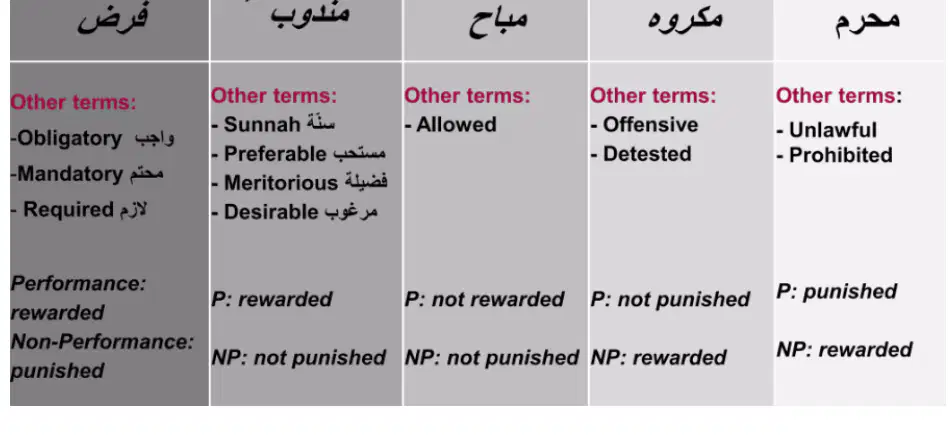
What is the term used for actions that are obligatory in the Rulings of Sacred Law?
Sunnah
Allowed
Obligatory
Offensive
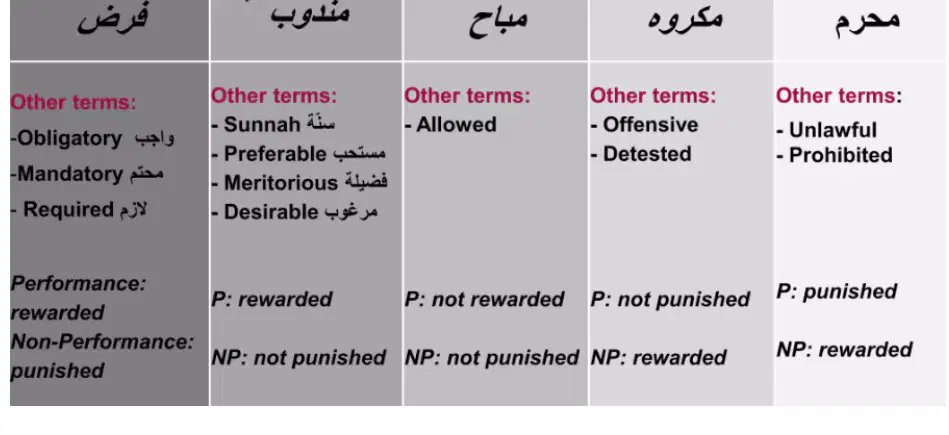
In the Rulings of Sacred Law, which category is associated with actions that are rewarded if performed but not punished if not performed?
Prescribed
Recommended
Permissible
Forbidden
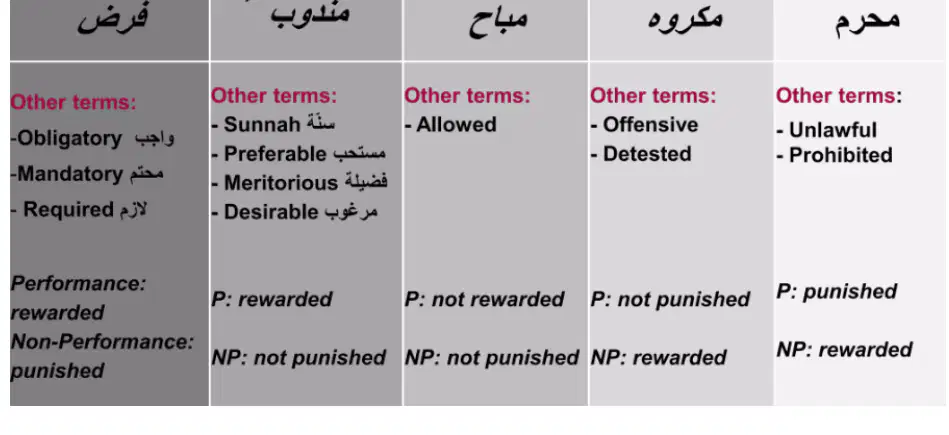
Which category in the Rulings of Sacred Law includes actions that are unlawful?
Disliked
Permissible
Forbidden
Recommended
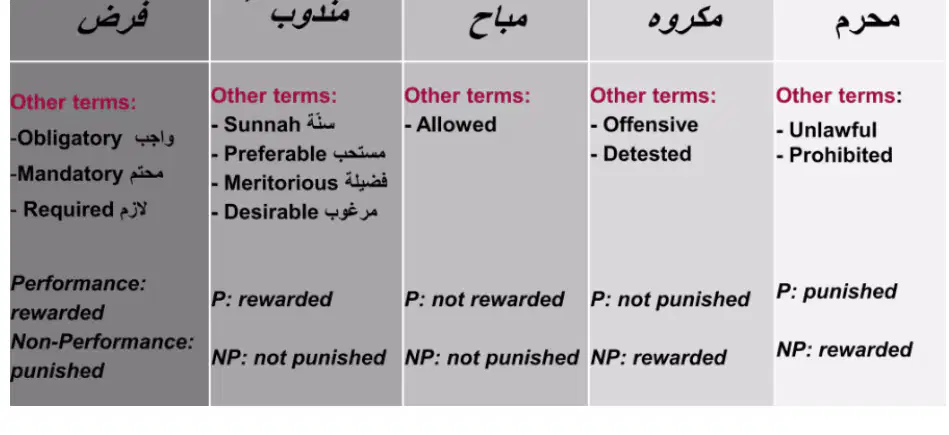
Analyze the implications of performing an action categorized as "Disliked" in the Rulings of Sacred Law.
Punished if performed
Rewarded if not performed
Not punished if performed
Rewarded if performed
What is one of the conditions of Wudu?
Being a non-Muslim
Being asleep
Being a Muslim
Being under the age of understanding
Which of the following is an obligatory act of Wudu?
Washing the face
Washing the hair
Washing the back
Washing the knees
What does "Shoroot" refer to in the context of Wudu?
Acts performed after Wudu
Things that must be present before starting the act of worship
Optional acts of Wudu
Acts that break Wudu
Which of the following is NOT a condition of Wudu?
Using pure water
Having the intention (niyyah)
Being asleep
Being sane
Which of the following is a Sunnah of Wudu?
Eating camel meat
Saying Bismillah
Deep sleep
Apostasy
What is one of the actions that invalidate Wudu?
Using miswak
Rinsing the mouth three times
Deep sleep
Washing between fingers and toes
Which action is recommended to be done three times during Wudu?
Saying the du’a
Washing hands at the start
Eating camel meat
Touching the private parts
Why might eating camel meat invalidate Wudu according to some scholars?
It is considered a Sunnah
It is a traditional practice
It is believed to break the state of purity
It is a form of apostasy
What is the English meaning of the term "Hayd"?
Menstruation
Postpartum bleeding
Irregular bleeding
Yellowish discharge
Which term refers to bleeding that occurs outside the time of Hayd or Nifas?
Nifas
Istihadah
Sufrah
Tuhur Mutakhalil
What is the Fiqh definition of "Nifas"?
Natural blood discharged during specific days of the month
Bleeding that occurs outside the time of Hayd or Nifas
Blood discharged after childbirth
Temporary cessation of bleeding during Hayd
What does "Sufrah and Kudrah" refer to in English?
Intermittent purity
Menstruation
Yellowish or brownish discharge
Postpartum bleeding
What is the significance of "Tuhur Mutakhalil" in the context of Hayd?
It is the regular menstrual cycle
It is the temporary cessation of bleeding
It is the postpartum bleeding period
It is the yellowish discharge after Hayd
What is the term for the total cessation of bleeding between two menstrual cycles?
Hayd
Tuhur Fasil
Sufrah
Kudrah
Which type of bleeding is considered natural monthly bleeding?
Postpartum Bleeding
Irregular Bleeding
Menstruation
Tuhur Fasil
What is the ruling for irregular bleeding in Islam?
It is treated the same as menstruation.
It requires fasting and praying to be stopped.
It is treated as pure, allowing prayer and fasting.
It is considered postpartum bleeding.
According to the rule, what is considered Hayd during the days of Hayd?
Only red discharge
Sufrah and Kudrah
Tuhur Fasil
Postpartum bleeding
What is the minimum duration of menstruation according to the Hanafi school of thought?
1 day
3 days
No minimum
15 days
According to most scholars, what is the maximum duration of menstruation?
10 days
12 days
15 days
20 days
What is the minimum purity period between two menstrual periods?
10 days
12 days
15 days
20 days
What is the maximum age of menstruation as mentioned in the document?
9 years
12 years
15 years
18 years
What is the maximum duration of postpartum bleeding according to the Hanafi and Hanbali schools?
30 days
35 days
40 days
45 days
What is forbidden for menstruating and postpartum women during their period?
Prayer
Eating
Sleeping
Reading
Which of the following must be made up later if missed during menstruation?
Prayer
Fasting
Tawaf
Marital relations
What must a woman with irregular bleeding perform for each prayer time?
Ghusl
Wudu
Tawaf
Fasting
If bleeding stops but ghusl has not been performed, what is still forbidden?
Eating
Marital relations
Sleeping
Traveling
During menstruation days, how is yellowish or brownish discharge considered?
Clean
Menstrual blood
Impure
Neutral
What is the definition of a woman with a regular menstrual cycle?
A woman who has a fixed pattern of menstruation each month.
A woman experiencing her first menstruation.
A woman who can distinguish between types of bleeding.
A woman with irregular menstrual cycles.
Which method is used for menstruation when some days of hayd bleeding are counted and others are skipped if blood mixes with purity?
Al-Tajmee (Combining Method)
Al-Talfeeq (Allocating Method)
Al-Taharah (Purity Method)
Al-Istihada (Irregular Bleeding Method)
In the case of a beginner woman in menstruation, what is the total number of Hayd days if there are 8 days of bleeding, 2 days of purity, and 4 days of bleeding?
10 days
12 days
14 days
16 days
What is the term for the 2 days of purity that do not break the Hayd in the given case?
Tuhur Mutakhalli
Al-Tajmee
Al-Talfeeq
Al-Istihada
In Case 2, how many days are considered as Hayd?
5 days
10 days
15 days
20 days
What is the total number of days of purity in Case 2?
5 days
10 days
15 days
20 days
In Case 3, what is the total number of days considered as Istihada?
6 days
8 days
10 days
15 days
In Case 3, what does Tuhur Mutakhallil refer to?
Continuous purity
Intermittent purity
Complete purity
Non-menstrual bleeding
In Case 1, if a woman’s usual period lasts 8 days, how many total days are considered Hayd when she experiences 8 days of bleeding and 2 days of yellowish discharge?
8 days
10 days
12 days
14 days
In Case 2, a woman’s usual period lasts 5 days. If she experiences 8 days of black blood, 3 days of red blood, and 3 days of yellowish discharge, how many total days are considered Hayd?
8 days
11 days
14 days
16 days
In Case 3, how many days are considered Hayd for a woman whose usual period lasts 8 days?
8 days
12 days
15 days
5 days
What is the total number of days of Istihada in Case 3?
8 days
5 days
12 days
15 days
In Case 1 of postpartum bleeding, how many days are considered Nifas?
10 days
20 days
30 days
40 days
What is the role of Tuhur Mutakhalli in the context of postpartum bleeding?
It separates periods of bleeding
It combines days of scattered bleeding
It marks the end of bleeding
It indicates the start of a new cycle
In Case 2, how many total days are considered as Nifas?
20 days
30 days
40 days
50 days
In Case 3, what is the duration of complete purity?
5 days
10 days
15 days
20 days

