
Font size
 Worksheets
Evolution Unit Exam C
Total questions: 40
Worksheet time: 21mins
At least five major ice ages have occurred throughout Earth's history; the earliest was over 2 billion years ago. Which type of organisms would natural selection favor if Earth had another ice age?
organisms that swim
organisms that carry out photosynthesis
organisms adapted for surviving cold temperatures
organisms that hibernate during winter
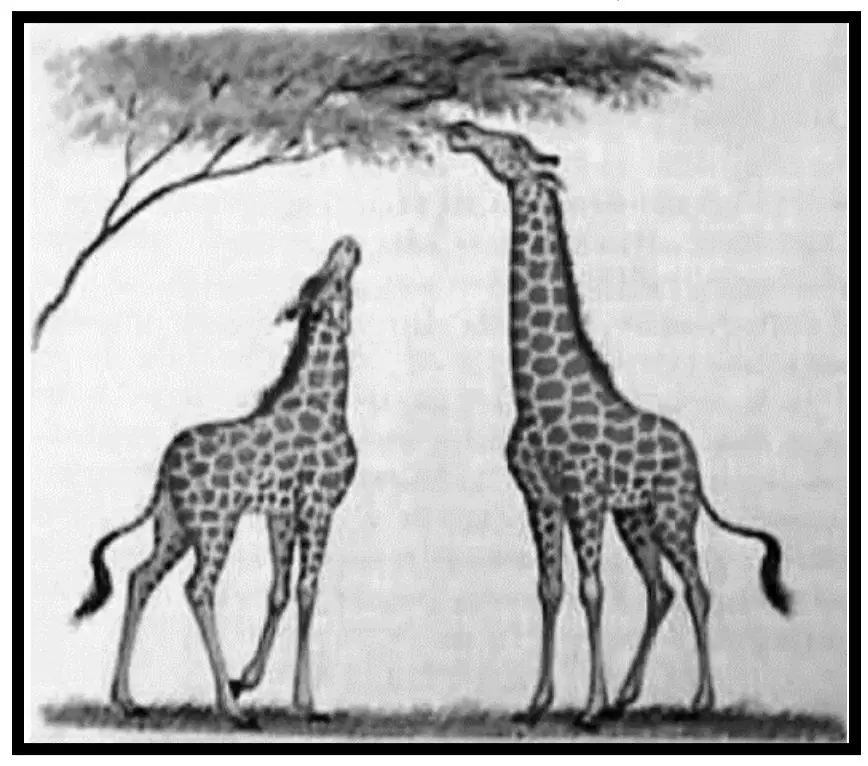
Which of the following best characterizes natural selection (represented by the image)?
Faced with an environment in which leaves grew only at the tops of trees, giraffes responded by growing longer necks.
The necks of giraffes that did not eat leaves from the tops of trees grew shorter from lack of exercise.
Among a population of giraffes, those with long necks were able to survive better in an environment in which leaves grew only at the tops of trees.
Giraffes with necks of varying lengths were born, but those with longer necks were more likely to survive and reproduce.
Mutations are essential to evolution. Every genetic feature in every organism was, initially, the result of a mutation. Which of the following statements about mutations is true? CHOOSE ALL THAT APPLY.
Mutations can be harmful to an organism.
Mutations occur randomly.
Mutations can cause organisms to evolve.
Some mutations have no effect on an organism.
______________ is the only cause of evolution that generally adapts a population to its environment.
natural selection
genetic drift
gene flow
extinction
Bacteria often become resistant to harmful agents much more quickly than plants or animals. Which of the following best explains why this is so?
Bacteria reproduce through asexual reproduction, which allows them to reproduce more quickly than plants or animals.
Bacteria reproduce asexually, so their offspring are not changed by mutations.
Bacteria reproduce sexually, increasing the variation within their populations.
Bacteria have shorter generation times, leading to faster accumulation of genetic changes.
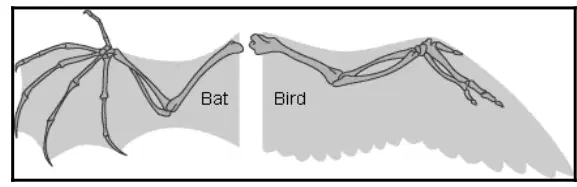
The wings of a bat and a bird share a similar function but have different structures, suggesting that they did not evolve from a common ancestor. What type of structures are the wings?
homologous structures
vestigial structures
analogous structures
embryonic structures
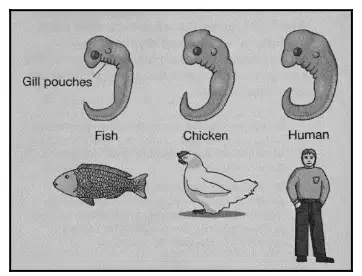
The diagram below shows the embryos and the adult forms of animals from different classification groups. What do the embryos suggest about these three animals?
The animals are not related.
The animals share a common ancestor and are therefore related.
Fish and chickens are closely related, but humans are not related to either fish or chickens.
All three animals have similar embryonic features, but develop into very different adults.
Which of the following is a risk of overusing antibiotics?
Bacteria may become resistant to the antibiotics, causing them to be ineffective.
Antibiotics increase the rate of infection.
Antibiotics can cause other diseases to develop.
Overuse of antibiotics can disrupt the balance of normal bacteria in the body, leading to side effects like diarrhea.
Which of the following is NOT a mechanism by which evolution occurs?
gene flow
natural selection
mutation
photosynthesis
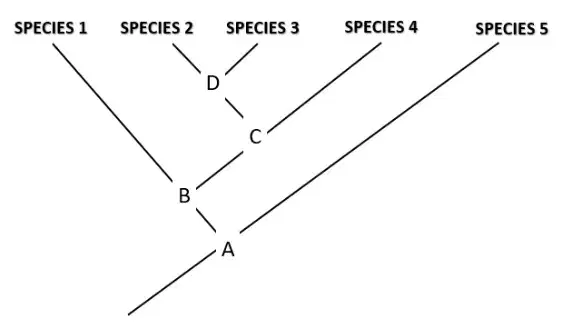
Refer to the diagram showing the evolutionary relationships among five species (Species 1, Species 2, Species 3, Species 4, Species 5) and their ancestors (A, B, C, D).
Species 2, 3, and 4 are descendants of ancestor D.
Species 5 is a descendant of ancestor B.
Species 2 and 3 are descendants of ancestor C.
Species 1 and Species 2 share ancestor B.
Which of the following is NOT considered to be evidence that life arose from a common ancestor?
a. Embryos of all vertebrates are very similar.
b. Homologous structures are found in many vertebrates.
d. Some organisms share analogous structures such as the fins of fish and dolphins.
c. The genetic code is nearly universal among all living organisms.
A particular bird species found in North America obtains most of its food energy by catching and eating insects. A mutation arises in this bird population that increases the length of its beak. Although many mutations are harmful, this mutation has increased the ability of the bird to catch and eat certain insects. Which of these is the most likely outcome of this mutation?
The insects that are eaten by this bird are likely to become extinct.
Other bird species will be more likely to also develop longer beaks in order to compete.
Individual birds with the mutation will be more likely to survive and reproduce than birds without the mutation.
The bird population may gradually have more individuals with longer beaks over generations.
One of the major elements of natural selection is that all species have genetic ________________.
mutations
variation
stability
drift
Gary sprays his sugarcane field with a highly effective pesticide called “Bug X 4.0.” For five years, the pesticide works well, effectively killing almost all the weevils trying to eat Farmer Gary’s crop. However, during the 6th year, some of the crop takes a hit. During the 7th year, he loses half of his crop, and during the 8th year, he loses almost the entire cane field to weevils, despite using twice the usual dose of Bug X 4.0. What happened?
The sugarcane became used to the pesticide, rendering it ineffective.
Weevils over-populated because the Bug X 4.0 killed all of the predatory insects.
Some of the pesticide-resistant weevils survived and reproduced more pesticide-resistant weevils.
The pesticide degraded in the environment faster over time, reducing its effectiveness each year.
If scientists wanted to learn more about evolutionary history, they would study all but one of the following molecules. Which biological molecule would NOT offer much information about the history of life?
DNA
proteins
carbohydrates
lipids
In 1831, Charles Darwin visited the Galapagos Islands. While observing the giant land tortoises that lived on these islands, Darwin noted that the shape of the tortoise shell varied depending on which island the tortoise lived. Tortoises on one island had round shells, for example, whereas tortoises on a neighboring island had more flattened, saddle-shaped shells. Which statement best summarizes Darwin’s explanation for these differences?
Random mutations caused the shape of the shells to fluctuate periodically.
The particular shape of the shell was best suited for the island on which the tortoise was living.
Tortoises who used their shells in special ways caused the shells to become larger, rounder, or flatter.
The differences in shell shape developed over generations as tortoises adapted to the specific environments of their islands.
Two populations of a plant species are separated after a period of volcanic activity. The environmental conditions for the separated populations are different. Which piece of evidence would BEST support a claim that speciation has occurred?
a comparison of average leaf length in each population
genetic analysis that shows the populations cannot interbreed
data that shows one population is better adapted to its environment
observation that the two populations flower at different times of the year
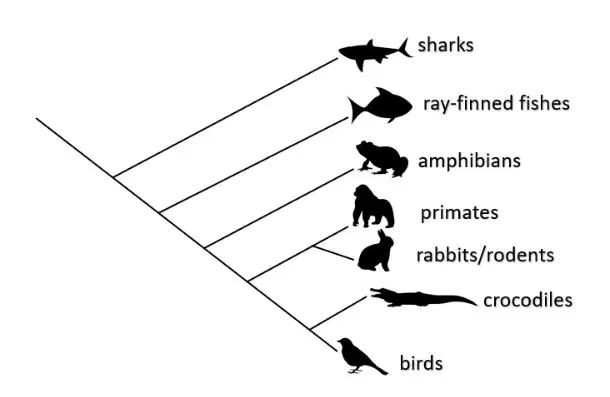
Which of the following conclusions can be drawn by studying the evolutionary relationships presented in this phylogenetic tree?
Sharks and ray-finned fishes evolved at approximately the same time in evolutionary history.
Primate species have remained relatively unchanged throughout their history on Earth.
Crocodiles and birds became separate species but share a common ancestor.
Amphibians share a more recent common ancestor with primates than with sharks.
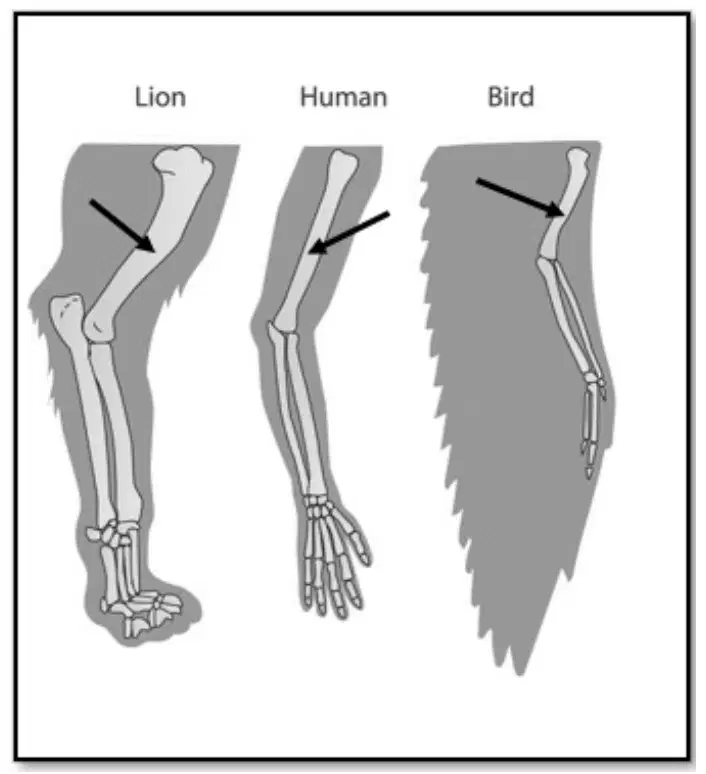
In the image below, arrows are pointing to the humerus bone of the lion, the human, and the bird. Comparing the bone structure can provide evidence to support which of the following conclusions?
The humerus bone evolved separately in many different lines of animals.
The size and position of various bones indicates how highly evolved an animal is.
Humans, lions, and birds evolved from a common ancestor.
Similar bone structures can perform different functions in different animals.
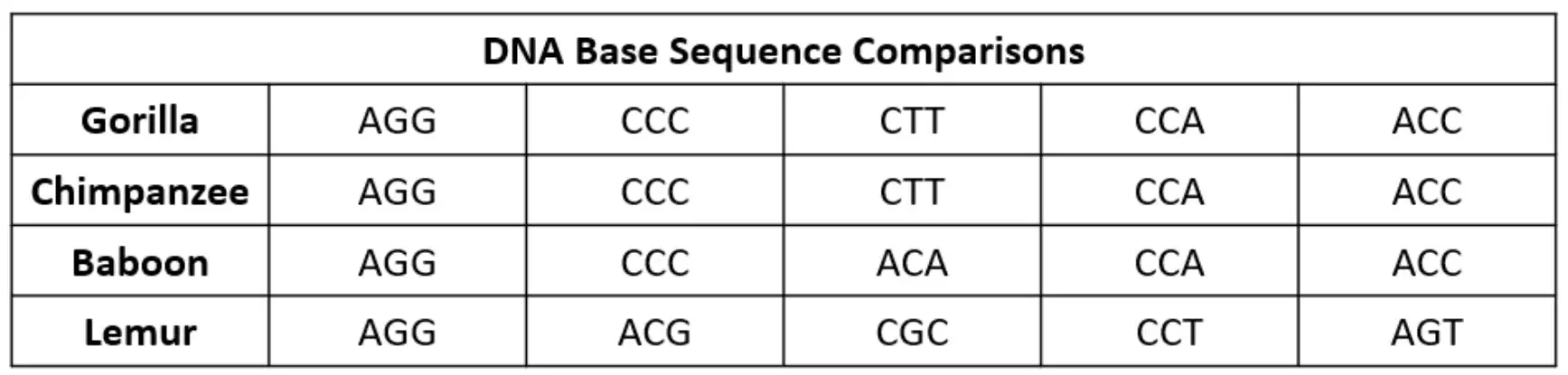
The provided chart compares base sequences of homologous segments of DNA from four different primates. The information in the table can be used to support which of the following claims?
The baboon is more closely related to the lemur than to the chimpanzee.
The gorilla is more closely related to the chimpanzee than to the baboon.
The lemur is more closely related to the chimpanzee than to the baboon.
The gorilla and chimpanzee have identical base sequences in the segments shown.
Which of the following is NOT an example of evolution?
Horses becoming taller and faster over millions of years.
All species of tortoises in the Galapagos islands descending from a common ancestor.
A caterpillar going through a change into a butterfly.
Dogs developing different fur colors due to selective breeding.
Which of the following is NOT a principle of natural selection?
Most organisms produce more offspring than the resources of their environment can support.
Organisms compete for limited resources.
Evolution will occur as an organism gets older and learns more.
Genetic variation exists within populations.
Ostriches have wings, but do not fly. Humans have an appendix with no apparent function. Whales contain bones for rear legs. Each of these are examples of _____
homologous structures
vestigial structures
analogous structures
evolutionary adaptations
The idea that species evolve at a slow, constant rate is called _____
gradualism
convergence
punctuated equilibrium
adaptive radiation
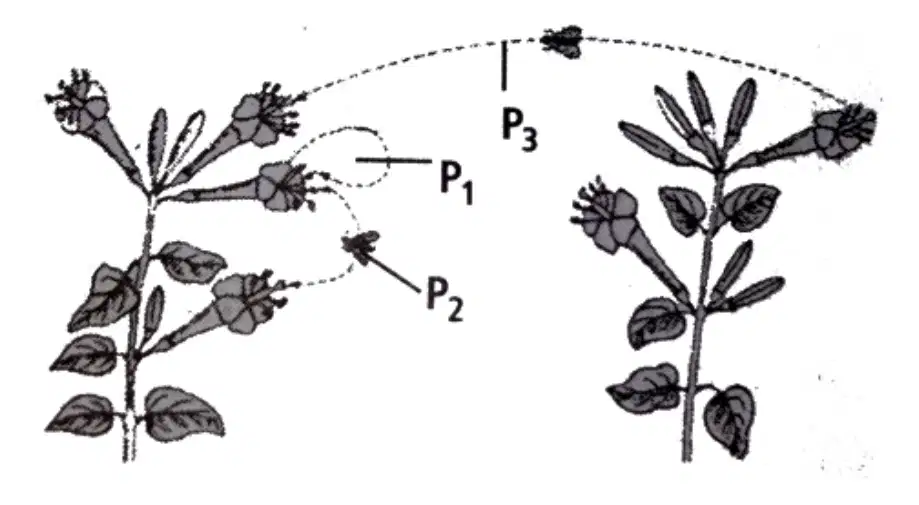
The image below shows two different plants that are members of the same species. Which of the following statements is true?
Both plants have the same DNA.
Both plants produce flowers and seeds with the same number of chromosomes.
Both plants can produce offspring that also produce fertile seed.
Both plants are capable of exchanging pollen with each other.
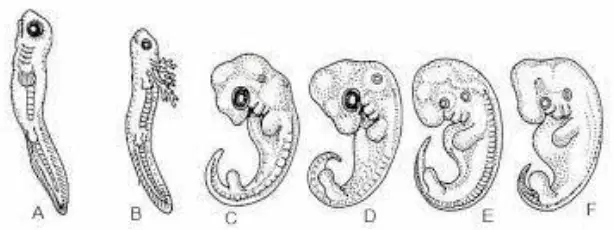
What name is given to the scientific study of how organisms develop from a single cell into independent living creatures?
cytology
embryology
zoology
genetics
Which pair of organisms show convergent evolution?
Despite being close relatives, cattle and giraffes have drastically different neck lengths.
A bluegill sunfish and a redear sunfish, closely related, have similar fin shapes and color patterns.
Tasmanian devils and wolverines are both thick-bodied predators with crushing teeth and similar food sources, but they are not at all related.
Dolphins (mammals) and sharks (fish) both have streamlined bodies and fins adapted for swimming, but are not closely related.
Which theory of how evolution occurs would argue that all the oak species in Georgia appeared suddenly from one common ancestor, over a short period of time, due to some extreme environmental changes. Since that time, the oak trees have not changed much.
gradualism
macroevolution
punctuated equilibrium
adaptive radiation
Which mechanism is responsible for introducing new alleles into a population’s gene pool?
gene flow
emigration
natural selection
genetic drift
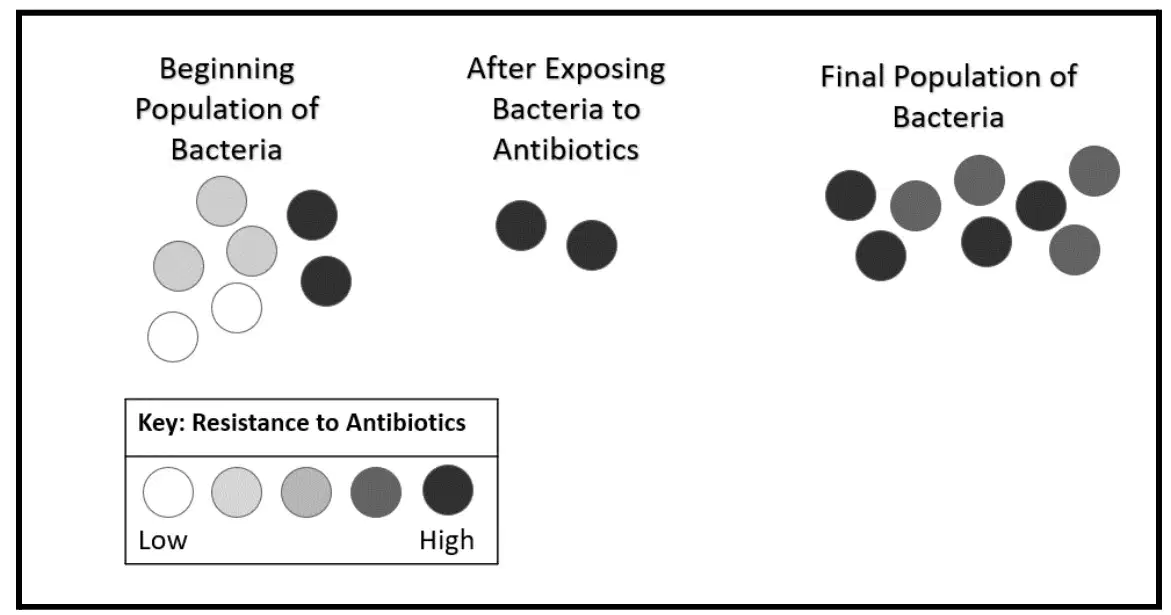
The diagram below models the development of antibiotic resistance in bacteria. Which statement best explains the role of natural selection in this process?
Natural selection resulted in the mutation of a bacterium into a virus.
Random variation provided some bacteria in the population with a favorable adaptation that allowed some bacteria to survive the antibiotics and reproduce.
The bacteria willfully mutated to prevent being killed by the antibiotic.
Antibiotics killed most bacteria, but those with higher resistance survived and passed on their traits to future generations.
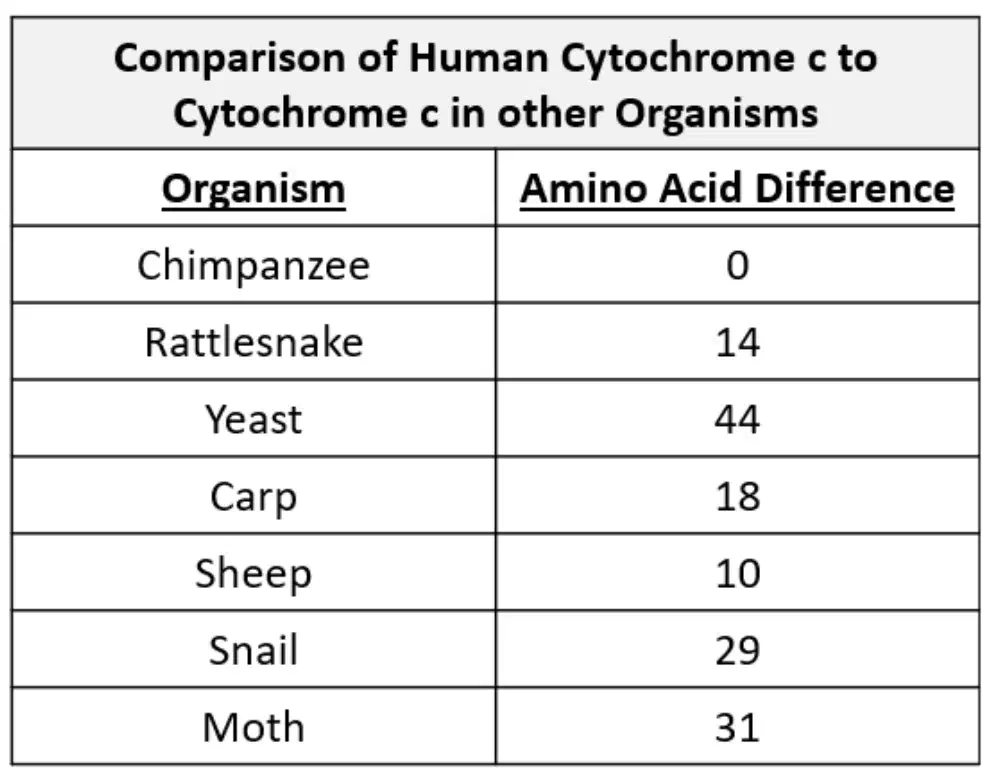
The similarity of amino acid sequences in proteins can be used to infer relationships. Scientists compare the amino acid sequences in cytochrome c, a protein important in cellular respiration. They recorded the number of differences as compared to human cytochrome c. Some of their data are shown in the table. Which organisms would be shown as most distantly related to humans in a phylogenetic tree developed using this data?
yeast
carp
snail
moth
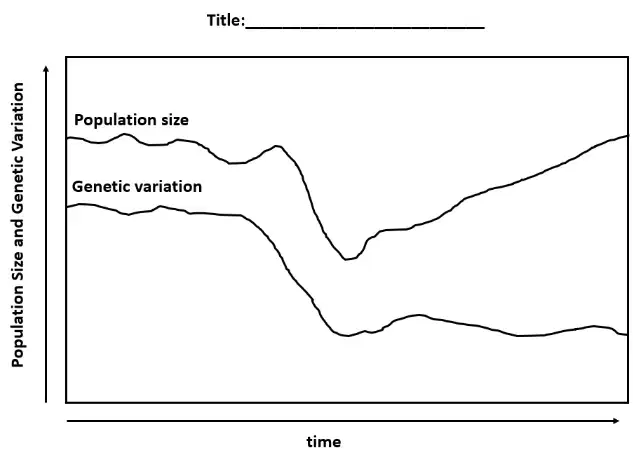
The modern panther population has very low genetic variability. Scientists think that a chance event happened to panthers about 100,000 years ago that severely reduced the population’s size and caused a large decrease in the number of different alleles in the population’s gene pool. The graph below shows a proposed model for changes in population size and genetic variation in the panther population over time.
Which of the following best describes what the model shows?
gene flow
genetic drift
genetic mutation
natural selection

Rock pocket mice are a type of small rodent found in the southwestern United States. These mice can have dark or light fur. Differences in the fur color of rock pocket mice are the result of a recessive mutation in a single gene, known as agouti. The agouti mutation causes dark fur to be striped with a band of reddish brown, resulting in lighter fur color. Scientists have noticed changes over time in fur coloration of populations of rock pocket mice living in locations with light, sandy-colored rock compared to those living in locations with black rock. The graph shows how populations of rock pocket mice are expected to change over the course of one hundred years after moving to each location.
Which explanations support the patterns seen in the graph?
Select the three correct answers.
Mice that have dark fur and live on sandy-colored rock are easy prey for hungry hawks and owls.
Mice with dark fur cannot survive on black rock because the temperature is too hot.
Mice born with the agouti trait are more likely to survive to breed and reproduce on sandy-colored rock.
Mice with light fur are less likely to survive on black rock than on sandy-colored rock.
Natural selection favors mice whose fur color matches their environment, increasing their chances of survival.
Which type of selection favors individuals with extreme values of a trait, leading to two distinct phenotypes in a population?
Stabilizing selection
Directional selection
Disruptive selection
Balancing selection
Which of the following is an example of directional selection?
Birds with medium-sized beaks are more successful than those with very large or very small beaks.
Dark-colored moths become more common than light-colored moths in a polluted environment.
Both very tall and very short plants are favored over medium-height plants.
Light-colored rabbits become less common in a region after the introduction of a new predator that easily spots them.
Why is genetic variation important in natural selection?
It ensures that all members of a species are identical.
It provides a range of traits that can be favored or disfavored by natural selection.
It stabilizes a population by eliminating mutations.
It allows populations to adapt to changing environments over time.
What role does mutation play in evolution?
It eliminates genetic variation within a population.
It is the only source of new genetic material for natural selection to act upon.
It stabilizes the genetic makeup of species over time.
It can introduce beneficial, neutral, or harmful changes to an organism's DNA.
What is the primary cause of genetic variation within a population?
The cloning of organisms within the population.
Mutations, sexual reproduction, and gene flow.
The lack of natural selection acting on the population.
Environmental changes affecting all individuals equally.
How does adaptation occur in a population?
Through the random mutation of genes.
Through the differential survival and reproduction of individuals with favorable traits.
By the migration of individuals into a new habitat.
Through the inheritance of acquired characteristics during an individual's lifetime.

What type of selection is depicted in the picture?
stabilizing
directional
disruptive
balancing

