wayground logo

Free Printable Worksheets

Font size

S
M
L
XL
Worksheets

G-CHAPTER 2 TEST 205-26

Total questions: 183

Worksheet time: 10hrs 8mins

Name
Class
Date
1.

Name the angle form by lines DE and EF in the long form.

a)

∠e

b)

∠f

c)

∠FED

d)

∠FDE

2.

Name the angle form by lines KL and ML in the long form.

a)

∠LMK

b)

∠KML

c)

∠KLM

3.

Name the angle form by lines XY and YZ in the long form.

a)

∠Y

b)

∠y

c)

∠XYZ

4.

∠STU is formed by Lines ______ and ______.

a)

S, T

b)

T, U

c)

SU, TU

d)

ST, UT

5.

Which is the vertex of the angle?

a)

X

b)

Y

c)

Z

6.

D is the vertex of the angle.

a)

True

b)

False

7.

Which is the vertex of the angle?

a)

E

b)

D

c)

F

8.

∠KML = ∠______

a)

m

b)

l

c)

k

9.

Name the vertex of the angle.

a)

S

b)

R

c)

Q

d)

S, R, and Q are vertices

10.

Name the vertex of the angle.

a)

E

b)

F

c)

D

d)

E, F, and D are vertices

11.
What is the correct definition of an angle? 
a)
one single ray
b)
two rays that meet at a single endpoint (vertex)
c)
two lines that never intersect
d)
two rays that go in opposite directions
12.
What is the correct definition of an angle? 
a)
one single ray
b)
two rays that meet at a single endpoint (vertex)
c)
two lines that never intersect
d)
two rays that go in opposite directions
13.
This angle is written as......
a)
 ∠ABC
b)
 ∠ACB
c)
∠BCA
d)
∠CAB
14.

What is the arrow pointing to in the angle?

a)

a ray

b)

geometry

c)

vertex

d)

line

15.
What does this represent?
a)
angle ABC
b)
triangle ABC
c)
arc ABC
d)
line ABC
16.

Name the vertex of the angle.

a)

S

b)

R

c)

Q

d)

S, R, and Q are vertices

17.

Choose the wrong name for the angle.

a)
b)
c)
d)
18.

Choose the wrong name for the angle.

a)
b)
c)
d)
19.

Choose the wrong name for the angle.

a)
b)
c)
d)
20.

Choose the wrong name for the angle.

a)
b)
c)
d)
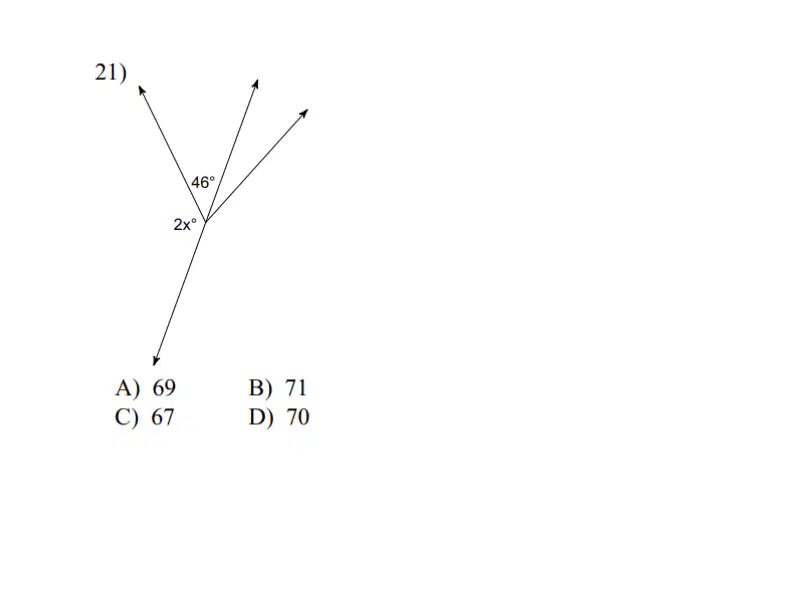
21.

Name the vertex of the angle.

a)

S

b)

R

c)

Q

d)

S, R, and Q are vertices

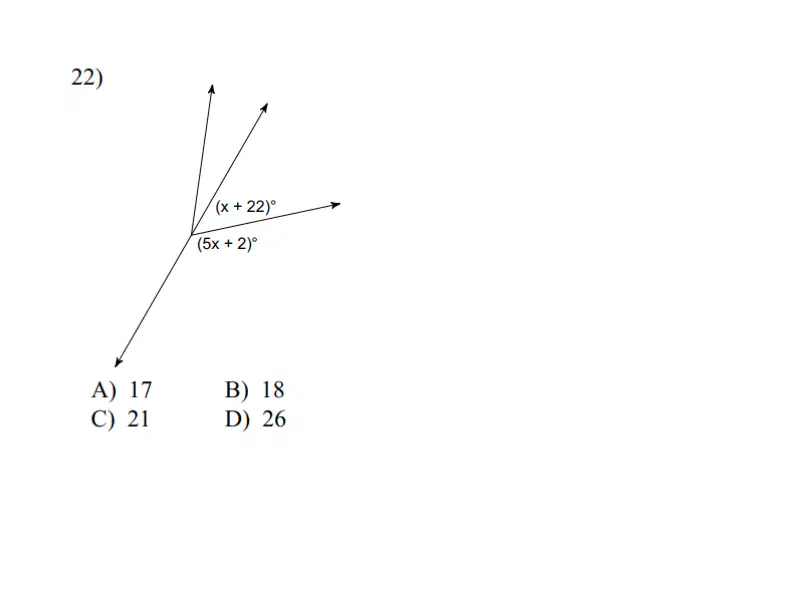
22.

Name this angle


(a)  

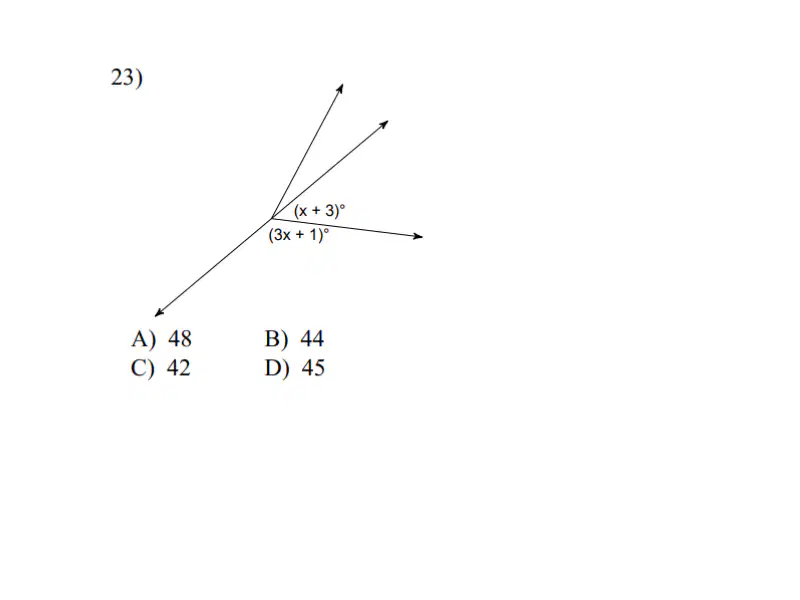
23.

Name this angle

(a)  

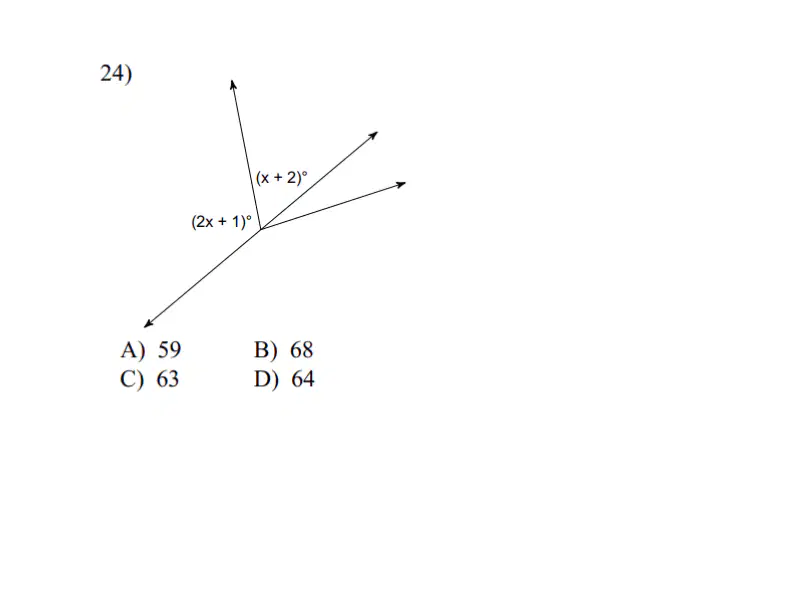
24.

Name this angle

(a)  

25.

An angle is formed when two lines __________.

a)

meet at a point

b)

do not meet at a point

26.

This angle is known as ∠________.

a)

ABX

b)

BAX

c)

BXA

d)

XAB

27.

∠AXB is also known as ∠________.

a)

A

b)

p

c)

X

d)

B

28.
a)

120 degrees

b)

80 degrees

c)

100 degrees

d)

0 degrees

29.
a)

145 degrees

b)

155 degrees

c)

35 degrees

d)

0 degrees

30.
a)

20 degrees

b)

160 degrees

c)

180 degrees

d)

0 degrees

31.
a)

180 degrees

b)

125 degrees

c)

55 degrees

d)

65 degrees

32.

Fill in the blank. This angle measures (a)   degrees.

33.
a)

acute

b)

right

c)

obtuse

34.
a)

acute

b)

right

c)

obtuse

d)

none of the above

35.
a)

acute

b)

right

c)

obtuse

d)

none of the above

36.
a)

acute

b)

right

c)

obtuse

d)

none of the above

37.

What tool do we use to measure angles?

a)

Protractor

b)

Ruler

38.

The amount of the angle above is . . . .

a)

40o

b)

60o

c)

80o

d)

130o

39.

Find the angle above

a)

130o

b)

120o

c)

90o

d)

50o

40.

Find the angle above

a)

50o

b)

53o

c)

127o

d)

130o

41.

What is the measurement of this angle?

a)

165°

b)

15°

c)

135°

42.

What is the measurement of this angle?

a)

66°

b)

54°

c)

126°

d)

134°

43.

What is the measure of this angle?

(This is the angle you described in the previous question.)

a)

25 degrees

b)

35 degrees

c)

155 degrees

d)

165 degrees

44.

What is the measure of this angle?

a)

65

b)

66

c)

125

d)

54

45.

What is the measure of this angle?

a)

84

b)

104

c)

76

d)

101

46.
A point where two or more lines meet, a corner. HINT: You use this to name an angle!
a)
Parallel lines
b)
a vertex
c)
vertical lines
d)
transversal
47.
What is the measure of the following angle? 
a)
120 degrees.
b)
175 degrees.
c)
60 degres.
d)
5 degrees.
48.
What is the measure of the following angle?
a)
78 degrees.
b)
102 degrees.
c)
190 degrees.
d)
58 degrees. 
49.
Angles are measured using a ______.
a)
compass
b)
protractor
c)
ruler
d)
prospector
50.
What is the measure of the following angle?  
a)
21 degrees.
b)
34 degrees.
c)
70 degrees.
d)
172 degrees. 
51.

What type of angles are these?

a)

Adjacent Angles

b)

Linear Pair

c)

Complementary Angles

d)

Supplementary Angles

e)

Vertical Angles

52.

What type of angles are these? (select 2)

a)

Adjacent Angles

b)

Linear Pair

c)

Complementary Angles

d)

Supplementary Angles

e)

Vertical Angles

53.

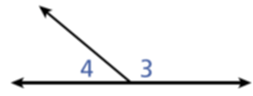
Supplementary angles always add up to

(a)  

54.

Complementary angles always add up to

(a)  

55.

Select the following statements that make the given statement true:

Adjacent angles _____.

a)

share a common vertex

b)

must be complementary

c)

must be supplementary

d)

share a common side

e)

overlap to share points in the interior of the angles
56.

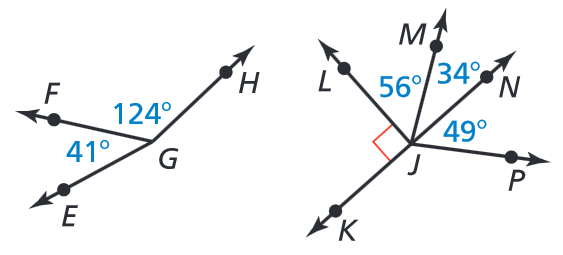
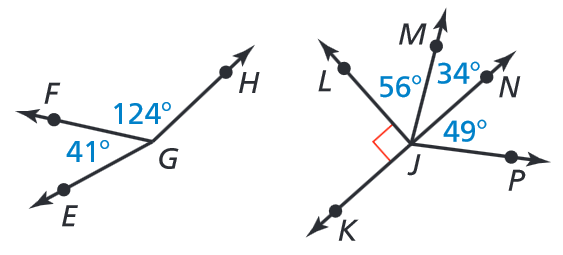
Which angle is complementary to LJM\angle LJM  

a)

MJN\angle MJN  

b)

NJP\angle NJP  

c)

FGE\angle FGE  

d)

LJK\angle LJK  

57.

Which of the following angles is  90°90\degree  ?

a)

FGH\angle FGH  

b)

KJL\angle KJL  

c)

PJK\angle PJK  

d)

EGH\angle EGH  

58.
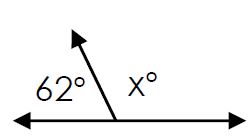
a)

x = 118

b)

x = 108

c)

x = 28

d)

x = 58

e)

x = 62

59.

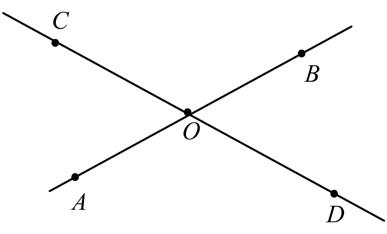
Which are pairs of adjacent angles?

a)

∠COB and ∠DOA

b)

∠AOD and ∠AOC

c)

∠COB and ∠AOD

d)

∠BOD and ∠AOC

60.

Find the measure of the complement of a 64º angle.

(a)  

61.

Find the measure of the complement of a 7º angle.

(a)  

62.

Find the measure of the supplement of a 153º angle.

(a)  

63.

Find the measure of the supplement of a 78º angle.

(a)  

64.

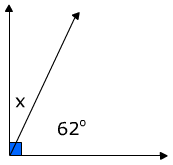
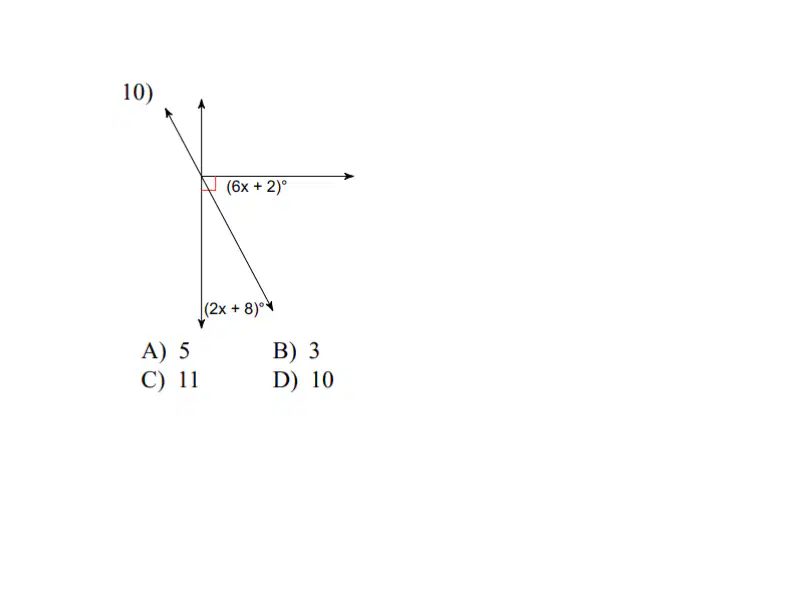
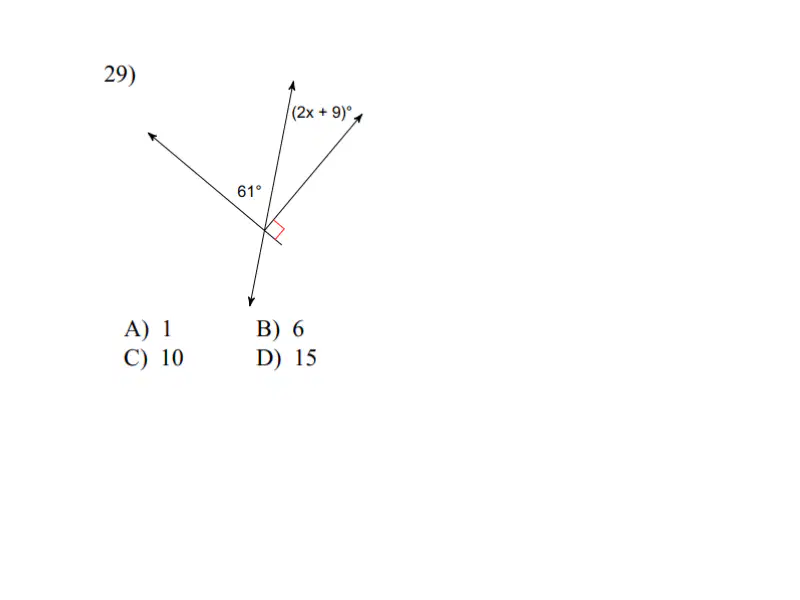
The measure of ABC=90°\angle ABC=90\degree . Find the value of x.

(a)  

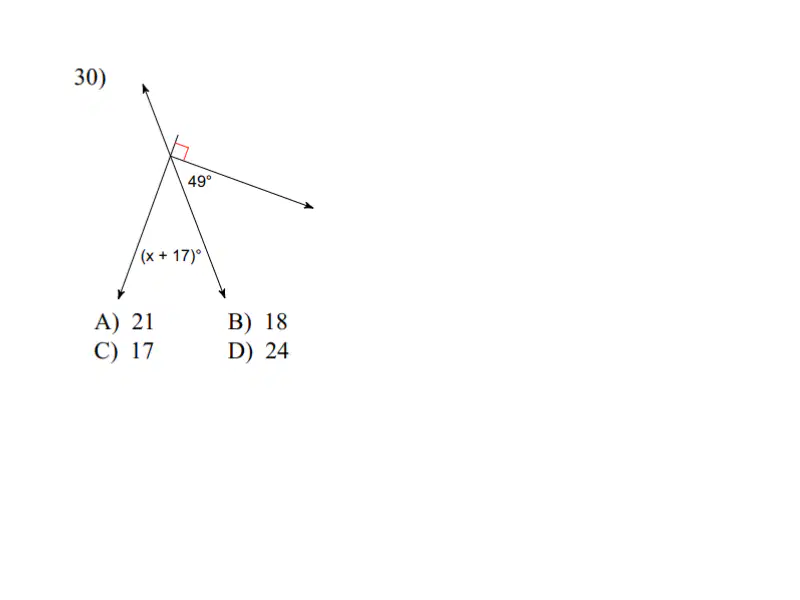
65.

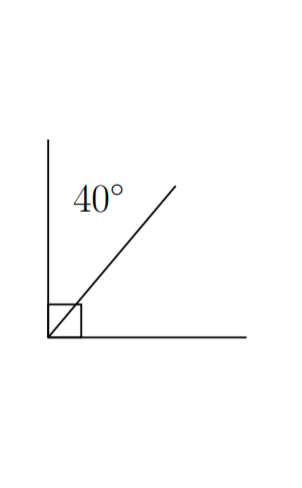
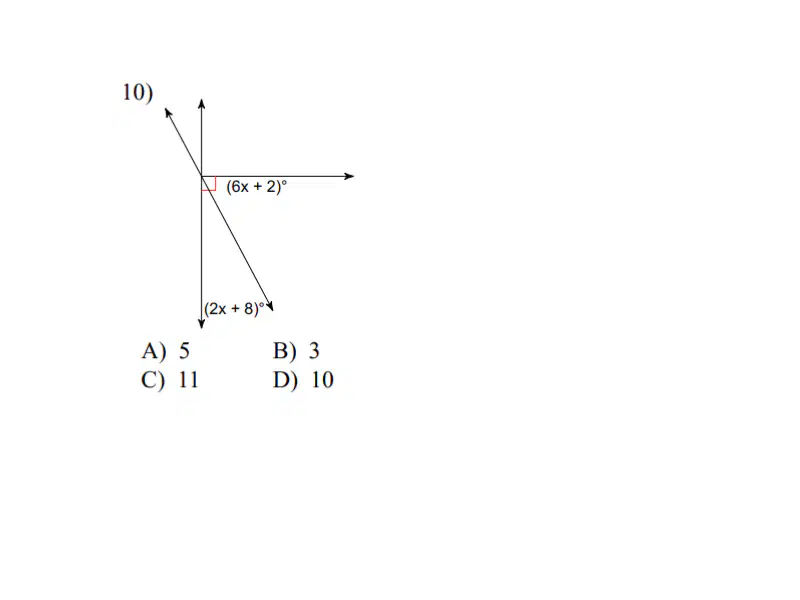
The measure of ABC=90°\angle ABC=90\degree . Find the value of x.

(a)  

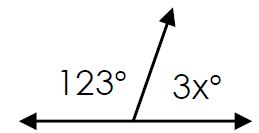
66.

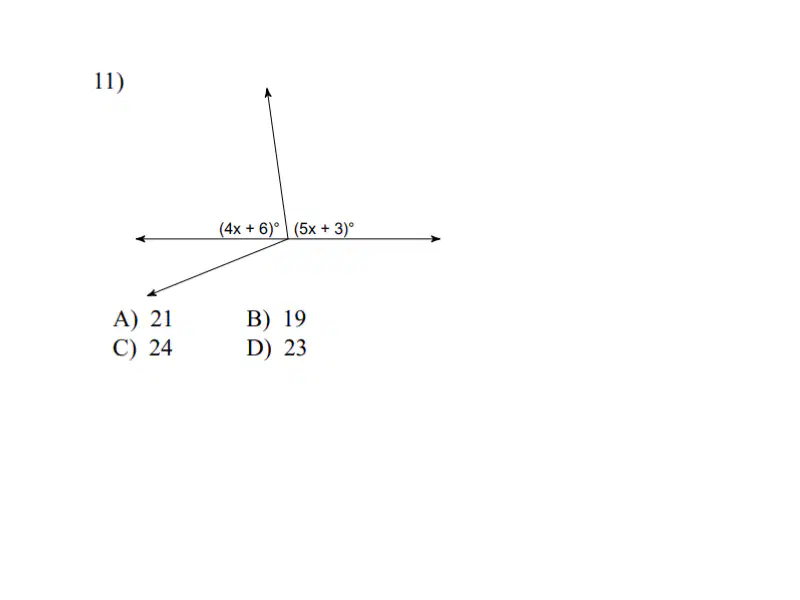
Line PR is a straight line. Find the value of m.

(a)  

67.

Line PR is a straight line. Find the value of m.

(a)  

68.

The diagram may not be drawn to scale.

The ratio a : b = 2 : 3 and mPQR=90m\angle PQR=90 .

Find the values of a and b.

69.

The diagram may not be drawn to scale.

The ratio a : b = 2 : 3 and line PR is a straight line.

Find the values of a and b.

70.

Determine whether the given pair of angles is complementary, supplementary, or neither.

mA =130°m\angle A\ =130\degree and mB=50°m\angle B=50\degree

a)

Complementary

b)

Supplementary

c)

Neither

71.

Determine whether the given pair of angles is complementary, supplementary, or neither.

mC =90°m\angle C\ =90\degree and mD=80°m\angle D=80\degree

a)

Complementary

b)

Supplementary

c)

Neither

72.

Determine whether the given pair of angles is complementary, supplementary, or neither.

mE =58°m\angle E\ =58\degree and mF=32°m\angle F=32\degree

a)

Complementary

b)

Supplementary

c)

Neither

73.

Determine whether the given pair of angles is complementary, supplementary, or neither.

mG =112°m\angle G\ =112\degree and mH=68°m\angle H=68\degree

a)

Complementary

b)

Supplementary

c)

Neither

74.

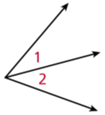
Angle 1 and angle 2 have a ​ (a)   relationship.

Choose from the below words
supplementary
complimentary
vertical
alternate interior
alternate exterior
75.

​ (a)   angles always add up to 180o.

Choose from the below words
Supplementary
Complementary
Vertical
76.
Solve for x
a)
5
b)
90
c)
25
d)
10
77.
Tell whether the angles are complementary or supplementary. Then find the value of x.
a)
Complementary; x=25
b)
Complementary; x=5
c)
Supplementary; x=25
d)
Supplementary; x=5
78.
Tell whether the angles are complementary or supplementary. Then find the value of x.
a)
Complementary, 15
b)
Supplementary, 16
c)
Complementary, 18
d)
Supplementary, 19
79.
What is the value of x?
a)
37
b)
72
c)
108
d)
18
80.
What is the relationship between angle 1 and 2?
a)
Supplementary
b)
Complementary
c)
Vertical
d)
Obtuse
81.
The angle relationship shown is -
a)
complementary angles
b)
supplementary angles
c)
vertical angles
d)
angle bisector
82.
The angle relationship shown is - 
a)
complementary angles
b)
supplementary angles
c)
vertical angles
d)
adjacent angles
83.
Find the value of x.
a)
18°
b)
28°
c)
38°
d)
118°
84.
What are complementary angles?
a)
Angles that add up to 180°
b)
Angles that add up to 90°
c)
Angles that are equal to each other
d)
Angles that are opposite of each other when lines intersect.
85.
What are supplementary angles?
a)
Angles that add up to 180°
b)
Angles that add up to 90°
c)
Angles that are equal to each other
d)
Angles that are opposite of each other when lines intersect
86.
If ∠BPD and ∠DPC have a sum of 72°. What is ∠APC?
a)
18°
b)
90°
c)
108°
d)
180°
87.
What kind of angles are shown?
a)
complementary
b)
supplementary
c)
adjacent
d)
corresponding
88.
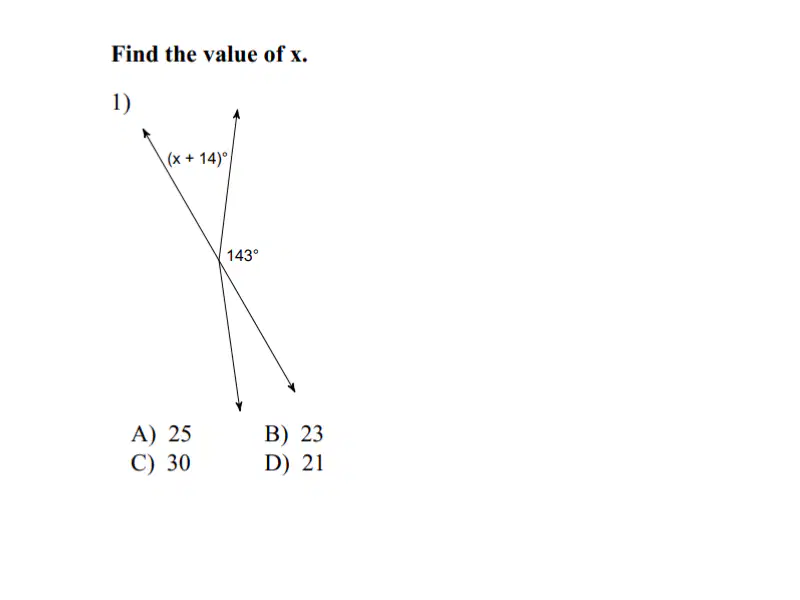
Find the value of x.
a)
14
b)
60
c)
35
d)
180
89.
What is an example of a pair of complementary angles?
a)
13° and 45°
b)
10° and 170°
c)
81° and 9°
d)
90° and 3°
90.
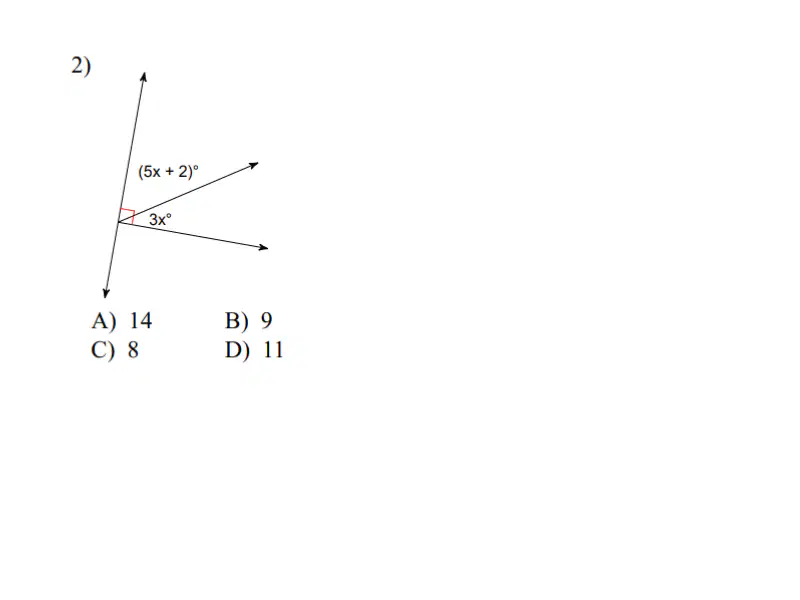
Find the value of x.
a)
15
b)
16
c)
18
d)
19
91.
a)
x = 118
b)
x = 108
c)
x = 28
d)
x = 58
92.
a)
x = 56
b)
x = 66
c)
x = 156
d)
x = 166
93.
Identify the type of angle shown.
a)
Complementary
b)
Supplementary
94.
a)
15
b)
16
c)
18
d)
19
95.

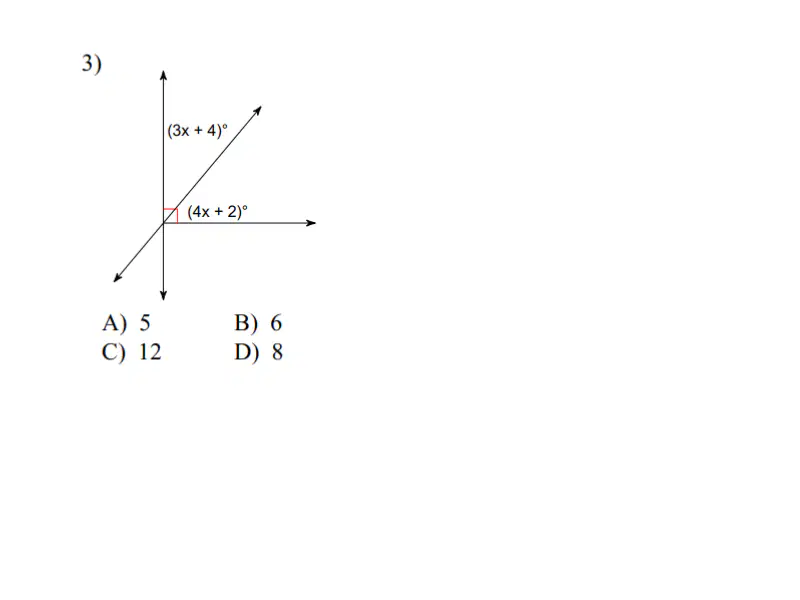
Find the value of x

a)

14

b)

6

c)

36

d)

12

96.
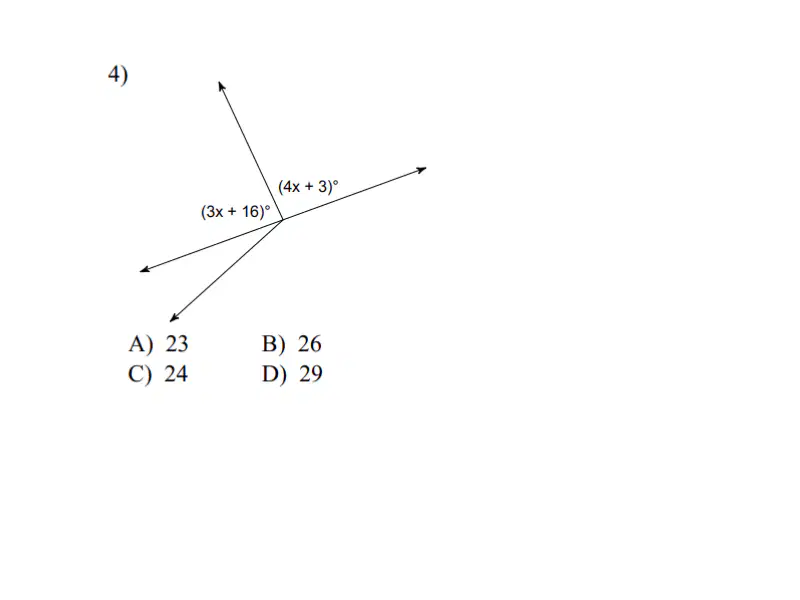
Find the value of x.
a)
15
b)
16
c)
18
d)
19
97.
What is an example of a pair of complementary angles?
a)
13° and 45°
b)
10° and 170°
c)
81° and 9°
d)
90° and 3°
98.
What kind of angles are shown?
a)
complementary
b)
supplementary
c)
adjacent
d)
corresponding
99.
Find the missing angle.
a)
60°
b)
70°
c)
50°
d)
140
100.
What are complementary angles?
a)
Angles that add up to 180°
b)
Angles that add up to 90°
c)
Angles that are equal to each other
d)
Angles that are opposite of each other when lines intersect.
101.
a)
x = 118
b)
x = 108
c)
x = 28
d)
x = 58
102.
Solve for x
a)
20
b)
25
c)
120
d)
180
103.
Solve for x
a)
5
b)
90
c)
25
d)
10
104.
complementary, supplementary, or neither?
a)
Complementary
b)
Supplementary
c)
Neither
105.
Find the supplement of the angle
a)
160
b)
20
c)
-70
d)
180
106.
Find the missing angle.
a)
60
b)
70
c)
50
d)
140
107.

8) Which two angles are complimentary?

a)

∠ XVS and ∠ SVW

b)

∠ XVY and ∠ YVT

c)

∠ ZVT and ∠ XVW

d)

∠ TVU and ∠ ZVT

108.

7) Angle FGH and angle HGM are complementary. If angle FGH measures 58o, what is the measurement of angle HGM?

a)

32o

b)

58o

c)

90o

d)

122o

109.

11) Look at the angles. Which pair of angles is supplementary?

a)

∠ 3 and ∠ 6

b)

∠ 1 and ∠ 4

c)

∠ 3 and ∠ 4

d)

∠ 1 and ∠ 6

110.

10) Which of the following could be measurements of two supplementary angles?

a)

7o and 83o

b)

83o and 83o

c)

97o and 83o

d)

117o and 83o

111.

23) Angle Y is complementary to angle Z, and they are congruent. Which statement must be true?

a)

m ∠ Z > 90o

b)

m ∠ Y = 45o

c)

m ∠ Z > 45o

d)

m ∠ Y = 90o

112.

32) Look at the diagram. Which statement is true?

a)

∠ 2 and ∠ 4 are vertical angles.

b)

∠ 2 and ∠ 3 are complementary angles.

c)

∠ 1 and ∠ 2 are supplementary angles.

d)

∠ 3 and ∠ 6 are adjacent angles.

113.
What is the measure of the missing angle?
a)
76
b)
86
c)
166
d)
156
114.
What is the supplement of 12°?
a)
78°
b)
180°
c)
168°
d)
90°
115.

Find x:

a)

46

b)

90

c)

36

d)

126

116.

Find x:

a)

73

b)

63

c)

153

d)

143

117.

Find x:

a)

34

b)

51

c)

146

d)

14

118.

Find x:

a)

3

b)

93

c)

103

d)

87

119.

Find x:

a)

62

b)

180

c)

50

d)

40

120.

What is the measure of the missing angle?

a)

76

b)

66

c)

156

d)

154

121.

What is the angle at b?

a)

90 degrees

b)

39 degrees

c)

45 degrees

d)

25 degrees

122.

Find what the value of x.

a)

118

b)

108

c)

28

d)

58

123.

In which diagram do <1 and <2 appear to be vertical angles

a)
b)
c)
d)
124.

Which pair of angles is supplementary

a)
b)
c)
d)
125.

Which of the following could be the measurements of two supplementary angles?

a)

7 and 83

b)

83 and 83

c)

97 and 83

d)

117 and 83

126.

Identify each angle that is adjacent to angle 2

a)

angle 1

b)

angle 3

c)

angle 4

d)

angle 5

127.
a)

31

b)

65

c)

85

d)

115

128.

What is the measure of angle 1, 2, and 3? Write you answer in the following form: <1=_, <2=_,<3=_

(a)  

129.
a)

angle 2 and angle 4 are vertical angles

b)

angle 3 and angle 6 are complimentary angles

c)

angle 1 and angle 2 are supplementary angles

d)

angle 1 and angle 5 are complementary angles

130.
a)

45

b)

55

c)

135

d)

145

131.
a)

20

b)

40

c)

50

d)

76

132.

SOLVE FOR X

a)

A

b)

B

c)

C

d)

D

133.

SOLVE FOR X

a)

A

b)

B

c)

C

d)

D

134.

SOLVE FOR X

a)

A

b)

B

c)

C

d)

D

135.

SOLVE FOR X

a)

A

b)

B

c)

C

d)

D

136.

SOLVE FOR X

a)

A

b)

B

c)

C

d)

D

137.

SOLVE FOR X

a)

A

b)

B

c)

C

d)

D

138.

SOLVE FOR X

a)

A

b)

B

c)

C

d)

D

139.

SOLVE FOR X

a)

A

b)

B

c)

C

d)

D

140.

SOLVE FOR X

a)

A

b)

B

c)

C

d)

D

141.

SOLVE FOR X

a)

A

b)

B

c)

C

d)

D

142.

SOLVE FOR X

a)

A

b)

B

c)

C

d)

D

143.

SOLVE FOR X

a)

A

b)

B

c)

C

d)

D

144.

SOLVE FOR X

a)

A

b)

B

c)

C

d)

D

145.

SOLVE FOR X

a)

A

b)

B

c)

C

d)

D

146.

SOLVE FOR X

a)

A

b)

B

c)

C

d)

D

147.

SOLVE FOR X

a)

A

b)

B

c)

C

d)

D

148.

SOLVE FOR X

a)

A

b)

B

c)

C

d)

D

149.

SOLVE FOR X

a)

A

b)

B

c)

C

d)

D

150.

SOLVE FOR X

a)

A

b)

B

c)

C

d)

D

151.

SOLVE FOR X

a)

A

b)

B

c)

C

d)

D

152.

SOLVE FOR X

a)

A

b)

B

c)

C

d)

D

153.

SOLVE FOR X

a)

A

b)

B

c)

C

d)

D

154.

SOLVE FOR X

a)

A

b)

B

c)

C

d)

D

155.

SOLVE FOR X

a)

A

b)

B

c)

C

d)

D

156.

SOLVE FOR X

a)

A

b)

B

c)

C

d)

D

157.

SOLVE FOR X

a)

A

b)

B

c)

C

d)

D

158.

CHOOSE BEST ANSWER

a)

A

b)

B

c)

C

d)

D

159.

CHOOSE BEST ANSWER

a)

A

b)

B

c)

C

d)

D

160.

CHOOSE BEST ANSWER

a)

A

b)

B

c)

C

d)

D

161.

CHOOSE BEST ANSWER

a)

A

b)

B

c)

C

d)

D

162.
a)
x=67
b)
x=43
c)
x=55
d)
x=12
163.

Angle ABC measures 34o. What is the measure of angle CBD?

a)

17o

b)

34o

c)

68o

164.

The measure of angle ABD is 74o. What is the measure of angle CBD?

a)

148o

b)

74o

c)

37o

165.

The measure of angle DBC is 14o. What is the measure of angle DBA?

a)

7o

b)

14o

c)

28o

166.
a)

m∠GHK=80.5,

m∠KHJ=161

b)

m∠GHK=161,

m∠KHJ=80.5

c)

m∠GHK=80.5,

m∠KHJ=80.5

d)

m∠GHK=161,

m∠KHJ=161

167.
a)
m∠SQP=29, m∠PQR=58
b)
m∠SQP=29, m∠PQR=29
c)
m∠SQP=58, m∠PQR=58
d)
m∠SQP=58, m∠PQR=29
168.
a)
m∠GHK=90, m∠KHJ=45
b)
m∠GHK=45, m∠KHJ=45
c)
m∠GHK=45, m∠KHJ=90
d)
m∠GHK=90, m∠KHJ=90
169.

AND find the measure of ∠ABD

a)

x=3/17 ∠ABD = 27°

b)

x=9 ∠ABD = 81°

c)

x=3 ∠ABD = 27°

d)

x= -3 ∠ABD = -27°

170.

EJ \overrightarrow{EJ}\  bisects  DEF\angle DEFmDEJ=5x+7m\angle DEJ=5x+7  ,  mJEF=8x8m\angle JEF=8x-8 .
Find x.

a)

5

b)

2

c)

6

d)

13

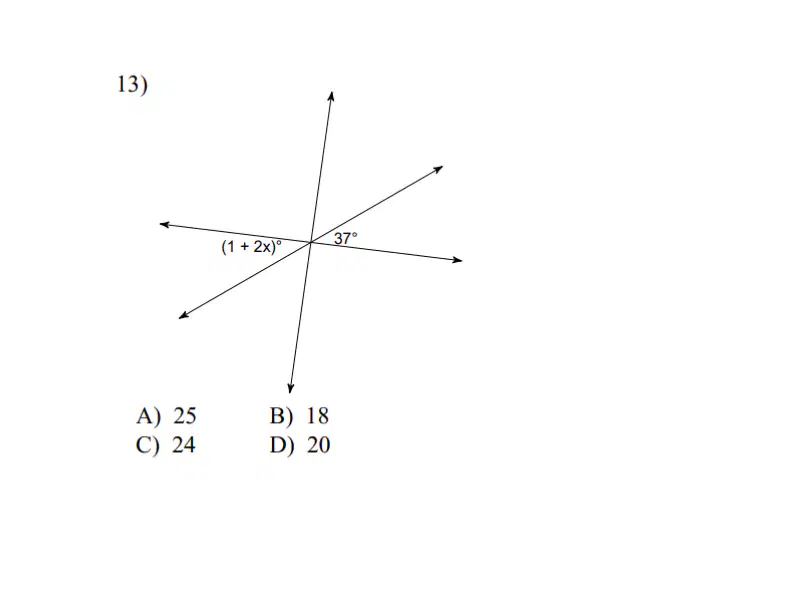
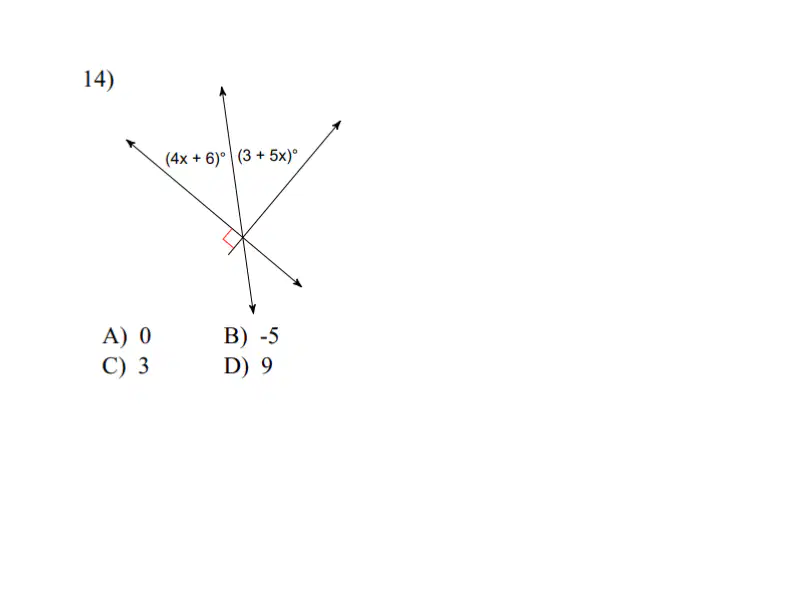
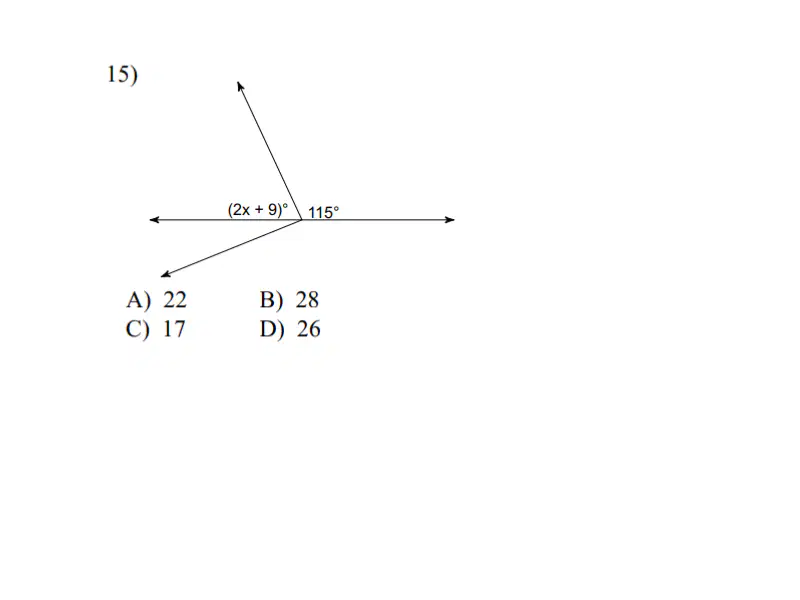
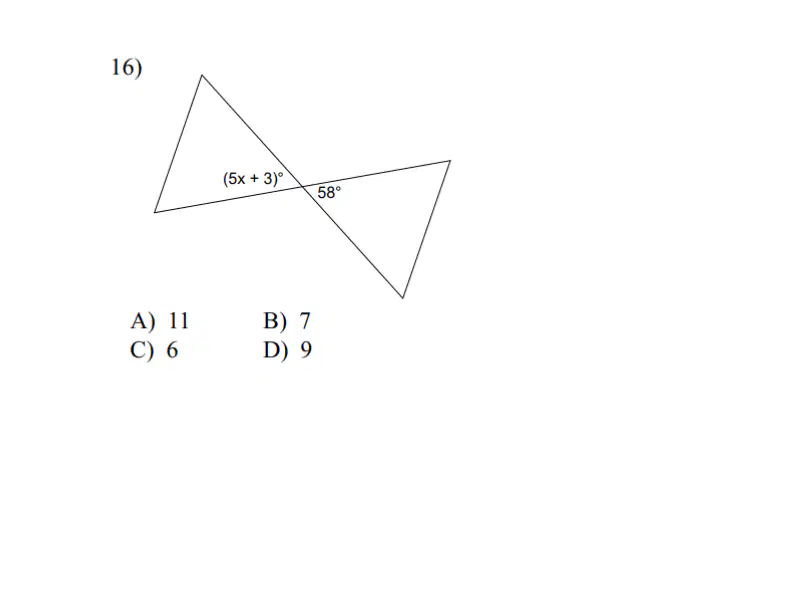
171.

BD\overrightarrow{BD}  bisects ABC\angle ABCmABD=3x+5m\angle ABD=3x+5  and  mABC=2x+30m\angle ABC=2x+30 . Find  mDBCm\angle DBC  . 

a)

15°15\degree  

b)

35°35\degree  

c)

5°5\degree  

d)

20°20\degree  

172.
Find the measure of Angle NJZ
a)
50 degrees
b)
40 degrees
c)
38 degrees
d)
76 degrees
173.
Find HG
a)
28
b)
14
c)
41
d)
7
174.
What is the length of DC
a)
4
b)
1
c)
2
d)
3
175.
Find x, then the measure of AC
a)
x=2, AC=8
b)
x=2, AC=16
c)
x=4, AC=8
d)
x=4, AC=16
176.

BE\overrightarrow{BE} bisects  ABC\angle ABCmABE=44°m\angle ABE=44\degree . Find  mCBE.m\angle CBE.  

a)

44°44\degree  

b)

22°22\degree  

c)

88°88\degree  

d)

Not enough information to answer

177.

PO\overrightarrow{PO} bisects  FPT\angle FPTmTPO=60°m\angle TPO=60\degree . Find  mFPO.m\angle FPO.  

a)

60°60\degree  

b)

30°30\degree  

c)

120°120\degree  

d)

40°40\degree  

178.

YR\overrightarrow{YR} bisects  XYZ\angle XYZmXYR=45°m\angle XYR=45\degree . Find  mXYZ.m\angle XYZ.  

a)

90°90\degree  

b)

45°45\degree  

c)

135°135\degree  

d)

27.5°27.5\degree  

179.

NO\overrightarrow{NO} bisects  MND\angle MNDmMND=160°m\angle MND=160\degree . Find  mMNO.m\angle MNO.  

a)

80°80\degree  

b)

160°160\degree  

c)

320°320\degree  

d)

40°40\degree  

180.

RT\overrightarrow{RT} bisects  FRY\angle FRYmFRY=220°m\angle FRY=220\degree . Find  mFRT.m\angle FRT.  

a)

110°110\degree  

b)

440°440\degree  

c)

90°90\degree  

d)

55°55\degree  

181.

GH\overrightarrow{GH} bisects  KGL\angle KGLmKGH=48°m\angle KGH=48\degree . Find  mKGL.m\angle KGL.  

a)

96°96\degree  

b)

48°48\degree  

c)

24°24\degree  

d)

130°130\degree  

182.

What is an angle bisector?

a)

A ray that is in the middle of an angle

b)

A ray that has the same endpoint as an angle

c)

Two rays that meet at the same point

d)

A part of a line without direction

183.

AF\overrightarrow{AF} bisects EAT\angle EATmEAF=24°m\angle EAF=24\degree and mEAT=(12x)°m\angle EAT=\left(12x\right)\degree . Find x.

a)

x = 4

b)

x = 2

c)

x = 8

d)

x = 3